Cape aloe (bitter aloe) · Cape aloes
Aloe ferox Mill. · Dried leaf exudate (Cape aloes); clear inner gel is a different material
Materia medica properties in reference
The linked references do not establish the taste, temperature, meridian entry, and traditional functions for this exact species/material. No properties are inferred from a related species.
Combinations recorded in formulas
No sufficiently specific formula record is linked to this profile. The page therefore does not invent a beneficial pairing or a ratio.
CITES international-trade evidence
The 2026.1 CITES Trade Database contains 108 comparative-tabulation rows for Aloe ferox during 2016, 2017, 2018, 2019, 2020, 2021, 2022, 2023, 2024. The query selected reported purpose T (Commercial) and trade term MED (medicine); appendices appearing in these rows: II. Reported importer codes include AE, AT, BG, BR, CA, CH, CL, CO; exporter codes include CH, DE, FR, IT, JP, TW, US, XX. These are comparative-tabulation rows, not shipment counts or summed volume. This record does not establish clinical efficacy, the legality of an individual transaction, or safety of use.
Open the CITES Trade Database ↗Name and part used
Aloe ferox is a South African single-stemmed aloe, commonly 2–3 m tall, with fleshy leaves bearing dark teeth and orange-red flower spikes. Cape aloes is the bitter brown leaf exudate concentrated and dried; it is distinct from the clear inner gel.
Traditional context
Kew’s botanical profile records mature leaves being arranged around a collection well so the bitter brown exudate drains from cut surfaces, then concentrated and dried into a dark glossy mass. Kew describes this traditional material as a potent laxative. A historic use or a product on the market does not establish that the plant treats other conditions, nor that fresh leaf, clear gel, crude exudate, and extracts are interchangeable in safety. “Aloe” is used for multiple species, so Aloe ferox and its plant part must remain explicit. Kew’s MPNS links Aloe ferox names to medicinal references, but this profile does not assign East Asian taste, temperature, meridian, or functions where a source for this exact species and exudate does not establish them.
Modern evidence
The European Medicines Agency (EMA) has a monograph for dried leaf juice of Aloe barbadensis and other Aloe species, mainly Aloe ferox and hybrids. It describes standardized preparations for short-term use in occasional constipation; that assessment applies to the specified material and preparation, not to every aloe gel, fresh leaf, homemade juice, or supplement. EMA describes anthranoid derivatives as stimulating colonic motility and altering water/electrolyte absorption and secretion; bowel effects may be delayed 6–12 hours. The monograph discusses the preparation and quality context, but mechanistic evidence is not individualized treatment advice. Findings about isolated compounds also cannot establish the effect of the whole plant or an arbitrary combination.
Safety
This material carries important cautions. EMA contraindicates dried aloe leaf juice in intestinal obstruction or stenosis, intestinal atony, inflammatory bowel disease such as Crohn’s disease or ulcerative colitis, unexplained abdominal pain, severe dehydration, pregnancy, breastfeeding, and children under 12. Prolonged stimulant-laxative use can impair bowel function and lead to dependence; severe diarrhea can cause fluid and potassium loss, and chronic abuse has been associated with liver toxicity. People with kidney disorders should consider electrolyte risks. EMA advises medical consultation with cardiac glycosides, antiarrhythmics, QT-prolonging medicines, diuretics, corticosteroids, or liquorice root; low potassium can potentiate cardiac glycosides and some co-use can increase potassium loss. Do not extract leaf exudate for self-ingestion or use this page to choose a personal dose.
Safety reference ↗Identification and study notes
Identification cues: look for a single woody stem with persistent dry leaves forming a skirt, topped by a dense rosette. Leaves are long, fleshy, grey-green and may redden under drought stress, with dark brown marginal teeth and sometimes smaller spines on the surfaces. The branched, candelabra-like inflorescence bears tubular red-orange flowers; natural forms can vary in flower color. The plant commonly occurs in semi-arid areas and on rocky slopes. Do not identify it from spines or flower color alone, or confuse it with Aloe vera and other aloes. Yellow-brown to reddish-brown exudate forms just under the leaf surface, while gel is the clear inner tissue. These are AI illustrations: morphology may be simplified or imperfect, so use them for broad study only, never to identify, harvest, or authenticate real material. Commercial species identity requires traceable documentation, qualified botanical/pharmacognostic review, and appropriate quality testing.
Growth and habitat
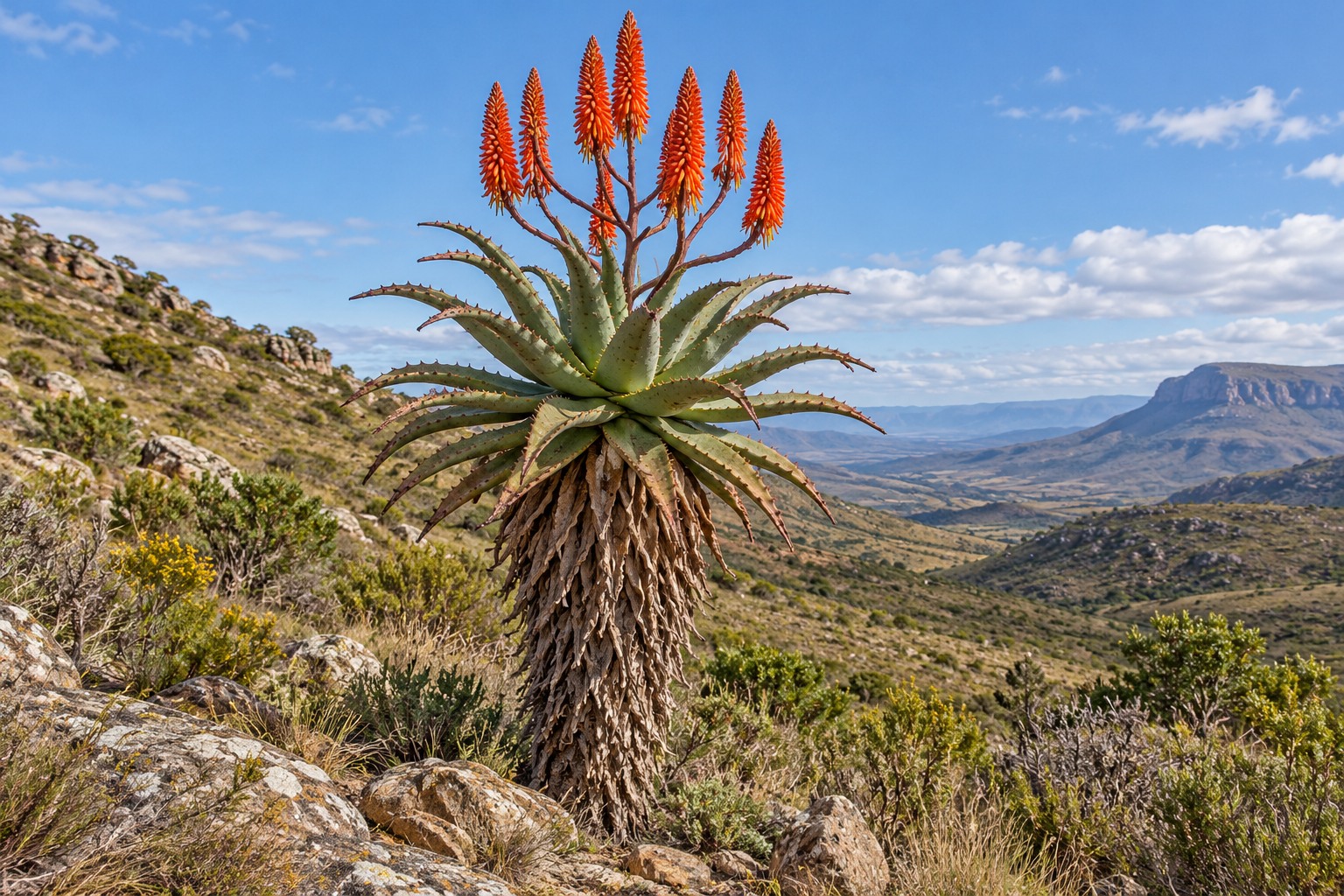
Kew places the native range from the Cape provinces to Lesotho; SANBI describes a range over 1,000 km through the Western and Eastern Cape, southern KwaZulu-Natal, southeastern Free State, and Lesotho. Habitats include rocky slopes, grassy fynbos, Karoo margins, valley bushveld, and open or lightly scrubbed areas; local conditions vary with winter/summer rainfall and elevation. It grows in drained soils from sandy to loamy types. Fleshy leaves support drought tolerance, but young plants still need protection from severe drying while establishing. This describes South African habitat and does not mean the species will thrive in every Vietnamese climate.
- Use traceable seed correctly identified as Aloe ferox; hybrids and related aloe species can be difficult to distinguish. Sow in shallow trays with clean, freely draining medium and cover lightly with sand.
- Kew recommends free-draining compost. A South African production guide suggests transplanting seedlings to bags once they are about 4 cm tall; do this only when plants are sturdy and avoid damaging young roots.
- Move established plants to a sunny, ventilated site with sandy or light loam soil that does not retain standing water. A South African production guide gives 1.5–2 m spacing and warm-climate conditions; treat these as local production references, not universal garden rules.
- Water enough to establish roots, then let the medium dry between waterings; reduce watering in cool or rainy periods. Watch for waterlogging, root rot, mealybugs, scale insects, and mites; do not casually apply pesticides to plants intended as raw material.
- Do not harvest young or excessive leaves. South African guidance describes controlled harvest of mature leaves, approximately once yearly; commercial harvesting must follow local law and conservation procedures, particularly because wild plants remain an important source.
How long until harvest? A South African production guide states that cultivated crops may begin leaf harvest after about 18 months; this is not a universal maturity age or a safe home-ingestion milestone. Harvest only under appropriate local standards and authorized operations.
References checked
From plant to dried material · source-recorded workflow
- Confirm the species and mature leaves through a traceable harvest operation; do not use an AI image or the generic word “aloe” as a harvest identification method.
- In the Cape aloes practice described by Kew, mature leaves are cut and arranged around a collection well so the bitter exudate drains. This is a documentary description of a professional method, not a home-preparation guide.
- The exudate is concentrated and dried into a dark glossy mass; product records should distinguish dried leaf juice from clear gel, dried leaf, powder, and extracts.
- Commercial processing requires controls for identity, quality, contaminants, constituent limits, and lot traceability under applicable pharmacopoeial and legal standards. Do not self-ingest crude exudate.
This record supports study and processing traceability; it is not a home preparation or self-use guide.
Open process source ↗