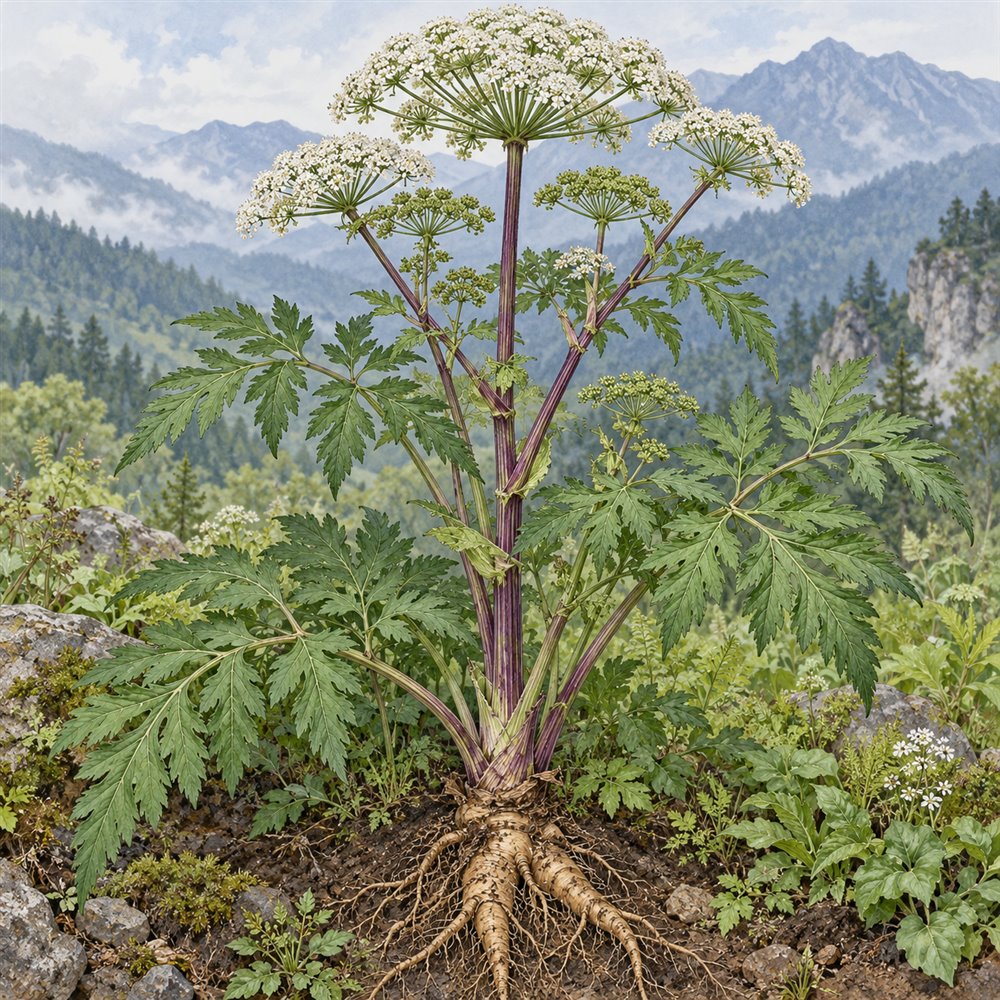
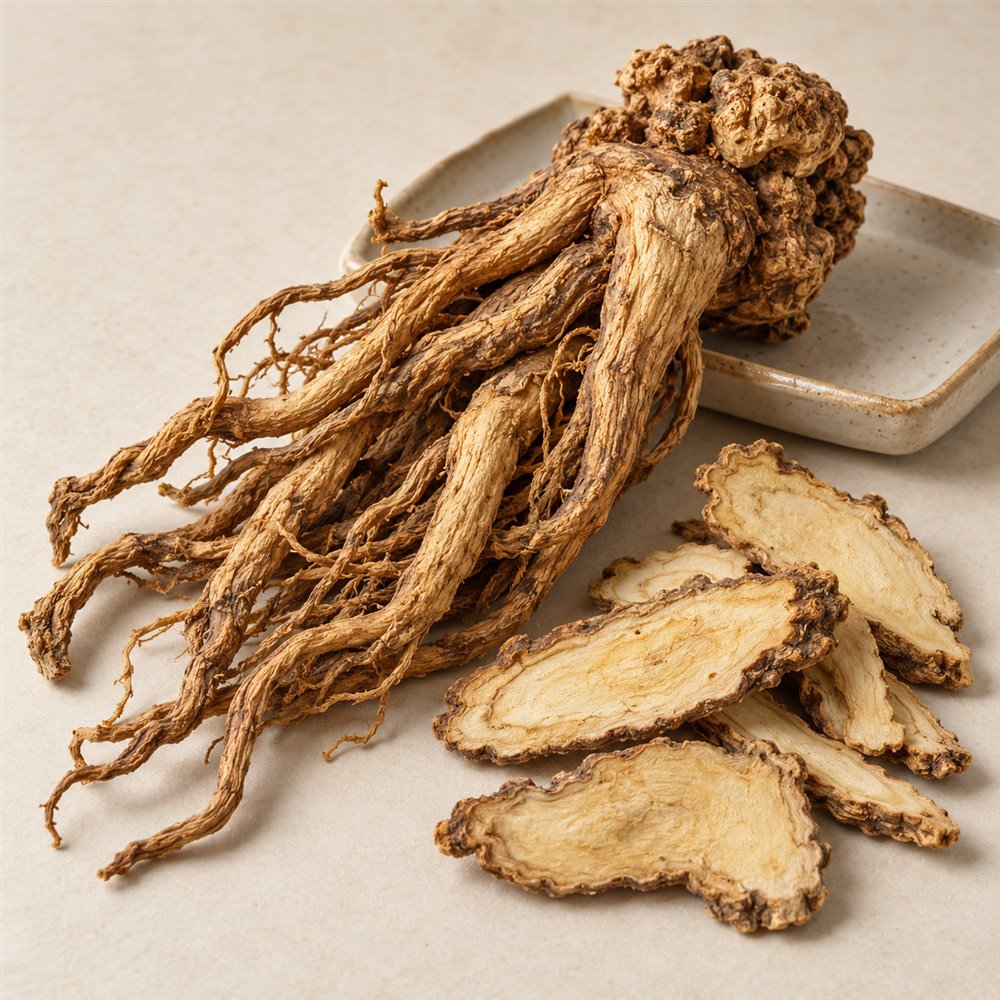
The paired study images show two forms for comparison. Use scientific nomenclature and source records for reference; do not identify real specimens from the image alone.
Chinese angelica · Dang Gui
Angelica sinensis (Oliv.) Diels · Root
Name and part used
An Apiaceae herb with a grooved purplish stem, finely divided leaves, and white umbels.
Traditional context
HKBU identifies Dang Gui as the root of Angelica sinensis. Distinguish it from other Angelica species and mixed commercial products.
Modern evidence
Research on Dang Gui products and preparations is heterogeneous; traditional use is not proof of efficacy for anemia or menstrual disorders.
Safety
It may affect clotting or interact with medicines; pregnancy, surgery, and combination products require professional review.
Pairing in reference texts
Appears in formulas such as Xiao Yao San and Gui Pi Tang in specific sources. Co-inclusion does not establish individual safety.
Growing, care, and harvest timing
HKBU habitat record: Mostly cultivated. Distributed in Gansu, Sichuan, Yunnan, Shaanxi, Guizhou, Hubei and etc. The medicinal materials are mainly produced in Gansu and Yunnan Harvest and processing as recorded: Collected at the end of autumn, removed the foreign matters, steamed, sun-dried or dried in low temperature
Source-recorded harvest/processing: Collected at the end of autumn, removed the foreign matters, steamed, sun-dried or dried in low temperature
The reviewed source does not provide a complete species-specific sowing/growing routine, irrigation/fertilization schedule, or universal plant age. The page therefore does not infer care instructions or years to harvest; consult local cultivation guidance.
Open habitat and season source ↗FROM PLANT / SOURCE HABITAT TO DRIED MATERIAL · REFERENCE HANDLING
- Harvest Angelica sinensis roots in late autumn as described in the HKBU record; keep them separate from other Angelica species.
- Remove soil and fine roots and let surface moisture drain; reject material with uncertain identity or source.
- Qualified processing may steam the roots and then sun-dry or use low-temperature drying; this is raw-material handling, not a home medicine recipe.
- Record Latin name, plant part, processing method, and lot; store dry and monitor quality.
These steps describe post-harvest handling for study; they are not directions for self-medication. Processing reference ↗
How to read formula amounts
The cited sources do not provide a formula with specific amounts for this profile; no ratio is invented. Absence from the incompatibility list does not establish safety.
Habitat, season, and harvest in the HKBU botanical record
HKBU botanical record (translated summary): Flowering and fruiting dates: Flowering: June to July, fruiting: June to August Habitat and distribution: Mostly cultivated. Distributed in Gansu, Sichuan, Yunnan, Shaanxi, Guizhou, Hubei and etc. The medicinal materials are mainly produced in Gansu and Yunnan Harvest and processing as recorded: Collected at the end of autumn, removed the foreign matters, steamed, sun-dried or dried in low temperature
Open botanical source ↗