Bai Hua She She Cao · spreading hedyotis · Bai Hua She She Cao
Hedyotis diffusa Willd. · Whole plant with roots
Name and part used
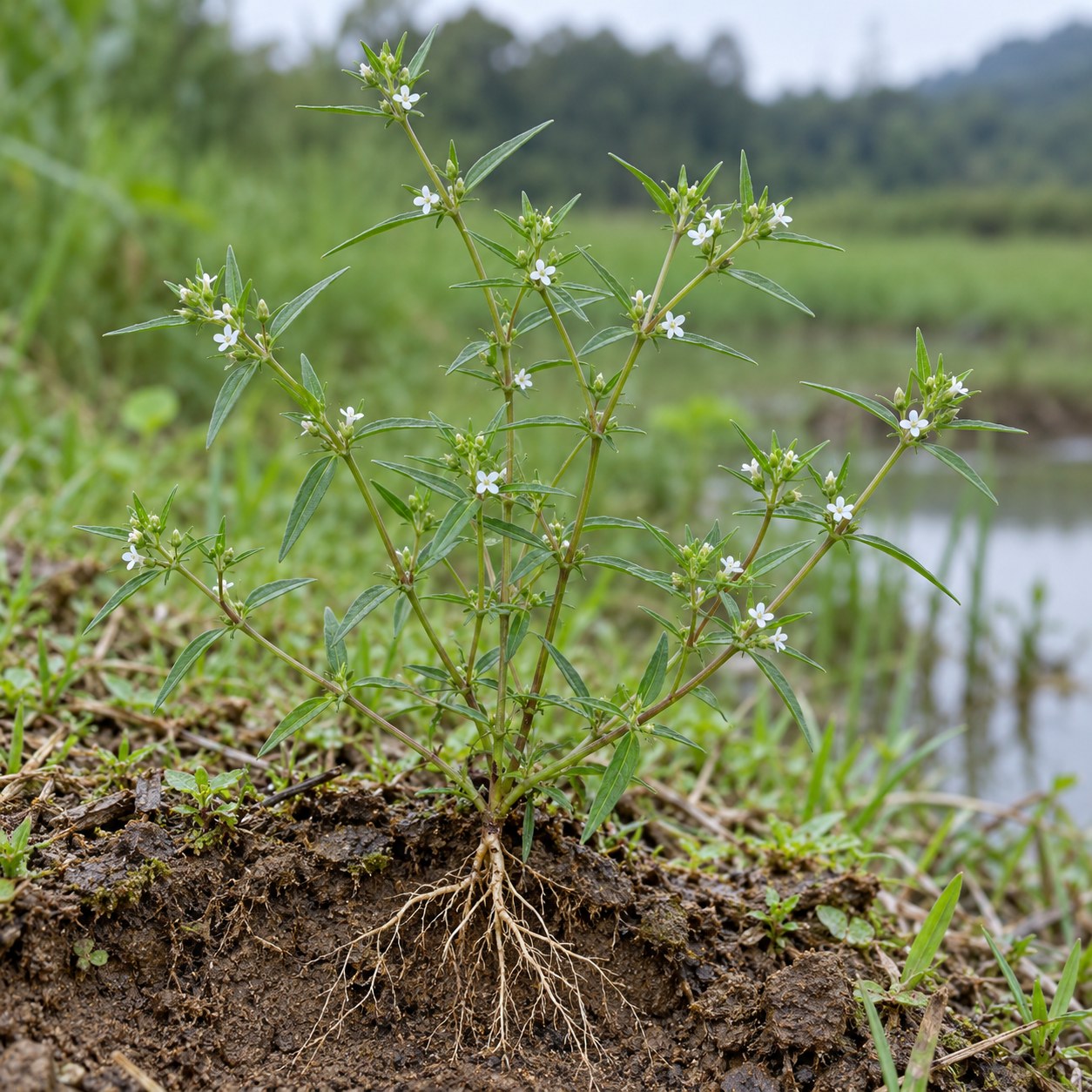
Bai Hua She She Cao is Hedyotis diffusa Willd., a slender glabrous annual in Rubiaceae. HKBU describes plants 15–50 cm tall, branching from the base, with very narrow sessile opposite leaves. Tiny white flowers grow singly or in pairs in leaf axils; flattened capsules contain yellow-brown seeds. The record uses the whole plant with roots. AI art supports study of habit and tiny flowers but cannot authenticate a wild plant.
Traditional context
HKBU records traditional actions of clearing heat, resolving toxin, and promoting urination. This is materia medica description, not proof of treatment in people. Serious disease names in a record do not establish anticancer benefit; do not delay medical assessment, biopsy, or clinician-directed care.
Modern evidence
HKBU documents morphology, habitat, plant part, and harvest season, not clinical efficacy. Chemical, cell, or animal findings about constituents do not prove the whole herb treats cancer, appendicitis, liver disease, or infection. A mass, high fever, worsening abdominal pain, blood in urine, or inability to urinate needs medical evaluation. Roadside or ditch material may be contaminated.
Safety
Do not self-ingest during pregnancy/breastfeeding, prescription-medicine use, or kidney/liver disease; the botanical record establishes no safe dose or interactions. Avoid roadsides, sprayed fields, and wastewater. A study plant does not become medicine merely by drying. Breathlessness, high fever, severe abdominal pain, bloody urine, or dehydration needs urgent care.
Safety reference ↗Pairing in reference texts
HKBU records a folk example pairing this herb with other plants for urinary stones, but local materia names may denote other species and the record does not establish modern efficacy or safety. Do not turn it into a home recipe or personal ratio. No species-specific toxic pair was confirmed; absence of a report is not proof of safety. Do not combine it yourself with diuretics, antibiotics, or cancer medicines.
Identification and study notes
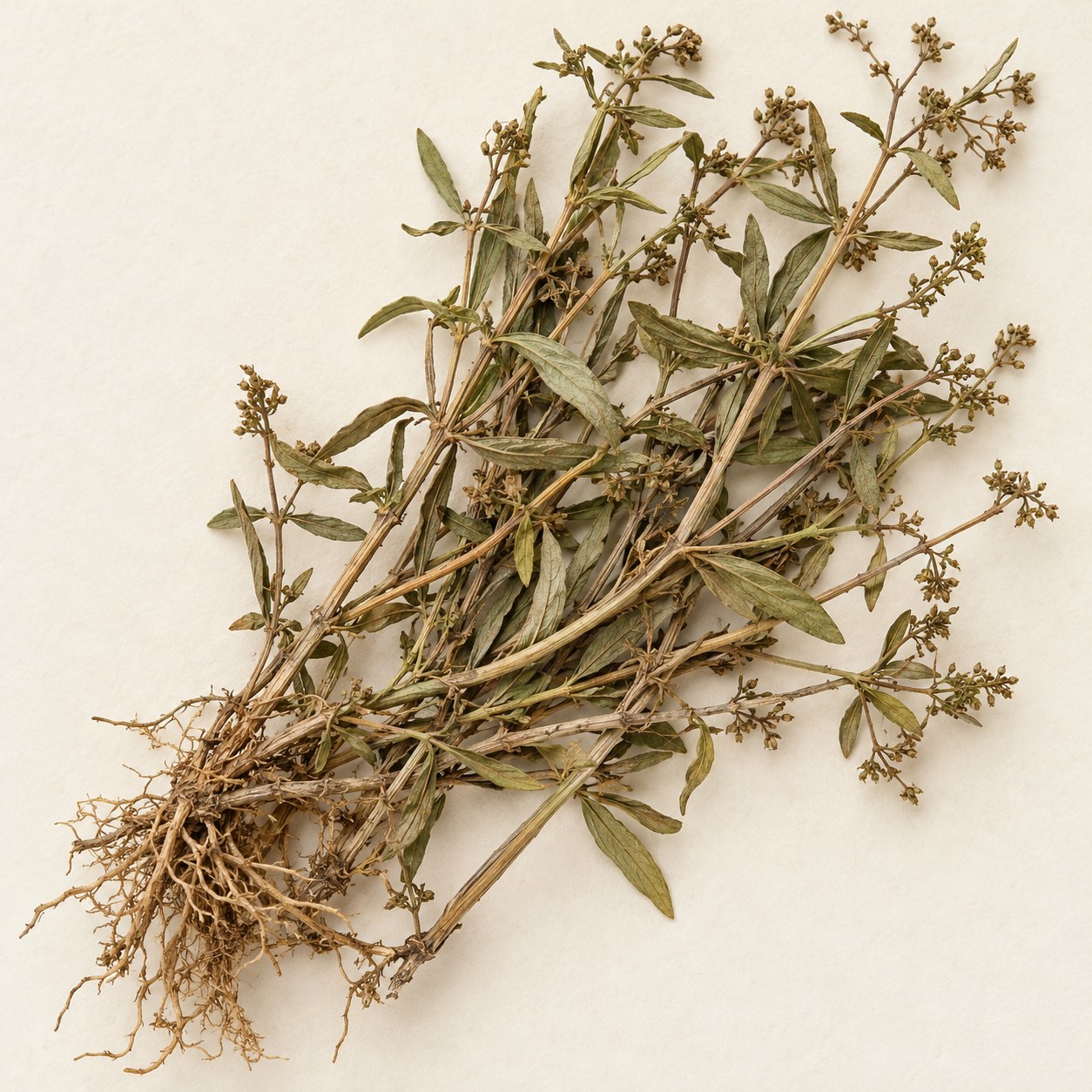
Study cues are slender basal branches, very narrow sessile opposite leaves, and tiny white axillary flowers. Use a hand lens for calyx/capsules because blooms are easy to miss. Dried whole material tangles; green-brown leaves and fine roots may retain soil. It may be confused with other low-growing Rubiaceae; verify Latin identity, source, and lot testing. AI art cannot show microscopic or chemical traits.
Growth and habitat
HKBU places it at humid field edges, ditches, roadsides, and grasslands in southeastern/southwestern China; commercial material is associated with Fujian, Guangdong, and Guangxi. A moist open habitat does not mean pollution tolerance. For study use a clean pot with moderately moist soil in gentle sun; avoid pesticide or wastewater sites.
Identification and study notes
Study cues are slender basal branches, very narrow sessile opposite leaves, and tiny white axillary flowers. Use a hand lens for calyx/capsules because blooms are easy to miss. Dried whole material tangles; green-brown leaves and fine roots may retain soil. It may be confused with other low-growing Rubiaceae; verify Latin identity, source, and lot testing. AI art cannot show microscopic or chemical traits. In a field notebook, record leaf width, node spacing, flower position, and capsule shape together. A single white flower or narrow leaf is not enough to distinguish related Rubiaceae. Photographs should include scale and both leaf surfaces; even detailed photos do not replace a voucher specimen or expert determination. Bạch hoa xà thiệt thảo có vài bẫy nhận dạng: hồ sơ này là Hedyotis diffusa, còn tên dân gian có thể áp cho Rubiaceae hoa trắng nhỏ khác. Cây mảnh, phân nhánh gốc, lá đối hẹp; hoa trắng nhỏ mọc ở nách lá. Dấu hiệu tinh tế dễ mất sau phơi/thái, nên cần tên Latin và nguồn truy xuất. HKBU ghi bờ ẩm, mương, nhưng nơi đó có thể nhận nước thải, thuốc trừ sâu hoặc kim loại ven đường. “Toàn cây gồm rễ” không có nghĩa loài giống hình được thay thế. “Giải độc” cổ truyền không chứng minh chữa ung thư/nhiễm trùng; nghiên cứu tế bào/động vật không xác lập kết quả lâm sàng. Phối dân gian trị sỏi tiết niệu không phải công thức chuẩn hay liều an toàn. Bộ mẫu học nên so cây có hoa được gắn nhãn với lô khô; ghi vùng, mùa thu, kiểm nghiệm tạp nhiễm và phiên bản nguồn. Không trì hoãn khám khối bất thường, sốt cao hay nhiễm trùng nặng.
Growing and care
- Use seed labeled Hedyotis diffusa and start in a clean tray rather than moving unidentified wild plants. Choose loose drained but lightly moisture-retentive medium in a bright site.
- Sow shallowly under a thin cover and mist. HKBU gives no dormancy treatment, germination rate, or emergence interval; record actual seed lot and dates.
- Thin established seedlings for airflow; keep soil moderately moist, hand-weed, avoid raw manure, and watch for mold after rain because low stems receive splash.
- Observe axillary white flowers and capsules through the annual cycle. HKBU records whole-plant harvest with roots in summer–autumn but gives no maturity age or days after sowing. Do not use a potted plant as medicine.
How long until harvest? An annual; HKBU records summer–autumn collection but gives no sowing-to-harvest interval or maturity standard. No fixed “ready in X days” is claimed. Study through flowering/fruiting; do not use a home-grown plant as medicine.
FROM PLANT / SOURCE HABITAT TO DRIED MATERIAL · REFERENCE WORKFLOW
- Collect legally in summer/autumn as HKBU records, authenticate the species, and take whole plants with roots; avoid protected or contaminated sites.
- Remove soil, weeds, and decayed parts. If needed, rinse briefly with clean water and drain; prolonged soaking damages the herb and encourages mold.
- HKBU records sun-drying or fresh use. For study, spread thinly in a clean ventilated place and turn evenly; avoid bare ground and dust.
- When dry, stems become green-brown, opposite leaves wrinkle, and fine roots shrink. Cool and label Latin name, origin, and date; AI art cannot certify quality or safety.
These are post-harvest study notes, not directions to prepare a remedy for self-treatment. Processing reference ↗
Habitat, season, and harvest in the HKBU botanical record
HKBU describes an annual 15–50 cm tall with smooth branching stems, narrow opposite leaves, axillary white flowers, and flattened capsules. It grows at humid field/ditch edges, roadsides, and grasslands; harvest the whole plant with roots in summer–autumn, dried or fresh.
Open botanical source ↗