Ce Bai Ye · Chinese arborvitae twig and leaf · Ce Bai Ye
Platycladus orientalis (L.) Franco · Dried branch tips and leaves
Name and part used
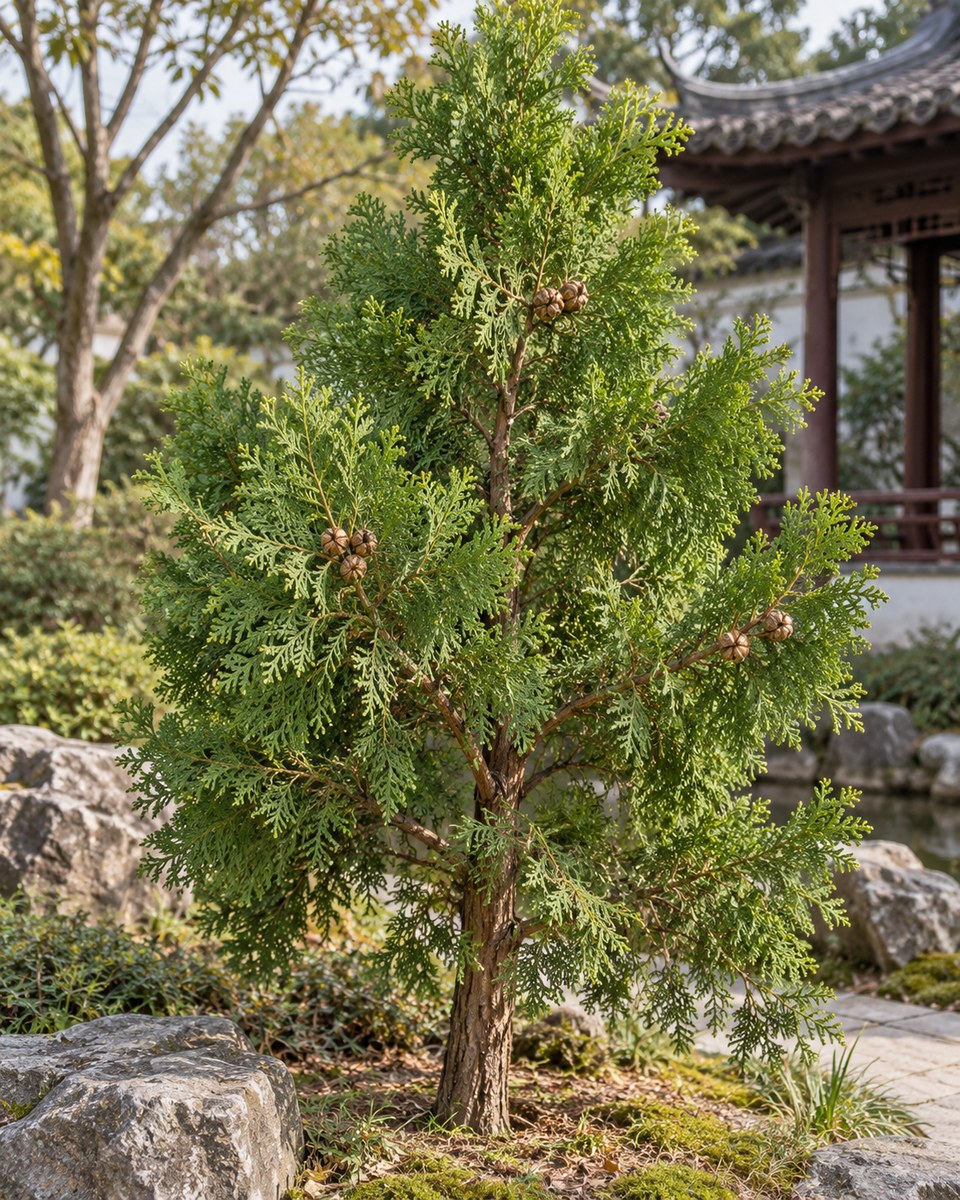
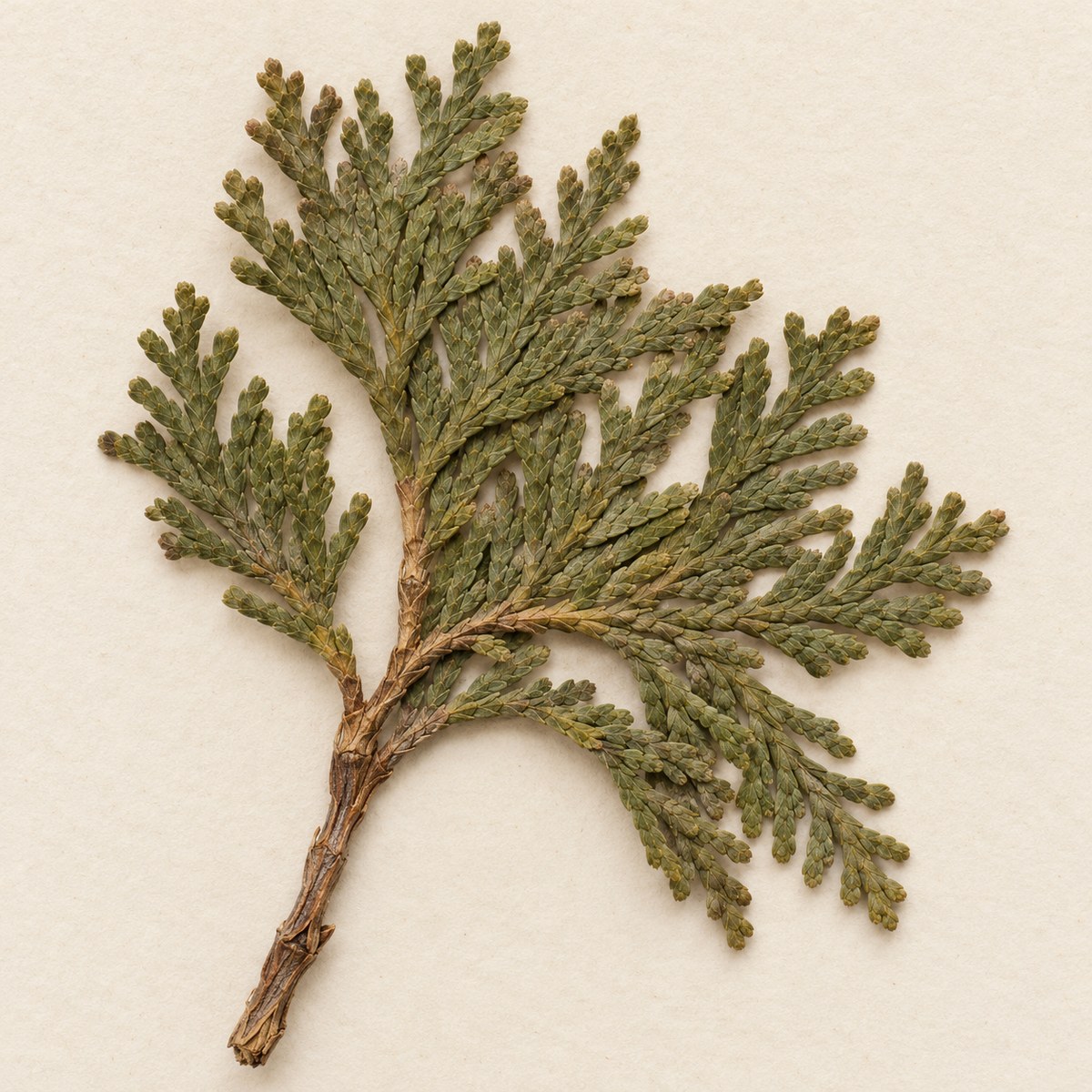
Ce Bai Ye is the dried branch tips and leaves of Platycladus orientalis, an evergreen Cupressaceae tree with flattened sprays and tiny scale leaves pressed against the twigs. It produces small woody cones; the dried material consists of flattened reddish-brown young branches with opposite dark- or yellow-green scales. HKBU describes it as brittle and aromatic. “Arborvitae” can refer to ornamental trees; the drug requires the correct species and plant part.
Traditional context
HKBU describes a bitter, astringent, slightly acrid, cold nature, with traditional actions of cooling blood, stopping bleeding, and promoting dark hair growth. Traditional indications do not prove treatment for gastrointestinal bleeding, hematuria, uterine bleeding, bronchitis, or hair loss. Abnormal bleeding needs appropriate medical assessment.
Modern evidence
Constituent and experimental studies do not establish that crude twigs/leaves stop bleeding or regrow hair in people. Data from essential oil, extracts, ornamental plants, and standardized products are not interchangeable. A tree or dried-sample image cannot reveal active-compound concentration or purity.
Safety
Do not take it orally to stop bleeding on your own. Heavy nosebleeds, vomiting blood, black stools, blood in urine, uterine bleeding, or faintness need medical care; delay can be dangerous. People taking anticoagulant/antiplatelet drugs, pregnant people, and those with chronic conditions should consult a professional before any preparation. HKBU does not establish a safe self-use dose. Do not ingest essential oil or ornamental-plant products.
Safety reference ↗Pairing in reference texts
Traditional formulas may combine Ce Bai Ye with other herbs depending on purpose and processing, but reviewed sources do not establish a specific toxic pair or a universally safe ratio. Charred processing is a distinct documented form; do not roast or decoct it at home to stop bleeding. Do not self-combine with anticoagulants, hemostatic drugs, or other herbs.
Identification and study notes
Platycladus orientalis is an evergreen tree, often conical or layered; lateral sprays flatten into fans and carry dense opposite decussate scale leaves. Small cones may appear on mature branches. Ce Bai Ye is the branch tip and scale foliage, not cones, wood, or any ornamental “thuja.” HKBU describes flat reddish-brown twigs with tiny opposite dark- or yellow-green scales; twigs are around 1–2 mm across, brittle, and distinctly aromatic. Superior material is described as deep-green tender twigs with little crushed debris. The source also records bitter, astringent, slightly acrid taste. Roadside branches can carry dust/metals, and ornamentals may be pesticide-treated. AI imagery cannot disclose growing site, twig age, contamination, or authentication, so it is not proof of safe material.
Growth and habitat
Platycladus orientalis is widely cultivated in China and temperate regions as an ornamental tree or hedge. Once established it tolerates some drought and needs well-drained soil and sun to partial shade; seedlings should avoid waterlogging and extreme cold. Urban foliage can accumulate dust or metals, so roadside branches should not be collected as materia medica.
Identification and study notes
Platycladus orientalis is an evergreen tree, often conical or layered; lateral sprays flatten into fans and carry dense opposite decussate scale leaves. Small cones may appear on mature branches. Ce Bai Ye is the branch tip and scale foliage, not cones, wood, or any ornamental “thuja.” HKBU describes flat reddish-brown twigs with tiny opposite dark- or yellow-green scales; twigs are around 1–2 mm across, brittle, and distinctly aromatic. Superior material is described as deep-green tender twigs with little crushed debris. The source also records bitter, astringent, slightly acrid taste. Roadside branches can carry dust/metals, and ornamentals may be pesticide-treated. AI imagery cannot disclose growing site, twig age, contamination, or authentication, so it is not proof of safe material.
Growing and care
- Obtain Platycladus orientalis from a labeled nursery; avoid confusion with ornamental Thuja or Chamaecyparis species. The pictured tree is a morphology aid only.
- Plant in sun or partial shade in well-drained soil; established trees tolerate dryness better than new transplants. Avoid prolonged waterlogging and allow airflow around the canopy.
- Water deeply after planting and taper according to weather; weed around the base and prune dead twigs with clean tools. Monitor pests/fungi and do not harvest immediately after pesticide use.
- This is a long-lived tree; HKBU does not specify an age for medicinal branch harvest. Collect only authenticated young twigs from a managed lot; do not trim dusty or pesticide-treated ornamentals for medicine.
How long until harvest? The tree is long-lived, but HKBU gives no standard medicinal harvest age. The materia medica is young branch tips and leaves after drying; being able to prune a garden tree does not make the material safe or medicinal-grade.
Documented toxic incompatibility
Reviewed sources do not establish a specific toxic pair; this does not mean arbitrary combinations are safe. The practical caution is not to self-treat bleeding or combine it with drugs affecting coagulation. Charring is a processing form, not a detoxification method.
AI study illustrations; not for specimen identification.
FROM PLANT / SOURCE HABITAT TO DRIED MATERIAL · REFERENCE WORKFLOW
- Select authenticated young tips and leaves of Platycladus orientalis from a clean managed lot; avoid roadsides, pesticide-treated parks, or polluted areas.
- Remove old, diseased branches, dust, and debris; keep branch-tip/leaf lots separate. The drug is not the cone or trunk wood.
- Dry in a clean, ventilated setting under qualified procedures; HKBU describes flat reddish-brown twigs, green scales, and brittle texture. Do not char it at home to stop bleeding.
- Seal and label with species and processing date, controlling moisture and mold. Do not ingest essential oil or ornamental-tree preparations.
These are post-harvest study notes, not directions to prepare a remedy for self-treatment. Processing reference ↗
Material source, dried appearance, and processing forms (HKBU)
HKBU identifies Ce Bai Ye as dried branch tips and leaves of Platycladus orientalis (L.) Franco (Cupressaceae), Platycladi Cacumen. Small flattened reddish-brown twigs are around 1–2 mm across; tiny scale leaves are opposite, pressed to the branch, and dark or yellow-green. Branches are brittle with a yellow-white fracture; odor is distinctly aromatic and taste bitter-astringent, slightly acrid. HKBU describes superior material as deep-green tender twigs with little debris. The drug is produced across many regions of China. These are source descriptors, not a home purity test.
Open original materia medica record ↗Habitat, season, and harvest in the HKBU botanical record
HKBU confirms the used part is dried branch tips and leaves of Platycladus orientalis, a Cupressaceae tree cultivated across many parts of China. Harvest requires appropriate twigs, drying, and correct species labeling; the source does not provide tree age, irrigation calendar, or a fixed number of months to medicinal harvest. An ornamental urban tree is not automatically clean or suitable.
Open botanical source ↗