Chinese goldthread · Huang Lian
Coptis chinensis Franch. · Rhizome
Name and part used
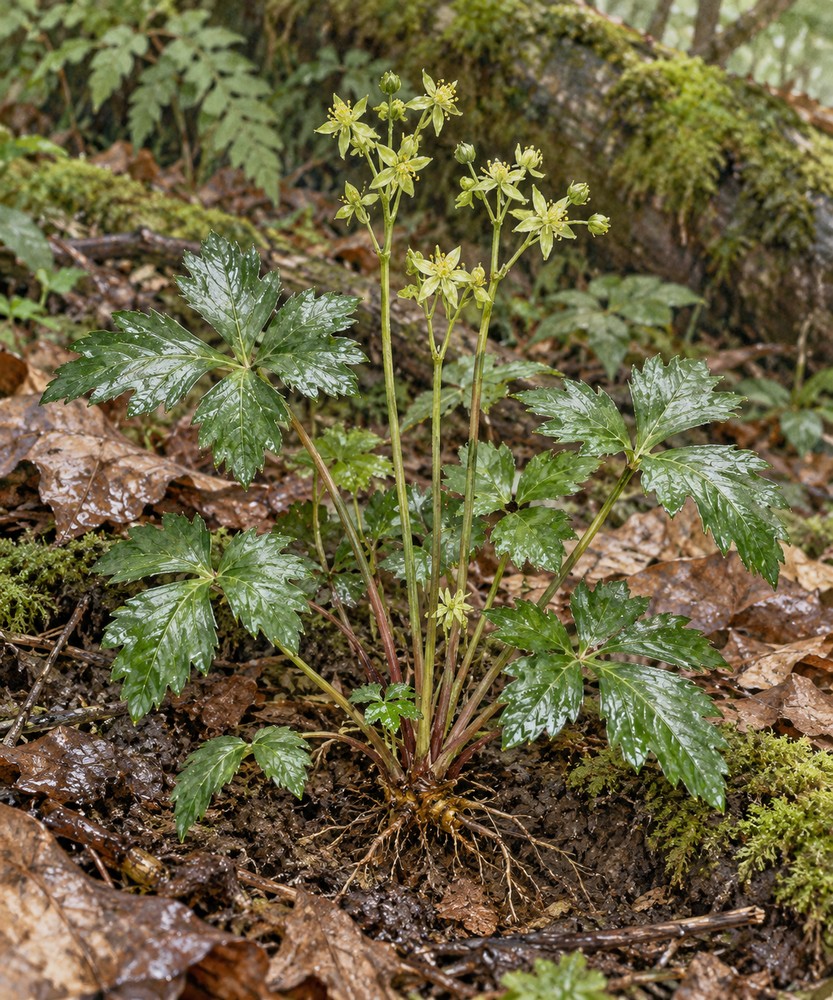
A low woodland herb with divided basal leaves and a branching yellow rhizome.
Traditional context
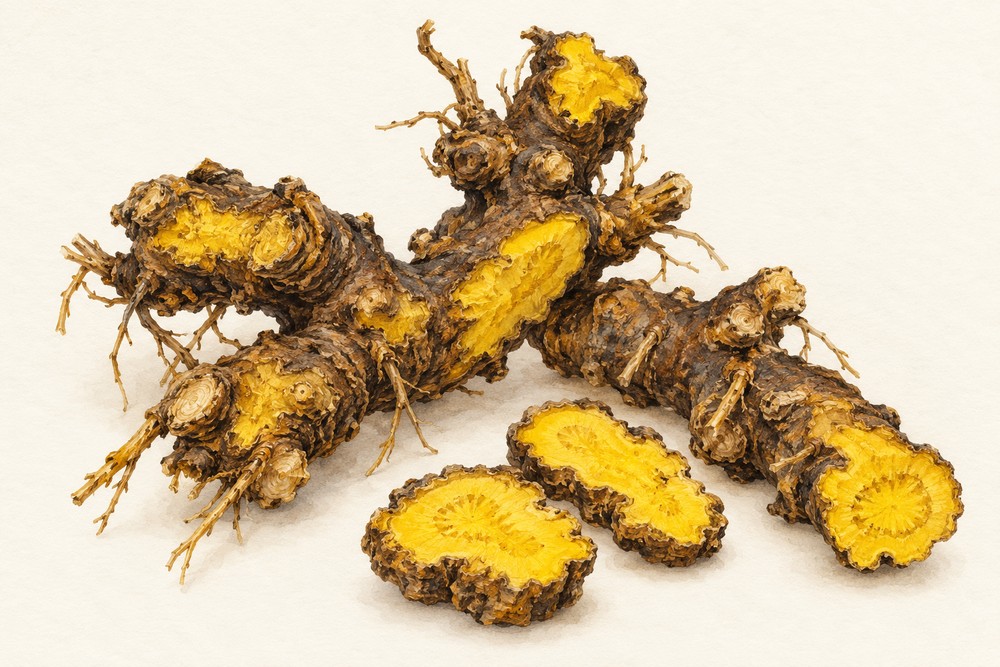
Huang Lian is the rhizome of Coptis chinensis; HKBU describes late-year harvest, cleaning, and drying. Other Coptis species or purified berberine are not equivalent materials.
Modern evidence
Berberine is a constituent in some Coptis species; compound research does not prove whole-herb or commercial formula effects.
Safety
Berberine/Coptis products may interact with medicines, and pregnancy/young-child use requires caution. People taking medicines should consult a professional before considering products.
Pairing in reference texts
Huang Lian appears in some classical formulas; an ingredient name in a text does not establish modern product dose, quality, or safety.
Growing, care, and harvest timing
HKBU habitat record: Growing in thick forests or shady places in ravine at altitude 1,000-2,000m. Distributed in Shaanxi, Hubei, Hunan, Sichuan, Guizhou and etc. The medicinal materials are mainly produced in Shanxi, Hubei, Hunan, Sichuan and Gansu Harvest and processing as recorded: Collected in October and November, excavated entire plant with root, removed soil, fibrous root and leaves, and dried rhizome
Source-recorded harvest/processing: Collected in October and November, excavated entire plant with root, removed soil, fibrous root and leaves, and dried rhizome
The reviewed source does not provide a complete species-specific sowing/growing routine, irrigation/fertilization schedule, or universal plant age. The page therefore does not infer care instructions or years to harvest; consult local cultivation guidance.
Open habitat and season source ↗FROM PLANT / SOURCE HABITAT TO DRIED MATERIAL · REFERENCE WORKFLOW
- Harvest cultivated rhizomes according to the production region’s season and verify Coptis chinensis; yellow color alone is not enough.
- Shake off soil and remove fibrous roots and leaves; clean under the facility’s procedure without mixing species.
- Dry rhizomes on ventilated trays or racks and control moisture; reject damaged material.
- Record species, source, date, lot, and quality checks; store in a dry place away from moisture.
These are post-harvest study notes, not directions to prepare a remedy for self-treatment. Processing reference ↗
How to read formula amounts
The cited sources do not provide a formula with specific amounts for this profile; no ratio is invented. Absence from the incompatibility list does not establish safety.
Habitat, season, and harvest in the HKBU botanical record
HKBU botanical record (translated summary): Flowering and fruiting dates: Flowering: April to May, fruiting: June to July Habitat and distribution: Growing in thick forests or shady places in ravine at altitude 1,000-2,000m. Distributed in Shaanxi, Hubei, Hunan, Sichuan, Guizhou and etc. The medicinal materials are mainly produced in Shanxi, Hubei, Hunan, Sichuan and Gansu Harvest and processing as recorded: Collected in October and November, excavated entire plant with root, removed soil, fibrous root and leaves, and dried rhizome
Open botanical source ↗