Cyclamen purpurascens Mill. · Swollen stem tuber (botanical morphology; not a use instruction)
Materia medica properties in reference
Subject illustration; does not establish use or dose
Properties as recorded in the source: Name and scope: Kew Plants of the World Online accepts Cyclamen purpurascens Mill. in Primulaceae; it is a tuberous geophyte native to Central and South-Central Europe. This botanical name does not by itself establish a medicinal drug identity. RHS lists Cyclamen europaeum as a synonym in its horticultural profile; when reading older references, retain the author’s name and reconcile it with the currently accepted name. Common labels such as ‘cyclamen’ or a market name alone cannot verify the species.
The reviewed sources did not establish a sufficiently specific Chinese materia-medica monograph for this exact species, plant part, and product form from which to state traditional properties, meridian entry, or a dose. USDA GRIN records a folk-medicine entry under Cyclamen europaeum but gives no condition, method, amount, or safety. Kew MPNS also shows medicinal-source records associated with this name, but a search result is not clinical evidence. A folklore note or trade code must not be turned into a treatment claim.
The tuber is a plant storage organ and should not be confused with an identified, quality-controlled dried medicinal drug. CITES lists the genus Cyclamen in Appendix II with an annotation defining covered specimens; this regulates international trade under applicable rules and does not establish therapeutic use. Other species in the genus, ornamental hybrids, fresh tubers, and dried goods of uncertain origin cannot be merged into this profile.
Subject illustration; does not establish use or dose
No sufficiently specific formula was found that identifies Cyclamen purpurascens, every ingredient, and amounts well enough to describe a beneficial pairing. No exact herb combination with this species was verified as becoming poisonous. This absence does not prove combinations safe; no ratio or ingestion instruction is given.
CITES international-trade evidence
Subject illustration; does not establish use or dose
The 2026.1 CITES Trade Database contains 176 comparative-tabulation rows for Cyclamen purpurascens during 2016, 2017, 2018, 2019, 2020, 2021, 2022, 2023, 2024, 2025. The query selected reported purpose T (Commercial) and trade term MED (medicine); appendices appearing in these rows: II. Reported importer codes include AT, AZ, BY, CA, CH, CN, CO, FR; exporter codes include BG, CH, DE, FR, MD. These are comparative-tabulation rows, not shipment counts or summed volume. This record does not establish clinical efficacy, the legality of an individual transaction, or safety of use.
Living plant · AI illustration, not specimen identification
Living-plant identification traits · AI illustration
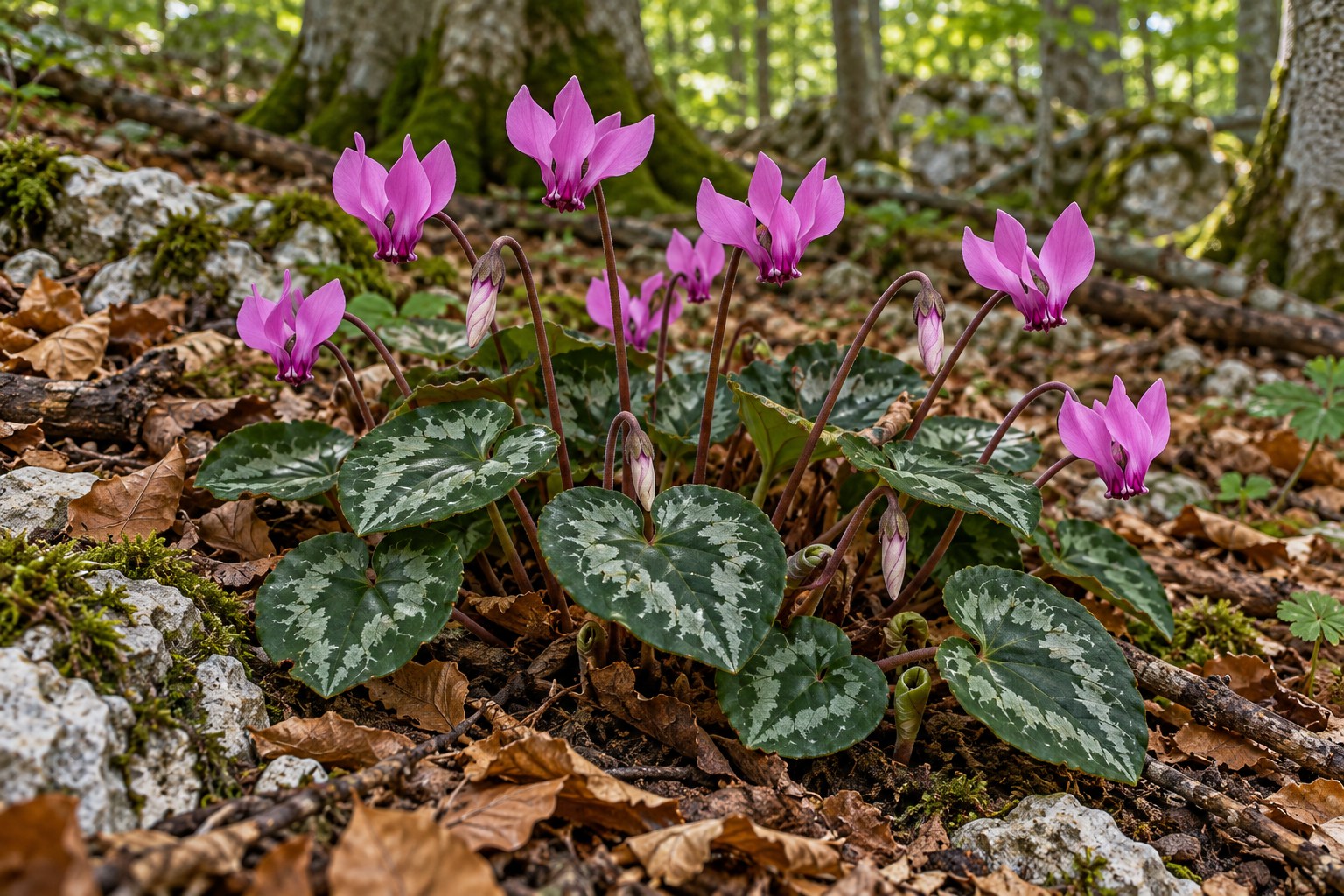
Cyclamen purpurascens Mill. is a low-growing perennial herb in Primulaceae. It grows from an underground swollen stem tuber; the above-ground plant is usually about 10 cm tall in the RHS profile. Leaves arise in a cluster and range from round to broadly oval, with smooth or slightly toothed edges; the upper surface is often dark green with silver marbling, and the underside may be purplish. Fragrant flowers range from rose pink to magenta, with reflexed, slightly twisted petals. The Cyclamen Society records wild flowering from June through October; timing varies by region and garden conditions.
Living-plant identification traits · AI illustration
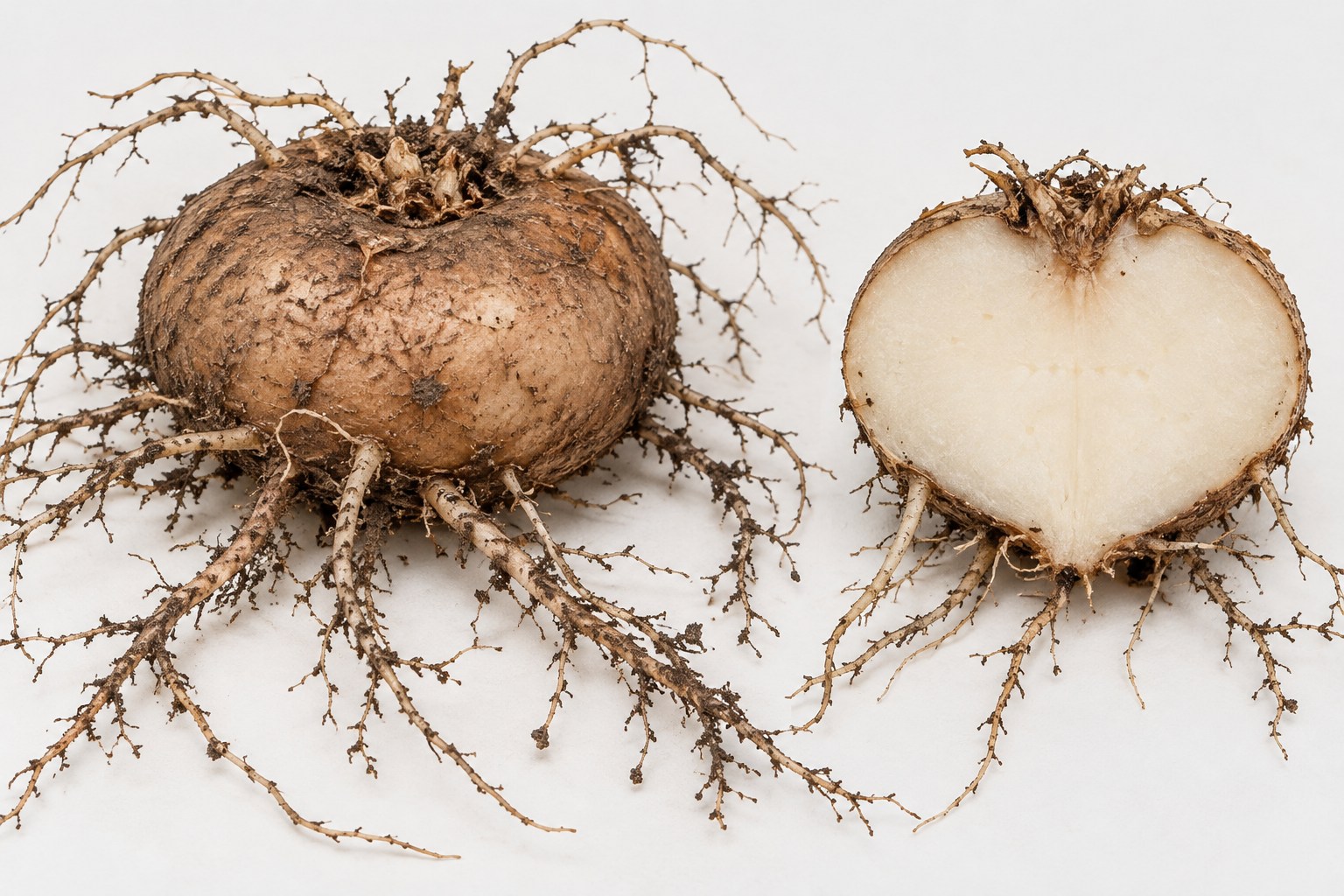
The mature tuber is rounded and can become irregular with age; it is pale brown, smooth when young and rougher later. Branching roots arise from multiple points on its surface. This is botanical morphology for study. AI art is not a herbarium voucher, cannot prove a traded product is the correct species, and does not encourage digging wild plants.
Living-plant identification traits · AI illustration
Separate images of the living plant, tuber, habitat, and container cultivation were created for their respective topics. AI art can contain small inaccuracies and must not be used to identify wild plants or decide to harvest them. For confirmation, use reliably labeled nursery stock, botanical records, and a qualified identifier.
Traditional context
Tuber morphology · not a verified medicinal ingredient
Subject illustration; does not establish use or dose
The name “cyclamen” is used for many species and ornamental cultivars. Ethnobotanical references may preserve historical records under Cyclamen europaeum; RHS lists this as a synonym of C. purpurascens. Synonymy does not prove every folk record concerns the same population, plant part, preparation, or amount.
Subject illustration; does not establish use or dose
USDA GRIN links the species to a folklore “medicines” note but gives no indication or method. This profile records only that historical trace; it does not present a validated use, turn it into a formula, or encourage experimentation. No specific Chinese formula ratio for this exact species was verified.
Modern evidence
Illustrates the subject, not a research result
Subject illustration; does not establish use or dose
Three evidence types must stay separate: taxonomy identifies the plant; a trade database records reported transactions; biomedical research evaluates a particular sample or product. One type cannot substitute for another.
Subject illustration; does not establish use or dose
In the CITES trade comparison compiled for this project, Cyclamen purpurascens has 176 reported tabulation rows for 2016–2025 under the term “medicine” and purpose T (commercial). Rows use different source codes, including artificially propagated, source unknown, and wild specimens; reporting-country lists do not mean every country grows, produces, or consumes it at the same scale. This is a count of rows in the project extract and grouping, not 176 shipments, plants, weight, revenue, or a market-wide estimate.
Subject illustration; does not establish use or dose
“Medicine” is a reported trade field; it does not identify contents, plant part, actual species in every shipment, safety, or therapeutic effect. Country, year, source code, trade term, and appendices need to be read together. No clinical evidence sufficient to claim that C. purpurascens treats disease is relied upon here.
Safety
Subject illustration; does not establish use or dose
RHS marks ornamental Cyclamen tubers as not for eating and advises gloves and protective equipment when handling. ASPCA lists Cyclamen spp. as toxic to dogs, cats, and horses; it identifies terpenoid saponins and reports salivation, vomiting, and diarrhea in pets. Large tuber ingestion can cause heart rhythm abnormalities, seizures, or death. ASPCA’s warning applies at genus level and to animals; it is not a human toxic threshold or a quantitative species-specific conclusion for C. purpurascens.
Temperate woodland habitat · AI illustration
Do not eat the tuber, leaves, flowers, or products of uncertain identity. Keep the plant and material away from children, dogs, cats, and horses. Wash hands after gardening and use gloves if skin is sensitive or contact is prolonged. If a person or animal ingests it, contact a healthcare provider or veterinarian; do not induce vomiting or try folk remedies.
Subject illustration; does not establish use or dose
No reviewed source confirms a specific herb pairing that makes this species a “poison.” The main warning is the plant’s own toxicity, not a demonstrated drug interaction. People taking medicines, with a health condition, pregnant, or breastfeeding should not experiment with cyclamen products. No dose or safe ratio is given.
Living-plant identification traits · AI illustration
When observing a living plant, record at least four traits together: rounded-to-oval silver-marbled leaves; stalks emerging close to ground level; rose flowers with reflexed petals; and low growth among leaf litter. Do not identify it by flower color alone: ornamental forms vary and other Cyclamen species can look similar.
Living-plant identification traits · AI illustration
Check purplish leaf undersides, summer-to-autumn flowering, and the underground tuber only on lawfully cultivated plants. Do not dig wild plants. AI images cannot represent every individual and may get petal counts, leaf proportions, roots, or colors wrong.
Growth and habitat
Temperate woodland habitat · AI illustration
Ornamental gardening illustration, not medicinal production
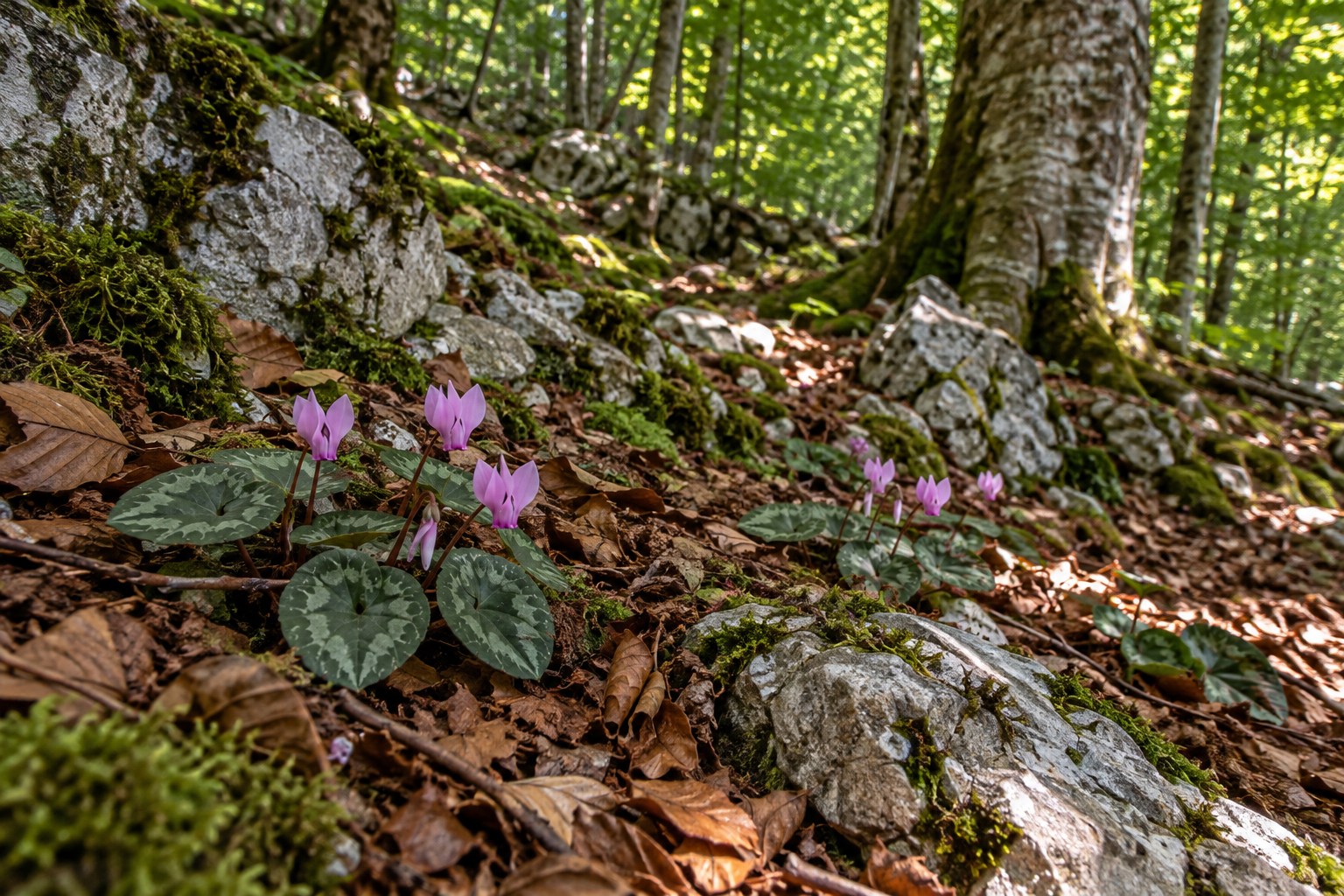
Kew records a native range in Central and South-Central Europe within the temperate biome. The Cyclamen Society describes deciduous or mixed woodland, often under thick leaf litter in humus-rich pockets over limestone; the plant can also occur in scree, sparse grassland, or above the tree line. Recorded elevations range from near sea level in the Balkans to around 1,500 m in the Alps. Woodland provides dappled shade and humus that retains moisture while draining.
Range and elevation describe ecology; they are not instructions to introduce the plant elsewhere. Nursery plants may be selected cultivars or cultivated stock, and a picture cannot establish population origin. Prefer nursery-propagated plants with labels, receipts, and provenance records; avoid wild-collected tubers.
Ornamental gardening illustration, not medicinal production
Ornamental gardening illustration, not medicinal productionChoose a scientifically labeled nursery plant; do not dig wild plants. Ornamental cultivation is not medicinal production: no medicinal harvest method or age is established here.
Temperate woodland habitat · AI illustrationChoose partial shade under deciduous trees or filtered light. In hot, humid regions avoid midday sun and prolonged heat; RHS hardiness ratings describe UK gardens and do not guarantee performance elsewhere.
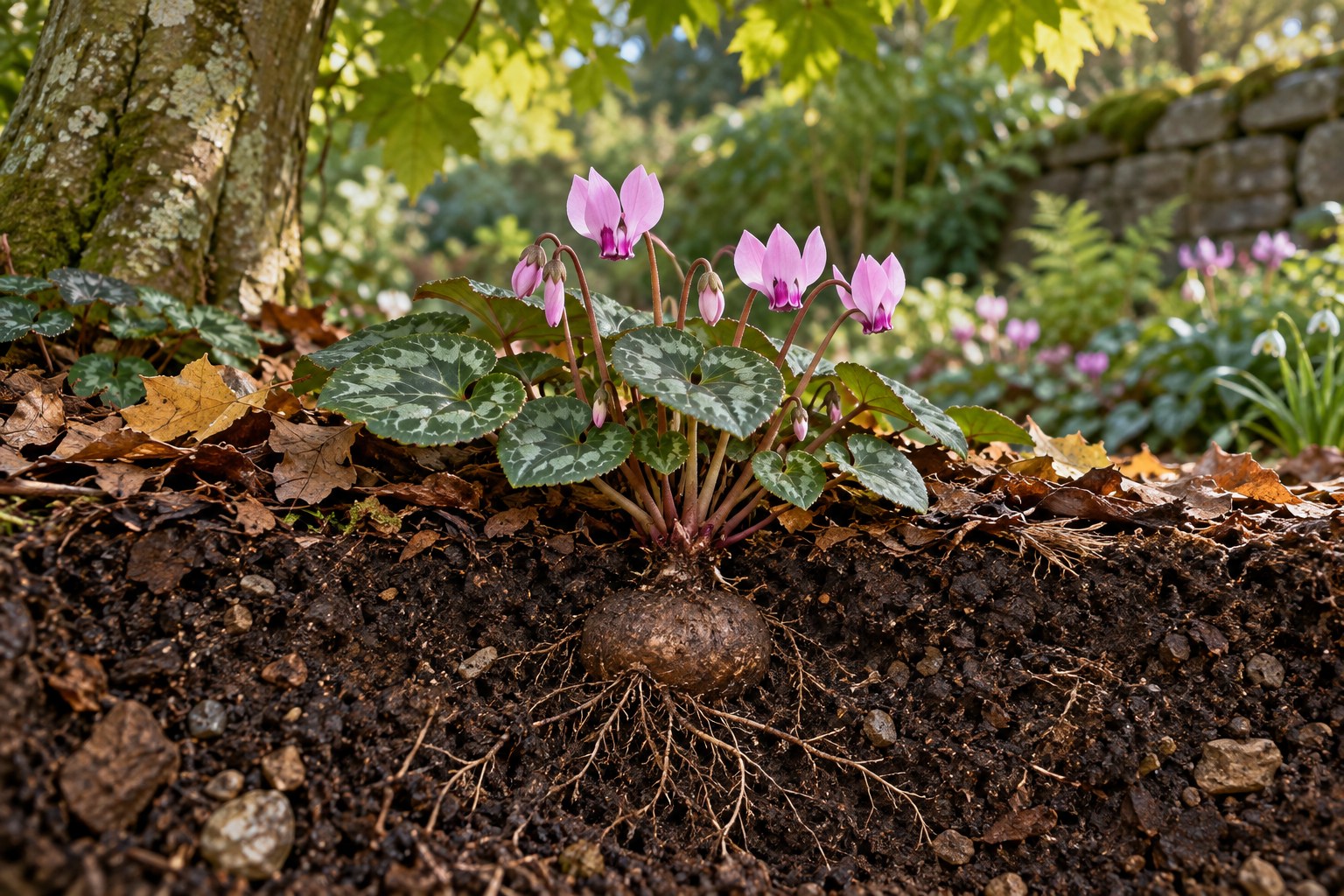
Temperate woodland habitat · AI illustrationUse a humus-rich, loose, free-draining medium. RHS advises planting the tuber about 5 cm deep in moderately fertile soil; avoid summer desiccation and prolonged waterlogging. Use drainage holes and respond to actual moisture, not a rigid watering calendar.
Ornamental gardening illustration, not medicinal productionPropagation can use ripe seed. RHS recommends sowing in darkness as soon as ripe and notes a 10-hour soak may help. Use a clean tray and free-draining seed medium; keep it moderately moist, record the date, and prevent standing water. Follow seedlings across seasons rather than expecting immediate emergence or flowering.
Temperate woodland habitat · AI illustrationRHS gives 2–5 years to ornamental maturity in its gardening context. This is not a medicinal harvest age or safe-use interval. Retain the label as foliage declines seasonally and avoid overwatering; pests may include mice, squirrels, and vine weevil, while greenhouse plants may develop Cyclamen grey mould.
Ornamental gardening illustration, not medicinal production
How long until harvest? The reviewed sources establish no medicinal cultivation age or tuber harvest time. RHS lists 2–5 years to ornamental maturity; that is not “safe to use after 2–5 years.” This profile does not recommend harvesting or ingestion.
Ornamental gardening illustration, not medicinal production
From plant to dried material · source-recorded workflow
Temperate woodland habitat · AI illustrationDo not collect wild plants or remove tubers from natural populations. Before purchase or shipment, check current CITES rules, exporting/importing countries, specimen source, and documents.
Dried materia medica form of this speciesFor cultivated ornamentals, retain the scientific label, nursery, purchase date, and propagation provenance. A garden tuber is not an identified or tested medicinal ingredient.
Dried materia medica form of this speciesFor morphology study, observe leaves, flowers, stalks, and habitat on lawfully sourced living plants; the AI tuber image is illustrative, and plants should not be dug to inspect underground organs.
Illustration of the processing step describedDo not wash, slice, dry, grind, decoct, or taste a tuber to make a home remedy. Reviewed sources establish no medicinal processing method or safe dose; RHS warns that ornamental Cyclamen tubers are not to be eaten.
Dried materia medica form of this speciesFor a trade record, keep declared scientific name, plant part, product form, specimen source, CITES code, and documents separate. Do not infer quality or efficacy from the term “medicine”.
Illustration of the processing step described
This record supports study and processing traceability; it is not a home preparation or self-use guide.