Pilose asiabell root · Dang Shen
Codonopsis pilosula (Franch.) Nannf. · Root
Name and part used
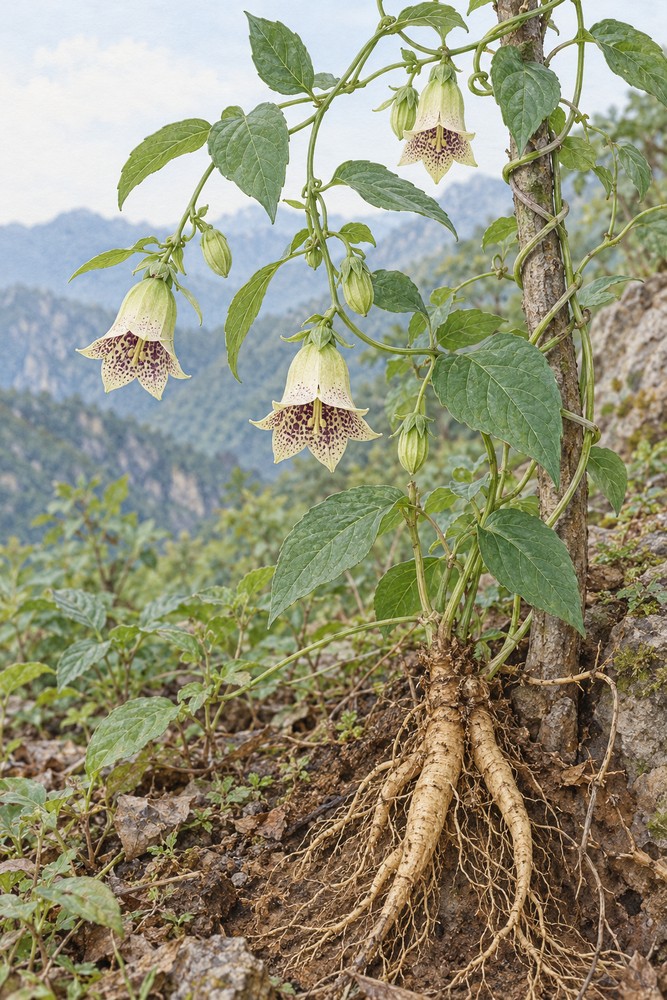
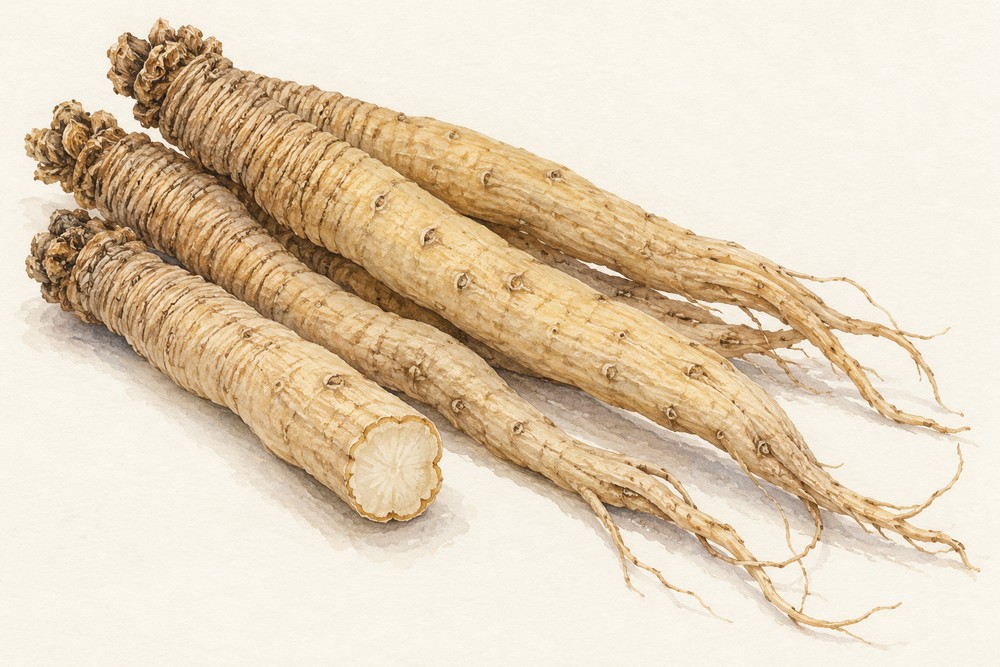
A soft twining vine with alternate oval leaves, yellow-green purple-speckled bells, and spindle-shaped roots.
Traditional context
Dang Shen is Codonopsis pilosula root from mountain thickets and forest edges. HKBU records autumn harvest and regional types; other Codonopsis species may appear in trade.
Modern evidence
Middle-qi tonifying is a traditional claim. Polysaccharide or immune research does not prove treatment for fatigue, diabetes, or cancer in people.
Safety
People using glucose, blood-pressure, or immunosuppressive medicines should seek advice before use. Species substitution and product quality require checking.
Pairing in reference texts
Dang Shen appears in qi-tonifying formulas with Astragalus or Atractylodes. Classical pairings do not make them safe with every medication.
Growing, care, and harvest timing
HKBU habitat record: Growing in mountain thickets or forest edges. Distributed in Heilongjiang, Jilin, Liaoning, Inner Mongolia, Hebei, Henan, Shanxi, South Shaanxi, East Gansu, Ningxia, East Qinghai, East Tibet, Northeast Yunnan, Sichuan, Hubei and Hunan. According to the origination, the medicinal material can be divided into Dongdang and Ludang. Dongdang: the medicinal materials are mainly produced in Heilongjiang, Jilin and Liaoning. Ludang: the medicinal materials are mainly produced in Shanxi and Henan; also produced in Inner Mongolia and Hebei Harvest and processing as recorded: Excavated in autumn, well washed, and sun-dried
Source-recorded harvest/processing: Excavated in autumn, well washed, and sun-dried
The reviewed source does not provide a complete species-specific sowing/growing routine, irrigation/fertilization schedule, or universal plant age. The page therefore does not infer care instructions or years to harvest; consult local cultivation guidance.
Open habitat and season source ↗FROM PLANT / SOURCE HABITAT TO DRIED MATERIAL · REFERENCE WORKFLOW
- Harvest mature roots in autumn from cultivated stock; document species and origin because commercial types vary.
- Wash soil thoroughly, remove decayed sections and foreign roots, and do not mix unauthenticated Codonopsis species.
- Sun-dry or use ventilated drying to a uniform endpoint under standards; prevent scorching or rewetting.
- Grade by form and integrity; record source and lot and pack against moisture.
These are post-harvest study notes, not directions to prepare a remedy for self-treatment. Processing reference ↗
How to read formula amounts
The cited sources do not provide a formula with specific amounts for this profile; no ratio is invented. Absence from the incompatibility list does not establish safety.
Habitat, season, and harvest in the HKBU botanical record
HKBU botanical record (translated summary): Flowering and fruiting dates: Flowering and fruiting: July to October Habitat and distribution: Growing in mountain thickets or forest edges. Distributed in Heilongjiang, Jilin, Liaoning, Inner Mongolia, Hebei, Henan, Shanxi, South Shaanxi, East Gansu, Ningxia, East Qinghai, East Tibet, Northeast Yunnan, Sichuan, Hubei and Hunan. According to the origination, the medicinal material can be divided into Dongdang and Ludang. Dongdang: the medicinal materials are mainly produced in Heilongjiang, Jilin and Liaoning. Ludang: the medicinal materials are mainly produced in Shanxi and Henan; also produced in Inner Mongolia and Hebei Harvest and processing as recorded: Excavated in autumn, well washed, and sun-dried
Open botanical source ↗