Dendrobium chrysotoxum Lindl. · Cultivated pseudobulbous stems are one source of Shihu (石斛) under the Chinese Pharmacopoeia 2020 Dendrobium Stem monograph. Shihu covers multiple species and materials; not every Shihu product is this species.
Materia medica properties in reference
Illustration of the dried stem form in the monograph
Properties as recorded in the source: The 2020 Shihu monograph records a sweet flavor, slightly cold property, and stomach/kidney meridian associations; traditional actions are nourishing the stomach and fluids, nourishing yin, and clearing heat. This describes the monograph’s materia medica, not individualized treatment advice.
Illustration of the dried stem form in the monograph
No sourced formula with ingredient amounts was verified for this exact species; no ratio is inferred.
CITES international-trade evidence
Illustration of the dried stem form in the monograph
The 2026.1 CITES Trade Database contains 1 comparative-tabulation rows for Dendrobium chrysotoxum during 2016. The query selected reported purpose T (Commercial) and trade term MED (medicine); appendices appearing in these rows: II. Reported importer codes include JP; exporter codes include CN. These are comparative-tabulation rows, not shipment counts or summed volume. This record does not establish clinical efficacy, the legality of an individual transaction, or safety of use.
General plant morphology; not species authentication
Dendrobium chrysotoxum Lindl. is accepted by Kew’s Plants of the World Online. It belongs to Orchidaceae and is an epiphyte with clustered, swollen pseudobulbous stems. Common English names include golden-bow dendrobium and fried-egg orchid; the Chinese name is 鼓槌石斛 (Gǔchuí Shíhú). Common names help with searching but do not replace the scientific name.
General plant morphology; not species authentication
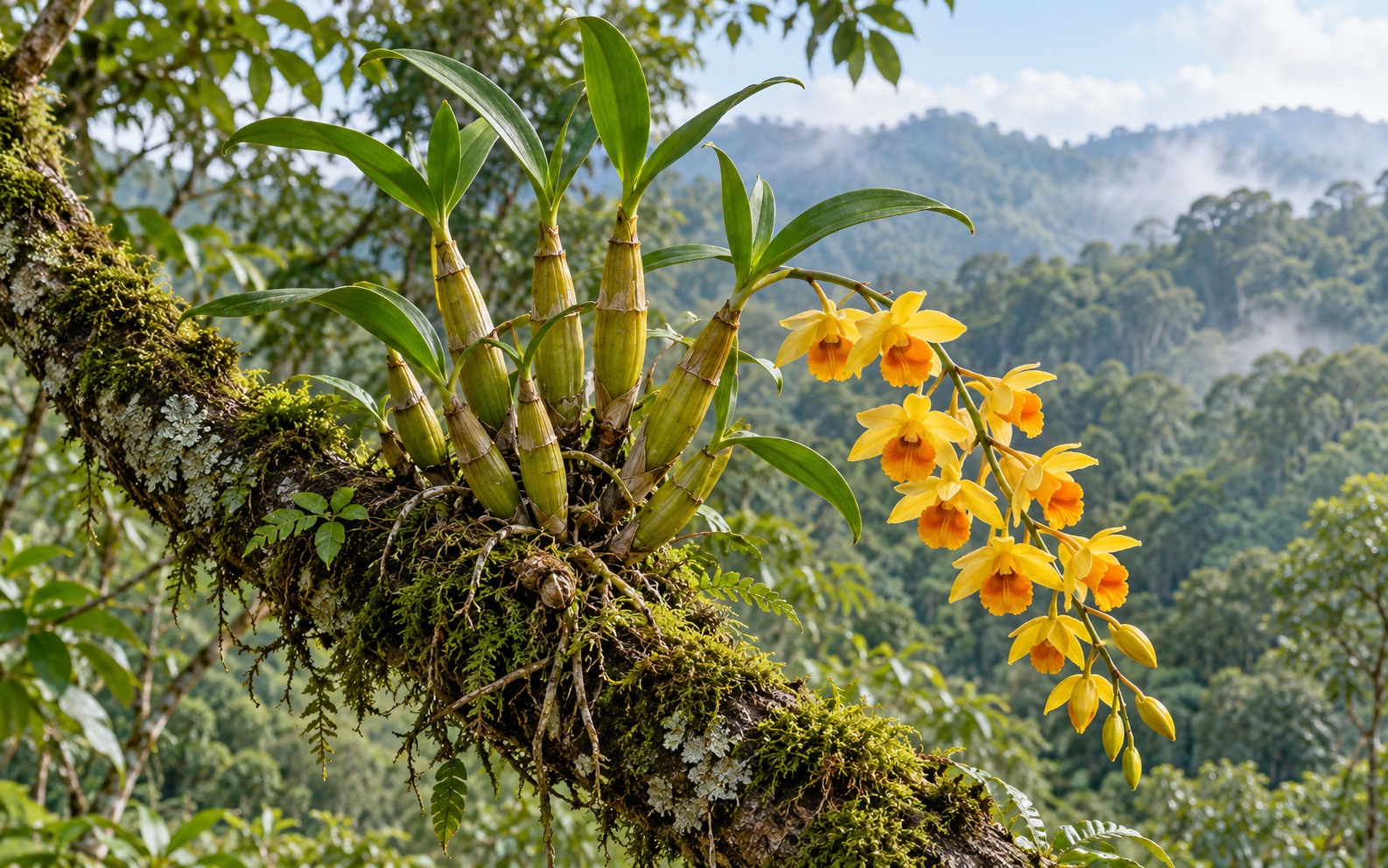
Kew gives its native range as Arunachal Pradesh to Yunnan and Indo-China, with records for Assam, Bangladesh, Cambodia, south-central China, the eastern Himalaya, Laos, Myanmar, Thailand, and Vietnam. Kew describes a pseudobulbous epiphyte of primarily wet tropical biomes. It grows attached to branches or a suitable mount rather than rooted like an ordinary garden plant. Mature clumps carry upright, swollen canes and narrow leaves near the upper nodes. Pendant racemes bear yellow flowers with a deeper orange-yellow lip. The RHS profile describes plants around 30 cm tall, with two to three leaves per cane and pendent clusters that may carry several fragrant yellow flowers. Actual size varies with age, climate, and cultivation.
General plant morphology; not species authentication
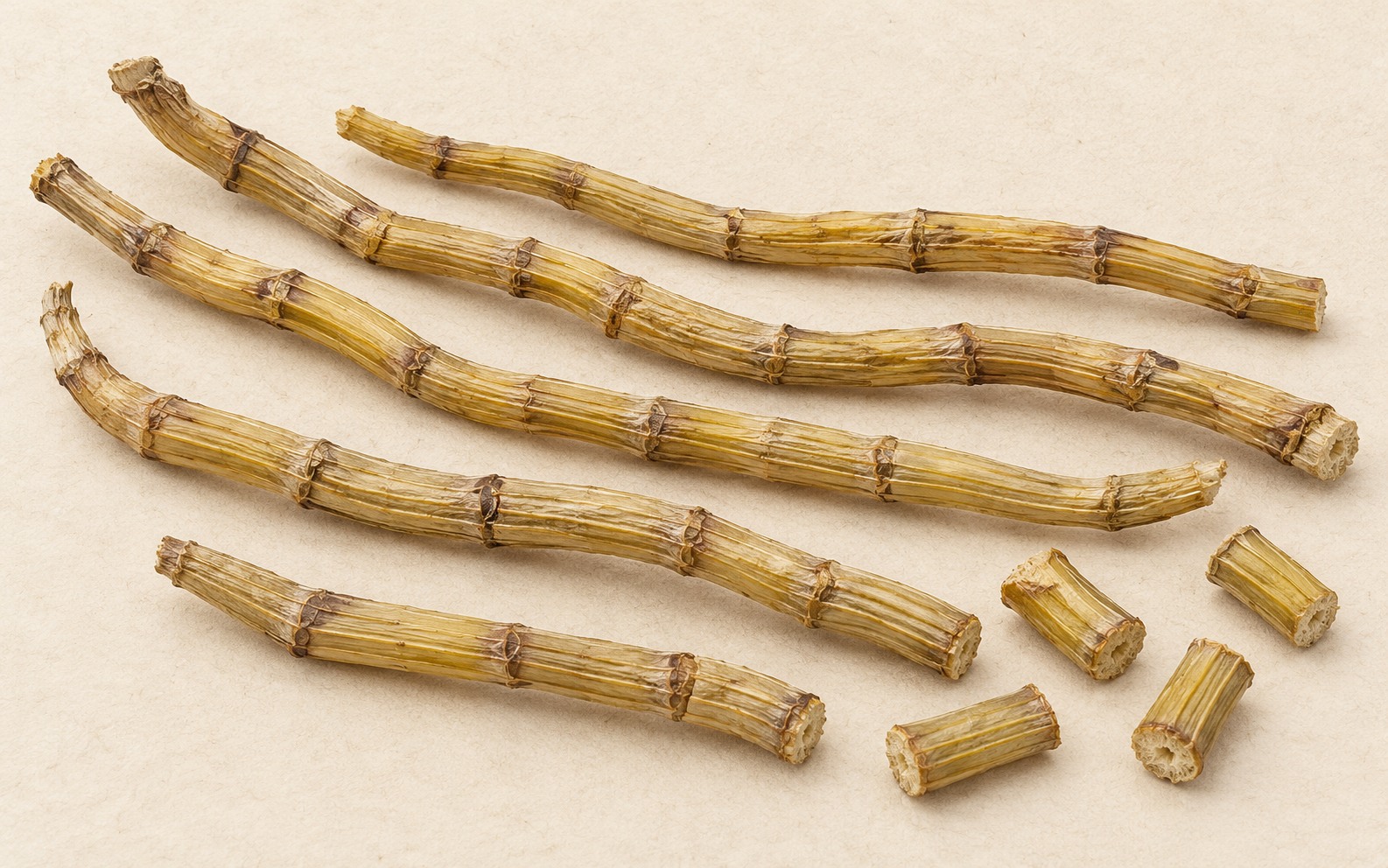
Living form and dried materia medica need to be studied separately. The Dendrobium chrysotoxum-specific description in the 2020 Chinese Pharmacopoeia text presented by ShennongAlpha describes a thick, spindle-shaped stem, roughly 1–3 cm in middle diameter, with about 3–7 nodes. The surface is smooth and golden, with distinct raised longitudinal ribs. Dried stems are light and brittle, with a spongy fracture and a sticky quality when chewed. These cues distinguish the monograph’s described material from some other Dendrobium stems, but visual inspection cannot prove species identity once material is cut or powdered.
General plant morphology; not species authentication
Under the Dendrobium Stem monograph, cultivated D. chrysotoxum is one of the botanical sources of fresh or dried stems; the same monograph also names D. nobile, D. huoshanense, D. fimbriatum, and similar species. This multi-species standard explains why a product labeled Shihu is not automatically one species. Kew’s Medicinal Plant Names Services also links the Shihu drug name to more than one scientific name and stem form. A good study record therefore keeps species, plant part, fresh or dried state, cultivation origin, and lot documentation distinct.
General plant morphology; not species authentication
A CITES Plants Committee document describes D. chrysotoxum raw material for research and extraction and discusses trade in dried plants and derivatives. The CITES dataset used for this atlas contains one reported commercial row in 2016: trade term medicine, purpose commercial, China reported as exporter, Japan as importer, Appendix II, source A; the exporter reported 10 kg. This is a reporting-party quantity in one comparative row, not total market volume, does not establish a matching import amount, and is not evidence of therapeutic efficacy. Source code A denotes artificially propagated specimens in CITES reporting; it does not replace checking permits for a particular transaction.
General plant morphology; not species authentication
The two images are separate AI study illustrations of the living orchid and dried stems. They are not authenticated vouchers or inspected trade lots. Flower color, flower count, stem proportions, and other details may differ. Use the images to visualize plant parts, not to wild-harvest, trade, identify, or quality-test real material.
Traditional context
Illustration of the dried stem form in the monograph
In the 2020 Dendrobium Stem (Shihu) monograph, cultivated D. chrysotoxum is one of the listed source species. The monograph records a sweet flavor, a slightly cold property, and stomach and kidney meridian associations; its traditional actions are described as nourishing the stomach and fluids, nourishing yin, and clearing heat. These are terms in a traditional medical framework, not established biological mechanisms.
Illustration of the dried stem form in the monograph
The monograph lists traditional indications using concepts such as fluid injury in heat illness, dry mouth and thirst, insufficient stomach yin, poor appetite and dry retching, lingering deficiency heat after illness, yin-deficiency fire, consumptive heat, dim vision, and weak sinews or bones. Historical pattern language cannot be converted directly into modern diagnoses. This page reports the scope of a multi-source materia-medica monograph; it does not claim that every product labeled Shihu contains this species or that it treats a condition in a person.
Illustrated epiphyte and habitat
The source distinguishes fresh from dried stems and gives separate identification and quality checks. The traditional materia medica discussed here is therefore standardized Dendrobium stem, not the yellow flowers or any arbitrary part of the plant. Reading the historical use alongside the botanical identity helps avoid transferring a drug name’s traditional functions to every species in the genus.
Modern evidence
Illustration of the dried stem form in the monograph
Evidence for identity is comparatively clear: Kew accepts D. chrysotoxum and reports its range; the Shihu monograph presented by Westlake University’s ShennongAlpha names the species among botanical sources of medicinal stems. Kew MPNS maps the drug name Shihu to multiple species and stem materials. These sources support name and material identification, not clinical efficacy.
Illustration of the dried stem form in the monograph
A 2021 Horticulture Research genomics study examines the genome and evolutionary relationships of the species and discusses its medicinal-material context and plant constituents. Phytochemical work, cell or animal activity, and genomic analysis do not establish that a dried stem treats a human disease. The CITES report concerns trade and orchid management, not medical outcomes.
Illustration of the dried stem form in the monograph
This page therefore keeps three layers separate: botanical name and range; traditional materia-medica standard; and human clinical evidence. The first two have identification and standard references. The sources reviewed here do not provide clinical evidence sufficient to recommend treatment or claim a specific therapeutic outcome.
Safety
Illustration of the dried stem form in the monograph
The sources reviewed did not provide reliable clinical interaction records for D. chrysotoxum stems with individual prescription drugs or specific herb pairs. “Safe” cannot be inferred from a pharmacopoeial listing or a CITES record. A pharmacopoeial standard concerns cultivated, identified, quality-controlled material within its scope; retail products may differ in species, plant part, processing, or concentration.
Illustration of the dried stem form in the monograph
Anyone taking medicines, pregnant or nursing, living with a chronic condition, or preparing for surgery should consult a clinician or pharmacist before using a product. Do not replace prescribed treatment with herbs. Do not collect wild orchids or buy material without provenance; identifying cut stems is harder than identifying a flowering plant, and the Shihu drug name covers multiple species.
Illustration of the dried stem form in the monograph
No specific pair was verified as becoming toxic when combined with this exact species. That statement describes a limit in the sources reviewed; it is not a safety guarantee for every person, extract, or co-administered medicine.
Kew records a native range from Arunachal Pradesh to Yunnan and Indo-China, including Assam, Bangladesh, Cambodia, south-central China, the eastern Himalaya, Laos, Myanmar, Thailand, and Vietnam. It is an epiphytic orchid of wet tropical biomes, attaching to trees or mounts rather than growing buried in garden soil. RHS grows it under glass, with bright indirect light, higher humidity, and freely drained media. Suitability will vary by local conditions.
Living plant for cultivation context
Illustrated epiphyte and habitatChoose nursery-propagated stock with a scientific label and provenance; avoid wild-collected plants. CITES controls international trade in listed Appendix-II orchids.
Illustrated epiphyte and habitatGrow in a modest pot or mount on cork/wood where humidity can be maintained. Use airy epiphytic media such as medium bark with grit and clean moss/coir; oversized pots and compact media hold excess moisture around roots.
Illustrated epiphyte and habitatProvide bright indirect light, airflow, and higher humidity. RHS advises watering through spring and summer, then moving the plant to a brighter, cooler position and reducing water and feed in autumn and winter until new growth starts.
Illustrated epiphyte and habitatAvoid prolonged waterlogging around the base and roots; adjust watering to local temperature, airflow, and media drying. There is no universal daily schedule for every climate.
Illustrated epiphyte and habitatOlder canes may produce keikis; RHS advises separating them only after new roots reach at least 2 cm. Seed propagation requires controlled laboratory conditions; divide mature plants only when they outgrow the pot.
Living plant for cultivation context
How long until harvest? RHS lists around 5–10 years to maturity as a cultivated plant, not as a medicinal harvest age. The monograph allows cultivated stems to be collected year-round within its standard; it does not establish a universal age for home medicinal harvest.
From plant to dried material · source-recorded workflow
Illustrated epiphyte and habitatRecord only stem lots with species, plant part, cultivation origin, and harvest documentation; do not take wild plants or use AI images to authenticate material.
Dried materia medica; not a processing tutorialThe Dendrobium Stem monograph includes cultivated D. chrysotoxum stems; described material is thick and spindle-shaped, golden, with 3–7 nodes and raised longitudinal ribs. These are monograph descriptors, not a substitute for testing.
Dried materia medica; not a processing tutorialThe monograph’s general dried-stem workflow removes impurities, briefly scalds or gently softens stems, rubs while drying to remove leaf sheaths, then dries. This is for appropriate processing facilities.
Dried materia medica; not a processing tutorialRecord fresh/dried state, date, cultivation site, lot, and quality standard; do not convert source processing notes into home-preparation or dosing instructions.
Dried materia medica; not a processing tutorial
This record supports study and processing traceability; it is not a home preparation or self-use guide.