Dendrobium fimbriatum Hook. · Fresh or dried pseudostem; the materia-medica entry is Dendrobium stem (Shihu)
Materia medica properties in reference
Materia medica form discussed in this paragraph
Properties as recorded in the source: Properties in the Shihu entry transcribed from the 2015 Chinese Pharmacopoeia: slightly cold, sweet, entering the Stomach and Kidney channels. Traditional actions recorded for the Shihu materia medica are to benefit the stomach, generate fluids, nourish yin, and clear heat. The monograph includes Dendrobium fimbriatum alongside D. nobile, D. chrysotoxum, and related species as sources of fresh or dried stems; these are pooled materia-medica properties, not species-specific clinical findings for every D. fimbriatum specimen.
No sourced formula was verified that specifies Dendrobium fimbriatum, its material form, and a species-specific ratio. The pooled Shihu monograph cannot be converted into an exact-species formula or dose.
CITES international-trade evidence
Materia medica form discussed in this paragraph
The 2026.1 CITES Trade Database contains 12 comparative-tabulation rows for Dendrobium fimbriatum during 2018, 2019, 2020, 2022, 2023, 2024. The query selected reported purpose T (Commercial) and trade term MED (medicine); appendices appearing in these rows: II. Reported importer codes include AU, CA, GB, HK, SG, US; exporter codes include CN, HK. These are comparative-tabulation rows, not shipment counts or summed volume. This record does not establish clinical efficacy, the legality of an individual transaction, or safety of use.
Living-plant identification features · AI illustration
Living-plant features for identification study
Kew accepts Dendrobium fimbriatum Hook. in the orchid family (Orchidaceae), a pseudobulbous epiphyte or lithophyte native from the Himalaya to southern China and Indochina. “Fringe-lipped dendrobium” is the common English name; Shihu / Dendrobium stem is the Chinese materia-medica name.
Traditional context
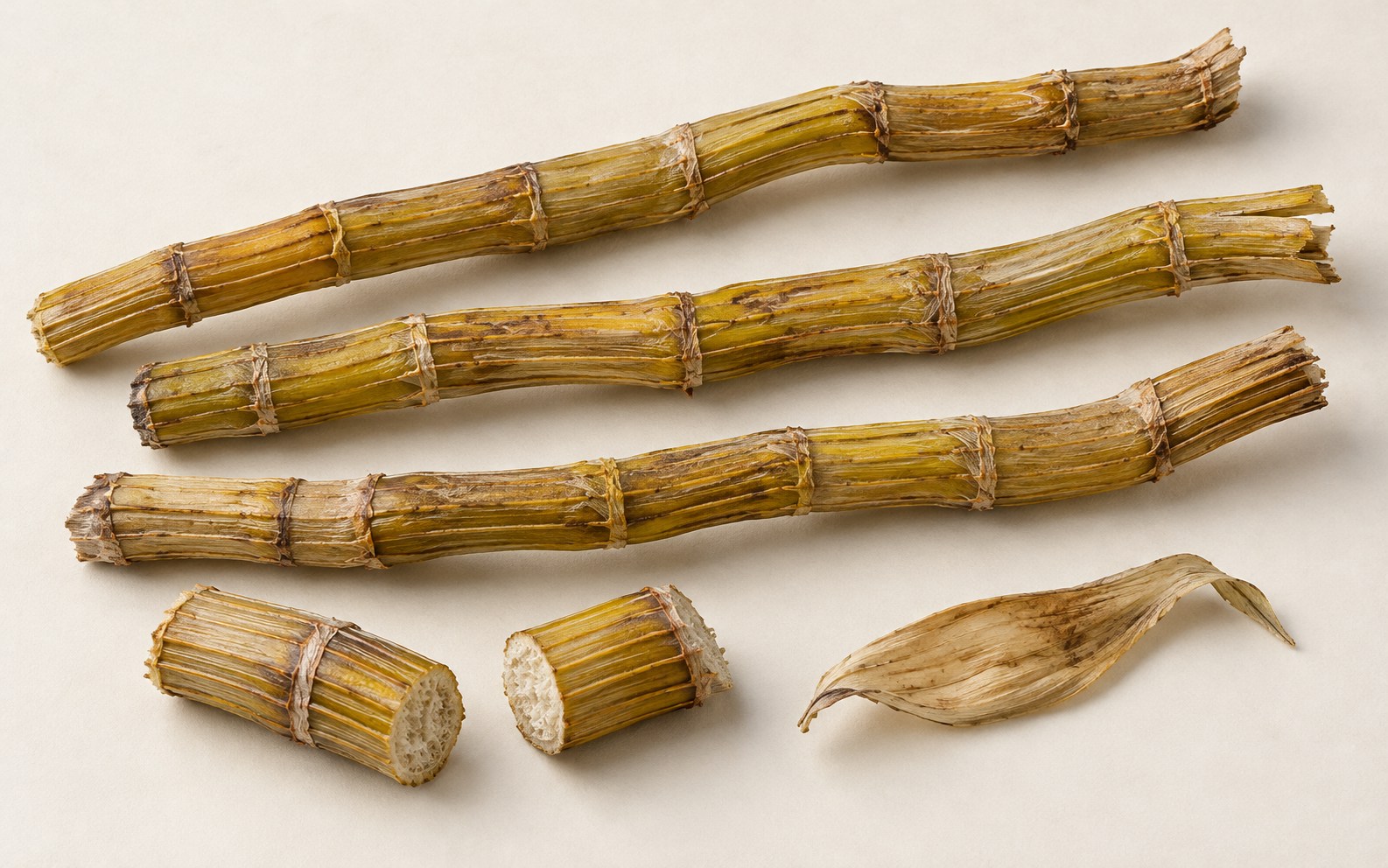
Dried stem form in the pooled Shihu monograph · AI illustration
Materia medica form discussed in this paragraph
The 2015 Chinese Pharmacopoeia entry reproduced by Westlake ShennongAlpha defines Shihu as fresh or dried stems from cultivated Dendrobium sources, explicitly including D. fimbriatum. It records the pooled materia medica as slightly cold and sweet, entering the Stomach and Kidney channels, with traditional actions of benefiting the stomach, generating fluids, nourishing yin, and clearing heat. These are traditional-system descriptions, not conclusions from clinical trials.
Materia medica form discussed in this paragraph
The medicinal-plant database of Kumamoto University’s School of Pharmacy identifies D. fimbriatum var. oculatum, gives the stem as the medicinal part and Shihu as the drug name, and summarizes reported traditional uses such as clearing heat, anti-inflammatory use, tonic use, and support for digestion. The university cautions that effects reported in references are not necessarily scientifically established. Keep that source’s variety and context explicit; do not transfer every historical use to an unidentified species or product.
Modern evidence
Illustrates the subject, not a chart or treatment evidence
Materia medica form discussed in this paragraph
A pharmacopoeia entry provides identity and quality specifications; it does not establish that every commercial product treats a disease or that each species source has the same clinical effects. Kumamoto University lists fimbriatone, confusarin, and rhein in its record for var. oculatum. Finding a compound in a sample does not establish a stable amount across growing regions or prove that the stem treats inflammation, fever, sexual dysfunction, or digestive disease in people.
Materia medica form discussed in this paragraph
Kumamoto presents this as composition and traditional-use information from references; its page does not present clinical trials establishing efficacy. The reviewed evidence does not establish a human dose-response, clinical benefit, equivalence between fresh and dried stems, or equivalence between extracts and raw material. Findings for the Dendrobium genus generally cannot automatically be assigned to D. fimbriatum.
Materia medica form discussed in this paragraph
Trade records are separated into the CITES section below so a reported transaction is not mistaken for medical evidence.
Safety
Image does not depict toxicity or interactions
Materia medica form discussed in this paragraph
The references reviewed do not provide a complete clinical toxicology assessment, drug-interaction profile, contraindication list, or species-specific safety threshold for D. fimbriatum. Do not assume the plant is harmless because it appears in a pharmacopoeial materia-medica entry, and do not label a particular herb pair “toxic” without a source documenting that combination. Do not collect wild orchids or use an unidentified ornamental plant as medicine; products sold as Shihu can include multiple species and vary in quality.
Materia medica form discussed in this paragraph
People who are pregnant or breastfeeding, children, people with chronic conditions, and anyone taking medicines should ask a qualified clinician or pharmacist before considering a Shihu product. This is a precaution based on missing interaction data and product variation, not a claim that a specific interaction has been demonstrated. A trade name, AI image, CITES code, or traditional description cannot replace authentication and testing for identity, constituents, contaminants, and residues.
No pairing image because no exact-species formula was verified
Materia medica form discussed in this paragraph
No formula was verified that names Dendrobium fimbriatum itself, its stem part and preparation, and a specific combination ratio. The Shihu monograph is pooled across several Dendrobium sources, so it cannot by itself identify a formula using this exact species. The profile therefore does not attach unrelated herb photographs to an invented pairing, recommend a beneficial ratio, or turn a recorded amount into personal advice.
Materia medica form discussed in this paragraph
The pooled monograph excerpt records 6–12 g for dried material or 15–30 g for fresh material, added late in decoction. These amounts belong to the multi-species Shihu entry; they are not a self-use dose for D. fimbriatum. Treat them only as an example of how the source records an amount, not as directions to ingest it. No reviewed source confirms a specific herb pairing that is toxic with this species; lack of a report does not mean every combination is safe.
Identification and study notes
Morphology study; not a substitute for expert identification
Living-plant features for identification study
Key features in the flowering illustration are a low clump, one bright yellow flower with many narrow radiating petals, and leaves divided into very fine, feathery segments. The Royal College of Physicians describes a mound of fine foliage and buttercup-like spring flowers; Kew records a temperate perennial. Colors and details in AI artwork follow those descriptions but do not represent all natural variation. When dried
Living-plant features for identification study
, flowers fade and stems/leaves collapse, reducing diagnostic features; a dried bundle cannot be securely identified by sight alone. An older CITES proposal notes that several perennial Adonis species look similar and may be confused in traded material. Do not forage this toxic plant for identification practice.
Growth and habitat
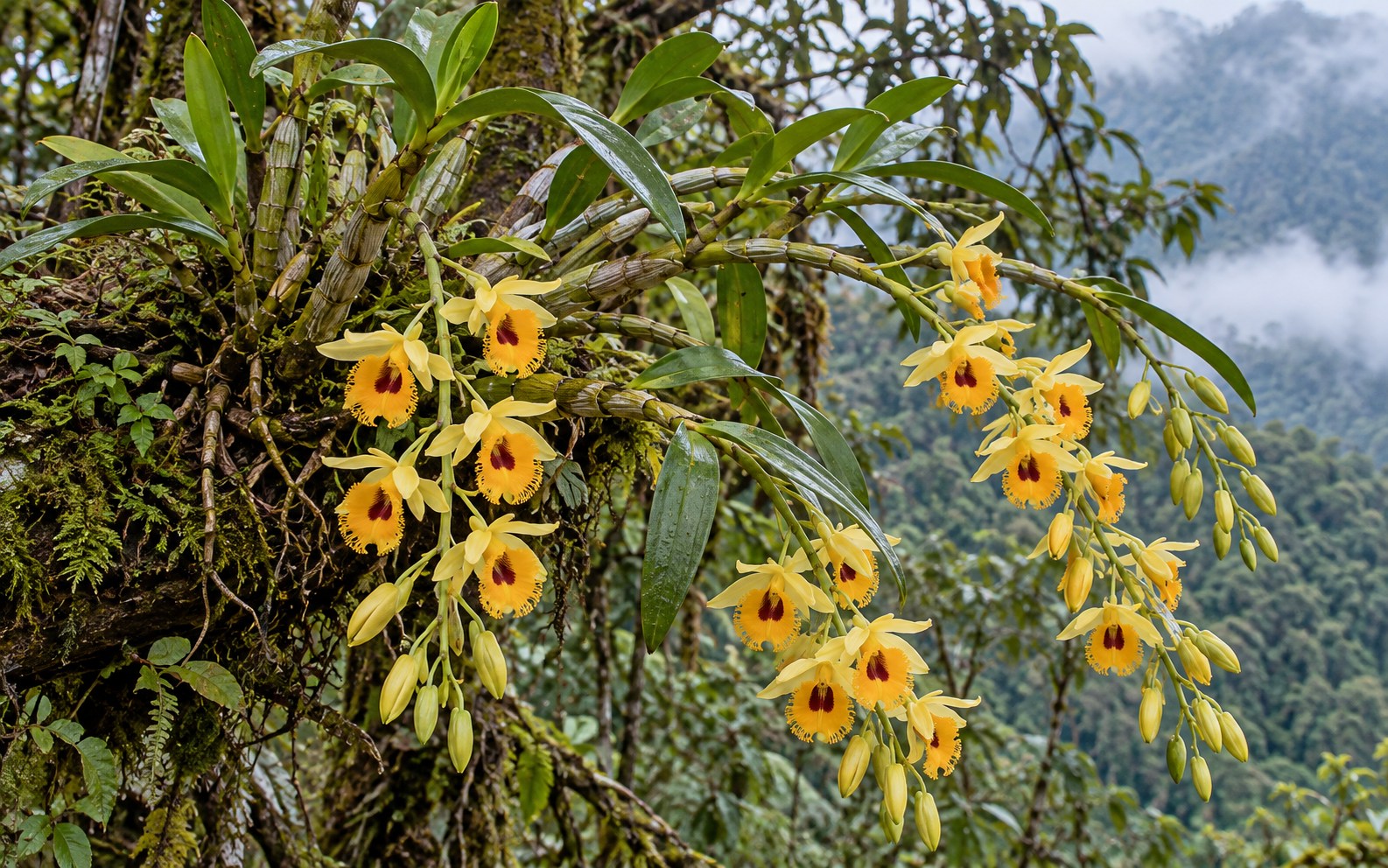
Illustrated epiphytic habit · AI
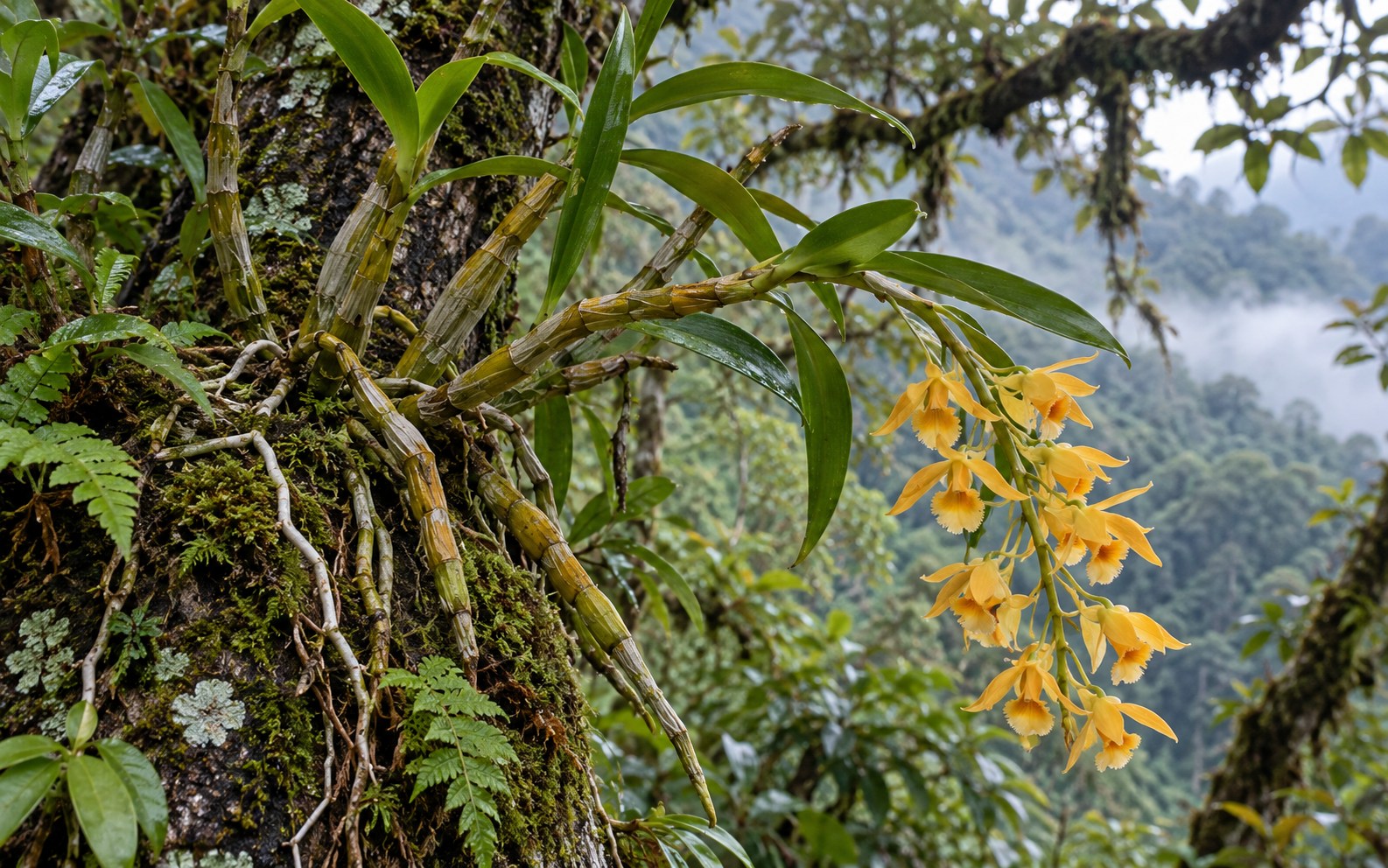
Illustrated epiphytic habit · AI
Kew gives the native range as the Himalaya to southern China and Indochina, including Assam, Bangladesh, south-central and southeast China, the eastern Himalaya, India, Laos, Myanmar, Nepal, Thailand, Vietnam, and the western Himalaya. It is a pseudobulbous epiphyte or lithophyte in subtropical biomes. This distribution is not permission to harvest wild plants.
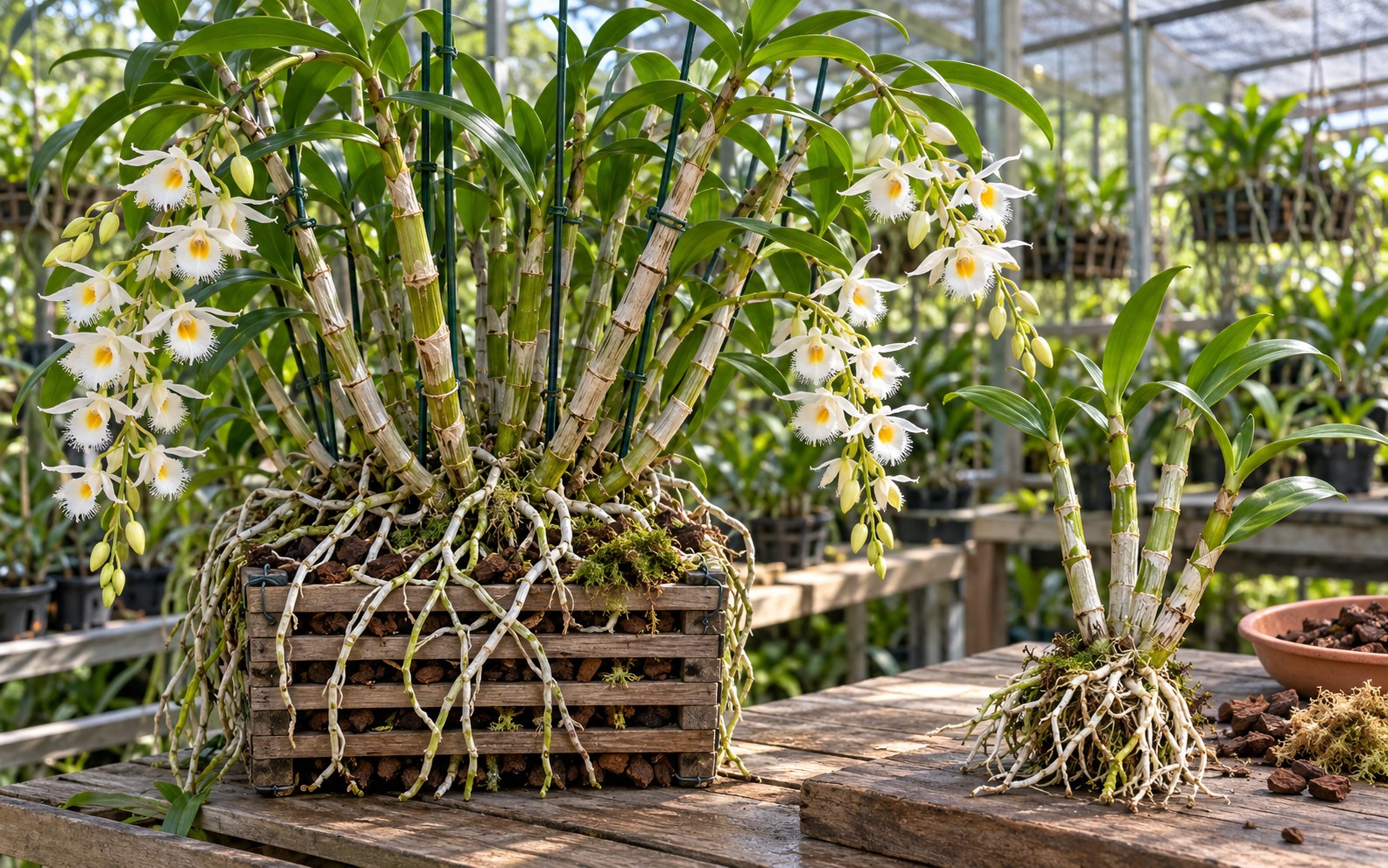
Ornamental basket culture · not a medicinal-crop protocol
Illustrated epiphytic habit · AIObtain a nursery-propagated plant labeled Dendrobium fimbriatum from a lawful source and retain the label and receipt. CITES lists Dendrobium in Appendix II; check current documents before cross-border movement.
Illustrated epiphytic habit · AIUse an airy orchid basket with medium-grade bark; a little horticultural grit, sustainably sourced moss, or coir may be adjusted to local humidity. Do not bury the roots in garden soil; this is an epiphytic/lithophytic orchid.
Ornamental basket culture · not a medicinal-crop protocolPlace it in bright filtered light, avoiding harsh midday sun; provide airflow and shelter from drying winds and prolonged driving rain. RHS lists full sun to partial shade, while its cultivation notes advise bright light with midday sun avoided.
Illustrated epiphytic habit · AIKeep roots moderately moist during active growth but ensure rapid drainage; water thoroughly and let the medium dry slightly before watering again. Avoid standing water in the basket or between cane sheaths. Observe roots and drying rate rather than following a rigid calendar.
Illustrated epiphytic habit · AIRHS describes average temperatures of 12–25°C for this orchid, higher humidity in spring and summer, and reduced watering and feeding in autumn as growth slows. Local conditions vary; increase airflow in humid weather to reduce fungal and rot problems.
Illustrated epiphytic habit · AIAvoid frequent repotting; roots slightly restricted in a basket are usually preferred. Replace the medium when bark breaks down or as new roots begin to grow; support long canes with soft ties to prevent breakage.
Illustrated epiphytic habit · AIPropagate vegetatively by dividing a mature clump when it outgrows its basket; retain several healthy canes per division to limit setback. RHS says to remove a keiki from an old cane only after its new roots reach about 2 cm. Seed propagation requires controlled laboratory conditions.
Illustrated epiphytic habit · AIWatch for scale, aphids, mealybugs, and red spider mites; isolate new plants and inspect leaf undersides and cane bases. Do not cut an older cane merely because it has lost leaves; RHS advises removing canes only when fully shrivelled or damaged.
Ornamental basket culture · not a medicinal-crop protocol
How long until harvest? RHS lists 5–10 years to horticultural maturity; this is not a medicinal harvest age. Commercial Shihu requires authenticated species and cultivation, lawful documentation, and controlled processing/testing. Do not harvest an ornamental plant for ingestion.
Ornamental basket culture · not a medicinal-crop protocol
Ornamental basket culture · not a medicinal-crop protocol
The pharmacopoeia text reproduced by Westlake describes Shihu stems from cultivated plants and collection throughout the year; it does not give a sowing calendar, monthly care plan, or species-specific harvest age for D. fimbriatum. RHS places the plant in conservatory/greenhouse culture with a free-draining bark medium; its 5–10-year figure is horticultural maturity. Do not turn an ornamental schedule into a medicinal-crop protocol.
From plant to dried material · source-recorded workflow
Illustrated epiphytic habit · AIVerify the cultivated-plant record, species label, and lawful propagation source; do not collect wild orchids. Shihu is a multi-species materia-medica name, so keep lots separate by authenticated species.
Dried materia medica after processingThe monograph says to remove roots and soil from fresh stems and foreign matter from dried material. Observe the jointed cane, longitudinal grooves, and sheaths, but do not use AI art to authenticate a real specimen.
Dried materia medica form of this speciesFor dried material, the monograph describes briefly scalding with boiling water or gently softening with heat, then rubbing while soft to remove leaf sheaths. This is a recorded standardized process, not a home recipe for ingestion.
Illustration of the processing step describedDry completely; the monograph describes washed and cut dried sections. A qualified producer must test identity, moisture, foreign matter, and the applicable pharmacopoeial quality specifications.
Illustration of the processing step describedRecord species, cultivated source, lot code, processing date, and storage conditions; keep dried material ventilated and dry, protected from moisture. Only a qualified facility should place it in a medicinal supply chain.
Illustration of the processing step described
This record supports study and processing traceability; it is not a home preparation or self-use guide.