Eucommia bark · Du Zhong
Eucommia ulmoides Oliv. · Stem bark
Name and part used
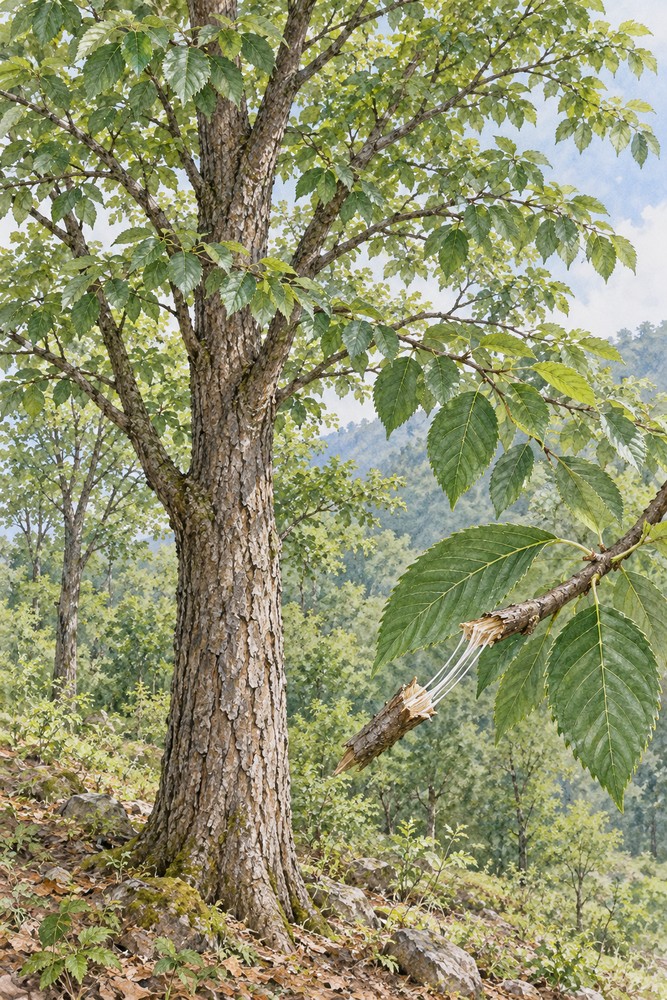
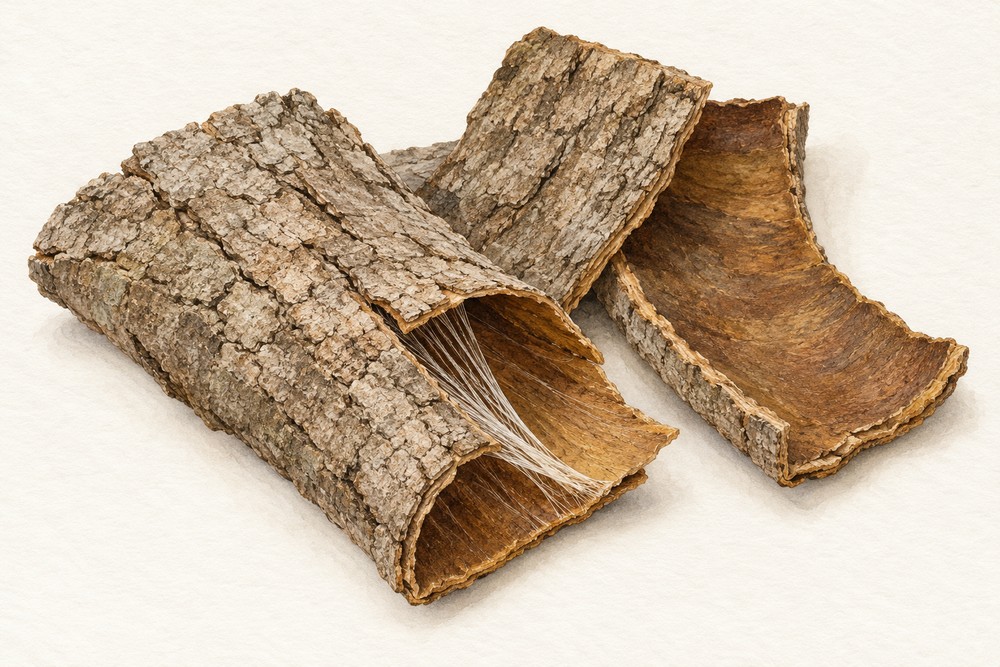
A deciduous tree with serrated oval leaves; snapped bark shows distinctive stretchy white gutta-percha threads.
Traditional context
Du Zhong is bark of Eucommia ulmoides. HKBU describes a tree up to 20 m, alternate leaves, and gray-brown bark. The database also flags conservation concern; use traceable cultivated sources and never girdle a tree.
Modern evidence
Liver-kidney tonic and sinew-bone strengthening are traditional claims. Chemical or animal studies are not proof of treatment for pain, hypertension, or pregnancy conditions.
Safety
Some references note toxicity and physiological effects. Do not self-use during pregnancy, cardiovascular or chronic illness, or prescription treatment; professional assessment is needed.
Pairing in reference texts
Du Zhong appears in some liver-kidney formulas, at times with Achyranthes. This is historical comparison, not a safety or pain-relief recommendation.
Growing, care, and harvest timing
HKBU habitat record: Growing in ravines and forests. Distributed in Gansu, Shaanxi, Henan, Hubei, Hunan, Guangxi, Guizhou and Sichuan. The medicinal materials are mainly produced in Guizhou, Shaanxi, Hubei, Sichuan, Henan and etc; Zunyi and Bijie of Guizhou, Xixiang and Ningqiang of Shaanxi are the genuine producing areas Harvest and processing as recorded: Bark: stripped bark in half-girdling after 10-20 years of planting. Immersed in boiled water, then make it double over the inner side, compressed slightly, encased by straw for sweating, the endothelium turn to slight puce after one week, taken out, sundried, scraped tertia, well trimmed and stored up. Young leaves: harvested in spring when young leaves just sprout out, used fresh or sundried. Leaves: harvested in late autumn, removed impurities, washed, and sun-dried
Source-recorded harvest/processing: Bark: stripped bark in half-girdling after 10-20 years of planting. Immersed in boiled water, then make it double over the inner side, compressed slightly, encased by straw for sweating, the endothelium turn to slight puce after one week, taken out, sundried, scraped tertia, well trimmed and stored up. Young leaves: harvested in spring when young leaves just sprout out, used fresh or sundried. Leaves: harvested in late autumn, removed impurities, washed, and sun-dried
The reviewed source does not provide a complete species-specific sowing/growing routine, irrigation/fertilization schedule, or universal plant age. The page therefore does not infer care instructions or years to harvest; consult local cultivation guidance.
Open habitat and season source ↗FROM PLANT / SOURCE HABITAT TO DRIED MATERIAL · REFERENCE WORKFLOW
- HKBU describes bark collected from mature cultivated trees. Use traceable lots only; never strip wild trees or girdle the trunk, which can kill the tree.
- Harvest only permitted stems or branches under sustainable forestry methods; remove foreign matter and authenticate identity.
- Professional processing may involve controlled heating, pressing, and conditioning before drying. Do not attempt this on self-collected bark.
- Dry and grade at a qualified facility; lot records should document species, cultivated source, sustainable harvest, and test results.
These are post-harvest study notes, not directions to prepare a remedy for self-treatment. Processing reference ↗
How to read formula amounts
The cited sources do not provide a formula with specific amounts for this profile; no ratio is invented. Absence from the incompatibility list does not establish safety.
Habitat, season, and harvest in the HKBU botanical record
HKBU botanical record (translated summary): Flowering and fruiting dates: Flowering: April; fruiting: October Habitat and distribution: Growing in ravines and forests. Distributed in Gansu, Shaanxi, Henan, Hubei, Hunan, Guangxi, Guizhou and Sichuan. The medicinal materials are mainly produced in Guizhou, Shaanxi, Hubei, Sichuan, Henan and etc; Zunyi and Bijie of Guizhou, Xixiang and Ningqiang of Shaanxi are the genuine producing areas Harvest and processing as recorded: Bark: stripped bark in half-girdling after 10-20 years of planting. Immersed in boiled water, then make it double over the inner side, compressed slightly, encased by straw for sweating, the endothelium turn to slight puce after one week, taken out, sundried, scraped tertia, well trimmed and stored up. Young leaves: harvested in spring when young leaves just sprout out, used fresh or sundried. Leaves: harvested in late autumn, removed impurities, washed, and sun-dried
Open botanical source ↗