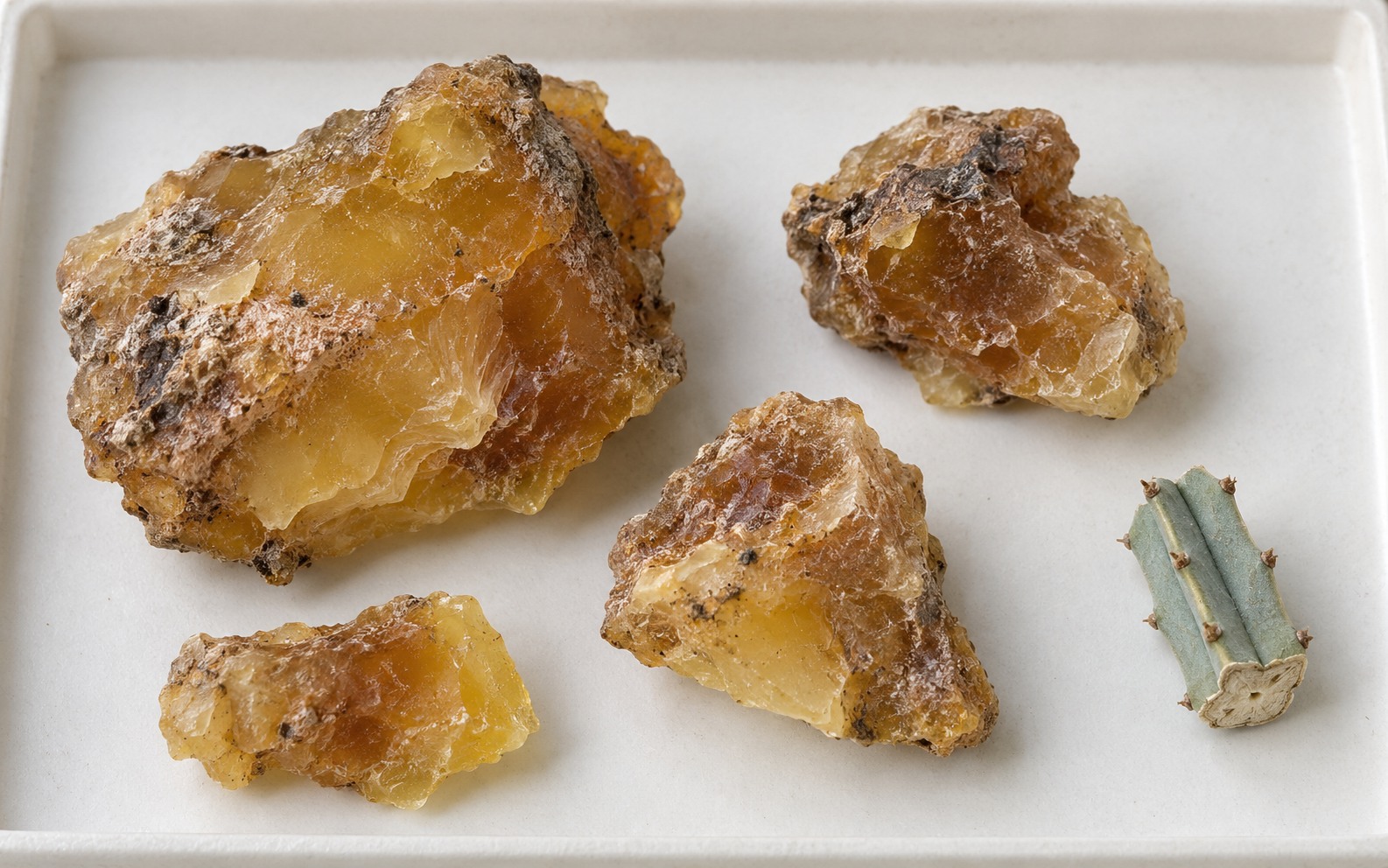
Euphorbia resinifera O.Berg · Dried latex (euphorbium) is recorded in materia-medica references; it is not interchangeable with the whole plant, fresh latex, other spurges, or diluted preparations. The plant releases strongly irritant milky latex. This profile is for identification study and source comparison only, never for collecting or using the sap.
Materia medica properties in reference
Materia medica form discussed in this paragraph
Properties as recorded in the source: No standardized Chinese materia-medica monograph for the exact species Euphorbia resinifera and euphorbium latex was verified. No taste, thermal nature, channels, or therapeutic action is assigned by borrowing from other Euphorbia drugs.
No reliably sourced pairing formula with an applicable ratio and indication was verified; do not self-use.
CITES international-trade evidence
Materia medica form discussed in this paragraph
The 2026.1 CITES Trade Database contains 1 comparative-tabulation rows for Euphorbia resinifera during 2017. The query selected reported purpose T (Commercial) and trade term MED (medicine); appendices appearing in these rows: II. Reported importer codes include CH; exporter codes include DE. These are comparative-tabulation rows, not shipment counts or summed volume. This record does not establish clinical efficacy, the legality of an individual transaction, or safety of use.
Euphorbia resinifera O.Berg is a succulent in the spurge family, Euphorbiaceae. Kew Plants of the World Online accepts this scientific name and records Morocco as its native range; NC State Extension describes it on Atlas Mountain slopes. Common names include resin spurge, African spurge, and Moroccan mound. “Euphorbium” generally refers to dried latex material rather than the whole living plant. Vernacular names vary by place and trade source, so a common-name label alone cannot establish species identity.
Living-plant features for identification study
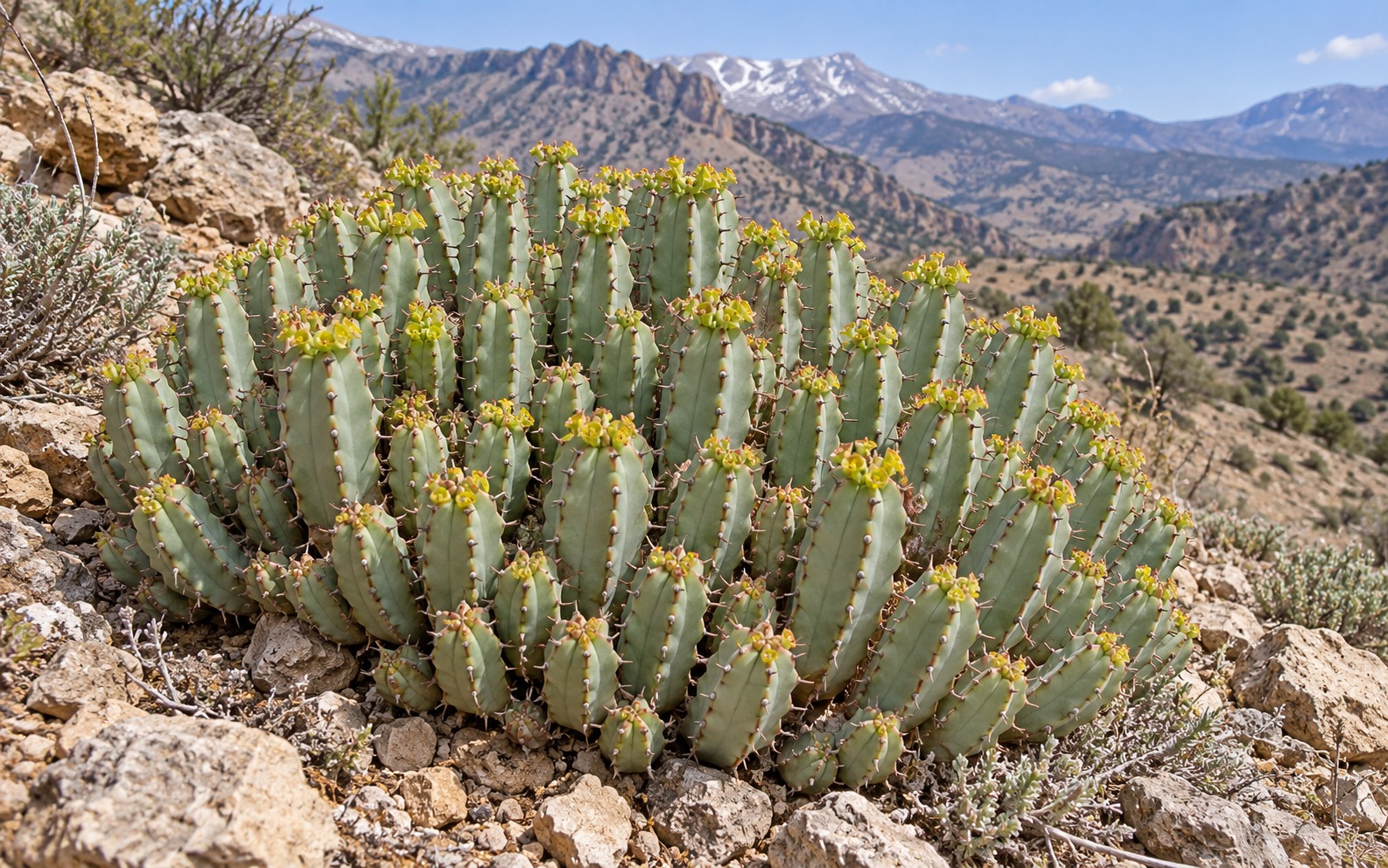
The succulent stems are upright, usually leafless or bearing only small, short-lived leaves, and pale bluish-green to green. Branches form a dense cushion. Stems commonly show four clear longitudinal ribs with short paired sharp spines; small yellow flowers occur along the ribs or near stem tips in spring to early summer. When a stem is damaged, opaque white latex exudes. The plant can be mistaken for a cactus, but the groups differ botanically: Euphorbia spines arise along stem ridges, whereas true cacti bear areoles.
Living-plant features for identification study
The profile images are AI study illustrations informed by botanical descriptions and horticultural references. They show the general mound form, four-ribbed stems, spines, and dried resin-like material. They cannot authenticate a living specimen or a commercial product, establish its purity or provenance, or indicate its toxicity.
Traditional context
Reference material form; does not identify a real sample
Materia medica form discussed in this paragraph
Some European materia-medica references record euphorbium as dried latex from Euphorbia species; a specialist review of commercially used Euphorbia medicinal materials associates E. resinifera with the drug name Euphorbium. Reviews of Moroccan ethnobotany report historical folk use of the plant’s latex, including a tiny topical application for toothache or its use as a drastic purgative. These are records of hazardous historical practices, not recommendations or proof of treatment.
Materia medica form discussed in this paragraph
A CITES reference on medicinally used Euphorbia species identifies euphorbium as dried latex and discusses historical pharmaceutical uses while acknowledging irritant/toxic properties. It also mentions highly diluted homeopathic products; presence in a reference or marketplace does not show efficacy. None of this supports instructions for fresh latex, oral dosing, skin application, or eye use. This profile assigns no Chinese-medicine taste, thermal nature, channels, or therapeutic action because a standardized Chinese materia-medica monograph for this exact species and material form has not been verified.
Modern evidence
One reported CITES row, not a market estimate
Materia medica form discussed in this paragraph
The project’s extract of CITES Trade Database 2026.1 contains exactly one comparative-tabulation row for Euphorbia resinifera during 2016–2025: purpose T (commercial), term MED (medicine), Appendix II, and source code W (wild-sourced). The exporter-reported record lists 0.001 g from Germany to Switzerland in 2017, with Morocco as reported country of origin. This is a tiny quantity in one reported row, not a market-size estimate, shipment count, or proof of medicinal consumption. CITES records a transaction as reported under a query; it does not authenticate the individual permit, product contents, safety, or clinical efficacy.
Materia medica form discussed in this paragraph
Chemical studies and laboratory experiments describe diterpene compounds in the latex and biological activity in research models. Some resiniferatoxin research investigates mechanisms involving pain-sensing receptors; results for purified chemicals or animal models do not establish raw latex as a safe human analgesic. Reviews of this species also note limits in toxicology data and poisonings associated with latex. Chemical activity, cell experiments, and traditional use cannot be translated into treatment claims.
Safety
Avoid contact with the plant and latex
Materia medica form discussed in this paragraph
NC State Extension classifies the whole plant as toxic and warns that its white latex may cause mild to severe dermatitis; eye exposure can cause prolonged or permanent corneal damage. Ingestion may blister the lips and oral mucosa, and toxicology reviews describe serious gastrointestinal irritation. Keep children and pets away, especially from broken stems and dried latex fragments. Do not touch, cut, burn, grind, closely smell, taste, or collect the latex; do not use it in homemade medicines, cosmetics, eye drops, or poultices.
Materia medica form discussed in this paragraph
If latex contacts skin or eyes, follow local poison-control or medical guidance and seek urgent medical care, particularly for eye exposure, severe pain, blurred vision, blistering, or ingestion. Do not attempt to neutralize it with household chemicals. Gloves do not remove the risk of splashes or cross-contamination; gardeners should keep the plant in a controlled location and follow professional safety practices. Do not experiment by combining latex with herbs, food, or prescription medicines.
For the living plant, study the low, dense succulent cushion and branching habit. Blue-green or glaucous stems show four ribs, with short paired spines along the ridges. The plant lacks the broad leafy canopy of many medicinal herbs. Tiny yellow cyathia occur along upper stem portions. An AI illustration may misstate rib count, spine density, flower scale, or color. Do not touch the plant to inspect it; all parts contain toxic latex.
Dried-drug features for identification study
In materia-medica descriptions, euphorbium is dried, coagulated latex, appearing in irregular fragments or masses that range from yellow-brown to amber-brown. Crude material may include stem fragments or contaminants. Color and translucency vary with processing, sample age, and storage, so an image cannot distinguish E. resinifera resin from latex of another Euphorbia or an adulterant. A real lot requires provenance records, suitable testing, and qualified expertise; never taste or burn a sample.
Growth and habitat
Dry rocky habitat informed by sources; AI art
Free-draining succulent; keep away from children and pets
Kew records Morocco as the native range and classifies the plant as a succulent shrub of the subtropical biome; NC State Extension places it on Atlas Mountain slopes. Horticultural sources describe tolerance of full sun to partial shade and sandy or rocky substrates, while stressing well-drained soil. This is a dry, mineral, freely draining setting rather than waterlogged ground. The plant is cultivated ornamentally where climate permits; occurrence outside Morocco may be introduced and does not imply a native population.
NC State describes a slow-growing plant roughly 30–60 cm tall that can spread into a broad, multi-stemmed cushion. Actual size varies with age, climate, and container or ground culture. The AI habitat illustration suggests a dry rocky landscape and general habit only; it does not identify a collection site, elevation, soil from a real lot, or the conservation status of any local population.
Free-draining succulent; keep away from children and pets
Dry rocky habitat informed by sources; AI artBuy legally propagated nursery stock; do not collect plants or cuttings from the wild. Place the container in bright sun to full sun and protect it from prolonged rain and standing water. In humid, hot climates such as Vietnam, use a draining pot and rain shelter; monitor locally because the cited horticultural source does not test monsoon-tropical conditions.
Dry rocky habitat informed by sources; AI artUse a mineral, sandy, or rocky medium that drains freely; NC State notes tolerance of sandy and rocky soils, while prolonged wetness can cause root rot. The source gives no universal substrate ratio, so none is invented here. Choose a stable pot sized for the clump and keep it away from walkways, children, and pets.
Dry rocky habitat informed by sources; AI artWater sparingly, only after the medium has dried substantially; reduce watering in cool weather or dormancy. Do not follow a fixed calendar when humidity and temperature differ from the source’s growing context. Watch for mealybugs, spider mites, and scale. Avoid pruning or taking cuttings at home because wounds release toxic latex. If maintenance is necessary, use an experienced grower with appropriate protective equipment.
Dry rocky habitat informed by sources; AI artNC State lists stem cuttings as a propagation method, but cutting the plant exposes the grower to its toxic latex; this page therefore does not turn it into a do-it-yourself procedure. Do not grow from seed without lawful, authenticated seed stock. The plant grows slowly; light, airflow, and drainage matter more than heavy fertilization or forcing growth.
Free-draining succulent; keep away from children and pets
How long until harvest? No safe medicinal harvest age is provided because this plant is not recommended for home medicinal use. NC State describes slow growth but gives no months-to-maturity figure. Cultivated plants should remain ornamental; do not harvest latex.
Free-draining succulent; keep away from children and pets
From plant to dried material · source-recorded workflow
Dried materia medica form of this speciesCITES reports one comparative-tabulation row under E. resinifera: purpose T, term MED, source W, Appendix II, in 2017. Any specimen requires its own identification and trade documentation; a database row is not a permit or lot record.
Dry rocky habitat informed by sources; AI artA specialist reference calls euphorbium dried latex. The CITES row records 0.001 g exported; it does not establish an ordinary production volume or harvest method.
Dry rocky habitat informed by sources; AI artDo not cut the plant, collect sap, dry it, or grind raw material yourself. These steps can expose skin, eyes, and airways; this page describes source records only and does not provide processing directions.
Dried materia medica form of this speciesLicensed research or trade facilities must segregate lots, verify species and provenance, comply with CITES rules, and use professional hazard assessments and protective procedures. AI images do not authenticate specimens or permits.
Illustration of the processing step described
This record supports study and processing traceability; it is not a home preparation or self-use guide.