Fen Fang Ji · Stephania root · Fang Ji · Fen Fang Ji
Stephania tetrandra S. Moore · Dried root
Name and part used
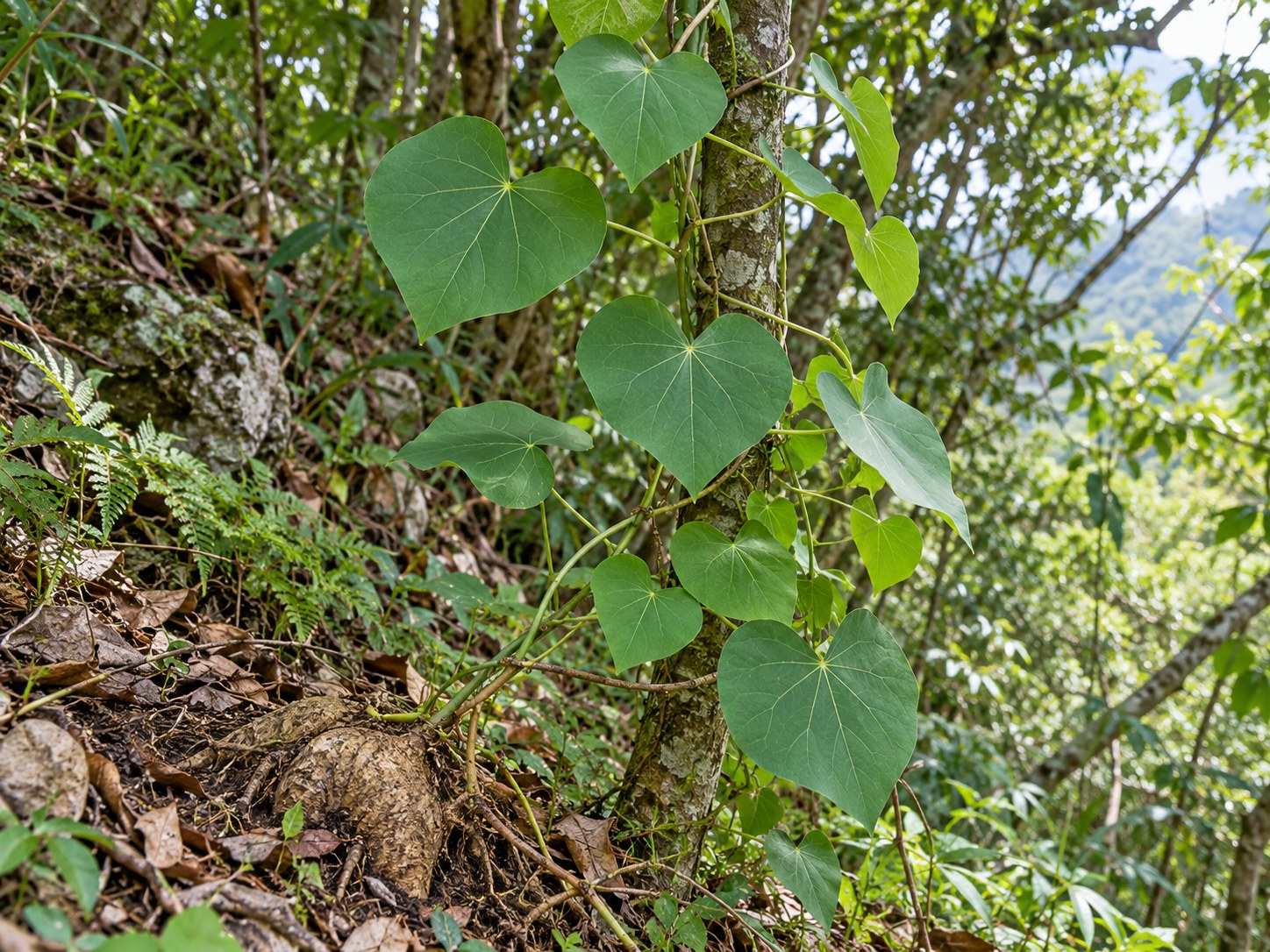
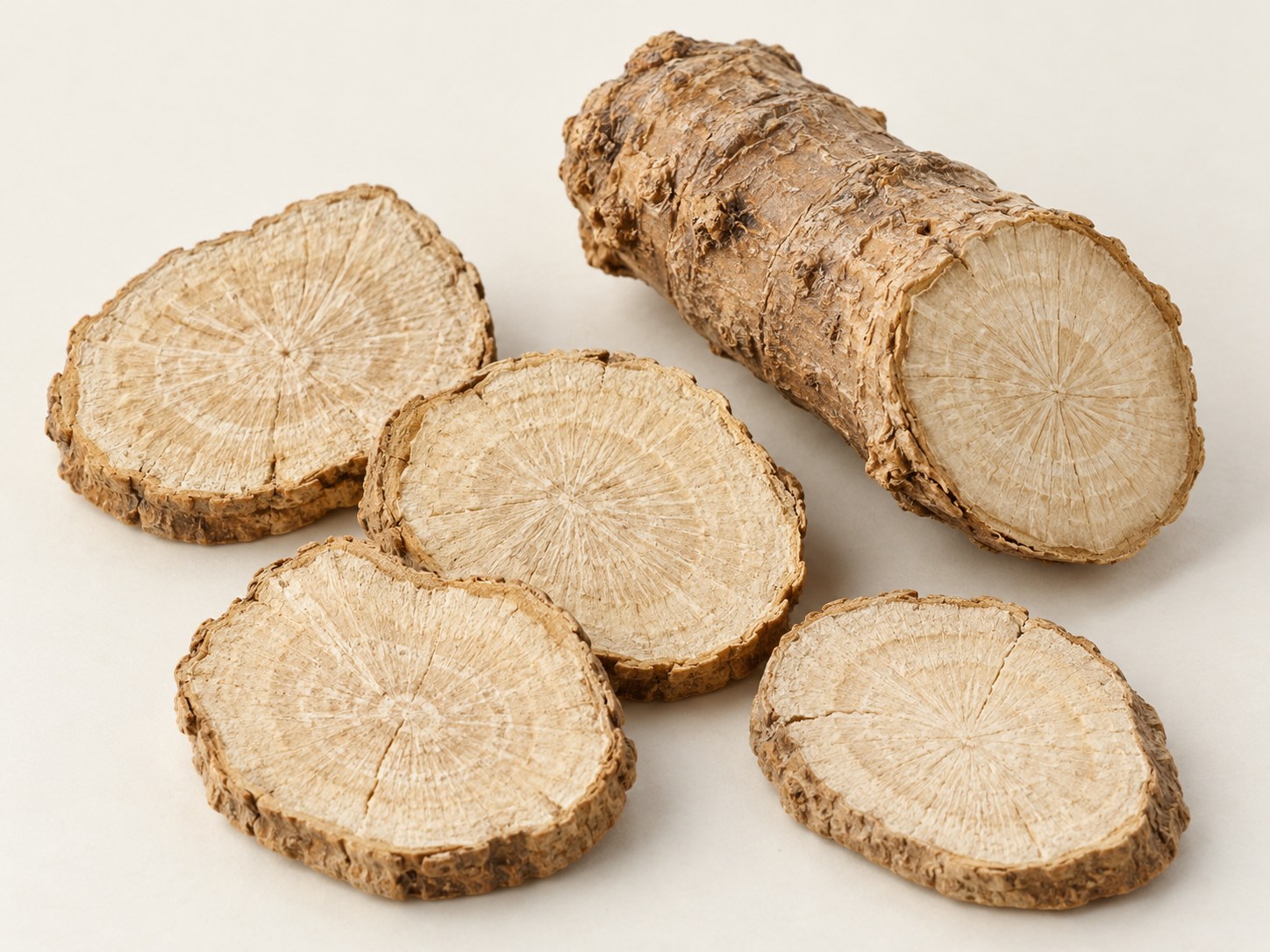
Fen Fang Ji is the root of Stephania tetrandra S. Moore, a herbaceous climbing vine in Menispermaceae. Leaves are alternate, broadly triangular to nearly round, with a heart-shaped basal notch; the petiole attaches within the blade, giving a peltate appearance. Vines may reach several metres, and the main root is fleshy and cylindrical with pale-brown transverse markings. HKBU records a perennial of hillsides, foothills, grassland margins, and shrubland. “Fang Ji” is an ambiguous name: only authenticated Stephania tetrandra should be labelled Fen Fang Ji. It must not be conflated with Guang Fang Ji / Aristolochia fangchi or Aristolochia heterophylla, which may contain nephrotoxic and carcinogenic aristolochic acids. Images are study aids and cannot authenticate a medicinal root.
Traditional context
HKBU and a scientific review describe Fen Fang Ji in traditional categories for wind-dampness and pain; this is historical classification. It does not mean the root self-treats arthritis, edema, urinary difficulty, eczema, or infection. New edema, breathlessness, reduced urine, or persistent pain needs clinical assessment.
Modern evidence
Research on tetrandrine and root extracts largely concerns constituents, preclinical models, or particular preparations; it does not establish that unstandardized root treats disease. A scientific review highlights identity, pharmacokinetics, toxicity, and substitution risks. An in-vitro result cannot substantiate clinical efficacy. Keep the drug name, Latin identity, and plant part explicit.
Safety
The major hazard is name substitution: Aristolochia fangchi / Guang Fang Ji may contain aristolochic acids associated with irreversible kidney injury and urothelial cancer. Never buy unlabeled loose roots, identify by photo, or use material without verified species identity. Even authenticated Stephania tetrandra is not for self-treatment; avoid during pregnancy or breastfeeding and consult a clinician/pharmacist with kidney disease, medications, or active treatment. Suspected Aristolochia exposure warrants prompt medical or poison-centre advice.
Safety reference ↗Pairing in reference texts
Classical sources record Fen Fang Ji with Huang Qi, Gui Zhi, Fu Ling, and Bai Zhu in formulas such as Fang Ji Huang Qi Tang; quantities vary by source and pharmacopoeial version. There is no universal ratio for home mixing, and pairing does not neutralize Aristolochia substitution or medicine-interaction risks. This profile is not a home recipe.
Identification and study notes
A useful recognition cue is the broad nearly round leaf with an interior, shield-like petiole attachment on a slender vine; the drug root is stout and cylindrical with a pale cut surface. A root photograph cannot reliably distinguish sliced Stephania tetrandra from Aristolochia. “Fang Ji” on a label is insufficient: require Latin identity and traceable testing. Aristolochia substitution has been linked to kidney disease, including in slimming products; learn this hazard before memorizing traditional actions. Sliced roots lose many botanical characters, making photo comparison of the finished drug especially weak. Learners should connect three forms of evidence: an authenticated mother plant, traceable harvest documentation, and analytical standards for the lot. Ask specifically for “Fen Fang Ji, Stephania tetrandra,” rather than just “Fang Ji”; a small difference in the label can indicate a different source species. The scientific review notes slow root development and historical dependence on wild harvesting, making sustainability relevant too. An ornamental Stephania plant is not automatically medicinal: species, cultivation, soil, residues, and drug standards all require assessment. Do not grow a plant and use its own root without verification. For hands-on learning, use an authenticated reference specimen supervised by a responsible materia-medica source. A teaching specimen should preserve a leaf attached to its petiole and a complete vine habit, with an accession label from a botanic garden or herbarium. Commercial material needs a separate medicinal-material reference because dried root anatomy is not a safe species test. Ask the supplier for the exact Chinese drug name, binomial, part, collection or cultivation location, and independent testing. A missing answer is a reason not to use the material. Never rely on the apparent effect of a product: kidney injury from aristolochic acids can progress silently before symptoms are obvious.
Growth and habitat
A scientific review places Stephania tetrandra on hillsides, foothills, grassland margins, and shrubland in tropical-to-subtropical Asia; HKBU confirms a perennial vine with a fleshy root. The species grows slowly, and the review notes that much medicinal supply has been wild-collected rather than cultivated. Do not dig wild plants; verify lawful, conservation-aware planting stock before cultivation.
Identification and study notes
A useful recognition cue is the broad nearly round leaf with an interior, shield-like petiole attachment on a slender vine; the drug root is stout and cylindrical with a pale cut surface. A root photograph cannot reliably distinguish sliced Stephania tetrandra from Aristolochia. “Fang Ji” on a label is insufficient: require Latin identity and traceable testing. Aristolochia substitution has been linked to kidney disease, including in slimming products; learn this hazard before memorizing traditional actions. Sliced roots lose many botanical characters, making photo comparison of the finished drug especially weak. Learners should connect three forms of evidence: an authenticated mother plant, traceable harvest documentation, and analytical standards for the lot. Ask specifically for “Fen Fang Ji, Stephania tetrandra,” rather than just “Fang Ji”; a small difference in the label can indicate a different source species. The scientific review notes slow root development and historical dependence on wild harvesting, making sustainability relevant too. An ornamental Stephania plant is not automatically medicinal: species, cultivation, soil, residues, and drug standards all require assessment. Do not grow a plant and use its own root without verification. For hands-on learning, use an authenticated reference specimen supervised by a responsible materia-medica source. A teaching specimen should preserve a leaf attached to its petiole and a complete vine habit, with an accession label from a botanic garden or herbarium. Commercial material needs a separate medicinal-material reference because dried root anatomy is not a safe species test. Ask the supplier for the exact Chinese drug name, binomial, part, collection or cultivation location, and independent testing. A missing answer is a reason not to use the material. Never rely on the apparent effect of a product: kidney injury from aristolochic acids can progress silently before symptoms are obvious.
Growing and care
- Use only traceable seed or cuttings verified as Stephania tetrandra; reject stock labelled merely “Fang Ji.”
- Provide a climbing support in a warm site with bright filtered light, deep organic soil, and good drainage; keep the crown cool and never waterlog it.
- Water consistently during establishment, mulch to conserve moderate moisture, and remove diseased vines with clean tools.
- Label every plant and retain provenance; do not harvest roots for medicinal use without botanical and materia-medica authentication.
How long until harvest? A review reports that roots require about three years of growth before medicinal harvest; this is a source description, not authorization to collect or use it. Cultivated roots require identity and quality assessment before harvest; never taste or use roots from ornamental plants.
Habitat, season, and harvest in the HKBU botanical record
HKBU identifies Stephania tetrandra S. Moore in Menispermaceae as a perennial vine with peltate heart-shaped leaves and a stout main root. Source habitat includes hillsides, foothills, and grassland margins; a scientific review adds its slow growth and roughly three-year root-development period. Expert sources emphasize confusion with Aristolochia species containing aristolochic acids.
Open botanical source ↗FROM PLANT / SOURCE HABITAT TO DRIED MATERIAL · REFERENCE WORKFLOW
- Verify the mother plant and planting stock as Stephania tetrandra with provenance and qualified identification; do not start with loose unlabeled roots.
- A review describes root harvest after about three years; use only lawful cultivated plants and avoid wild collection.
- Wash soil away and discard damaged material; process under a validated materia-medica standard and segregate any lot with identity concerns.
- Record Latin name, seed source, plant age, harvest date, and qualified testing; reject material without traceability.
These are post-harvest study notes, not directions to prepare a remedy for self-treatment. Processing reference ↗