Sharpleaf Uncaria stem · Gou Teng
Uncaria rhynchophylla (Miq.) Jacks. · Hooked stem
Name and part used
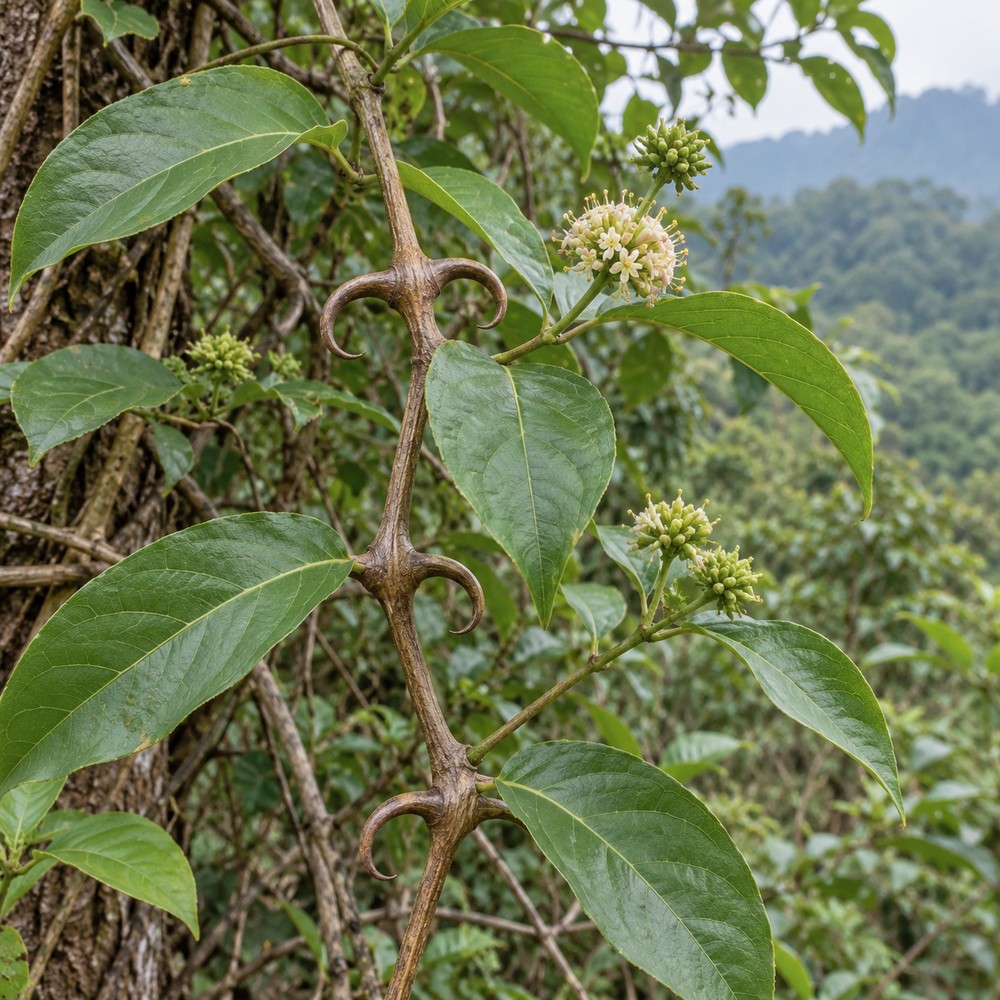
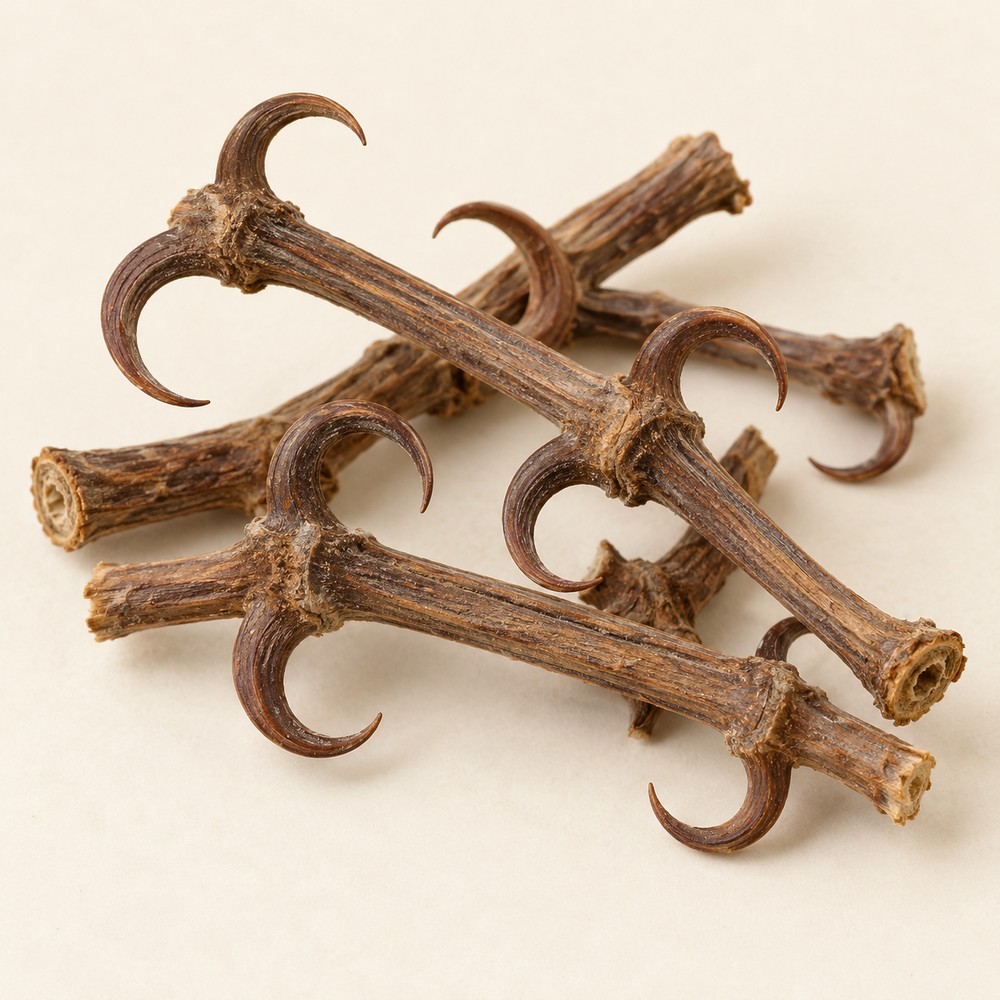
A woody vine with opposite leaves and paired downward-curving hooks at nodes; the used material is hooked stem.
Traditional context
Gou Teng is dried hooked branch of Uncaria rhynchophylla. HKBU describes round to sub-square stems with opposing hooks; other Uncaria species share the common name, so authenticate the source.
Modern evidence
Liver-calming and wind-extinguishing are traditional concepts. Alkaloid or laboratory blood-pressure research does not prove treatment for seizures, pre-eclampsia, or stroke.
Safety
Blood-pressure lowering or drowsiness may occur; caution is needed with antihypertensives, sedatives, or neurological drugs. Seek clinician advice, especially during pregnancy.
Pairing in reference texts
Gou Teng appears with Tian Ma or abalone shell in historical formulas. This is reference context, not self-treatment for dizziness or seizures.
Growing, care, and harvest timing
No sufficiently reliable species-specific source was found for habitat, cultivation, and harvest age. Do not infer timing from a related species; add an agronomic source before publishing a recommendation.
FROM PLANT / SOURCE HABITAT TO DRIED MATERIAL · REFERENCE WORKFLOW
- Harvest Uncaria rhynchophylla branches in autumn-winter from traceable supply; authenticate species and avoid overharvesting wild vines.
- Cut sections retaining hooks, remove leaves and debris, and inspect paired hooks and node scars.
- Sun- or ventilated-dry while preventing hook breakage; segregate other Uncaria species.
- Grade by slender stem, intact hooks, and color; record source, date, and lot moisture.
These are post-harvest study notes, not directions to prepare a remedy for self-treatment. Processing reference ↗
How to read formula amounts
Displayed amounts belong to the cited formula and source; they are not a general safe ratio, treatment dose, or home-decoction instruction. Do not transfer amounts to another formula or adjust them by body weight.
HKBU formula record containing this herb: Ling Jiao Gou Teng Tang / Antelope Horn and Uncaria Decoction
Traditional action in the source: of cooling the liver and extinguishing wind Ju Hua Assistant Bai Shao nourishes yin and drains heat softens the liver and relaxes the sinews Nourish yin and supplement fluid, soften the liver, and relax the sinews to reinforce the effect of extinguishing wind. Bei Mu clear heat and dissolves phlegm Zhu Ru Fu Shen Mu calms the liver nourishes the heart to calm the mind Assistant&Envoy Gan Cao relieves convulsion harmonizes other medicinals Gan cao combines with acrid bai shao to generate yin, relax the sinews, and relieve convulsions, as the foundation for nourishing yin and relaxing the sinews. Chief Ling Yang Jiao clears heat and cools the liver extinguishes wind to relieve convulsion Treat both the branch and the root by cooling the liver and extinguishing wind. This combination is the foundation for cooling the liver and extinguishing wind. Gou Teng clears wind and calms the liver extinguishes wind to relieve convulsion Deputy Sang Ye clear heat and calm the liver reinforce the action of cooling the liver and extinguishing wind Ju Hua Assistant Xian Sheng Di cools blood and nourishes yin Nourish yin and supplement fluid, soften the liver, and relax the sinews to reinforce the effect of extinguishing wind. Bai Shao nourishes yin and drains heat softens the liver and relaxes the sinews Bei Mu clear heat and dissolves phlegm Zhu Ru Fu Shen Mu calms the liver nourishes the heart to calm the mind Assistant&Envoy Gan Cao relieves convulsion harmonizes other medicinals Gan cao combines with acrid bai shao to generate yin, relax the sinews, and relieve convulsions, as the foundation for nourishing yin and relaxing the sinews. Chinese Name 羚角鉤藤湯 Phonetic Ling Jiao Gou Teng Tang English Name Antelope Horn and Uncaria Decoction Classification Wind-calming formulas Source 《Popular Guide to the ‘Treatise on Cold Damage’》Tong Su Shang Han Lun《通俗傷寒論》 Combination Saigae Tataricae Cornu (Ling Yang Jiao) 1.5 qian (4.5g), Mori Folium (Shuang Sang Ye) 2 qian (6g), Fritillariae Cirrhosae Bulbus (Jing Bei Mu) 4 qian (12g), Rehmanniae Radix (Xian Sheng Di) 5 qian (15g), Uncariae Ramulus cum Uncis (Shuang Gou Teng) 3 qian (9g), Chrysanthemi Flos (Chu Ju Hua) 3 qian (9g), Poria (Fu Shen Mu) 3 qian (9g), Paeoniae Radix Alba (Sheng Bai Shao) 3 qian (9g), Glycyrrhizae Radix et Rhizoma (Sheng Gao Cao) 0.8 qian (2.4g), Bambusae Caulis in Taenias (Dan Zhu Ru) 5 qian (15g) Method Prepare the ingredients as a decoction for oral use. Action Cools the liver and extinguishes wind, and increases fluids to relax the sinews
Ingredient images and source amounts are shown for comparison only; this is not a treatment recipe.
HKBU source-recorded composition
Saigae Tataricae Cornu (Ling Yang Jiao) 1.5 qian (4.5g), Mori Folium (Shuang Sang Ye) 2 qian (6g), Fritillariae Cirrhosae Bulbus (Jing Bei Mu) 4 qian (12g), Rehmanniae Radix (Xian Sheng Di) 5 qian (15g), Uncariae Ramulus cum Uncis (Shuang Gou Teng) 3 qian (9g), Chrysanthemi Flos (Chu Ju Hua) 3 qian (9g), Poria (Fu Shen Mu) 3 qian (9g), Paeoniae Radix Alba (Sheng Bai Shao) 3 qian (9g), Glycyrrhizae Radix et Rhizoma (Sheng Gao Cao) 0.8 qian (2.4g), Bambusae Caulis in Taenias (Dan Zhu Ru) 5 qian (15g)
The ingredients and amounts below are one HKBU-recorded version; texts, historical units, processing, and modern products can differ. This is comparative reference data, not a home-preparation recipe or personal dose.
Open complete HKBU formula record ↗