Mo Han Lian · false daisy · Mo Han Lian
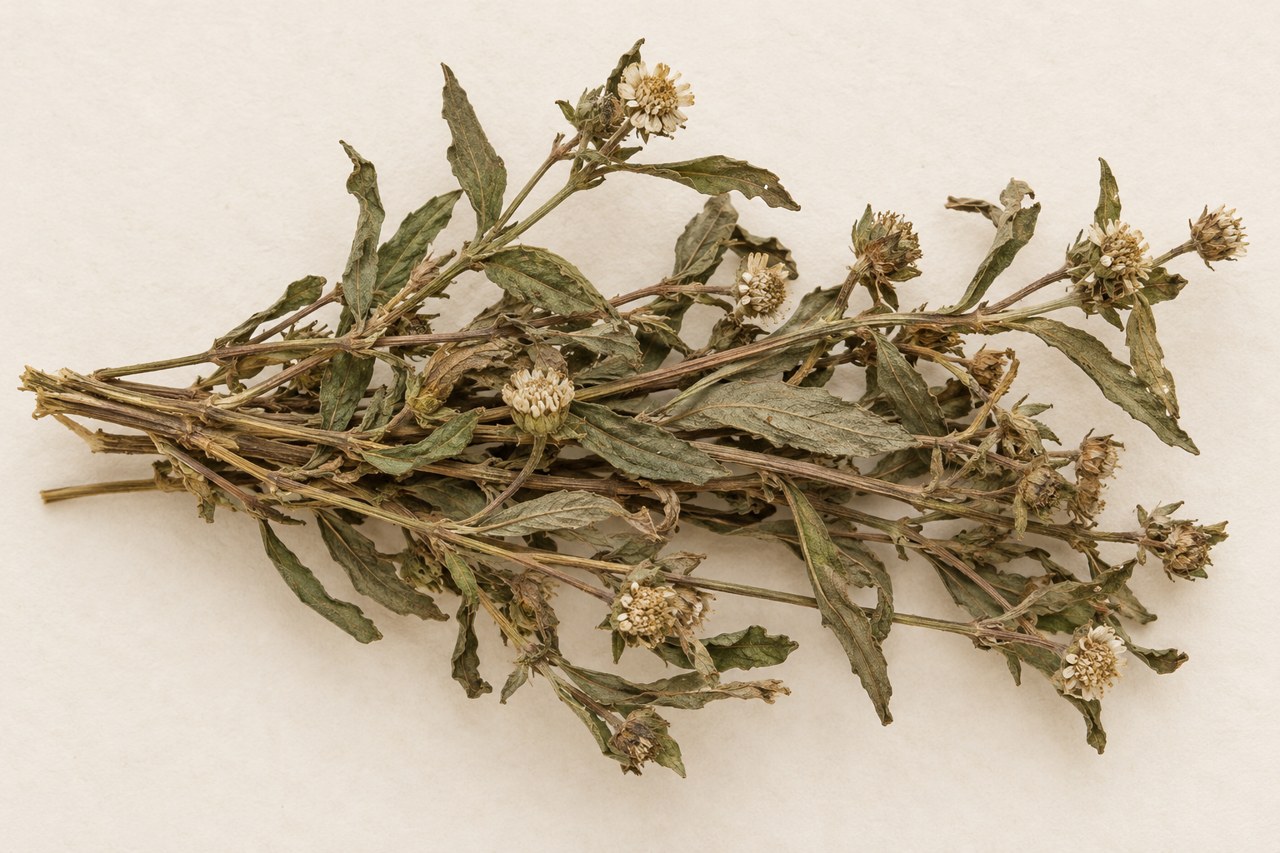
Eclipta prostrata (L.) L. · Dried aerial herb
Name and part used
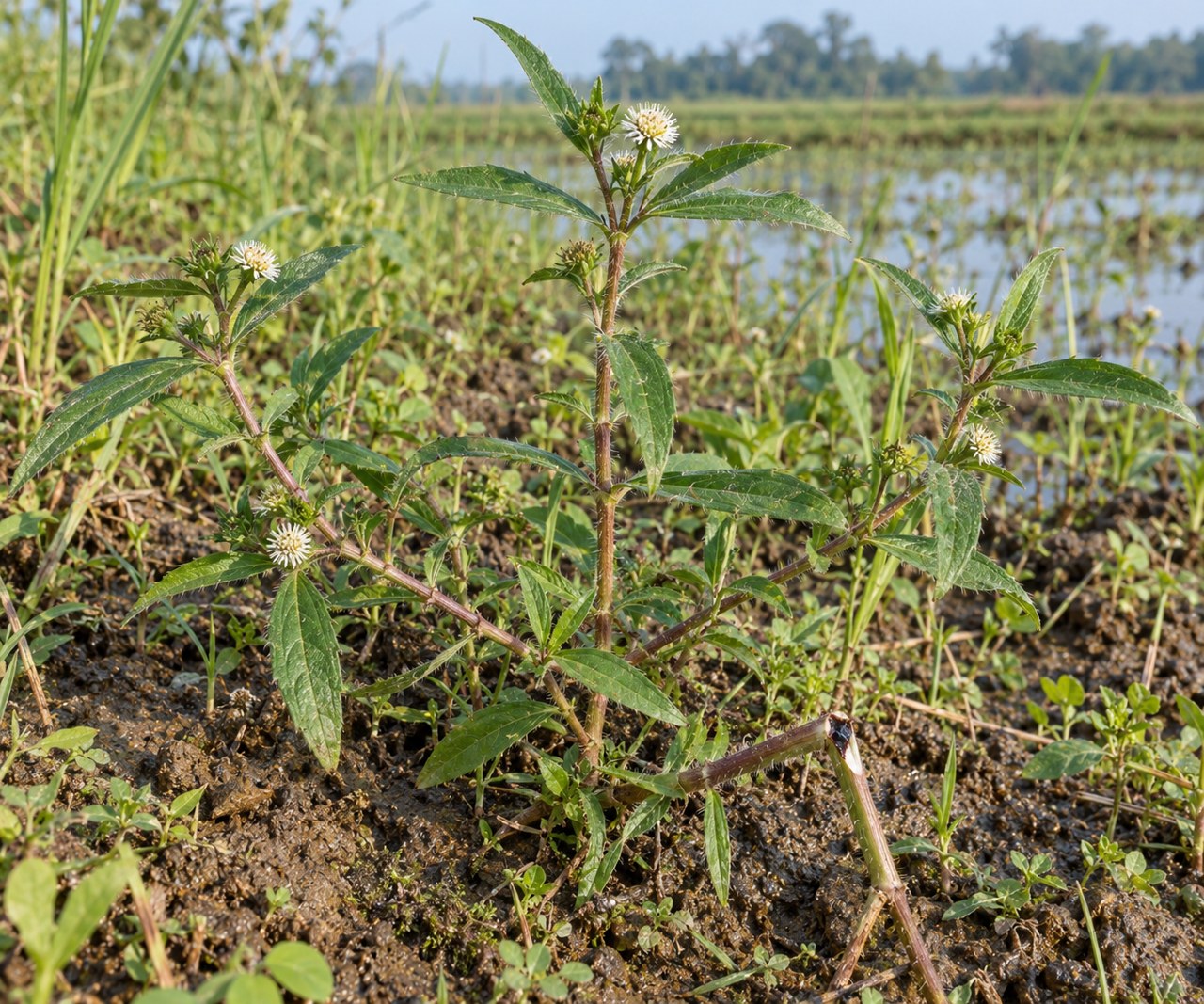
This record concerns Eclipta prostrata, a usually annual herb about 10–60 cm tall. Stems may be erect or spreading and rough-hairy; opposite narrow lance-shaped leaves have slightly wavy or finely toothed edges and hairs on both surfaces. Small white composite flower heads occur in leaf axils or at stem tips. Sap from a broken fresh stem may darken blue-black after several minutes, an observable clue that cannot identify a specimen on its own. HKBU records the medicinal material as the dried aerial herb, not only root or seed. The plant occurs on damp ground near ditches, grassland, and fields and can be confused with small wild daisies. AI art and sap color must never be used to justify wild collection.
Traditional context
HKBU records traditional descriptions involving liver-kidney support, cooling blood, and stopping bleeding; its specimen record also lists historical uses for diarrhea and some skin conditions. These are materia-medica traditions, not proof that the plant treats bleeding, liver or kidney disease, eczema, or fungal infection. Heavy bleeding, black stools, blood in urine, vomiting blood, or faintness needs urgent care, not a trial of herbs.
Modern evidence
HKBU provides identity, processing, and traditional records rather than clinical trials. Chemical or preclinical reports on saponins, thiophenes, or antioxidant activity do not prove that fresh plants, homemade tea, or commercial products safely stop bleeding. Findings from one extract cannot be generalized to the whole herb. People taking anticoagulants, diabetes medicines, or medicines affecting the liver should ask a clinician or pharmacist before considering concentrated products; do not stop prescriptions.
Safety
Do not collect roadside plants or material from herbicide-treated ditches, wastewater, or contaminated soil. Fresh sap may irritate skin or cause contact allergy; wash hands and keep it away from eyes and mucosa. Pregnant/breastfeeding people, children, people with liver/kidney disease, and anyone taking medicine should not self-ingest fresh plant, decoctions, or extracts. Never use it instead of urgent care for deep wounds, unexplained bleeding, or severe blood loss. Discard moldy, unusual-smelling, or mixed material.
Safety reference ↗Pairing in reference texts
A historical HKBU example pairs Mo Han Lian with Loropetalum chinense flower, but the example is not a treatment dose and does not establish efficacy or safety. Because this library lacks an authenticated ingredient image for that partner, the page does not depict it as verified. No specific toxic incompatibility was established in the reviewed source; that does not make arbitrary combinations safe. Do not self-combine herbs to stop bleeding.
Identification and study notes
Study cues include opposite leaves, rough hairs on both surfaces, tiny white flower heads, and sap that may darken over time. The dried drug is aerial stem, leaves, and flower heads; drying shrinks and changes color, so dark green-black color alone is not diagnostic. Small wild Asteraceae can look alike; compare hairs, leaf arrangement, flower heads, Latin identity, and supplier lot. AI art depicts general features, not every growth stage, and cannot authenticate a specimen. When observing the living plant, check several features together: opposite leaf arrangement, rough hairs on the leaves and stem, the position of small flower heads, and whether the stem is erect or spreading. Darkening sap is a time-dependent observation, not a standardized chemical test. Ditch plants may take up contaminants from mud, metals, or herbicides; wild material cannot be assumed clean. In dried samples, look for stem sections with opposite leaves and remaining flower heads, but note that heads often break during transport. If only brown fragments or powder remain, a lot label and testing are needed because color cannot authenticate it. Common names vary regionally; the Latin name and part used help prevent confusion.
Growth and habitat
HKBU places it along roadsides, wet ground, ditch edges, and fields, with broad distribution in China and materia-medica production in provinces including Jiangsu, Zhejiang, Jiangxi, and Hubei. This describes ecology; it does not make wild plants elsewhere safe to harvest. For observation, use clean moist but drained soil in a sunny site and avoid contaminated water or pesticide drift.
Identification and study notes
Study cues include opposite leaves, rough hairs on both surfaces, tiny white flower heads, and sap that may darken over time. The dried drug is aerial stem, leaves, and flower heads; drying shrinks and changes color, so dark green-black color alone is not diagnostic. Small wild Asteraceae can look alike; compare hairs, leaf arrangement, flower heads, Latin identity, and supplier lot. AI art depicts general features, not every growth stage, and cannot authenticate a specimen. When observing the living plant, check several features together: opposite leaf arrangement, rough hairs on the leaves and stem, the position of small flower heads, and whether the stem is erect or spreading. Darkening sap is a time-dependent observation, not a standardized chemical test. Ditch plants may take up contaminants from mud, metals, or herbicides; wild material cannot be assumed clean. In dried samples, look for stem sections with opposite leaves and remaining flower heads, but note that heads often break during transport. If only brown fragments or powder remain, a lot label and testing are needed because color cannot authenticate it. Common names vary regionally; the Latin name and part used help prevent confusion.
Growing and care
- Obtain seed labeled Eclipta prostrata; do not collect roadside or ditch plants. Prepare a clean, loose seed tray or bed and keep it lightly moist.
- Sow shallowly, cover lightly, place in bright conditions, and mist gently so seed is not displaced. HKBU gives no validated germination temperature or irrigation schedule.
- Once established, maintain moderate moisture and drainage and hand-weed. Avoid fresh manure, herbicides, and contaminated irrigation because aerial parts can retain dirt or residues.
- HKBU records summer–autumn collection of aerial parts but gives no days from sowing to harvest or medicinal-cultivation standard. Record your plant’s germination and flowering; grow it for study, not home medicine.
How long until harvest? This is an annual plant. The source records summer–autumn harvest but not a sowing-to-harvest interval. Flowering and fruiting follow local seasons; height alone cannot establish when material is “ready to use.” Commercial materia medica requires authentication, testing, and standardized processing.
Habitat, season, and harvest in the HKBU botanical record
HKBU describes Eclipta prostrata as 10–60 cm tall, rough-haired, with opposite narrow leaves and white heads; flowering is around July–September and fruiting around September–October. Habitat includes roadsides, wet ground, ditches, and fields. The aerial herb is collected in summer–autumn, washed, and sun- or shade-dried.
Open botanical source ↗FROM PLANT / SOURCE HABITAT TO DRIED MATERIAL · REFERENCE WORKFLOW
- HKBU records summer–autumn harvest of aerial parts. Collect only labeled cultivated plants or material authenticated by a professional supplier; do not gather wild plants for ingestion.
- Shake off soil, rinse briefly if needed, and remove yellow leaves, weeds, and insects; do not soak. Drain on a clean rack.
- Cut into manageable lengths and sun-dry or shade/air-dry in clean ventilated conditions as recorded; prevent mold.
- Once stably dry, cool, seal, and label Latin name, part, source, and harvest date. This is post-harvest context, not a drink recipe.
These are post-harvest study notes, not directions to prepare a remedy for self-treatment. Processing reference ↗