Lotus leaf · He Ye
Nelumbo nucifera Gaertn. · Mature leaf
Name and part used
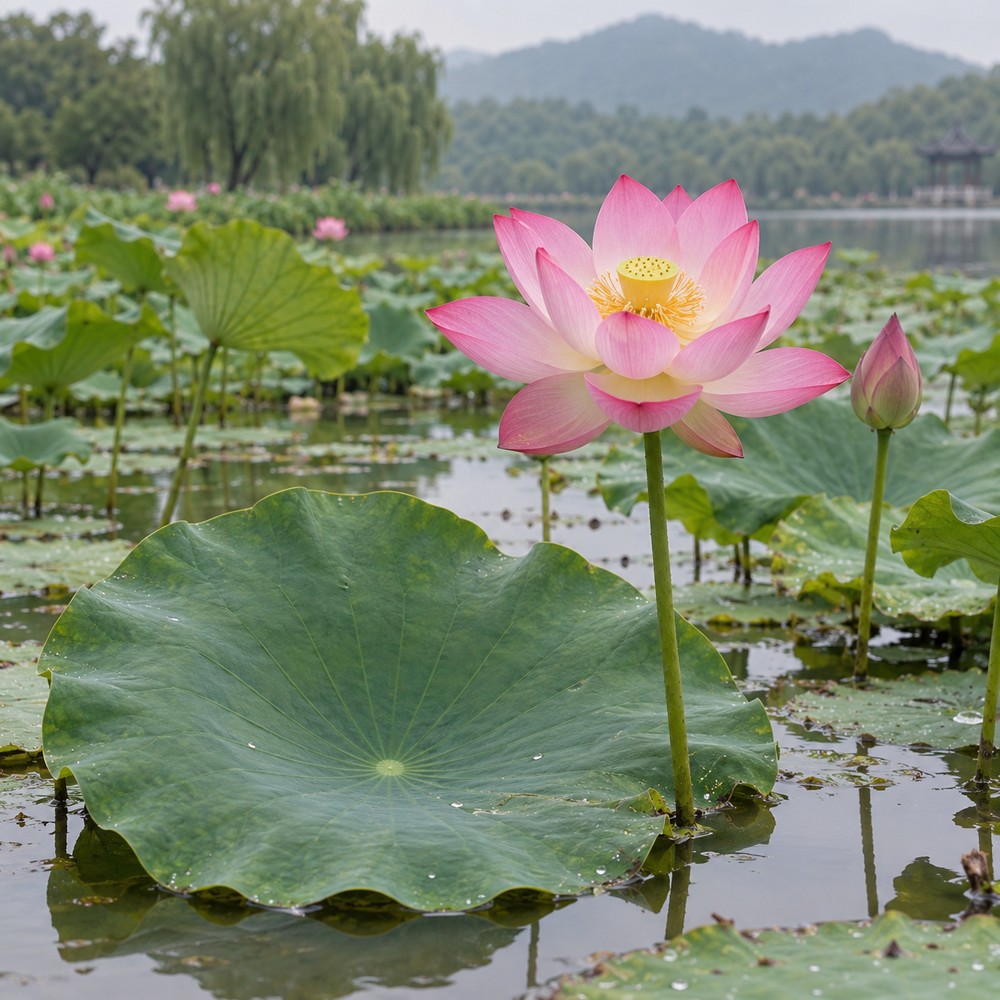
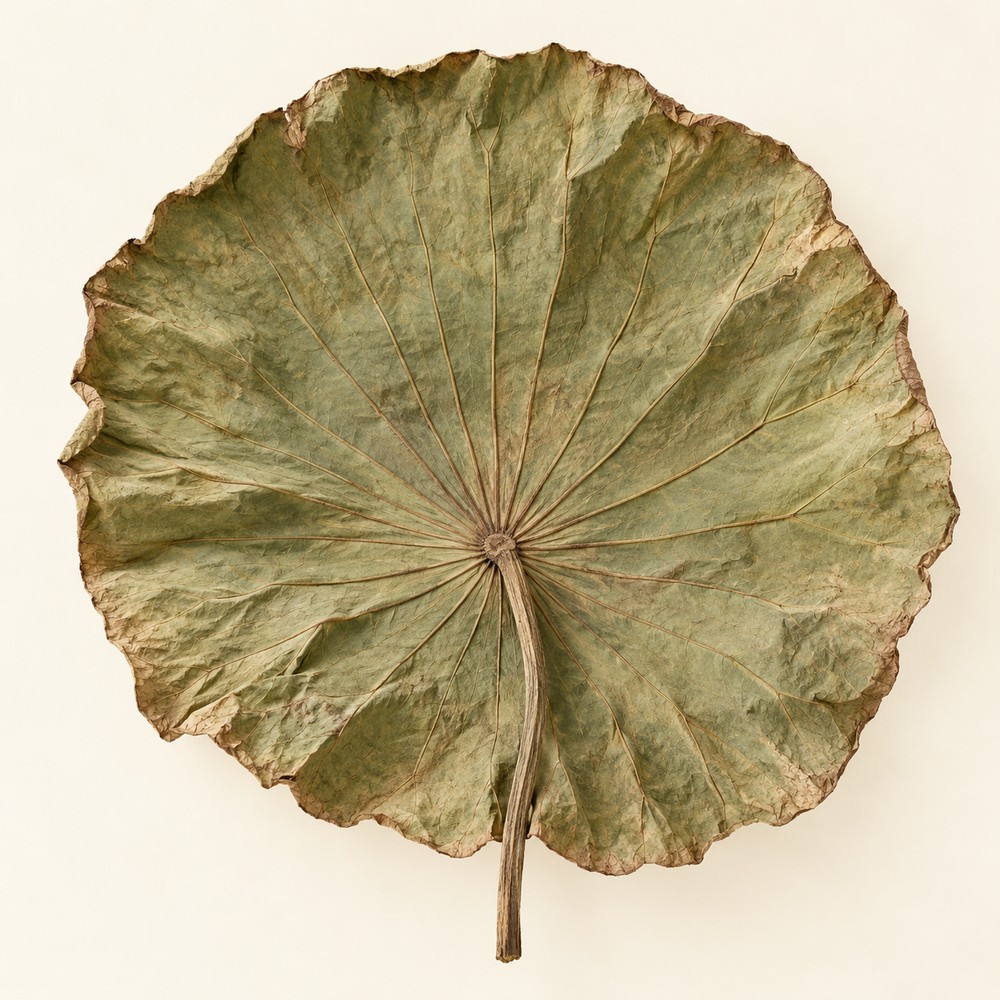
The very broad, nearly round lotus leaf has radiating veins from a central stalk; upper surface is darker and rougher than the underside.
Traditional context
Summer-heat clearing and yang-lifting are traditional concepts; they do not prove weight loss or hemostasis and do not replace heat-illness care. HKBU describes dried leaves folded into semicircle/fan shapes; spread leaves are round, 20–50 cm, with about 21–22 strong veins.
Modern evidence
Constituents are studied preclinically; this does not establish treatment of obesity or bleeding.
Safety
May affect glucose or blood pressure or interact with medicines; pregnancy, chronic disease, and medication use warrant professional advice.
Pairing in reference texts
Lotus leaf appears in some summer-heat formulas, sometimes with Bai Zhu or Fu Ling; this is not a weight-loss recipe.
Growing, care, and harvest timing
HKBU habitat record: Growing in paddy fields or ponds. Distributed in provinces in the southern and northern parts of China. The medicinal materials are mainly produced in Hunan, Hubei, Fujian, Jiangsu, Zhejiang, Anhui, Jiangxi and etc Harvest and processing as recorded: Rhizome: excavated in autumn, winter and spring. Often used fresh. Leaves: collected from June to September when not flowering, removed the petioles, sun-dried to seventy to eighty percent dried, fold into semicircle, and sun-dried. Summer, also used fresh or use tender leaves. Tender leaf and radicles: peel off the lotus seed, taken the green radicles (lotus nut), and sun-dried. Flower: collected just opening bud or flowers and dried in shade. Receptacle: collected lotus seedpod in September and October when fruits become mature, removed the seed and stem, and sun-dried. Fruit: collected the lotus seed when it becomes mature, and sun-dried. Seeds: harvested lotus seedpod in autumn when fruits become mature, taken the fruits, removed pericarp, and sun-dried. Seeds coat: collected in September and October when fruits become mature, taken the seed, peeled, and sun-dried the seed coat
Source-recorded harvest/processing: Rhizome: excavated in autumn, winter and spring. Often used fresh. Leaves: collected from June to September when not flowering, removed the petioles, sun-dried to seventy to eighty percent dried, fold into semicircle, and sun-dried. Summer, also used fresh or use tender leaves. Tender leaf and radicles: peel off the lotus seed, taken the green radicles (lotus nut), and sun-dried. Flower: collected just opening bud or flowers and dried in shade. Receptacle: collected lotus seedpod in September and October when fruits become mature, removed the seed and stem, and sun-dried. Fruit: collected the lotus seed when it becomes mature, and sun-dried. Seeds: harvested lotus seedpod in autumn when fruits become mature, taken the fruits, removed pericarp, and sun-dried. Seeds coat: collected in September and October when fruits become mature, taken the seed, peeled, and sun-dried the seed coat
The reviewed source does not provide a complete species-specific sowing/growing routine, irrigation/fertilization schedule, or universal plant age. The page therefore does not infer care instructions or years to harvest; consult local cultivation guidance.
Open habitat and season source ↗FROM PLANT / SOURCE HABITAT TO DRIED MATERIAL · REFERENCE WORKFLOW
- Collect mature clean Nelumbo nucifera leaves from controlled cultivation; avoid decayed or chemically contaminated leaves.
- Rinse briefly, drain, cut according to facility protocol, and ventilated-dry.
- Preserve the broad leaf and avoid crushing; charcoal processing belongs to official facilities, not home burning.
- Grade clean green dry leaves, moisture-proof package, and label plain leaf versus processed form.
These are post-harvest study notes, not directions to prepare a remedy for self-treatment. Processing reference ↗
How to read formula amounts
Displayed amounts belong to the cited formula and source; they are not a general safe ratio, treatment dose, or home-decoction instruction. Do not transfer amounts to another formula or adjust them by body weight.
Habitat, season, and harvest in the HKBU botanical record
HKBU botanical record (translated summary): Flowering and fruiting dates: flowering, obconical, has small holes 20-30, each hole has fruit 1; nut fruit elliptic or ovate, 1.5-2 Habitat and distribution: Growing in paddy fields or ponds. Distributed in provinces in the southern and northern parts of China. The medicinal materials are mainly produced in Hunan, Hubei, Fujian, Jiangsu, Zhejiang, Anhui, Jiangxi and etc Harvest and processing as recorded: Rhizome: excavated in autumn, winter and spring. Often used fresh. Leaves: collected from June to September when not flowering, removed the petioles, sun-dried to seventy to eighty percent dried, fold into semicircle, and sun-dried. Summer, also used fresh or use tender leaves. Tender leaf and radicles: peel off the lotus seed, taken the green radicles (lotus nut), and sun-dried. Flower: collected just opening bud or flowers and dried in shade. Receptacle: collected lotus seedpod in September and October when fruits become mature, removed the seed and stem, and sun-dried. Fruit: collected the lotus seed when it becomes mature, and sun-dried. Seeds: harvested lotus seedpod in autumn when fruits become mature, taken the fruits, removed pericarp, and sun-dried. Seeds coat: collected in September and October when fruits become mature, taken the seed, peeled, and sun-dried the seed coat
Open botanical source ↗HKBU formula record containing this herb: Qing Luo Yin / Channel-Clearing Beverage
Traditional action in the source: Dispels summerheat and clears fire
Ingredient images and source amounts are shown for comparison only; this is not a treatment recipe.
HKBU source-recorded composition
Nelumbinis Folium (Xian He Ye fresh) 2 qian (6g), Lonicerae Japonicae Flos (Xian Yin Hua fresh) 2 qian (6g), Retinervus Luffae Fructus (Si Gua Pi) 2 qian (6g), Exocarpium Citrulli (Xi Gua Pi) 2 qian (6g), Flos Lablab Album (Xian Bian Dou Hua fresh) 1 piece (6g), Lophatheri Herba (Xian Zhu Ye Xin fresh) 2 qian (6g)
The ingredients and amounts below are one HKBU-recorded version; texts, historical units, processing, and modern products can differ. This is comparative reference data, not a home-preparation recipe or personal dose.
Open complete HKBU formula record ↗