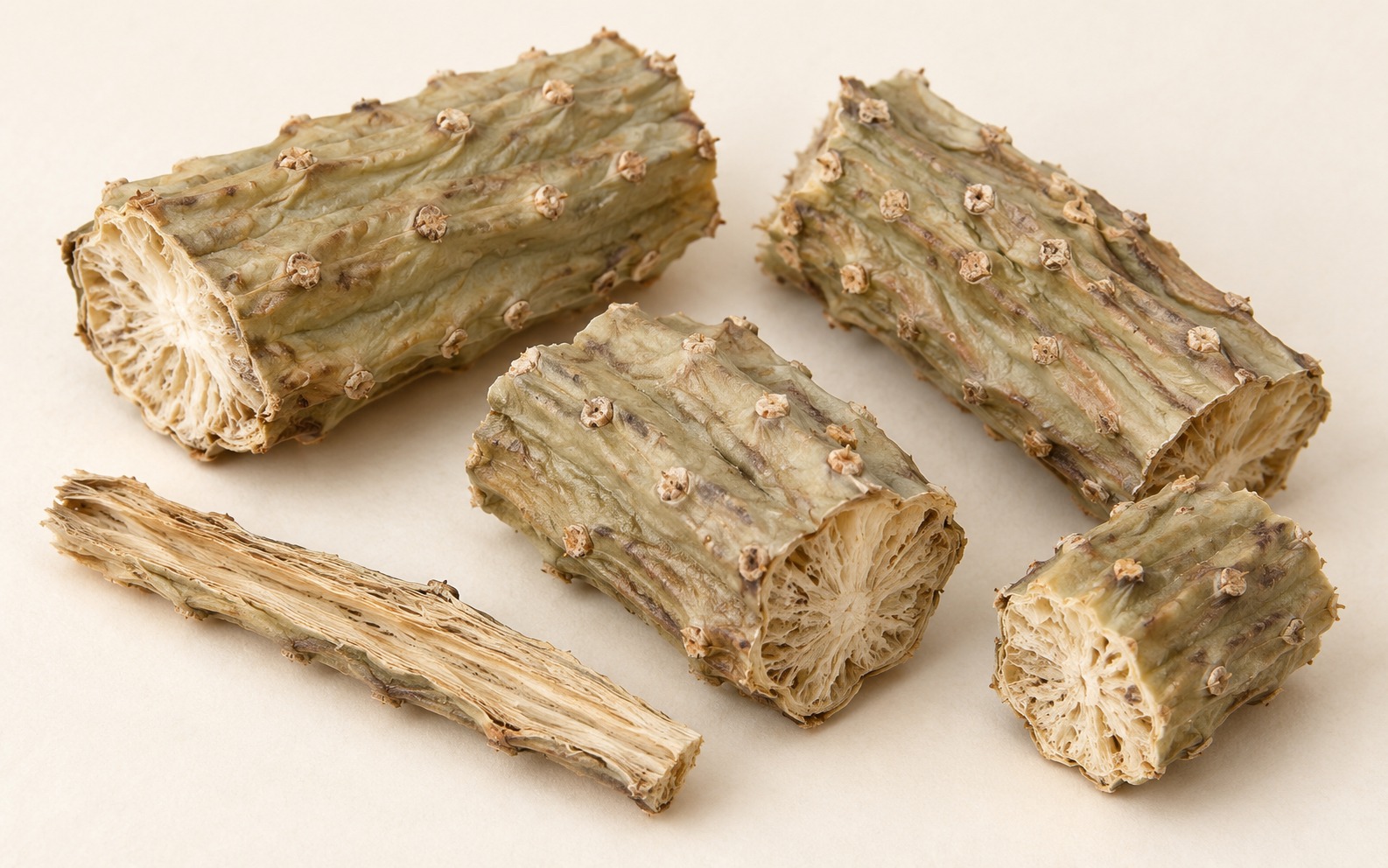
Hoodia gordonii (Masson) Sweet ex Decne. · Stem; MPNS records sliced and dried stems
Materia medica properties in reference
Materia medica form discussed in this paragraph
Properties as recorded in the source: The linked sources do not establish Chinese materia medica taste, meridian entry, or functions for H. gordonii. Do not infer them from a related species or weight-loss marketing.
No sufficiently sourced, quantified formula pairing was confirmed for this species; no ratio or combination benefit is assigned.
CITES international-trade evidence
Materia medica form discussed in this paragraph
The 2026.1 CITES Trade Database contains 6 comparative-tabulation rows for Hoodia gordonii during 2016, 2017, 2018, 2021. The query selected reported purpose T (Commercial) and trade term MED (medicine); appendices appearing in these rows: II. Reported importer codes include AE, SG, US; exporter codes include IN, MX. These are comparative-tabulation rows, not shipment counts or summed volume. This record does not establish clinical efficacy, the legality of an individual transaction, or safety of use.
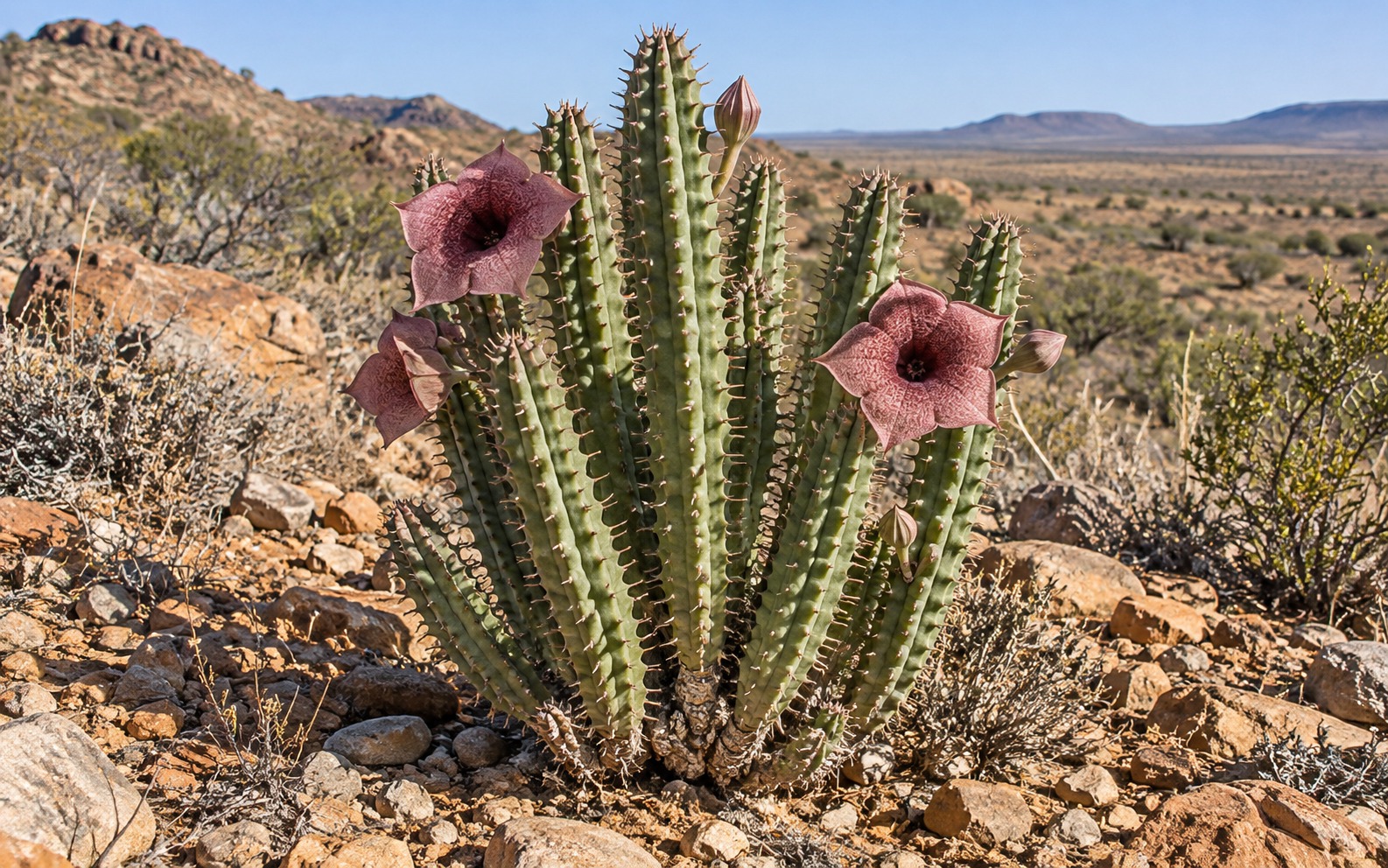
Hoodia gordonii is a succulent shrub in Apocynaceae, native from Namibia to the Free State of South Africa. Kew describes a clump-forming plant up to about 75 cm tall, with fleshy, spiny green stems and no conventional leaves. Its large flowers are star-shaped and five-lobed, ranging from flesh-pink to reddish purple; the fruit is a paired, V-shaped follicle. These features help readers picture the species but are not a field identification standard for beginners. The genus contains related species, and labels such as “Hoodia,” “ghaap,” or “Kalahari cactus” do not by themselves verify identity. Kew MPNS records the stem as the medicinal plant part, including sliced and dried stems. CITES also records commercial trade under this species name with the trade term medicine. The images are AI study illustrations, not authenticated vouchers or inspected commercial lots.
Traditional context
Materia medica form discussed in this paragraph
Hoodia should be read in its Southern African context rather than folded into Chinese materia medica simply because this site is an Eastern herbal journal. Kew records that several Hoodia species, including H. gordonii, have been used as food by Indigenous San communities: young peeled shoots were eaten to relieve thirst on long hunting trips. NCCIH describes traditional use by San people to suppress appetite during long hunts. These are historical and local-knowledge records, not clinical evidence for modern extracts. Kew also summarizes folk-medicine reports from the region, but those reports do not establish efficacy or a dose. The sources reviewed here do not support assigning this species the taste, temperature, meridian entry, functions, or formula role of a classical Chinese herb. Supplement marketing and common names do not substitute for species, plant-part, and preparation verification.
Modern evidence
Materia medica form discussed in this paragraph
NCCIH says human research on hoodia is very limited. One small study of 49 overweight women using an extract for 15 days found no difference from placebo in energy intake or body weight. The NIH Office of Dietary Supplements summarizes the same result and emphasizes the limited human evidence. Hoodia should therefore not be presented as a proven method for weight loss or appetite control. Chemical findings, proposed mechanisms, or animal studies do not establish benefits from commercial products. Products can differ in species, plant part, extraction, and purity; Kew flags quality-control and clinical-efficacy concerns in unregulated trade. This profile records historical use and trade evidence, not a recommendation to use hoodia for treatment or weight loss.
Safety
Materia medica form discussed in this paragraph
NCCIH reports that the small trial raised concerns about heart rate and blood pressure. ODS also notes changes in bilirubin and alkaline phosphatase in that study, although the clinical significance of some laboratory findings is unclear. Reported effects include headache, dizziness, nausea, and vomiting. Because the evidence is sparse, risk cannot be characterized for every product or population. Some clinical references also flag a possible effect on drug-metabolizing enzymes, while its practical significance remains uncertain. People with cardiovascular, blood-pressure, or liver conditions, people taking medicines, and those who are pregnant or breastfeeding should not experiment with hoodia products; consult a qualified clinician first. No reliable source reviewed here confirms a specific toxic herb pairing for this exact species, but that does not establish that arbitrary combinations are safe. CITES trade records do not verify a particular product’s quality, identity, or legality.
For morphology study, look for a clump-forming succulent with grey-green cylindrical or angled stems and small spines along the stem; it lacks the broad pads of many familiar cacti. The large five-lobed flower is conspicuous when present, but young plants and out-of-season plants may not flower. Fruits usually occur as a pair. Colors in AI art can differ from living plants with age, light, water, and soil; do not use this image to distinguish H. gordonii from other Hoodia or similar succulents. Commercial identity requires a checked scientific name, provenance, and, where needed, expert voucher or molecular methods.
Growth and habitat
Illustrated plant and growing setting
Kew places Hoodia gordonii among small succulent shrubs of dry regions, primarily desert or dry shrubland. Its native distribution includes Namibia, the Cape Provinces, and the Free State of South Africa. Kew’s ecology notes very dry settings from rocky ground to sandy river beds; CITES succulent-plant guidance describes arid gravel plains, slopes, and ridges. These records describe natural range and habitat, not permission to collect wild plants. Populations face pressure from live-plant collectors and harvesting for use; the genus Hoodia is listed in CITES Appendix II. Cultivation and trade must follow CITES requirements and the laws of source and importing countries.
Living plant / habitatUse legally sourced nursery seed or cuttings with a scientific name; do not dig wild plants. Kew says seed is generally the easier propagation route for growers.
Living plant / habitatChoose a bright, warm, ventilated position and a gritty or sandy, freely draining medium. This matches Kew’s dry-habitat account; it does not imply tolerance of every heatwave or frost.
Living plant / habitatWater sparingly. Kew warns that the base may rot if overwatered; allow the compost to dry fully between waterings as its horticultural guidance advises rather than keeping it continuously moist.
Illustrated plant and growing settingSow seed on the surface of moist sterilized compost and cover lightly with fine grit. Kew describes placing the pot in a sealed transparent bag until seedlings are large enough to prick out; it does not give a universal week-by-week schedule.
Living plant / habitatFor cuttings, follow nursery procedures and allow the cut surface to callus before placing it in a slightly damp medium. Kew notes rooting can be difficult; do not use hormones or chemicals without following their labels and local rules.
Illustrated plant and growing settingMonitor basal rot, pests, and substrate condition; record stock source, sowing/cutting date, repotting, and watering conditions. These are horticultural records, not medicinal-crop standards or a guarantee of commercial quality.
Illustrated plant and growing setting
How long until harvest? The references reviewed did not provide a reliable number of months or years from sowing to harvestable commercial stem material. Kew gives propagation and care notes but no medicinal-harvest maturity age. This page therefore does not invent a harvest interval. H. gordonii belongs to a CITES Appendix-II genus; do not harvest wild plants or move specimens across borders without checking permits and current legal requirements.
From plant to dried material · source-recorded workflow
Plant before harvestCheck the scientific name, cultivation provenance, and CITES status before accepting a lot; do not collect wild plants or trade across borders without clear documentation.
Illustration of the processing step describedMPNS records the stem, including sliced and dried stems. Accept only material with a lot record and facility procedure; the sources reviewed do not specify a drying temperature or duration for home use.
Illustration of the processing step describedRecord the plant part, processed form, date, and processing facility separately; do not use an illustration or color to verify identity or quality.
Illustration of the processing step describedStore and test under qualified facility standards and local rules. These notes support traceability and study, not home processing for consumption.
Illustration of the processing step described
This record supports study and processing traceability; it is not a home preparation or self-use guide.