Amur corktree bark · Huang Bai
Phellodendron amurense Rupr. · Stem bark
Name and part used
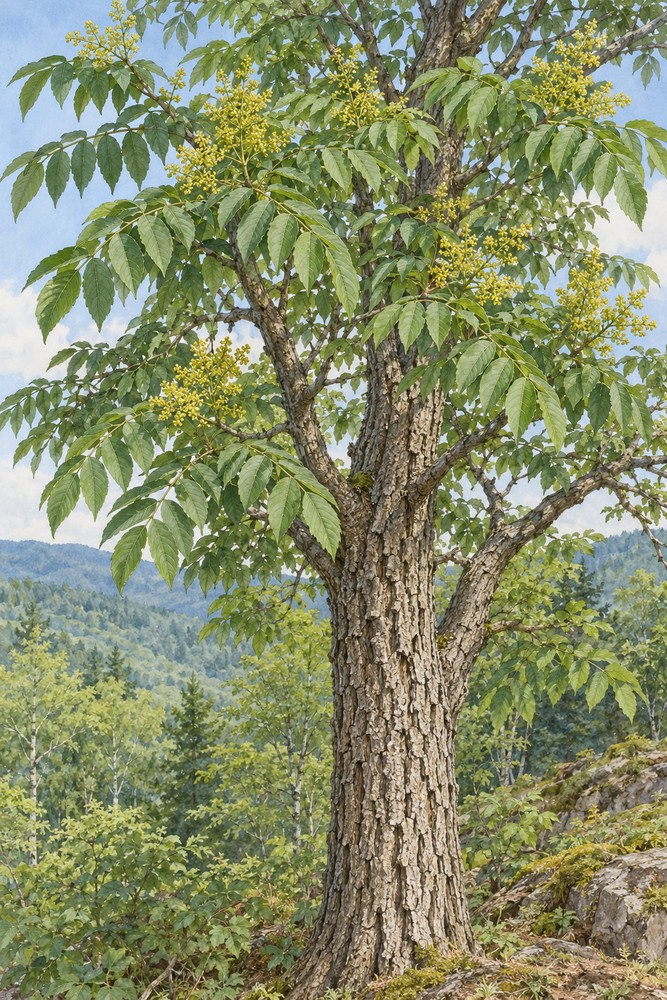
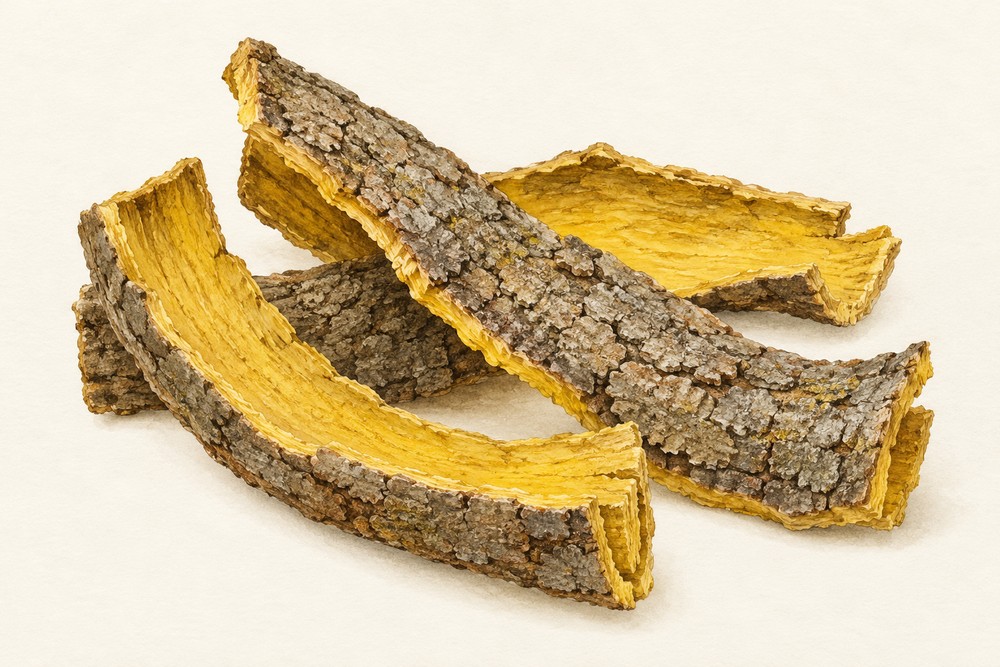
A deciduous tree with pinnate leaves, thick corky bark, and bright yellow inner bark.
Traditional context
HKBU records Huang Bai as Phellodendron amurense bark; P. chinense products may be related materia medica but must be labeled as the correct species.
Modern evidence
Vỏ chứa berberine và dịch chiết chuẩn hóa không tương đương nhau; tên nguyên liệu hoặc màu vàng không xác nhận thành phần hóa học hay hiệu quả điều trị.
Safety
It may interact with medicines; do not use bark from an uncertain source. Pregnant or breastfeeding people and those taking prescription medicines should consult a professional.
Pairing in reference texts
It appears in classical formulas; a traditional role does not prove that bark or berberine products are safe with medicines.
Growing, care, and harvest timing
HKBU habitat record: Growing in miscellaneous forests, or valley streams. Can be cultivated. Distributed in Northeast and North China, etc. The medicinal materials are mainly produced in Liaoning, Jilin, Heilongjiang, Hebei and etc Harvest and processing as recorded: Picked off the bark, removed raw bark, and sun-dried
Source-recorded harvest/processing: Picked off the bark, removed raw bark, and sun-dried
The reviewed source does not provide a complete species-specific sowing/growing routine, irrigation/fertilization schedule, or universal plant age. The page therefore does not infer care instructions or years to harvest; consult local cultivation guidance.
Open habitat and season source ↗FROM PLANT / SOURCE HABITAT TO DRIED MATERIAL · REFERENCE WORKFLOW
- Bark should come only from authorized, traceable forestry plans and correctly identified trees; girdling can kill the tree.
- Remove foreign matter and outer layers under a materia medica procedure; document tree/source and assess impacts on tree health.
- Dry bark with good airflow, maintain lot separation, and protect from moisture, mold, and smoke or dust.
- Record the exact Phellodendron species, plant part, sustainable source, date, and lot; do not collect forest bark yourself.
These are post-harvest study notes, not directions to prepare a remedy for self-treatment. Processing reference ↗
How to read formula amounts
The cited sources do not provide a formula with specific amounts for this profile; no ratio is invented. Absence from the incompatibility list does not establish safety.
Habitat, season, and harvest in the HKBU botanical record
HKBU botanical record (translated summary): Flowering and fruiting dates: Flowering: May to June, fruiting: September to October Habitat and distribution: Growing in miscellaneous forests, or valley streams. Can be cultivated. Distributed in Northeast and North China, etc. The medicinal materials are mainly produced in Liaoning, Jilin, Heilongjiang, Hebei and etc Harvest and processing as recorded: Picked off the bark, removed raw bark, and sun-dried
Open botanical source ↗