Siberian Solomon's seal · Huang Jing
Polygonatum sibiricum Delar. ex Redouté · Rhizome
Name and part used
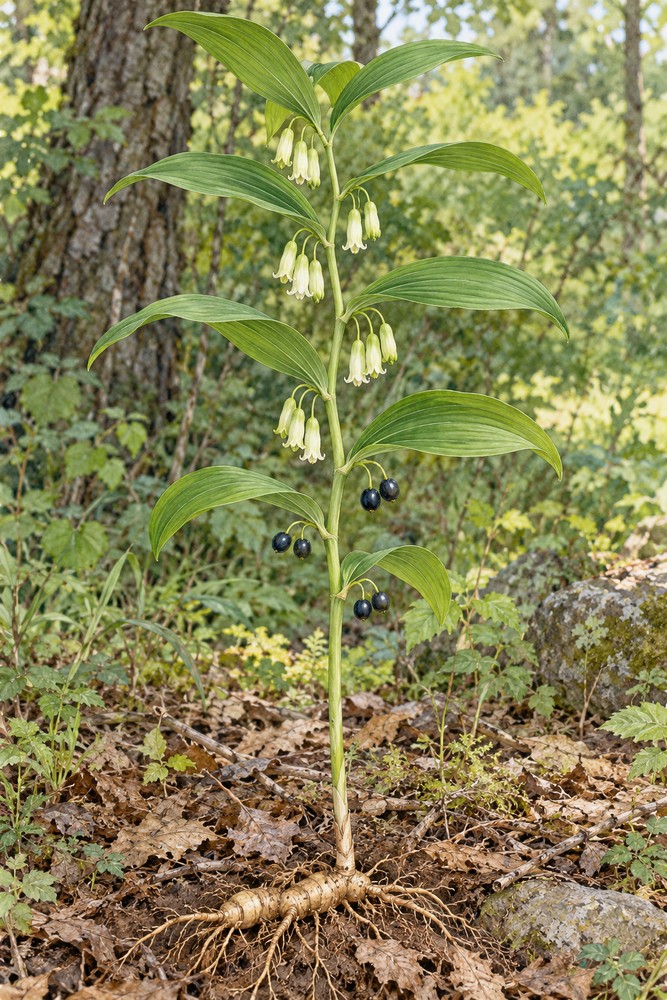
A woodland herb with simple stems, alternate to whorled leaves, drooping bell flowers, and round berries.
Traditional context
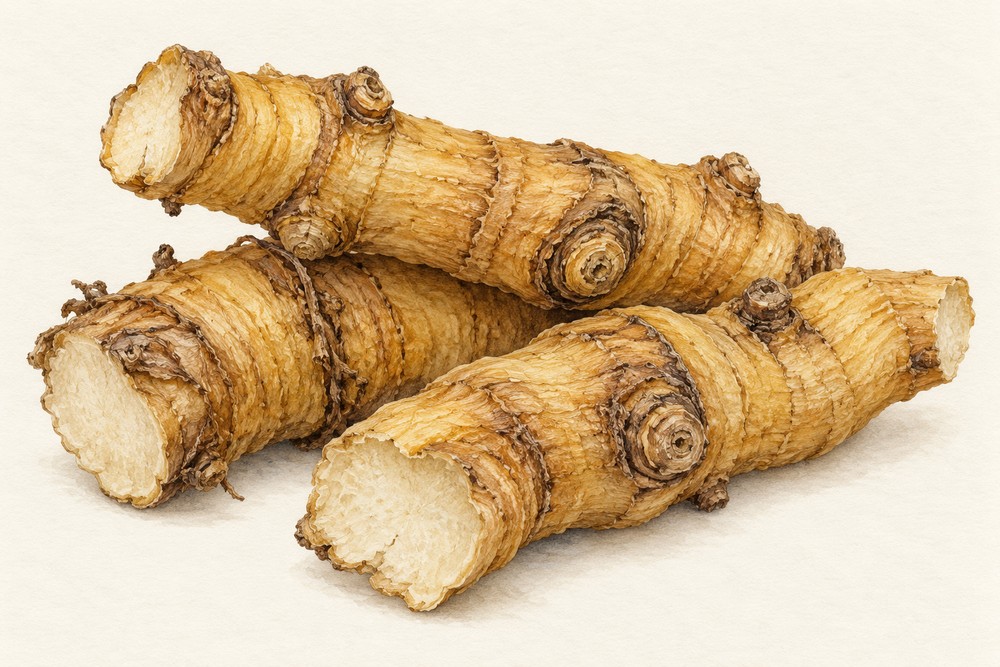
Medicinal Huang Jing is the rhizome of Polygonatum sibiricum. HKBU records it from slopes, mixed woodland, and thicket margins; the rhizome has distinct nodes and stem scars. Several Polygonatum species look similar, so authentication matters.
Modern evidence
Spleen-tonifying, qi-supporting, and lung-nourishing are traditional descriptions. Sugar, starch, or preclinical findings do not establish treatment in humans.
Safety
Unprocessed material may cause digestive discomfort. Processed forms vary; seek professional advice before use, especially during pregnancy, chronic illness, or medication use.
Pairing in reference texts
Huang Jing appears in various traditional tonic combinations; no single pairing suits every constitution. Historical use does not establish modern safety.
Growing, care, and harvest timing
HKBU habitat record: Growing on deserted slopes and miscellaneous forests or thickets sides. Distributed in Heilongjiang, Jilin, Liaoning, Hebei, Shandong, Jiangsu, Henan, Shanxi, Shaanxi, Inner Mongolia and etc. The medicinal materials are mainly produced in Guizhou, Hunan, Zhejiang, Guangxi, Hebei, Inner Mongolia, Liaoning and Shanxi Harvest and processing as recorded: Harvested in spring, (better in autumn). Excavated rhizome, removed aboveground parts and fibril, washed off sediment, steamed till oil oozing out, taken out and sun-dried or baked to dry, or sun-dried or baked to dry after boiled in water
Source-recorded harvest/processing: Harvested in spring, (better in autumn). Excavated rhizome, removed aboveground parts and fibril, washed off sediment, steamed till oil oozing out, taken out and sun-dried or baked to dry, or sun-dried or baked to dry after boiled in water
The reviewed source does not provide a complete species-specific sowing/growing routine, irrigation/fertilization schedule, or universal plant age. The page therefore does not infer care instructions or years to harvest; consult local cultivation guidance.
Open habitat and season source ↗FROM PLANT / SOURCE HABITAT TO DRIED MATERIAL · REFERENCE WORKFLOW
- Harvest rhizomes in a cultivation-approved season; authenticate the species and protect wild populations from overharvest.
- Remove aerial stems and fine roots, clean adhering soil under facility procedures, and lot the fresh material.
- HKBU describes heat treatment or steaming before sun- or oven-drying. This is a controlled facility step, not a home preparation guide.
- Dry to specification, grade, and document species, origin, and processing form; store dry and protected from insects.
These are post-harvest study notes, not directions to prepare a remedy for self-treatment. Processing reference ↗
How to read formula amounts
The cited sources do not provide a formula with specific amounts for this profile; no ratio is invented. Absence from the incompatibility list does not establish safety.
Habitat, season, and harvest in the HKBU botanical record
HKBU botanical record (translated summary): Flowering and fruiting dates: Flowering: May to June, fruiting: August to September Habitat and distribution: Growing on deserted slopes and miscellaneous forests or thickets sides. Distributed in Heilongjiang, Jilin, Liaoning, Hebei, Shandong, Jiangsu, Henan, Shanxi, Shaanxi, Inner Mongolia and etc. The medicinal materials are mainly produced in Guizhou, Hunan, Zhejiang, Guangxi, Hebei, Inner Mongolia, Liaoning and Shanxi Harvest and processing as recorded: Harvested in spring, (better in autumn). Excavated rhizome, removed aboveground parts and fibril, washed off sediment, steamed till oil oozing out, taken out and sun-dried or baked to dry, or sun-dried or baked to dry after boiled in water
Open botanical source ↗