Goldenseal (Hydrastis) · Goldenseal
Hydrastis canadensis L. · Dried rhizome and roots; underground parts are specified by CITES
Materia medica properties in reference
The linked references do not establish the taste, temperature, meridian entry, and traditional functions for this exact species/material. No properties are inferred from a related species.
Combinations recorded in formulas
No sufficiently specific formula record is linked to this profile. The page therefore does not invent a beneficial pairing or a ratio.
CITES international-trade evidence
The 2026.1 CITES Trade Database contains 151 comparative-tabulation rows for Hydrastis canadensis during 2016, 2017, 2018, 2019, 2020, 2021, 2022, 2023, 2024. The query selected reported purpose T (Commercial) and trade term MED (medicine); appendices appearing in these rows: II. Reported importer codes include AE, BG, BR, CA, CH, CO, FR, HK; exporter codes include FR, ID, US. These are comparative-tabulation rows, not shipment counts or summed volume. This record does not establish clinical efficacy, the legality of an individual transaction, or safety of use.
Open the CITES Trade Database ↗Name and part used
Goldenseal is a perennial herb native to eastern North America. It typically has a single unbranched stem, two large lobed leaves near the top, a small greenish-white flower without conspicuous petals, and a red berry-like fruit. The traded medicinal material is the yellow rhizome and roots, not the leaves or fruit. Labels may use “goldenseal,” “yellow root,” or “yellow puccoon”; a common name alone does not verify the species. The images here are AI study illustrations and cannot replace a voucher specimen, traceable label, or lot testing.
Traditional context
Goldenseal has a history of use among some Indigenous communities in North America and later entered the supplement trade. NCCIH records historical uses involving digestive problems, wounds, and some skin or eye conditions, while noting that current products are promoted for colds, diarrhea, and many other purposes. These records describe historical use or marketing, not proven treatment effects. This profile does not establish goldenseal as a classical Chinese materia medica drug: do not assign Chinese taste, meridian, or formula roles to a North American species merely because it is called a “root” or contains berberine. Traditional records must be kept distinct from trials and safety evidence.
Modern evidence
NCCIH concludes that there is not enough evidence to determine whether goldenseal is useful for any health condition; rigorous human studies of goldenseal itself have not evaluated its effects. Berberine is studied separately, but NCCIH notes that little berberine may be absorbed when goldenseal is taken orally, so findings about isolated berberine cannot be transferred to the whole herb. Laboratory or animal findings do not establish clinical benefit for commercial capsules, powders, teas, or extracts. Commercial products may also be adulterated or contain undeclared ingredients. This profile therefore presents goldenseal as a botanical and trade-study subject, not as a treatment claim.
Safety
NCCIH warns that goldenseal may change how the body processes many medicines. In a study of healthy adults, goldenseal extract taken with metformin reduced metformin levels by about 25%; NCCIH notes that this reduction could make blood-glucose control more difficult for people with diabetes taking the medicine. This is a documented herb–drug interaction, not evidence that mixing the two materials instantly creates a poison. People taking metformin or other prescription medicines should consult a clinician or pharmacist before using goldenseal products. NCCIH advises against use during pregnancy or breastfeeding and against giving it to infants because berberine can harm newborns. Long-term safety is uncertain; a lack of serious effects in a short study does not establish safety for everyone. Untraceable products also deserve caution because labels may be inaccurate or ingredients adulterated.
Safety reference ↗Identification and study notes
For visual study, look for a short plant arising from a rhizome, usually with one upright stem bearing a pair of large leaves near the top. The petiolate blades have 3–7 lobes and toothed margins; the small flower sits between the leaves and has many stamens but no conspicuous petals. The ripe fruit is red and berry-like in a cluster. Bright yellow rhizome tissue is a striking feature, but yellow color alone cannot identify goldenseal: other plants have yellow tissues, and powders or extracts lose many external characters. Identification should combine leaves, flowers or fruit, range, voucher material, and the scientific name; do not dig wild plants to test an identification. AI art may simplify leaf number, flower structure, or roots and is only a broad memory aid.
Growth and habitat
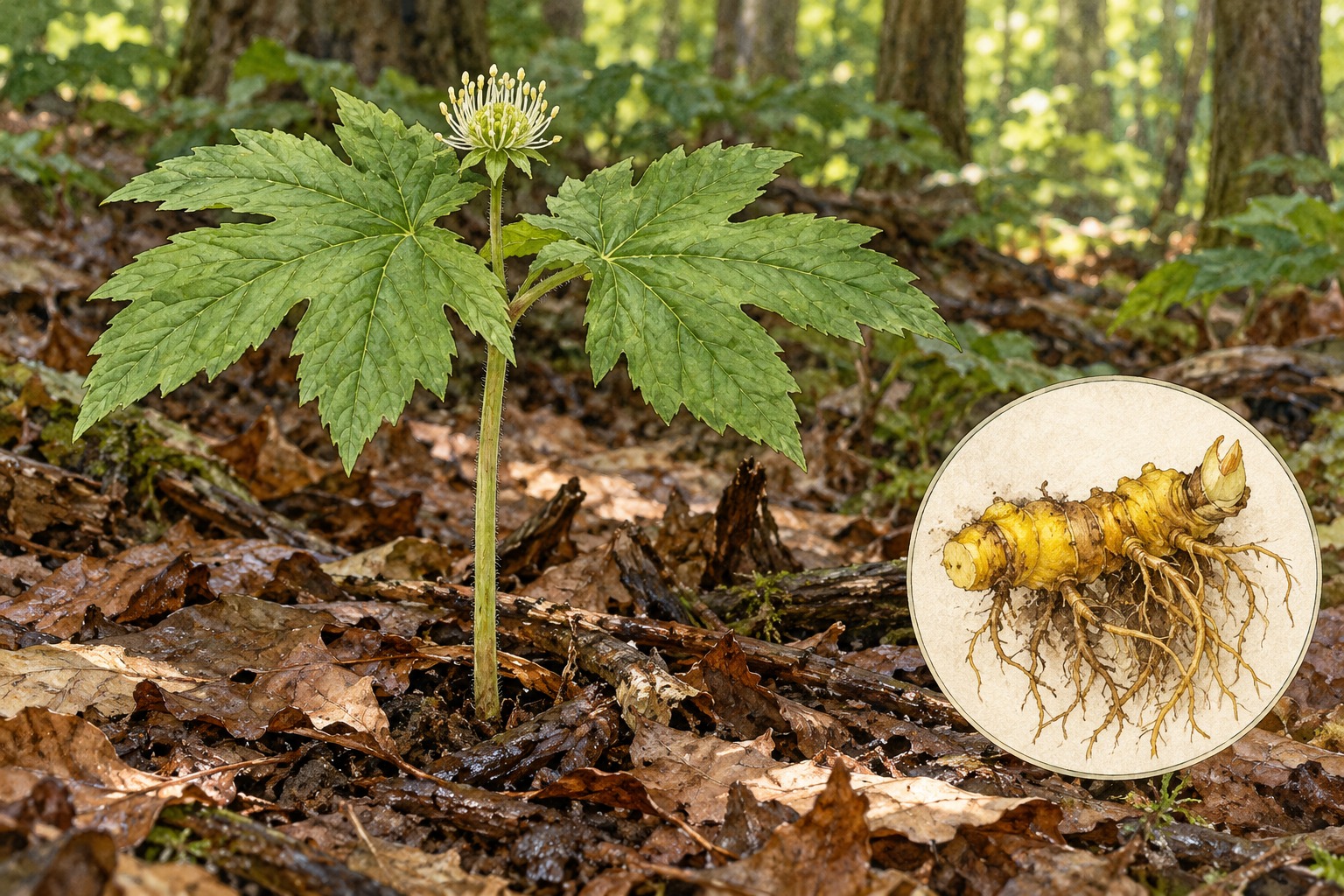
The native range is in eastern North America, including southeastern Canada and the eastern United States. Conservation records describe the plant in mesic deciduous woods with organic-rich, well-drained soil; it occurs in seasonal bottomlands near rivers and in upland sites under closed to partly open forest canopy. Canada’s COSEWIC report records populations on sandy loam or clay soils, with pH ranging from moderately acidic to near-neutral or slightly alkaline by habitat. These are descriptions of North American populations, not a recipe that guarantees success in a tropical climate. The plant is vulnerable to drought and drainage changes; canopy removal or ground disturbance can alter its microhabitat.
- Start with documented seed or nursery rhizome stock; do not dig wild populations. Seed has dormancy and slow germination, so established nursery plants or healthy rhizome divisions can shorten establishment time.
- Choose woodland-like shade and humus-rich soil that stays moderately moist but drains freely. USDA guidance gives roughly 47–80% shade as a reference range; local conditions and planting stock matter.
- Prepare a bed with leaf mold or mature compost, maintaining a loose, drained structure. Avoid prolonged flooding, compacted soil, or all-day direct sun; do not place fresh manure directly around rhizomes.
- Plant rhizome divisions shallowly according to nursery instructions, with buds upward and a light soil/leaf-mold cover. Water young plants when the soil begins to dry but do not leave water standing around the crown.
- Maintain stable shade, hand-weed gently, and watch for disease or rhizome rot. Do not apply untracked pesticides to a medicinal crop; record planting-stock source, site, and year.
- Harvest only from an authorized cultivated bed when it reaches the regional quality standard. Grower sources report about 3–5 years from rhizome pieces and 5–7 years from seed; timing varies with region, method, and bed health.
How long until harvest? North Carolina State Extension estimates harvestable roots at about 3–5 years from rhizome pieces and 5–7 years from seed. Ontario’s agriculture guidance gives roughly 3–5 years and notes that disease pressure can affect harvest timing. These are North American production estimates, not guarantees of yield or quality and not recommendations for human use. Do not harvest wild plants simply because they appear mature; local conservation rules and harvest rights apply.
References checked
- Taxonomy and accepted-name record · Kew POWO ↗
- Usefulness and safety · NCCIH ↗
- Canadian habitat and conservation assessment · COSEWIC ↗
- Commercial cultivation · NC State Extension ↗
- Harvest and processing · Ontario Ministry of Agriculture ↗
- CITES: analysis of trade in goldenseal parts and derivatives ↗
- CITES PC25: annotation #8 for roots and rhizomes ↗
From plant to dried material · source-recorded workflow
- Record the cultivated lot, species, planting-stock source, and harvest date; dig in autumn after the tops die back as local grower guidance recommends. Do not collect from the wild without authorization.
- Remove soil and gently wash rhizomes/roots with clean water; discard rotten or mixed material. Avoid aggressive scrubbing and do not substitute color for an identity test.
- Dry promptly in clean airflow at a low controlled temperature under the facility standard. Ontario guidance reports around 38°C or below as an optimum; follow the applicable monograph and calibrated equipment.
- Cool, grade, inspect for moisture/mold, and package in sealed, lot-coded containers. Only qualified facilities can confirm identity, quality, and chemical specifications; these are post-harvest notes, not a home-use preparation.
This record supports study and processing traceability; it is not a home preparation or self-use guide.
Open process source ↗