Jiang Huang · Turmeric rhizome · Jiang Huang
Curcuma longa L. · Dried rhizome
Name and part used
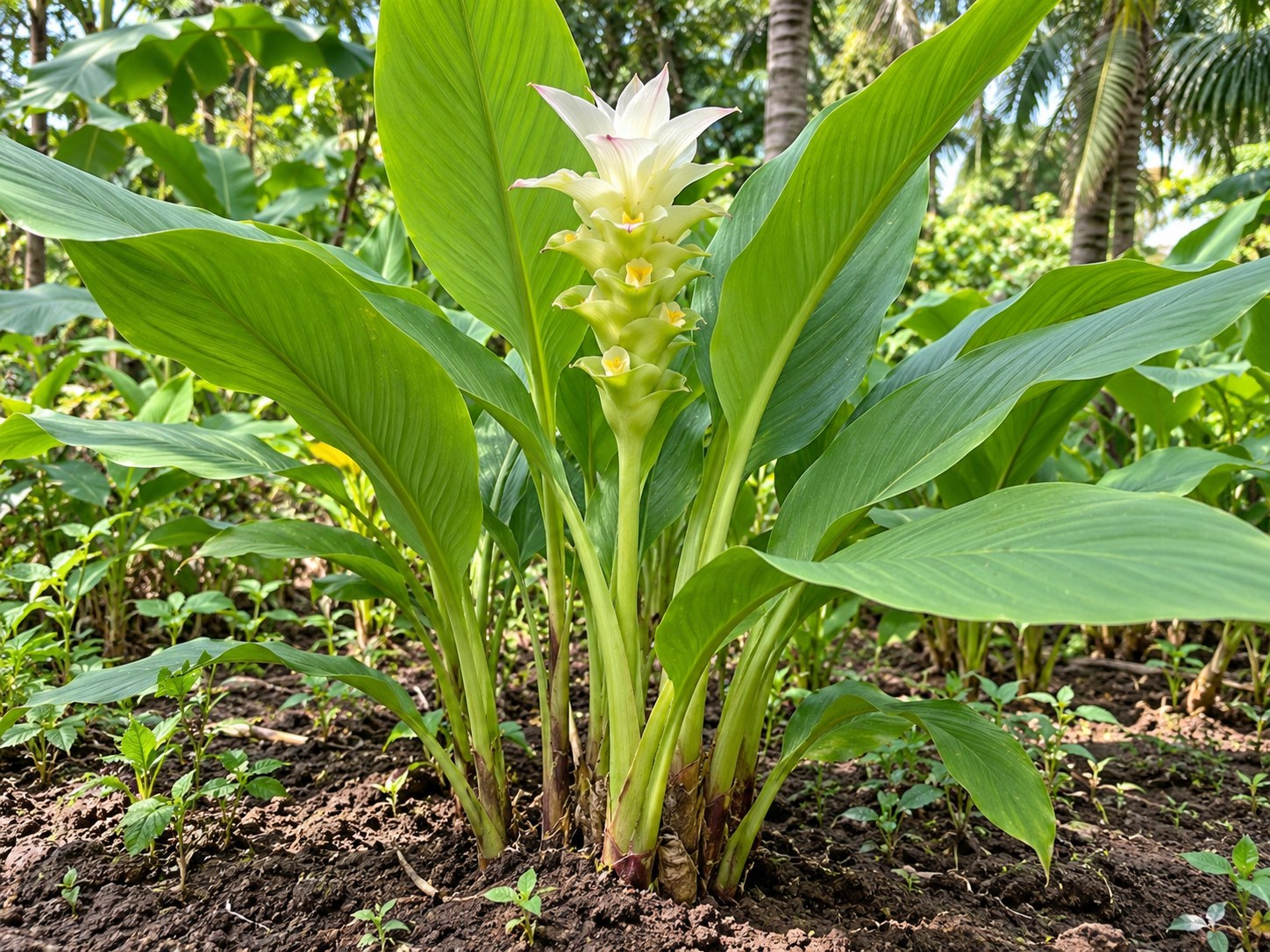
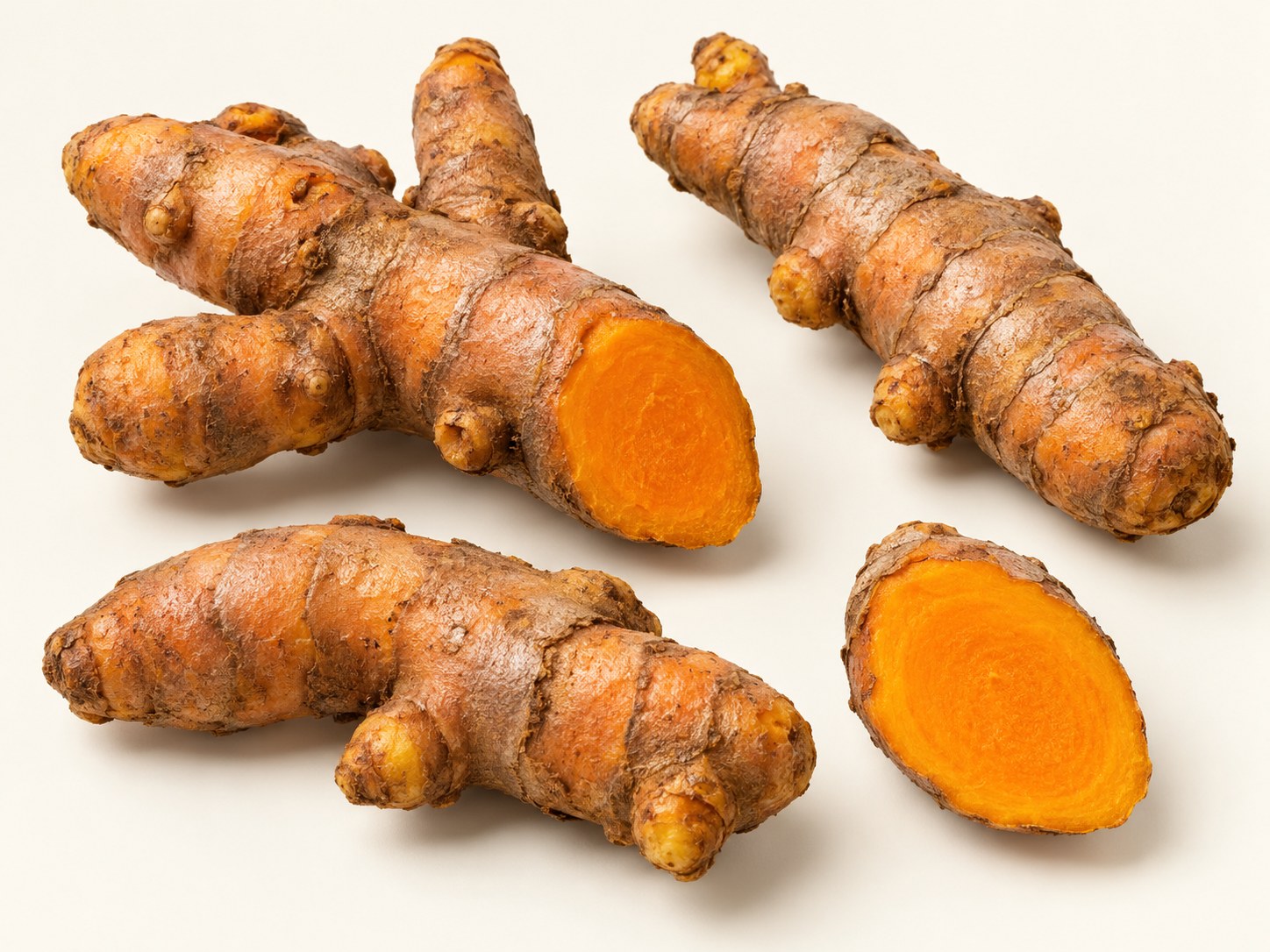
Jiang Huang is the rhizome of Curcuma longa L., a perennial Zingiberaceae herb. Plants reach roughly 1.5 m, with five to seven large oblong leaves and long petioles emerging from underground rhizomes. A pale-bracted spike bears light-yellow flowers. Rhizomes grow in clusters, with brownish skin and aromatic orange-yellow flesh; dried drug pieces are short and branched with deep yellow cut surfaces. Do not conflate Jiang Huang with Yu Jin: they can involve different underground parts or Curcuma species and require separate processing. Culinary turmeric from the same species is not automatically equivalent to a processed medicinal lot. AI images help visualize the plant and rhizome but cannot establish curcuminoid content or purity.
Traditional context
HKBU records Jiang Huang as pungent, bitter, and warm, with traditional actions described as moving blood stasis, regulating qi, and relieving pain. Historical records list complaints such as chest or flank pain, injury, and menstrual disorders. These descriptions do not show turmeric treats blood clots, acute pain, cardiovascular disease, or abdominal emergencies. Chest pain, heavy bleeding, or sudden severe pain requires urgent care.
Modern evidence
Curcumin and turmeric constituents are widely studied, but culinary powder, decocted rhizome, purified curcumin, and enhanced-bioavailability products are different exposures. A result for one standardized extract does not establish efficacy of spice or decoction for a disease. Kew notes that rhizome constituents vary with cultivar, growing site, harvest stage, and processing. Do not replace anticoagulants, cancer treatment, or pain medicine with turmeric; evidence and safety depend on formulation.
Safety
HKBU’s materia-medica record flags Jiang Huang as toxic in its traditional data; culinary spice and concentrated products cannot be assumed to have the same dose or risk. Bleeding risk or biliary/liver effects may matter for some people; consult a clinician or pharmacist when using anticoagulants, with gallstones or biliary obstruction, liver disease, planned surgery, pregnancy, or ongoing treatment. Allergy and digestive upset are also possible. Jaundice, dark urine, bleeding, or severe abdominal pain needs assessment.
Safety reference ↗Pairing in reference texts
HKBU transcribes historical examples pairing Jiang Huang with Gui Zhi for pain and another with Hua Shi and Mu Tong; these examples include mineral ingredients and identity/safety concerns. Do not reproduce historical quantities or combine with anticoagulants or biliary medicines without review. A traditional pairing does not establish modern interaction safety.
Identification and study notes
The orange-yellow rhizome cross-section is a useful visual cue; the plant forms a clump of broad leaves with a pale-bracted spike. Deep color does not measure potency, purity, or active-compound dose. Do not confuse Jiang Huang with Yu Jin because both involve Curcuma: drug names specify species and part. Yellow powder may be adulterated; learn whole-rhizome morphology, Latin labelling, and processing records before assessing powders. When studying the images, inspect the cut rhizome color and branching; the exterior is brownish-yellow with rings. Turmeric has broad leaves, unlike small ginger-like culinary rhizomes, and the inflorescence has pale bracts. Drug slices are often thick, hard, and orange-yellow, while Yu Jin has a different botanical source or process. Natural constituents vary with cultivar, soil, and harvest time, so color cannot replace analysis. Record planting source, cultivation period, digging date, boiling/drying method, and storage conditions. Powder hides many morphological cues and may be adulterated; learn whole rhizomes and labelled slices before comparing powder. Mùi thơm, độ cứng và mặt cắt cam chỉ là đặc điểm mô tả, không phải phép thử hoạt chất tại nhà. Lô thương mại cần tránh ẩm/ánh sáng và được đánh giá theo tiêu chuẩn dược điển. Cây cảnh đúng loài vẫn có thể có dư lượng thuốc hoặc thiếu hồ sơ chế biến. Hãy tách ảnh học tập khỏi tuyên bố điều trị và đối chiếu nguồn thực vật với hồ sơ dược liệu.
Growth and habitat
HKBU records Curcuma longa from sunny sites and cultivation in southern China and tropical Asia. It needs warm conditions, a frost-free growing season, loose organic soil, and drainage. Prolonged rain, waterlogging, or infected seed rhizomes can rot the crop. Do not grow food/medicinal material beside contaminated water; soil and planting-stock quality affect residue risks.
Identification and study notes
The orange-yellow rhizome cross-section is a useful visual cue; the plant forms a clump of broad leaves with a pale-bracted spike. Deep color does not measure potency, purity, or active-compound dose. Do not confuse Jiang Huang with Yu Jin because both involve Curcuma: drug names specify species and part. Yellow powder may be adulterated; learn whole-rhizome morphology, Latin labelling, and processing records before assessing powders. When studying the images, inspect the cut rhizome color and branching; the exterior is brownish-yellow with rings. Turmeric has broad leaves, unlike small ginger-like culinary rhizomes, and the inflorescence has pale bracts. Drug slices are often thick, hard, and orange-yellow, while Yu Jin has a different botanical source or process. Natural constituents vary with cultivar, soil, and harvest time, so color cannot replace analysis. Record planting source, cultivation period, digging date, boiling/drying method, and storage conditions. Powder hides many morphological cues and may be adulterated; learn whole rhizomes and labelled slices before comparing powder. Mùi thơm, độ cứng và mặt cắt cam chỉ là đặc điểm mô tả, không phải phép thử hoạt chất tại nhà. Lô thương mại cần tránh ẩm/ánh sáng và được đánh giá theo tiêu chuẩn dược điển. Cây cảnh đúng loài vẫn có thể có dư lượng thuốc hoặc thiếu hồ sơ chế biến. Hãy tách ảnh học tập khỏi tuyên bố điều trị và đối chiếu nguồn thực vật với hồ sơ dược liệu.
Growing and care
- Select firm, healthy planting rhizomes labelled Curcuma longa; keep them separate from other Curcuma species.
- Plant at the start of warm weather in a loose, well-drained bed amended with mature organic matter; bury eye-bearing rhizome pieces under local agronomic guidance.
- Maintain even moisture, weed and earth up, and monitor rot; prevent standing water and avoid products not labelled for edible crops.
- When foliage naturally yellows, reduce irrigation and lift the cluster carefully; separate planting stock from rhizomes intended for processing.
How long until harvest? Kew reports turmeric is ready about 7–10 months after planting when lower leaves yellow; HKBU describes December digging in a production region. Timing varies by cultivar and climate. Harvest at natural senescence; immature rhizomes may be undersized, while seed stock must be kept intact and not boiled.
Habitat, season, and harvest in the HKBU botanical record
HKBU describes plants up to 1.5 m tall with 30–45 cm leaves and orange-yellow rhizomes, cultivated in sunny regions. Underground parts are harvested late in the year, separated into drug and daughter rhizomes, then washed; Jiang Huang may be boiled and dried or sliced and sun-dried. This page distinguishes Yu Jin and is not a self-treatment recipe.
Open botanical source ↗FROM PLANT / SOURCE HABITAT TO DRIED MATERIAL · REFERENCE WORKFLOW
- Authenticate Curcuma longa and lot the crop; reject rotten, bruised, or contaminated rhizomes.
- Dig after foliage yellows or dies back; remove soil and tops, wash with clean water, and separate planting stock.
- HKBU describes thorough boiling followed by drying and peeling, or slicing about 0.7 cm and sun-drying; these are controlled processing steps.
- Cool and label species, origin, harvest date, and process; store dry, protected from insects and mold, and separate from Yu Jin.
These are post-harvest study notes, not directions to prepare a remedy for self-treatment. Processing reference ↗