Ji Xue Cao · Asiatic pennywort · Ji Xue Cao
Centella asiatica (L.) Urb. · Dried whole herb, sometimes including roots
Name and part used
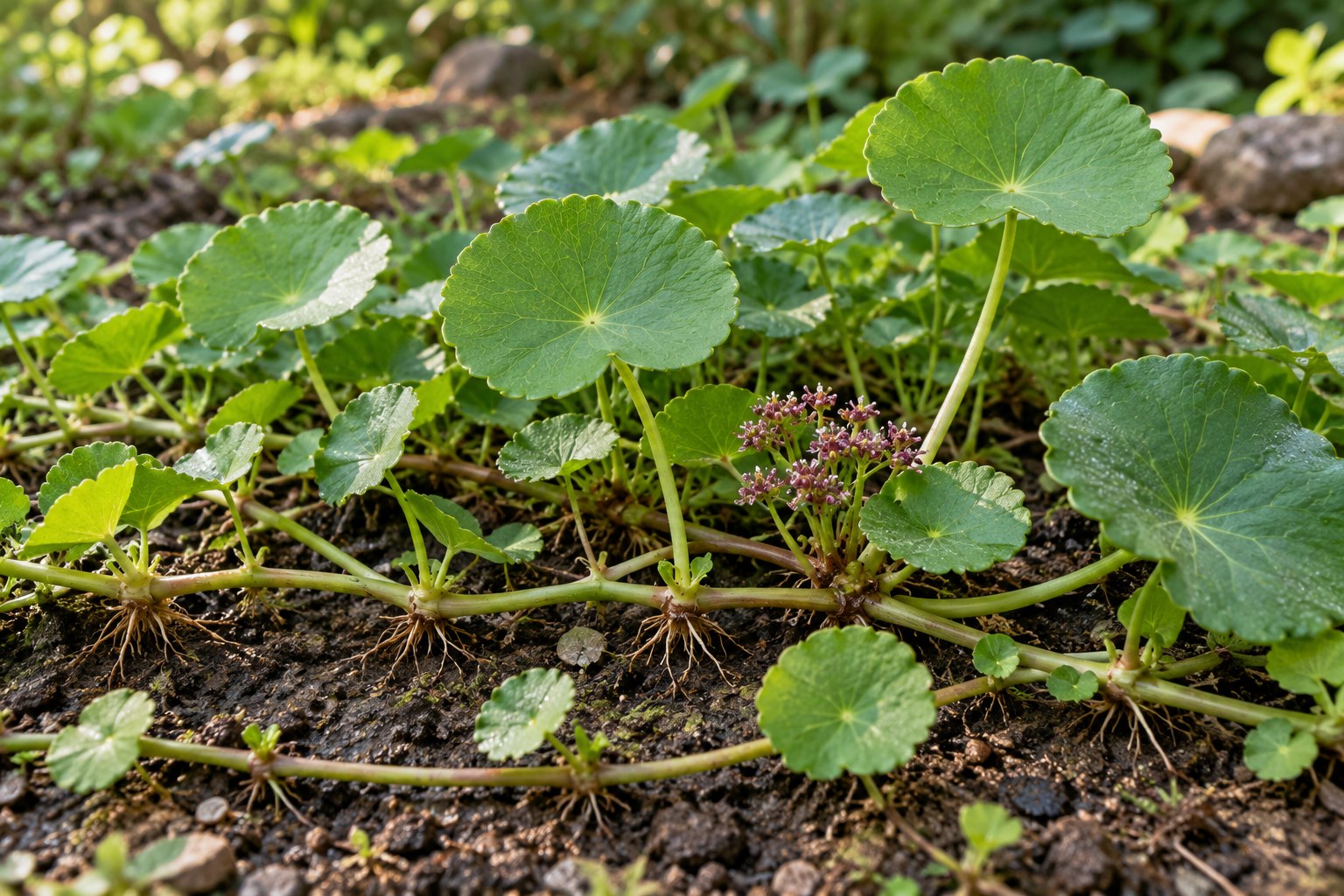
Ji Xue Cao is Centella asiatica (L.) Urb. in Apiaceae, a perennial creeping herb. Slender stolons root at nodes and produce new shoots. Simple alternate leaves have long petioles and round to kidney-shaped blades about 2–4 cm wide, a broad heart-shaped base, and rounded teeth. Small axillary umbels bear a few minute reddish-purple flowers; the fruit is small and flattened. These features help distinguish it from Hydrocotyle sibthorpioides, another low creeping plant sometimes called pennywort. HKBU records the drug as the whole plant, sometimes with roots; collection is in summer or autumn, followed by removal of mud and sun-drying. It commonly grows in slightly moist fertile soil beside roads, ditches, and field banks. “Pennywort” or “rau má” is also a food name in many places, but a wild specimen is not automatically clean or correctly identified.
Traditional context
HKBU materia-medica records traditional concepts of clearing heat, promoting urination, resolving toxin, and reducing swelling; examples mention damp-heat jaundice, diarrhea, painful urination, and skin lesions. These are historical records, not evidence that Centella treats liver disease, infection, diarrhea, or urinary stones. Jaundice, blood in urine, high fever, or dehydrating diarrhea needs medical assessment.
Modern evidence
HKBU brings together botanical, constituent, and traditional descriptions; that record is not a clinical trial. Studies of triterpenes/asiaticoside, cosmetics, or wounds use particular extracts and conditions and cannot be generalized to fresh salad, homemade tea, or decoctions. Species, plant part, material quality, and topical versus oral exposure matter. A familiar food name does not establish that every preparation is safe for everyone.
Safety
Do not collect pennywort from drains, roadsides, or sprayed fields: low creeping plants readily contact mud, animal waste, and chemicals. Washing food properly does not turn an unidentified plant into medicine. People who are pregnant/breastfeeding, have liver disease, take medicines, or are preparing for surgery should not self-use concentrated extracts; ask a clinician or pharmacist. Do not apply it to deep or infected wounds. Culinary use requires correctly identified food-grade plants from a clean source and does not equal self-treatment.
Safety reference ↗Pairing in reference texts
HKBU cites a folk example pairing Centella with motherwort and rock sugar in historical records, but “a handful” is not a standardized ratio, does not prove efficacy, and is not a prescription. This page does not turn that account into a dose or treatment recipe. No specific toxic incompatibility was verified in the reviewed sources; this does not make arbitrary combinations safe. Do not combine it with prescription medicines without professional advice.
Identification and study notes
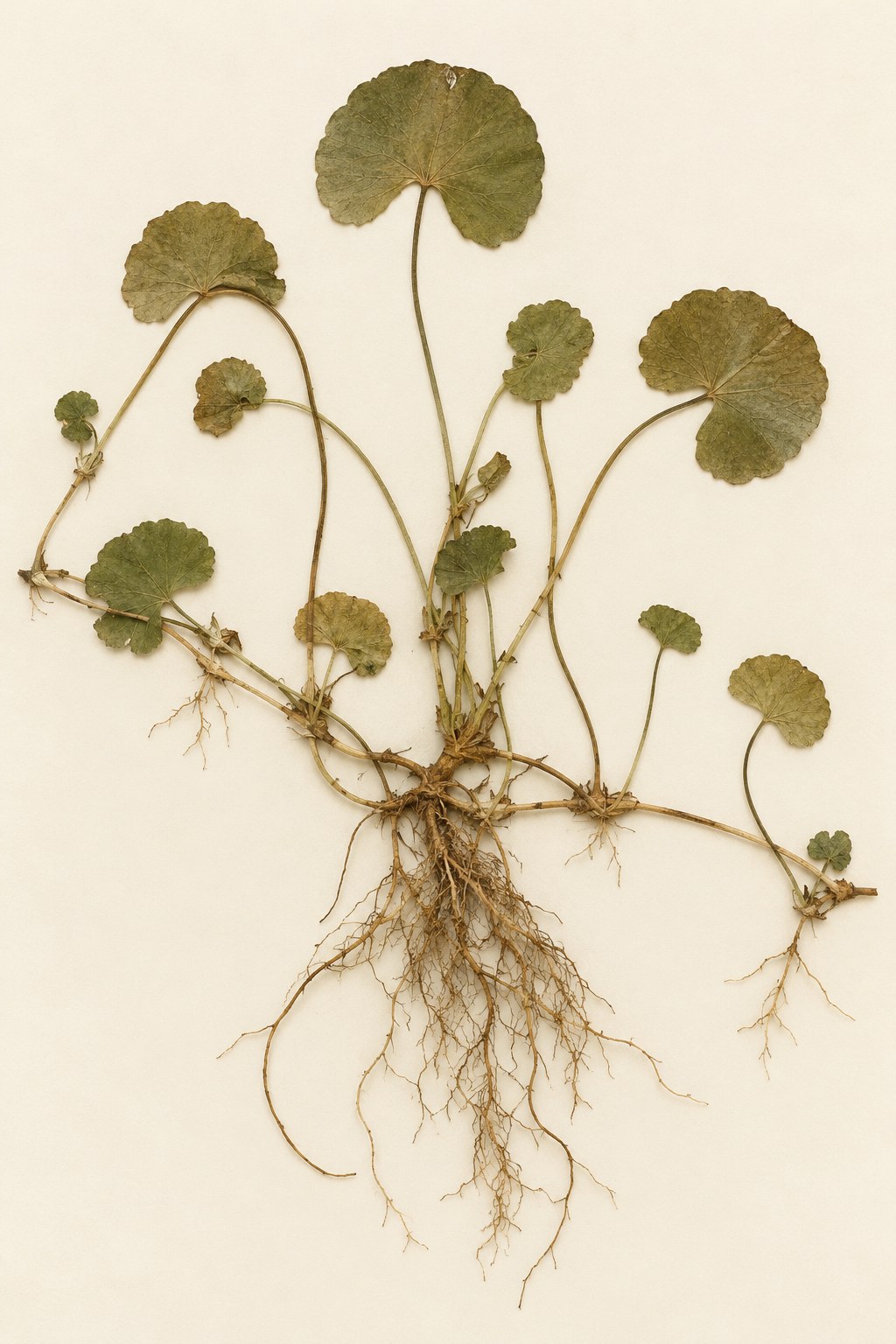
Centella creeps rather than forming an erect bush. Slender stolons run over the ground and root at nodes; each leaf is carried on a separate long petiole, with a nearly round or kidney-shaped blade and veins radiating from the petiole attachment. Margins have rounded teeth rather than deep sharp lobes. The flower clusters are tiny and hard to see at a distance; AI art may enlarge them for study. A dried whole-plant specimen retains fine brown stolons and wrinkled green-brown leaves. Distinguish it from Hydrocotyle by comparing petioles, venation, inflorescences, and fruits—not by the common name “pennywort” alone. Although culinary rau má is eaten in some regions, the dried illustration here is a study specimen, not eating or treatment advice.
Growth and habitat
HKBU places Centella in slightly moist, fertile soil along roads, ditches, and field banks, with distribution across many eastern, central, southern, and southwestern Chinese provinces. The plant spreads by stolons that root at nodes and is associated with moist but not persistently flooded ground. A home observation bed can use a wide tray, clean organic-rich soil with drainage, and gentle sun or partial shade. Natural growth in drains is not a safe materia-medica source because of contamination risk.
Identification and study notes
Centella creeps rather than forming an erect bush. Slender stolons run over the ground and root at nodes; each leaf is carried on a separate long petiole, with a nearly round or kidney-shaped blade and veins radiating from the petiole attachment. Margins have rounded teeth rather than deep sharp lobes. The flower clusters are tiny and hard to see at a distance; AI art may enlarge them for study. A dried whole-plant specimen retains fine brown stolons and wrinkled green-brown leaves. Distinguish it from Hydrocotyle by comparing petioles, venation, inflorescences, and fruits—not by the common name “pennywort” alone. Although culinary rau má is eaten in some regions, the dried illustration here is a study specimen, not eating or treatment advice.
Growing and care
- Choose nursery stock labeled Centella asiatica from a clean source; use a wide planter and clean organic soil, never collect from drains or sprayed fields.
- Place in morning sun or partial shade; keep evenly moist but allow drainage and do not leave the tray flooded. Stolons may root at nodes and spread into neighboring pots.
- Remove yellow leaves, hand-weed, and monitor leaf pests; record round/kidney-shaped blades, long petioles, heart-shaped bases, and rooting stolons. Do not spray a study specimen.
- The source records summer and autumn harvest but does not state plant age or weeks after planting. Photograph stolon spread, flowering, and fruiting for study; do not assume a home-grown plant meets medicinal quality standards.
How long until harvest? HKBU gives summer–autumn as a collection season but no number of days from planting. A plant may cover a tray quickly under suitable moisture and light, but this does not demonstrate medicinal safety or quality. Record planting, node rooting, flowering, and fruiting; keep it for observation.
Habitat, season, and harvest in the HKBU botanical record
HKBU describes Centella asiatica as a perennial creeping herb with slender stems rooting at nodes, round/kidney leaves, and small reddish-purple umbels. Habitats include slightly moist fertile soil beside roads, ditches, and field banks. The drug is the whole plant, sometimes with roots; harvest is in summer–autumn, followed by mud removal and drying. The botanical profile includes historical use examples but is not a clinical trial.
Open botanical source ↗FROM PLANT / SOURCE HABITAT TO DRIED MATERIAL · REFERENCE WORKFLOW
- HKBU records summer or autumn collection of the whole plant, mud removal, and sun-drying; do not use this to encourage wild harvesting.
- Compare kidney-shaped leaves, rooting stolons, and small flower clusters; remove debris, mud, and damaged parts. Keep similar species separate and record specimen provenance.
- The profile describes cleaning mud and sun-drying. For a study sample, spread it thinly on a clean ventilated surface away from dust, animal waste, insects, and contaminated water; do not make a specimen for ingestion.
- Label Latin name, growing location, part, and collection date; store dry and sealed. Discard unusual-smelling, moldy, untraceable, or chemically exposed material rather than trying to “rescue” it by washing.
These are post-harvest study notes, not directions to prepare a remedy for self-treatment. Processing reference ↗