Suberect spatholobus stem · Ji Xue Teng
Spatholobus suberectus Dunn · Vine stem
Name and part used
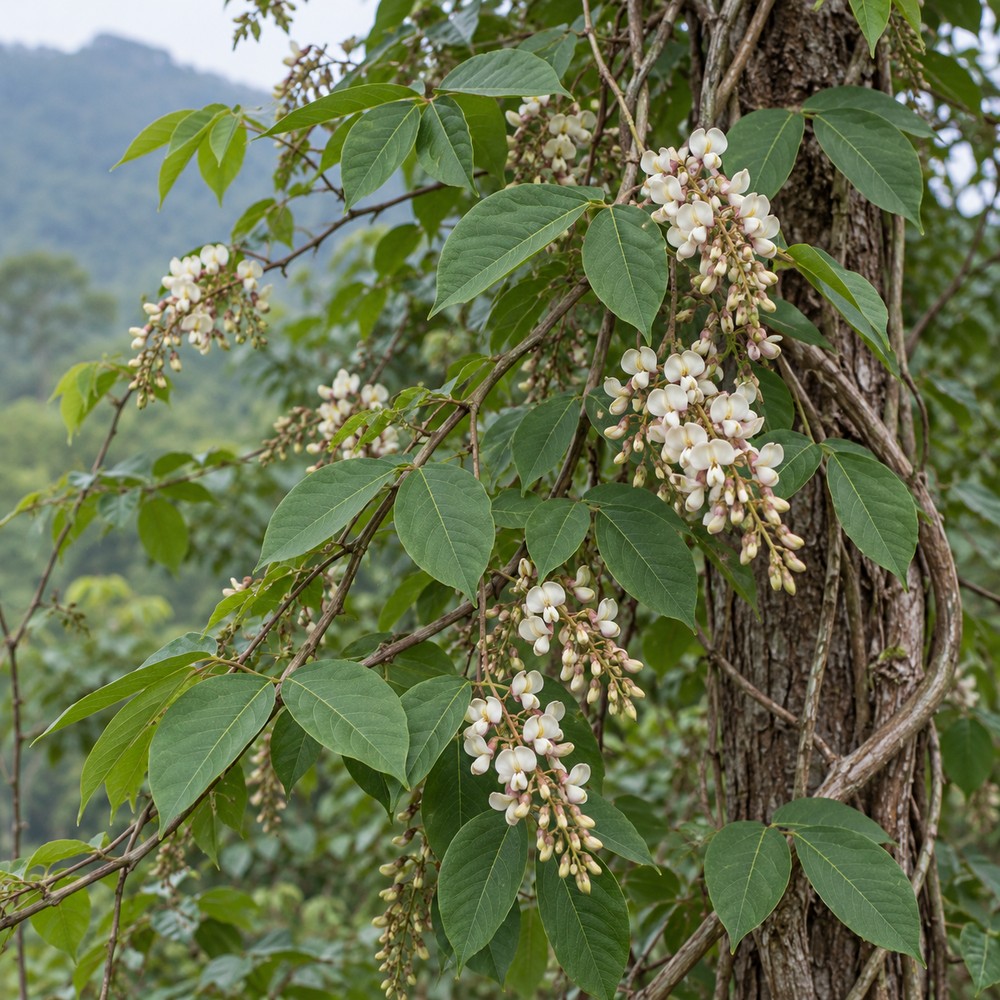
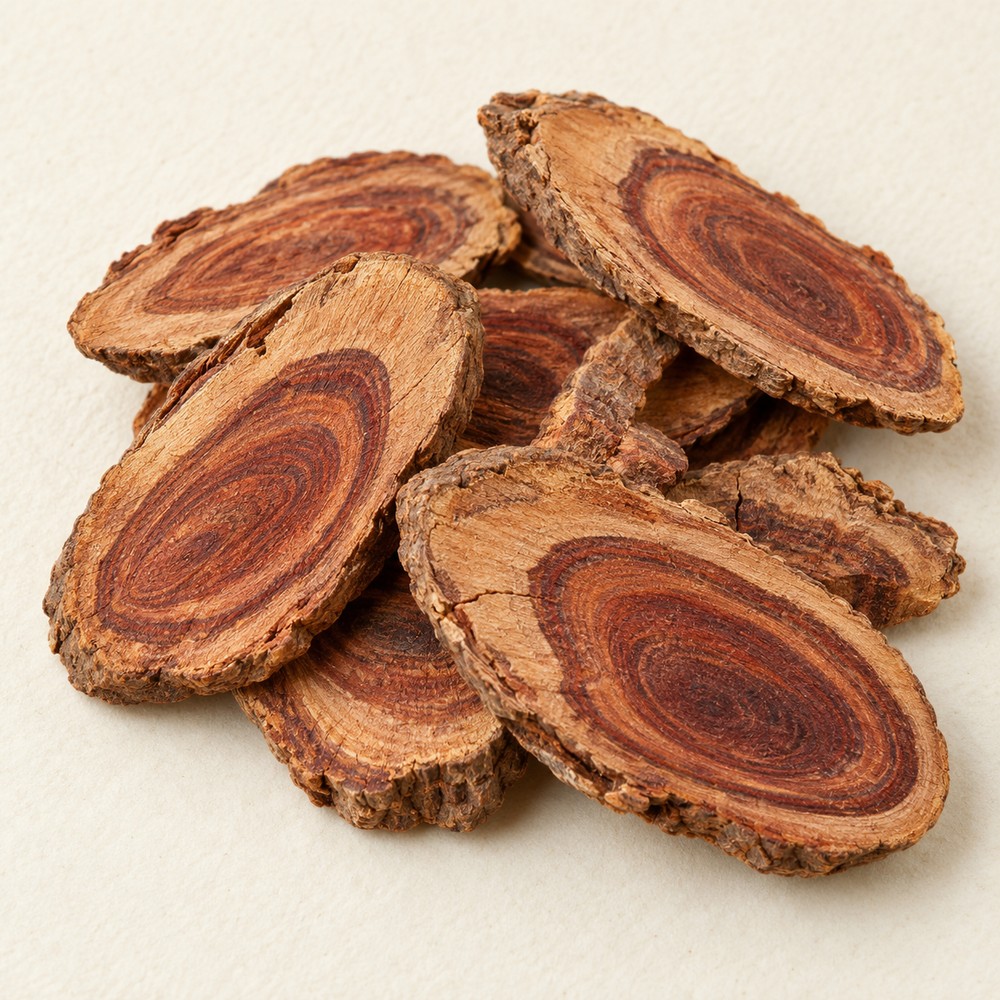
A woody perennial vine has trifoliate leaves and papilionaceous flowers; dried stem slices show reddish wood and eccentric dark-red resin rings.
Traditional context
Blood-nourishing, blood-moving, and network-opening are traditional claims, not treatment for anemia, menstrual disease, or paralysis.
Modern evidence
HKBU identifies dried Spatholobus suberectus vine; 3–8 eccentric resin rings are a macroscopic feature.
Safety
May affect coagulation/hormones; use caution in pregnancy, heavy bleeding, anticoagulant use, liver disease, and pre-surgery.
Pairing in reference texts
Ji Xue Teng appears with Dang Gui or Xu Duan in historical formulas; do not self-treat paralysis or arthritis.
Growth and habitat
Spatholobus suberectus is a woody Fabaceae vine climbing through valley forests, stream margins, and thickets in southern China. It has trifoliate leaves and clusters of small white flowers; mature cut stems show reddish-brown secretions in rings. It needs a support structure, warm humid conditions, and humus-rich but drained soil. Without a trellis, crowded vines tangle and lose airflow.
Botanical / habitat source ↗Growing, care, and harvest timing
The profile above includes sourced steps and a documented harvest window. Harvest timing is agronomic information, not a self-use instruction.
Growing and care
- Obtain seed or cuttings from authenticated, legal Spatholobus suberectus stock; do not confuse it with other woody Fabaceae vines.
- Install a sturdy trellis or support tree before planting; use loose, drained humus-rich soil and light afternoon shade.
- Maintain moisture during establishment, mulch with clean organic matter, and avoid prolonged waterlogging or crown injury.
- Train young vines up the support, prune dead or diseased stems for airflow, and use moderate mature compost rather than excess nitrogen.
- Monitor aphids, stem borers, and fungi after rainy periods; sanitize cutting tools and dispose of diseased debris separately.
- Harvest mature stems selectively under a sustainable plan, retaining mother vines and regrowth; do not strip bark or clear-cut the plant.
How long until harvest? HKBU records medicinal stems as collected in autumn–winter, but reviewed open sources give no universal number of years from planting to harvest. Vine age varies with propagation, support, and region; harvest mature stems under local standards rather than treating flowering as proof of materia quality.
Cultivation / season source ↗FROM PLANT / SOURCE HABITAT TO DRIED MATERIAL · REFERENCE WORKFLOW
- Thu dây vào thu đông, loại cành lá theo hồ sơ HKBU.
- Collect vines in autumn/winter and remove branches and leaves per HKBU.
These are post-harvest study notes, not directions to prepare a remedy for self-treatment. Processing reference ↗
How to read formula amounts
The cited sources do not provide a formula with specific amounts for this profile; no ratio is invented. Absence from the incompatibility list does not establish safety.
Habitat, season, and harvest in the HKBU botanical record
HKBU botanical record (translated summary): Flowering and fruiting dates: Flowering: June, fruiting: November to December Habitat and distribution: Growing in valley forests, by streams or in thickets. Distributed in Fujian, Guangdong, Guangxi, Yunnan and etc. The medicinal materials are mainly produced in Guangxi Harvest and processing as recorded: Collected in autumn and winter, removed branches and leaves, cut into thick slices, and sun-dried
Open botanical source ↗