Lu Gen · reed rhizome · Lu Gen
Phragmites australis (Cav.) Trin. ex Steud. (syn. Phragmites communis Trin.) · Fresh or dried rhizome
Name and part used
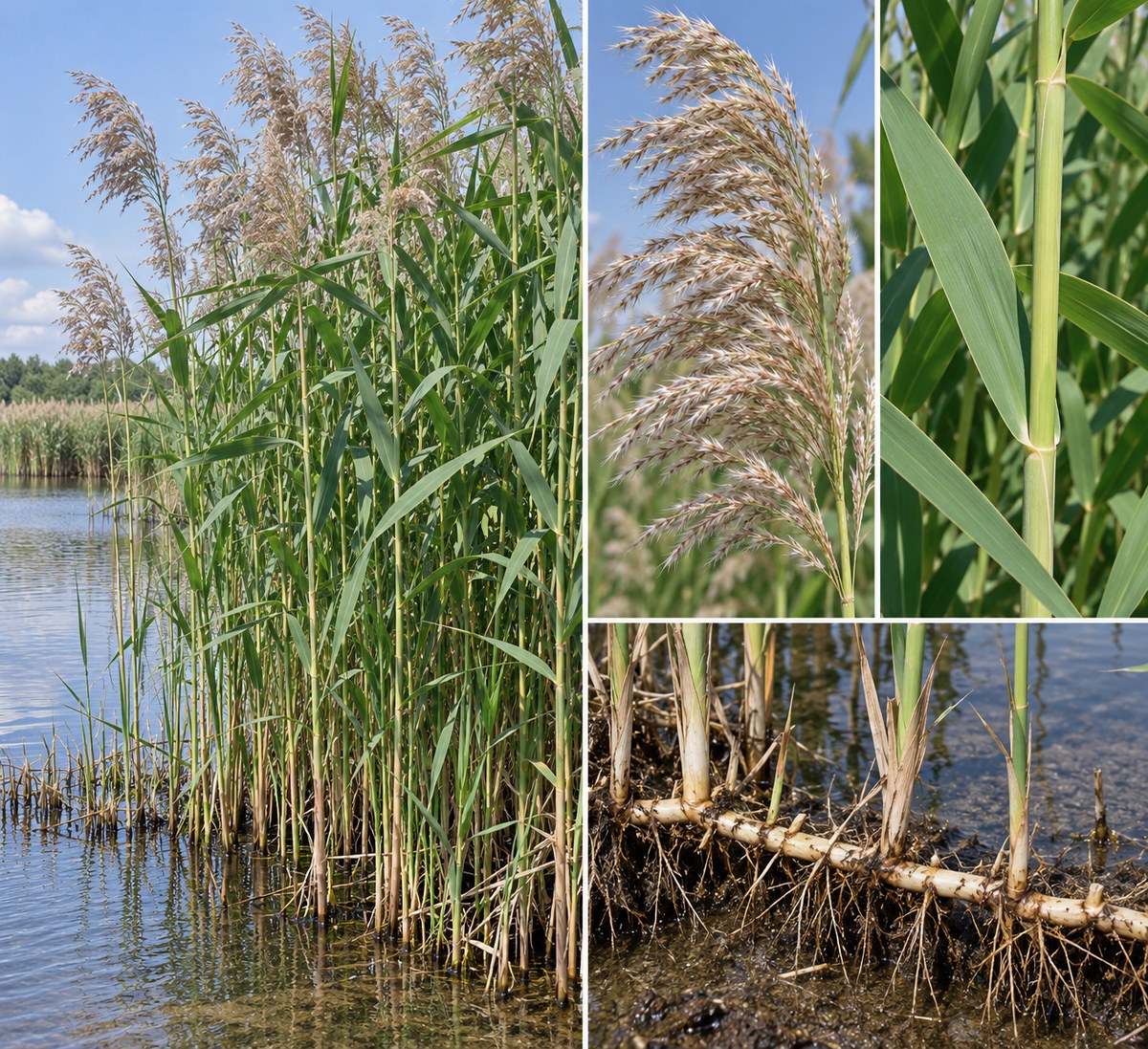
Lu Gen is the rhizome of reed, Phragmites; HKBU uses Phragmites communis (L.) Trin., a name commonly treated as synonymous with P. australis. This perennial aquatic grass grows 1–3 m tall, with jointed culms, two-ranked long leaves, and a sparse slightly drooping terminal panicle. The creeping underground rhizome is yellow-white with nodes and root scars. Riverside reeds can be misidentified and may accumulate water pollutants.
Traditional context
HKBU records a sweet, cold nature and traditional actions of clearing heat, generating fluids, relieving irritability, checking vomiting, and promoting urination. These are not proof of treatment for pneumonia, fever, persistent vomiting, or infection.
Modern evidence
HKBU records species, rhizome, and traditional actions; this is not a clinical trial proving treatment. Chemistry or preclinical studies do not validate an individual dose. Do not use rhizomes dug from a riverbank because metals, pesticides, and microbes in water may contaminate the material.
Safety
Do not harvest from polluted rivers, canals, or ponds and do not confuse it with other wetland grasses. Kidney disease, fluid restriction, diuretics, pregnancy/breastfeeding, or dehydration from vomiting warrants professional advice. Fever, ongoing vomiting, confusion, or little urine needs medical care, not just an herbal decoction.
Safety reference ↗Pairing in reference texts
HKBU mentions Lu Gen in Wu Zhi Yin with pear, water chestnut, Ophiopogon, and lotus-root juices; this is a historical beverage combination, without a standardized ratio in the cited record and not a preparation instruction. No specific toxic pair is confirmed; do not self-combine with diuretics or use it to treat pufferfish poisoning.
Identification and study notes
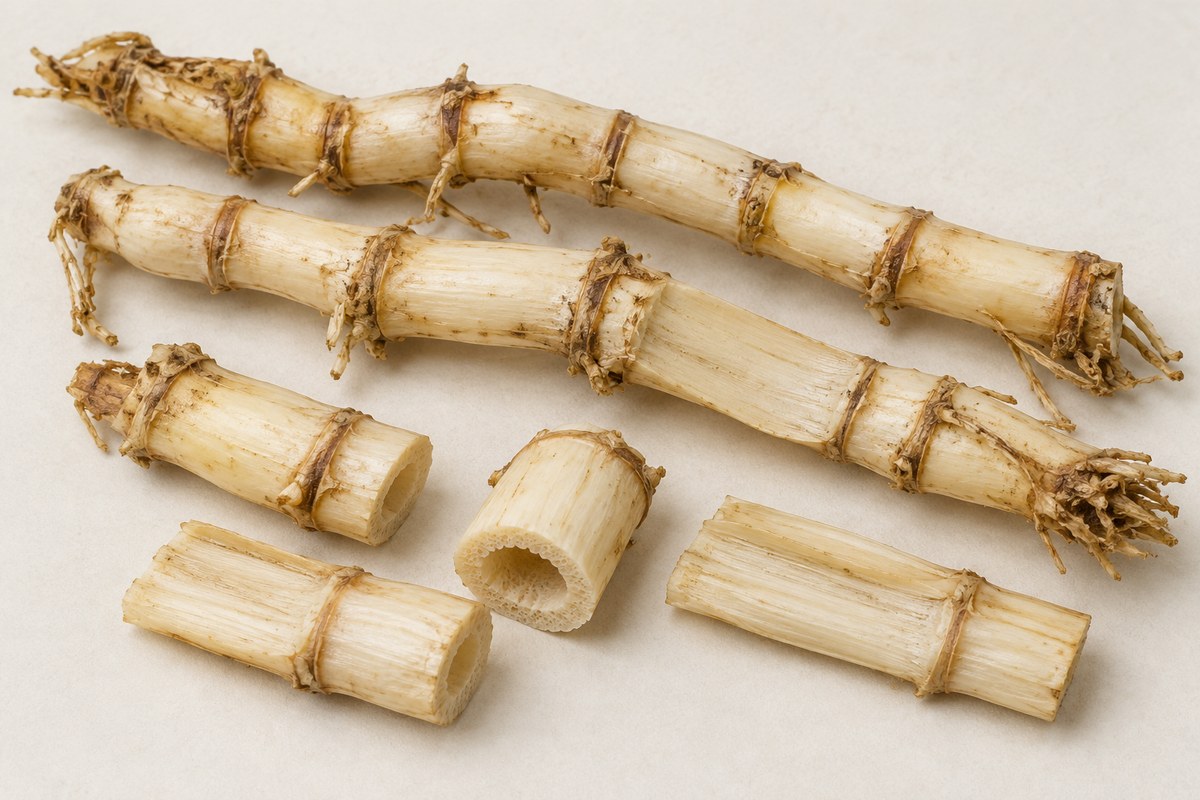
Reed is a perennial wetland grass with upright hollow jointed culms, often 1–3 m tall. Leaf sheaths wrap the stem; broad lanceolate blades form two ranks, and a long slightly drooping panicle rises at the top. Rhizomes creep horizontally in wet ground, with long nodes and pointed buds. Lu Gen is the rhizome, not the culm or plume. Fresh pieces are long, yellow-white, light but tough, with nodes and root scars; dried pieces are often flattened with longitudinal wrinkles and hard nodes. HKBU describes washing mud away, trimming culms/shoots/fibrous roots, peeling thin sheaths, then drying. Wetland plants may accumulate pollutants; a clean-looking image cannot prove a clean harvest site.
Growth and habitat
Reeds grow along rivers, pond margins, and shallow wetlands, with tall culms and spreading rhizomes in mud. They need sun, moist or shallowly flooded soil, and space; use a contained bed to prevent spreading. Select clean soil away from wastewater.
Identification and study notes
Reed is a perennial wetland grass with upright hollow jointed culms, often 1–3 m tall. Leaf sheaths wrap the stem; broad lanceolate blades form two ranks, and a long slightly drooping panicle rises at the top. Rhizomes creep horizontally in wet ground, with long nodes and pointed buds. Lu Gen is the rhizome, not the culm or plume. Fresh pieces are long, yellow-white, light but tough, with nodes and root scars; dried pieces are often flattened with longitudinal wrinkles and hard nodes. HKBU describes washing mud away, trimming culms/shoots/fibrous roots, peeling thin sheaths, then drying. Wetland plants may accumulate pollutants; a clean-looking image cannot prove a clean harvest site.
Growing and care
- Trồng thân rễ có mắt trong bùn sạch hoặc đất sét giàu hữu cơ, nơi nắng; giữ ẩm liên tục hoặc ngập nông. Tránh nước thải và dòng chảy từ khu công nghiệp.
- Plant a node-bearing rhizome in clean organic mud/clay in full sun; keep consistently moist or shallowly flooded. Avoid wastewater and industrial runoff.
How long until harvest? A perennial, harvested after a rhizome network has formed; HKBU gives harvest seasons but no age or month count. Young rhizomes are not automatically medicinal-grade.
Documented toxic incompatibility
Reviewed sources do not establish a specific toxic pair for Lu Gen. Practical collection risks are environmental contamination and misidentification; historical references to “pufferfish detoxification” are not an antidote.
AI study illustrations; not for specimen identification.
FROM PLANT / SOURCE HABITAT TO DRIED MATERIAL · REFERENCE WORKFLOW
- Excavate in spring, summer, or autumn per HKBU only from clean water and authenticated Phragmites; obtain permission before collecting.
- Wash mud away, remove culms, shoots, and fibrous roots, then peel remaining thin sheaths. Keep clean fresh rhizome lots separate if fresh form is studied.
- For dried material, sun-dry in a clean place, turn evenly, and protect from mud, insects, and dirty water; dried pieces are often flattened, yellow-white, and jointed.
- Record water source and date; discard chemical-smelling, black-muddy, or moldy lots. Do not use for pufferfish poisoning—call emergency services.
These are post-harvest study notes, not directions to prepare a remedy for self-treatment. Processing reference ↗
Material source, dried appearance, and processing forms (HKBU)
HKBU identifies Lu Gen as fresh or dried Phragmites communis Trin. rhizome. Fresh rhizomes are long cylinders, yellow-white, jointed, and pointed like a bamboo shoot; dried rhizomes are flattened, light, tough, longitudinally wrinkled, with hard nodes. Processing: excavate spring–autumn, wash, remove stems/shoots/fibrous roots, peel thin sheaths, and sun-dry; fresh material may be kept in moist sand.
Open original materia medica record ↗Habitat, season, and harvest in the HKBU botanical record
HKBU records Phragmites communis as a 1–3 m aquatic grass of river margins and shallow water; rhizomes are excavated in spring, summer, and autumn, washed, trimmed, and sun-dried. No cultivation-to-harvest schedule is provided.
Open botanical source ↗