Lu Lu Tong · Chinese sweetgum fruit · Lu Lu Tong
Liquidambar formosana Hance · Dried mature infructescence
Name and part used
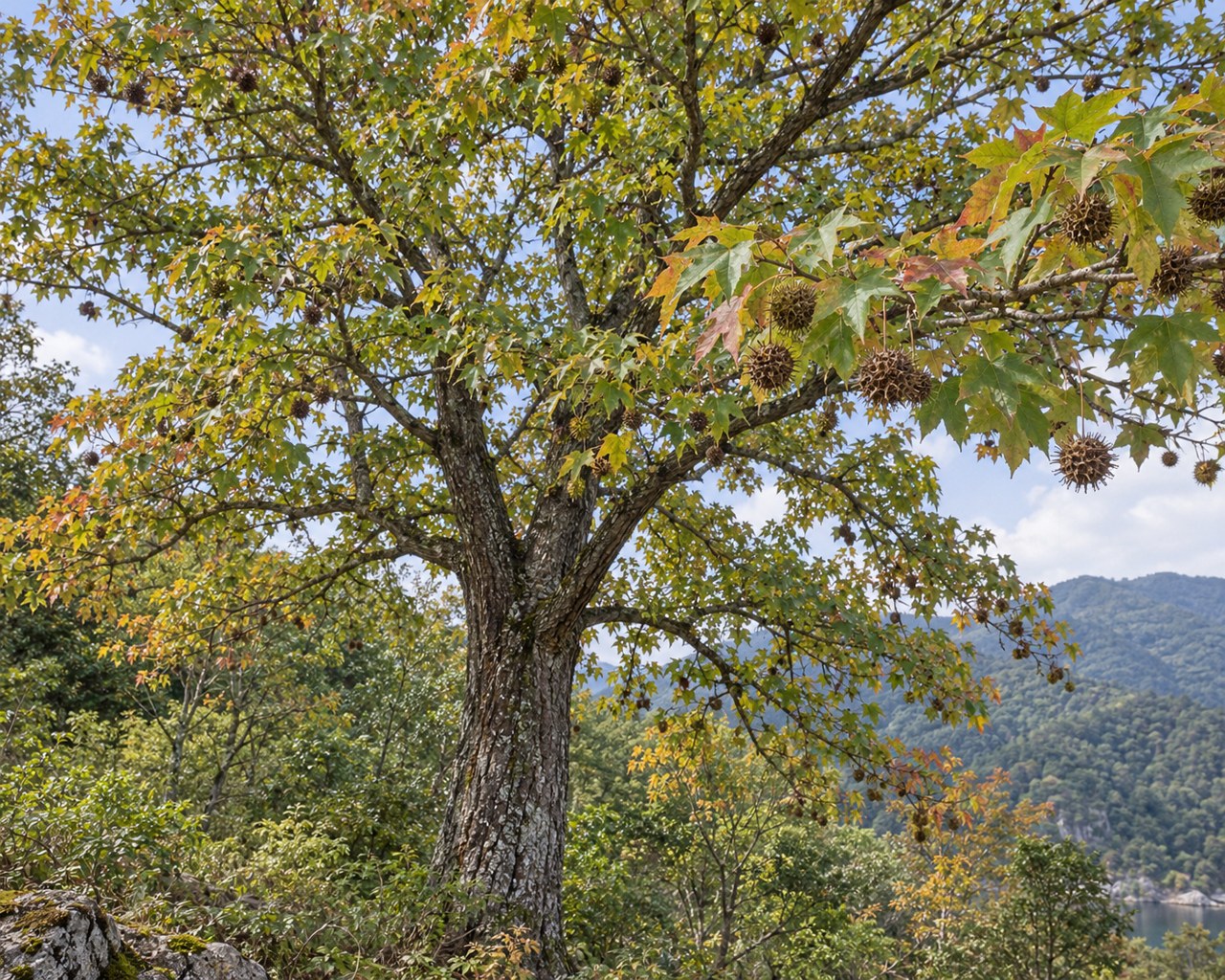
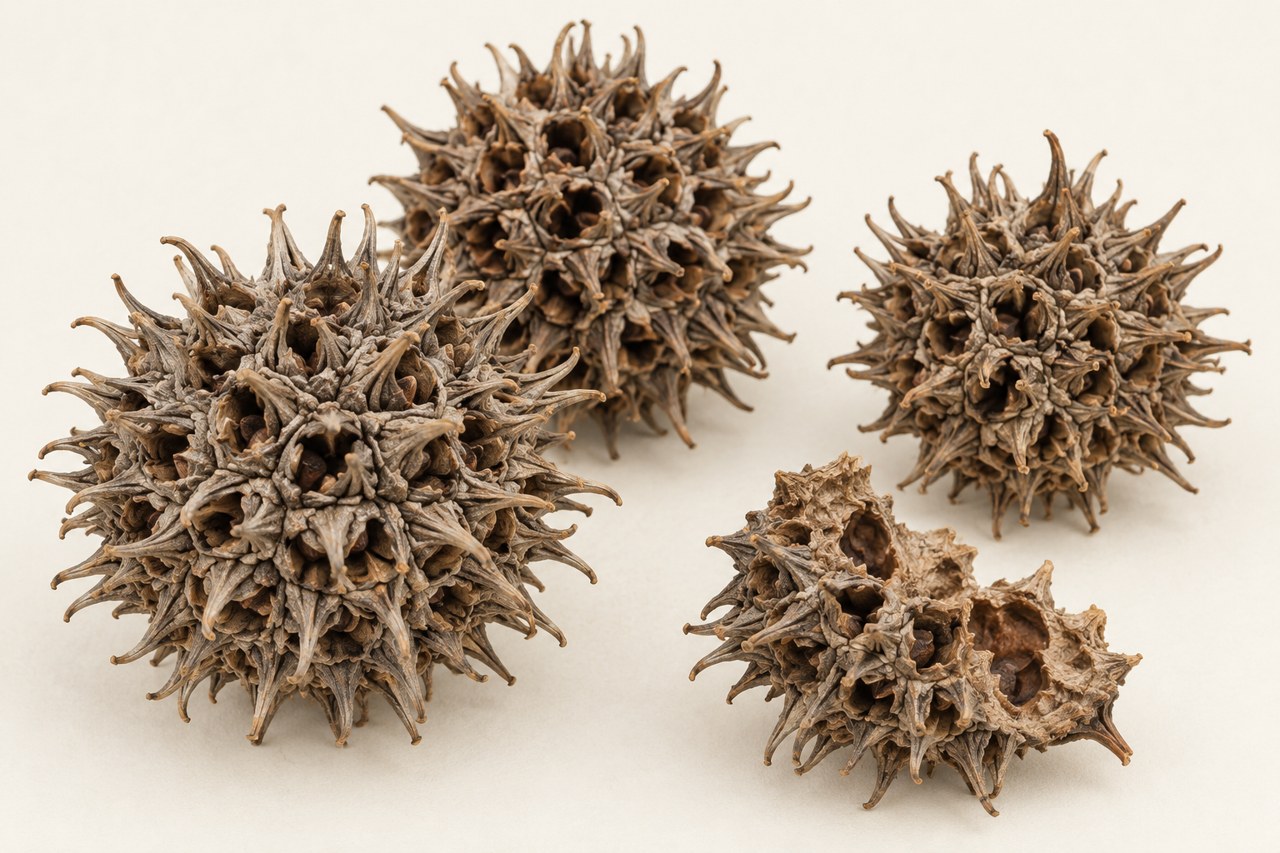
Lu Lu Tong in this record is the mature infructescence of Liquidambar formosana Hance, a large deciduous tree that may reach 20–40 m. Leaves are alternate and usually palmately three-lobed; mature trees bear separate male and female flowers on the same tree. After pollination, many small capsules form a woody sphere a few centimeters wide, with a spiky surface and honeycomb-like openings as capsules split. HKBU distinguishes Lu Lu Tong fruit clusters from the tree resin called Feng Xiang Zhi; these are different materials and are not interchangeable. Mature clusters are commonly collected in winter, cleaned, and sun-dried. This large tree is not a practical balcony medicinal crop. AI art illustrates the fruit form, not a quality-control standard.
Traditional context
HKBU records the fruit cluster as bitter and neutral, with traditional descriptions of dispelling wind, unblocking channels, promoting urination, and regulating menstruation. Its specimen record lists historical contexts such as joint pain, numbness, edema, menstrual disorders, and lactation. These records do not prove the fruit treats pain, urinary retention, menstrual disorders, or low milk supply. Do not confuse it with sweetgum resin, which has different descriptions and uses.
Modern evidence
HKBU documents identity and traditional knowledge; constituent or preclinical research does not prove that dried fruit clusters treat human disease. Findings on tree resin cannot be transferred to the fruit because HKBU treats them as separate materials. Persistent joint pain, new edema, reduced urination, jaundice, or major menstrual changes need assessment; do not delay care to trial an herb.
Safety
The woody clusters have many sharp projections; wear gloves and protect eyes from scratches. Do not cut large branches or tap resin. HKBU records a pregnancy contraindication; pregnant people should avoid self-use. Anyone taking diuretics, anticoagulants, or medicines affecting menstruation should consult a clinician/pharmacist before concentrated products. Do not use moldy material, resin-contaminated clusters, or unidentified species.
Safety reference ↗Pairing in reference texts
The reviewed source did not establish a formula with sufficiently clear ratios and interaction warnings to present as guidance. HKBU records a pregnancy warning; do not self-combine with diuretics, menstrual medicines, or anticoagulants. No specific toxic pair was verified in this record; absence of a report does not make arbitrary combinations safe.
Identification and study notes
Identify the tree by alternate, usually three-lobed leaves on long petioles; the drug is a spherical woody cluster of many capsules, not a berry. The surface is spiky and open capsules leave small honeycomb-like holes. At 20–40 m, a whole-tree image cannot show fruit scale; the dried card uses a close-up. Distinguish Lu Lu Tong clusters from sweetgum resin and fruits of other Liquidambar; compare Latin identity, provenance, and part used. One Liquidambar tree can yield two separately named materials: trunk resin and mature woody fruit clusters. This page studies only the Lu Lu Tong cluster. The three-lobed leaf suggests a star shape, though juvenile leaves may have more lobes; do not identify a tree from one leaf alone. Each cluster contains many small capsules and seeds; the woody structure and openings become clearer at maturity. The sharp projections are surface features, not a claim of poisonous spines. A sound reference sample should remain spherical, dry, hard, mold-free, and free of resin. The dried image is enlarged to show structure and cannot convey real-world scale; the approximate diameter is taken from HKBU. A useful comparison exercise is to place a three-lobed leaf beside the dried sphere, then trace the relationship from female flower head to many-capsule fruit cluster. This prevents the common mistake of calling the cluster a single berry. The plant illustration shows a branch and canopy; the material illustration isolates the harvested object so its woody openings are easier to study. For a real specimen, record whether it is fruit or resin before discussing use, because a shared source tree does not make two materials equivalent. A museum or botanical-garden sample is preferable to collecting from public trees.
Growth and habitat
HKBU places the tree in sunny sites, villages, montane evergreen and broadleaf forests, across much of China and Taiwan. It is a large tree needing space, light, and many years to develop; it is unsuitable for narrow sidewalks or sites where roots/branches affect structures. Grow for identification only, not to harvest bark, resin, or fruit for medicine.
Identification and study notes
Identify the tree by alternate, usually three-lobed leaves on long petioles; the drug is a spherical woody cluster of many capsules, not a berry. The surface is spiky and open capsules leave small honeycomb-like holes. At 20–40 m, a whole-tree image cannot show fruit scale; the dried card uses a close-up. Distinguish Lu Lu Tong clusters from sweetgum resin and fruits of other Liquidambar; compare Latin identity, provenance, and part used. One Liquidambar tree can yield two separately named materials: trunk resin and mature woody fruit clusters. This page studies only the Lu Lu Tong cluster. The three-lobed leaf suggests a star shape, though juvenile leaves may have more lobes; do not identify a tree from one leaf alone. Each cluster contains many small capsules and seeds; the woody structure and openings become clearer at maturity. The sharp projections are surface features, not a claim of poisonous spines. A sound reference sample should remain spherical, dry, hard, mold-free, and free of resin. The dried image is enlarged to show structure and cannot convey real-world scale; the approximate diameter is taken from HKBU. A useful comparison exercise is to place a three-lobed leaf beside the dried sphere, then trace the relationship from female flower head to many-capsule fruit cluster. This prevents the common mistake of calling the cluster a single berry. The plant illustration shows a branch and canopy; the material illustration isolates the harvested object so its woody openings are easier to study. For a real specimen, record whether it is fruit or resin before discussing use, because a shared source tree does not make two materials equivalent. A museum or botanical-garden sample is preferable to collecting from public trees.
Growing and care
- Select nursery stock labeled Liquidambar formosana; check mature size and local street-tree rules. Do not plant near foundations or utility lines.
- Choose a spacious sunny site with deep drained soil; plant during the nursery-recommended dormant season. A large tree is unsuitable for a small pot.
- Water deeply while establishing and mulch the root zone without piling against the trunk; have damaged limbs pruned professionally and avoid topping.
- HKBU records fruiting around September–October and mature infructescence collection in winter; it gives no tree age for harvest. Do not fell trees or tap resin.
How long until harvest? This is a long-lived tree. HKBU gives no age at first fruit or planting-to-harvest interval. Fruit appears only after maturity and seasonal fruit set; no fixed month marks when a planted tree is “ready.” The materia medica profile describes authenticated commercial material.
Habitat, season, and harvest in the HKBU botanical record
HKBU describes Liquidambar formosana as a 20–40 m tree with alternate, usually three-lobed leaves; flowering is around March–April and fruiting September–October. It grows in sunny sites, villages, and montane forests. Mature clusters are collected in winter, cleaned, and sun-dried; the source separately identifies tree resin as Feng Xiang Zhi.
Open botanical source ↗FROM PLANT / SOURCE HABITAT TO DRIED MATERIAL · REFERENCE WORKFLOW
- HKBU records winter harvest of mature clusters. Collect legally from authenticated trees or fallen fruit; do not cut branches or tap resin.
- Remove leaves, twigs, soil, and foreign matter; check for sweetgum resin, which is a separate drug part. Wear gloves because the projections are hard.
- Sun-dry or dry the clusters as recorded, retaining their woody spherical form; reject moldy, soft, decayed, or insect-damaged material.
- Cool, seal, and label Latin name, harvest season, tree source, and drying method. Do not grind or soak as a treatment recipe.
These are post-harvest study notes, not directions to prepare a remedy for self-treatment. Processing reference ↗