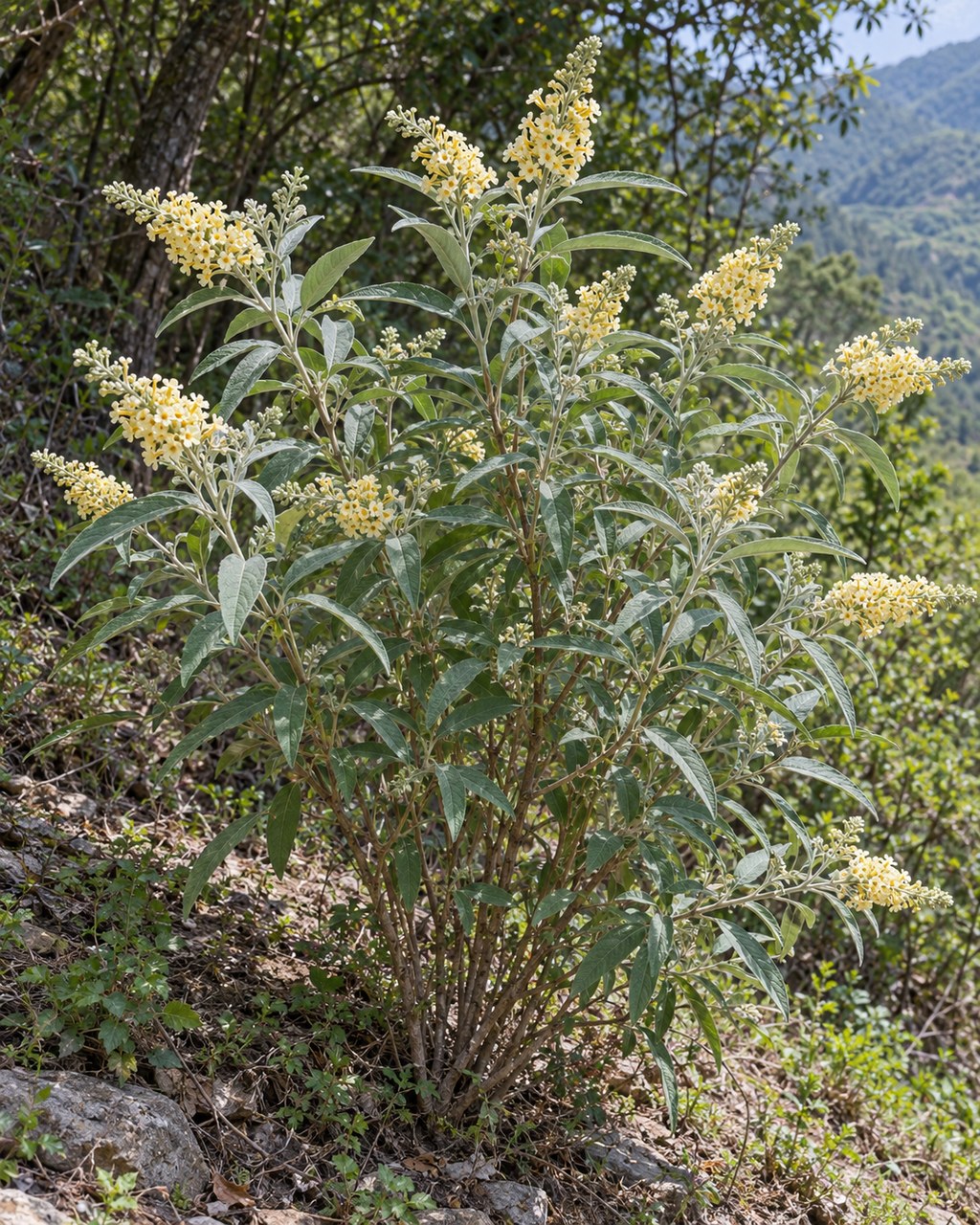
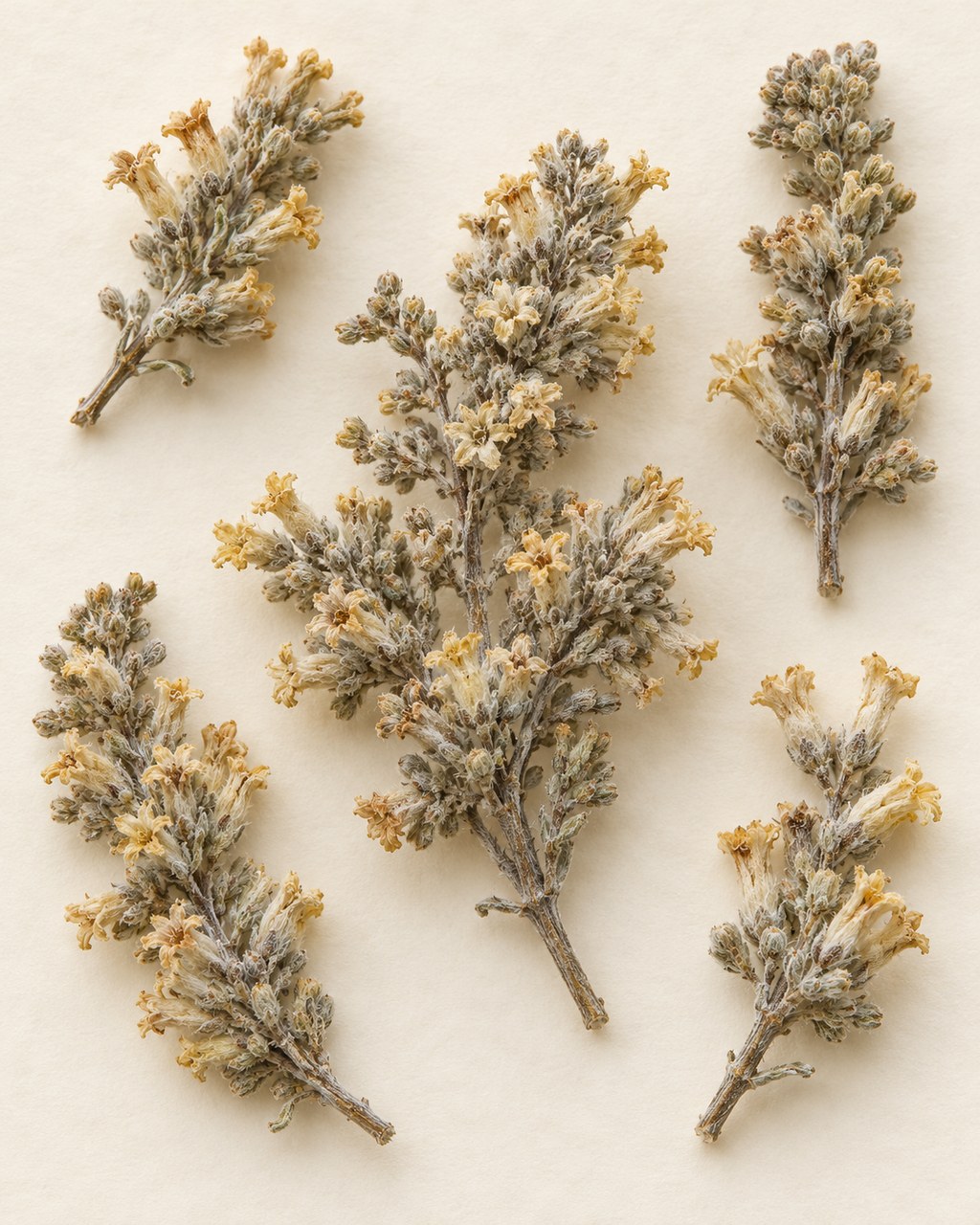
Mi Meng Hua · pale butterflybush flower · Mi Meng Hua
Buddleja officinalis Maxim. · Dried flower buds and inflorescences
Name and part used
Mi Meng Hua is the bud/inflorescence of Buddleja officinalis, a deciduous shrub about 1–3 m tall. Young branches, petioles, leaf undersides, and flower clusters carry gray-white star hairs; leaves are opposite and narrow-lanceolate. Tiny pale-yellow tubular flowers form dense panicles, blooming in late winter/early spring in HKBU’s account. The drug is buds/inflorescences, not the whole plant. Trade names can confuse other Buddleja; verify Latin identity and source.
Traditional context
HKBU records sweet, slightly cool qualities and traditional actions of dispelling wind, clearing heat, benefiting vision, and reducing opacity. This is not proof for conjunctivitis, cataracts, glaucoma, eye infection, or improved vision. Do not put decoction in the eye or delay care.
Modern evidence
HKBU describes the species and traditional eye-related applications, not clinical trials. Laboratory antioxidant/inflammation findings do not prove dried flowers treat eye disease. Red painful eyes, light sensitivity, discharge, sudden vision changes, or injury need prompt eye care. Quality also depends on flower identity, contamination, and storage.
Safety
Never soak/decoct it for eye washing; nonsterile fluid can cause infection/corneal injury. People with pollen allergies, pregnancy/breastfeeding, children, or medicine use should ask a clinician before concentrated products. No therapeutic safe dose is established. Discard moldy, unusual-smelling, or pest-damaged material.
Safety reference ↗Pairing in reference texts
Reviewed sources do not establish a safe ratio or a specific toxic pair for Buddleja officinalis, so no formula is invented. Do not self-combine it with eye drops or prescriptions. Folk records do not determine modern interactions or personal doses.
Identification and study notes
Opposite narrow leaves with gray-white star hairs beneath and dense terminal panicles of tiny pale-yellow tubular flowers are cues. Dried material is buds/inflorescences, not all leaves or bark. Confusion with other Buddleja and mixed flowers is possible; check structure, Latin name, and source. AI art supports memory, not eye diagnosis or foraging.
Growth and habitat
HKBU places it on mountain slopes, mixed woodland, riversides, and hills, often in partial shade; distribution includes Hubei, Sichuan, Shaanxi, Henan, Guangdong, Guangxi, and Yunnan. Grow in drained soil, gentle sun/partial shade, away from waterlogging and pollution.
Identification and study notes
Opposite narrow leaves with gray-white star hairs beneath and dense terminal panicles of tiny pale-yellow tubular flowers are cues. Dried material is buds/inflorescences, not all leaves or bark. Confusion with other Buddleja and mixed flowers is possible; check structure, Latin name, and source. AI art supports memory, not eye diagnosis or foraging. Mật mông hoa là nụ/cụm hoa khô Buddleja officinalis, không phải hoa chăm sóc mắt nói chung. Lá đối hẹp, lông sao xám trắng và hoa ống vàng nhạt giúp quan sát; nụ khô có thể còn lông và cuống ngắn. Bó vụn không chứng minh loài hay lịch sử thuốc trừ sâu; ảnh AI chỉ để học. Tài liệu cổ dùng cụm từ liên quan mắt, nhưng nghiên cứu hóa học/tế bào không chứng minh chữa đục thủy tinh thể, glaucoma, nhiễm trùng hay viêm kết mạc. Tuyệt đối không nhỏ nước sắc, bột hay dịch không vô trùng vào mắt; thuốc nhỏ vô trùng và chẩn đoán cần chuyên môn. Trang không tự bịa cặp độc/tỷ lệ vì chưa tìm được chuẩn đáng tin. HKBU ghi sinh cảnh/mùa nhưng không có tuổi cây chung đến khi ra hoa; trồng nhiều năm không làm hoa đạt dược liệu. Ghi loài, nụ hay hoa, nơi thu, sấy và kiểm soát tạp. Mờ mắt đột ngột, đau, sợ sáng hay chấn thương cần khám sớm. Cụm từ liên quan “mắt” ở Mật mông hoa cần khiến người học đọc kỹ, không thử làm thuốc nhỏ mắt. Hoa khô không vô trùng; bụi/nước sắc nhỏ vào mắt có thể kích ứng hoặc gây nhiễm trùng. Nụ có lông xám và hoa vàng nhạt giúp học nhận dạng, nhưng ảnh không loại trừ Buddleja khác hay tồn dư thuốc. Nguồn chưa xác minh tỷ lệ phối chuẩn nên trang không đưa. Ghi rõ nguồn nói về nụ, hoa nở hay cao chiết; không chuyển nghiên cứu chống oxy hóa phòng thí nghiệm thành claim điều trị. Đau mắt hay mờ đột ngột cần khám. Thuật ngữ cổ liên quan mắt chỉ cách nguồn phân loại dược liệu, không phải hướng dẫn chăm sóc mắt. Nguyên liệu hoa khô không vô trùng, triệu chứng mắt có thể cần chẩn đoán sớm. Cần giữ rõ phân biệt này dù ảnh hoa trông hiền hoặc quen thuộc.
Growing and care
- Choose a sapling/cutting labeled Buddleja officinalis; ornamental congeners share common names. Avoid roadsides/sprayed fields.
- Plant in loose drained soil in partial shade with moderate mature compost; water after planting and maintain moderate moisture while establishing.
- Prune dead stems after flowering, maintain airflow, hand-weed, monitor pests/fungi, and avoid sprays with unknown residues around flowers.
- HKBU records flowering around February–March and collection of buds/inflorescences but no plant age or seasons-to-bloom. Record your plant’s bud date; do not use home-dried flowers medicinally or for eye washing.
How long until harvest? The perennial shrub may take several seasons to establish and flower; HKBU gives no age/size or cutting-to-flowering interval. No “X days until use” is supported. Grow for observation, not home medicine.
Habitat, season, and harvest in the HKBU botanical record
HKBU describes Buddleja officinalis as a 1–3 m deciduous shrub with gray-white star hairs and pale-yellow tubular flowers around February–March; habitat includes partly shaded slopes, mixed woods, and riversides. Buds/inflorescences are dried for use.
Open botanical source ↗FROM PLANT / SOURCE HABITAT TO DRIED MATERIAL · REFERENCE WORKFLOW
- HKBU identifies buds/inflorescences as the drug; collect authenticated material from legal lots, away from dust/sprays.
- Remove leaf/stem debris, retain buds/inflorescences, cut if needed, and dry in a clean ventilated area.
- Dried material includes tiny pale-yellow to yellow-brown star-haired tubular flowers on fine branches. Color/aroma cannot establish efficacy.
- Cool, seal, store dry, and label Latin/date/origin/process. Never use homemade powder/suspension in the eye.
These are post-harvest study notes, not directions to prepare a remedy for self-treatment. Processing reference ↗