Pei Lan · Fortune eupatorium · Pei Lan
Eupatorium fortunei Turcz. · Dried aerial parts
Name and part used
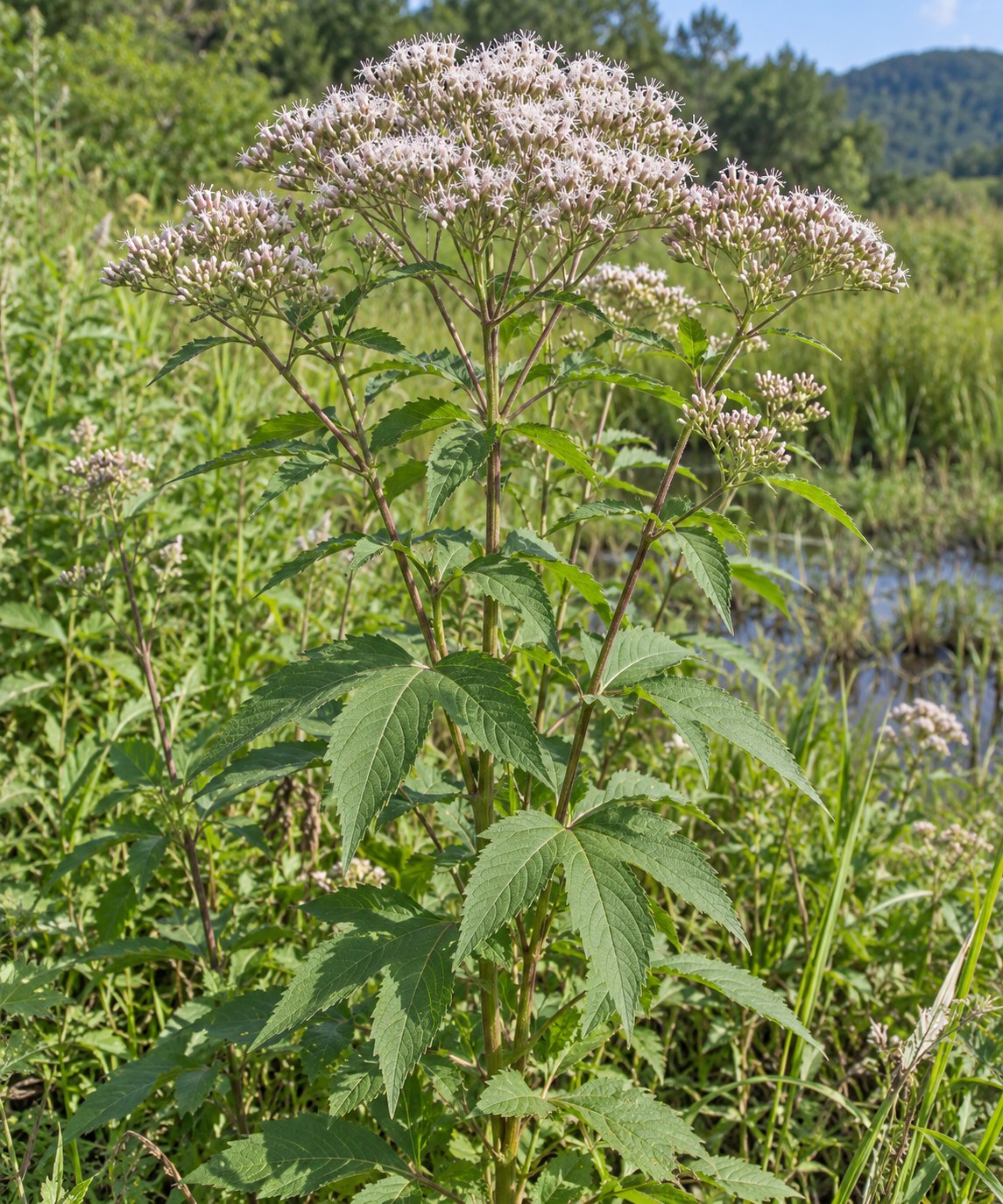
This profile treats Pei Lan as Eupatorium fortunei Turcz. (some taxonomies list E. fortunei as a synonym), a perennial Asteraceae herb. Its upright, furrowed or angled stems commonly reach about 40–100 cm. Opposite lance-shaped to ovate-lanceolate leaves have toothed margins; middle leaves may be three-lobed. Bruised foliage is aromatic. Small white-pink florets form heads in terminal clusters, with flowering and fruiting generally in the latter part of the year depending on region. The medicinal material is the aerial herb, not the root. HKBU records stream banks, damp grassland, roadsides, thickets, and forest edges as habitats; occurrence on damp ground does not mean the plant tolerates standing water. AI art is a morphology aid, not a voucher specimen or proof of identity.
Traditional context
HKBU materia-medica records describe traditional aromatic dampness-resolving, spleen-awakening, appetite-supporting, and summer-heat concepts; a specimen record notes a slightly bitter taste and aromatic odour. These are traditional categories, not proof that Pei Lan treats abdominal fullness, nausea, fever, or diarrhea. Persistent vomiting, high fever, severe abdominal pain, dehydration, or breathing difficulty needs medical assessment rather than a homemade decoction.
Modern evidence
HKBU provides botanical identity, specimen, processing, and traditional records; these are not clinical trials. Chemical studies of essential oils or in-vitro activity do not establish clinical benefit from fresh leaves, homemade tea, or extracts. Findings for an isolated constituent cannot be generalized to the whole plant. Literature searches should distinguish this Pei Lan from other Eupatorium species and unrelated local plants containing “lan” in their names.
Safety
Do not self-use crude herb or essential oil, especially in children, pregnancy or breastfeeding, people allergic to Asteraceae, or anyone taking medicines. Concentrated oil can irritate skin and mucosa; never put it in the eyes or nose or drink it as a folk remedy. Roadside, field-edge, or waterway plants may carry herbicides, fertilizer, or contaminants and should not be harvested for medicine. Available records cannot establish that all known or unknown interactions are safe; consult a clinician or pharmacist before combining herbs with prescription medicines.
Safety reference ↗Pairing in reference texts
The reviewed sources do not establish a modern herb pair with proven efficacy and safety or a personal ratio. This page therefore does not invent a formula or a supposed ingredient-pair image. Historical prescriptions may include Pei Lan among several ingredients selected by pattern differentiation; that is historical documentation, not a self-mixing guide. No specific toxic incompatibility was confirmed in the cited record; absence of a listed pair is not evidence that arbitrary combinations are safe.
Identification and study notes
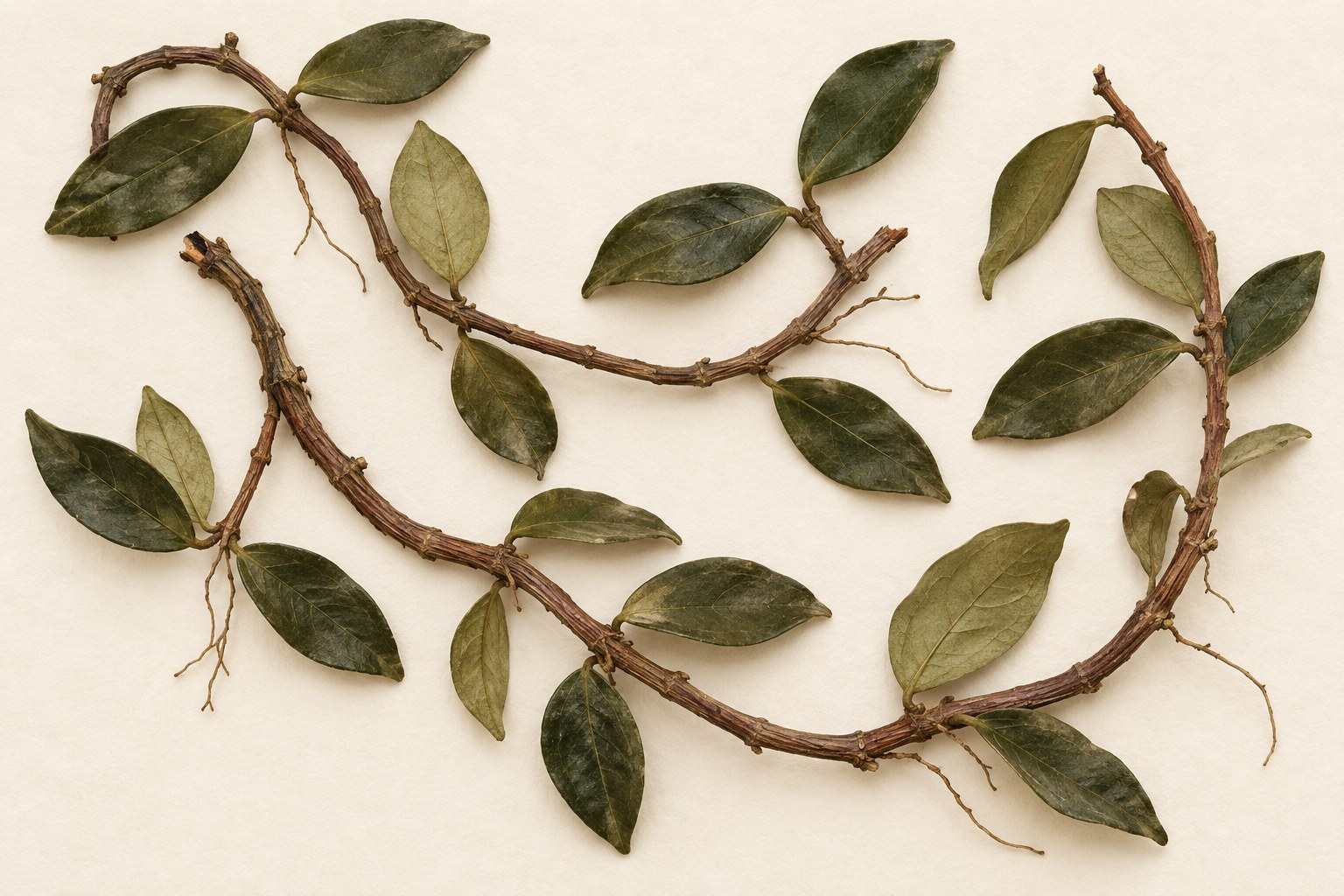
Opposite leaf pairs are an important cue: leaves at one node usually rotate relative to the pair above. Lower leaves may be entire or ovate-lanceolate; middle leaves are longer, toothed, and sometimes three-lobed. Lightly bruising a leaf often releases an aroma, but scent alone cannot identify it because many Asteraceae are aromatic. Small white-pink flower heads cluster at the stem tips. Stems may be purplish and furrowed. The dried-material illustration shows cut stems with opposite wrinkled leaves and dry flower clusters; AI art cannot represent every commercial lot accurately. Compare leaves at different stem levels and retain the Latin name to avoid confusing Pei Lan with Agastache or unrelated plants whose names contain “lan.”
Growth and habitat
HKBU records Pei Lan beside streams and roads, in damp grassland, thickets, and forest margins; its source records distribution across several Chinese regions, including Jiangsu, Zhejiang, Hubei, and neighboring provinces. It favors sun to partial sun and loose, organic soil that retains moderate moisture yet drains freely. For an observation planting in Vietnam, choose a clean site with morning sun and water when the bed surface begins to dry; do not leave a pot standing in water. This is a horticultural observation guide because the HKBU profile does not provide a complete commercial cultivation protocol for every climate.
Identification and study notes
Opposite leaf pairs are an important cue: leaves at one node usually rotate relative to the pair above. Lower leaves may be entire or ovate-lanceolate; middle leaves are longer, toothed, and sometimes three-lobed. Lightly bruising a leaf often releases an aroma, but scent alone cannot identify it because many Asteraceae are aromatic. Small white-pink flower heads cluster at the stem tips. Stems may be purplish and furrowed. The dried-material illustration shows cut stems with opposite wrinkled leaves and dry flower clusters; AI art cannot represent every commercial lot accurately. Compare leaves at different stem levels and retain the Latin name to avoid confusing Pei Lan with Agastache or unrelated plants whose names contain “lan.”
Growing and care
- Obtain labeled Eupatorium fortunei seed or nursery stock; do not collect roadside plants. Use a pot or bed with drainage holes, clean humus-mixed soil, and morning sun or partial sun.
- Sow shallowly following the supplier’s directions or plant nursery stock; keep evenly moist while establishing, but never waterlog the soil. HKBU does not specify soil pH or seed treatment, so do not present an invented figure as a medicinal standard.
- Stake tall stems if they lodge; remove broken growth, hand-weed, and inspect for pests. Record the opposite leaves, sometimes three-lobed mid-stem leaves, aroma when bruised, and small clustered flower heads.
- Materia-medica records describe repeated aerial harvests during the growing season but do not set a universal number of days after sowing or plant age. Take an observation specimen only after strong growth; do not use home-grown plants as medicine.
How long until harvest? The source describes seasonal, sometimes repeated aerial harvest but gives no universal time after sowing. Record sowing, emergence, branching, and budding dates to track the plant. Ornamental growth does not establish medicinal quality; do not ingest home-grown material.
Habitat, season, and harvest in the HKBU botanical record
HKBU describes Eupatorium fortunei as a perennial herb around 40–100 cm tall, with opposite leaves, sometimes three-lobed mid-stem leaves, and small white or pale-pink flower heads; flowering/fruiting is reported around July–November depending on region. Habitats include stream banks, roadsides, thickets, and damp grassland. The medicinal part is aerial herb; the source describes repeated harvests during the year, partial wilting/sun exposure and bundling, followed by further drying. Dates and details vary by region, so this page preserves the source’s limits.
Open botanical source ↗FROM PLANT / SOURCE HABITAT TO DRIED MATERIAL · REFERENCE WORKFLOW
- The source identifies the aerial herb as the material; confirm the species and record collection date, growing location, and plant condition. Never collect plants suspected of pesticide or wastewater exposure.
- Separate aerial parts and remove soil, wilted leaves, and mixed species. Do not add roots, seeds, or another Eupatorium species when the record specifies aerial material.
- HKBU describes drying the medicinal material; spread it thinly on a clean tray in a ventilated place protected from rain and dust. A controlled facility may use food-drying equipment, but do not invent a validated temperature standard.
- When the sample is brittle and surface-dry, label Latin name, part, collection date, and method; store sealed, dry, and away from light. Discard moldy or unusually scented material and never taste it.
These are post-harvest study notes, not directions to prepare a remedy for self-treatment. Processing reference ↗