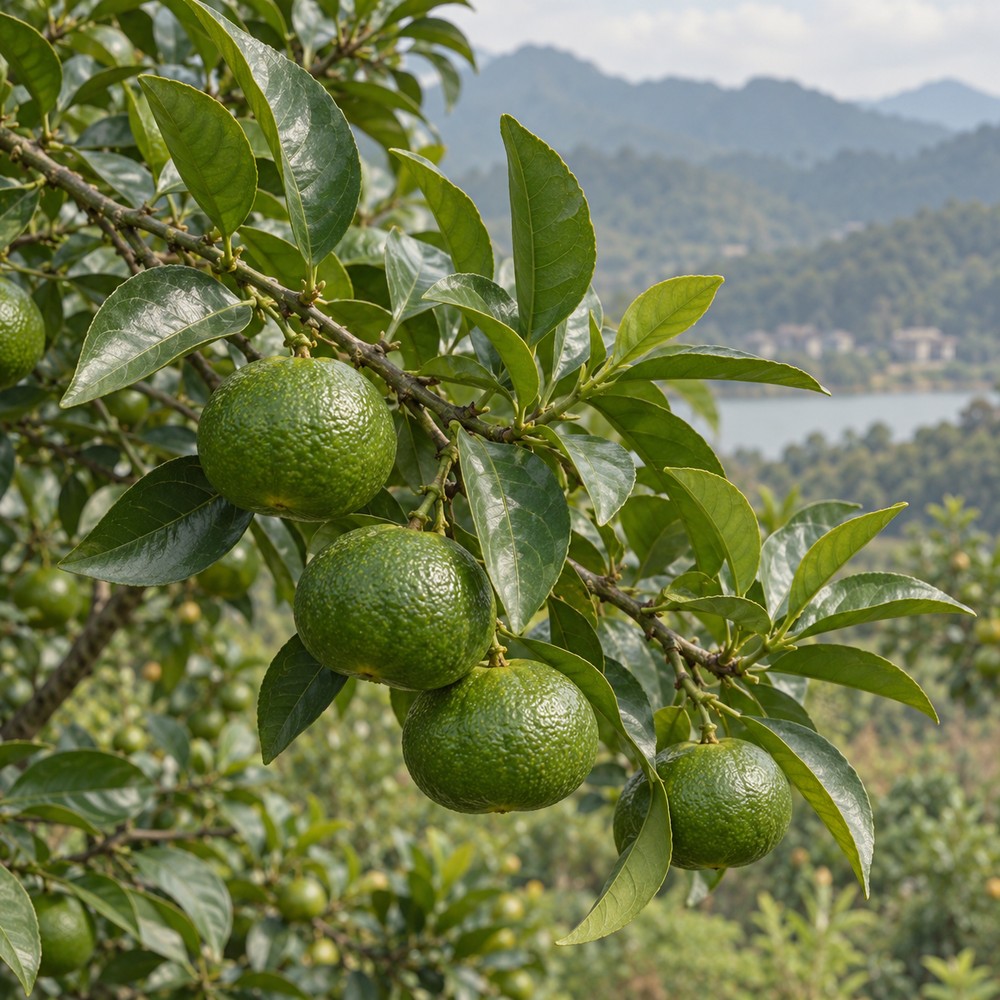
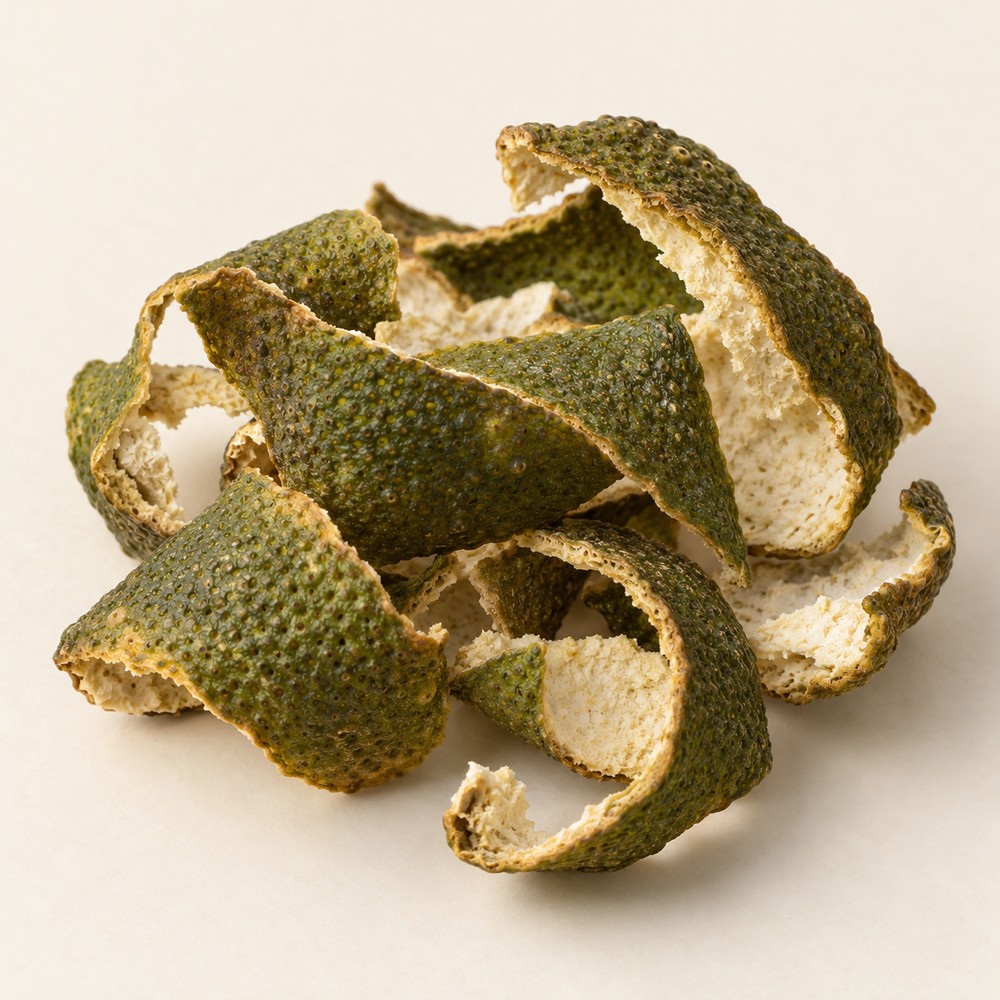
Immature tangerine peel · Qing Pi
Citrus reticulata Blanco · Young fruit or immature peel
Name and part used
From the same mandarin species as Chen Pi but harvested young; the immature peel is green with dense oil glands.
Traditional context
Qing Pi is young fruit or immature Citrus reticulata peel. HKBU distinguishes naturally fallen Ge Qing Pi from vertically cut Si Hua Qing Pi; it is not mature Chen Pi.
Modern evidence
Liver-qi dispersing and stagnation-resolving are traditional claims. There is no basis for using it for weight loss, abdominal pain, or liver disease.
Safety
Concentrated medicinal forms may interact or irritate digestion; use caution during pregnancy, gastric disease, cardiovascular treatment, or polypharmacy.
Pairing in reference texts
Qing Pi may pair with Cyperus in historical formulas; Citrus forms are not interchangeable and combinations are not universally safe.
Growing, care, and harvest timing
HKBU habitat record: Growing on hills, hilly areas, river and lake banks or plains. Can be cultivated. Distributed in Jiangsu, Anhui, Zhejiang, Jiangxi, Taiwan, Hubei, Hunan, Guangdong, Guangxi, Hainan, Sichuan, Guizhou, Yunnan and etc. The medicinal materials are mainly produced in Guangdong, Sichuan and etc Harvest and processing as recorded: Chenpi: excavated from November to December, stripped pericarp, sun-dried or dried in low temperature. Qingpi: collected naturally fallen fruitlets from May to June, sun-dried, called "Geqingpi"; picked immature fruits from July- August, cut the pericarp vertically into four pieces to the fruits base, removed pulp disc, called “Sihuaqingpi”. Juhong: cut off the outer pericarp from November to December, sun-dried or air-dried. Juhe: collected when fruits get mature, well washed and sun-dried
Source-recorded harvest/processing: Chenpi: excavated from November to December, stripped pericarp, sun-dried or dried in low temperature. Qingpi: collected naturally fallen fruitlets from May to June, sun-dried, called "Geqingpi"; picked immature fruits from July- August, cut the pericarp vertically into four pieces to the fruits base, removed pulp disc, called “Sihuaqingpi”. Juhong: cut off the outer pericarp from November to December, sun-dried or air-dried. Juhe: collected when fruits get mature, well washed and sun-dried
The reviewed source does not provide a complete species-specific sowing/growing routine, irrigation/fertilization schedule, or universal plant age. The page therefore does not infer care instructions or years to harvest; consult local cultivation guidance.
Open habitat and season source ↗FROM PLANT / SOURCE HABITAT TO DRIED MATERIAL · REFERENCE WORKFLOW
- Collect naturally fallen fruitlets in May-June or immature fruits in July-August under standards; verify Qing Pi form and Citrus reticulata.
- Remove stems, wash, and drain; small fruits may remain whole while larger fruit is cut per the validated process.
- Sun-dry or use low-temperature drying; do not mix with mature peel sold as Chen Pi.
- Record Ge/Sihua form, harvest time, origin, and lot; control moisture and residues and package sealed.
These are post-harvest study notes, not directions to prepare a remedy for self-treatment. Processing reference ↗
How to read formula amounts
The cited sources do not provide a formula with specific amounts for this profile; no ratio is invented. Absence from the incompatibility list does not establish safety.
Habitat, season, and harvest in the HKBU botanical record
HKBU botanical record (translated summary): Flowering and fruiting dates: Flowering: March to April, fruiting: October to December Habitat and distribution: Growing on hills, hilly areas, river and lake banks or plains. Can be cultivated. Distributed in Jiangsu, Anhui, Zhejiang, Jiangxi, Taiwan, Hubei, Hunan, Guangdong, Guangxi, Hainan, Sichuan, Guizhou, Yunnan and etc. The medicinal materials are mainly produced in Guangdong, Sichuan and etc Harvest and processing as recorded: Chenpi: excavated from November to December, stripped pericarp, sun-dried or dried in low temperature. Qingpi: collected naturally fallen fruitlets from May to June, sun-dried, called "Geqingpi"; picked immature fruits from July- August, cut the pericarp vertically into four pieces to the fruits base, removed pulp disc, called “Sihuaqingpi”. Juhong: cut off the outer pericarp from November to December, sun-dried or air-dried. Juhe: collected when fruits get mature, well washed and sun-dried
Open botanical source ↗