Mulberry leaf · Sang Ye
Morus alba L. · Leaf
Name and part used
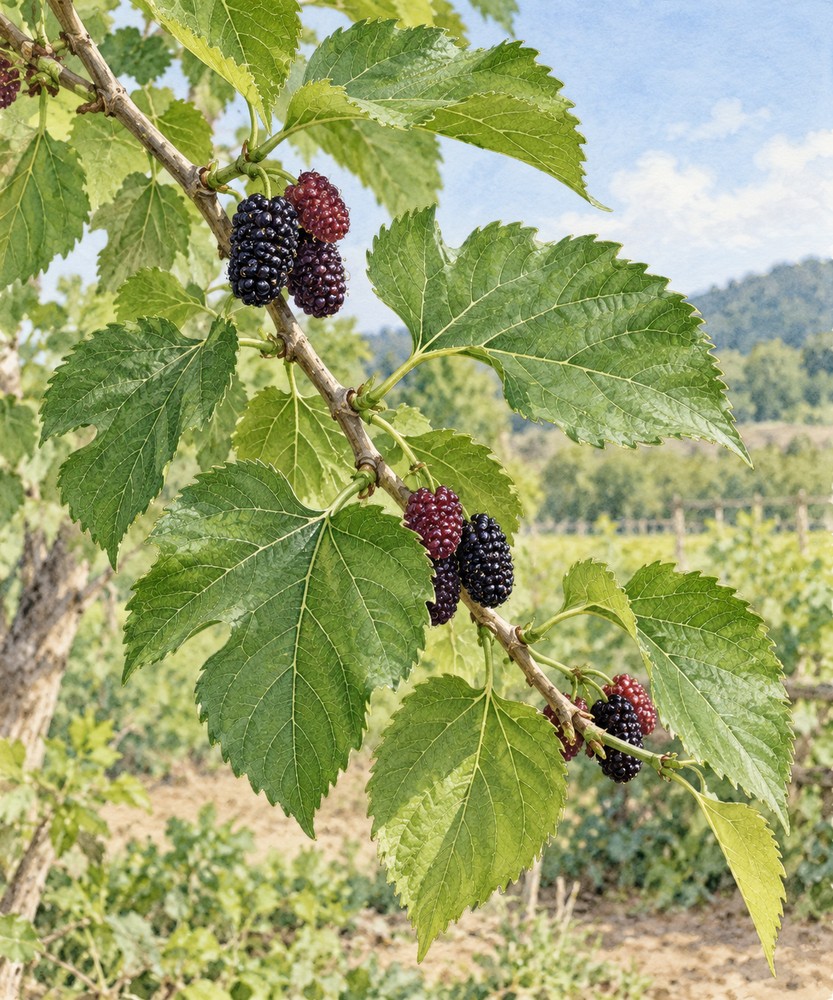
A small tree with broad serrated leaves, prominent reticulate veins, and aggregate fruits ripening from green to dark purple.
Traditional context
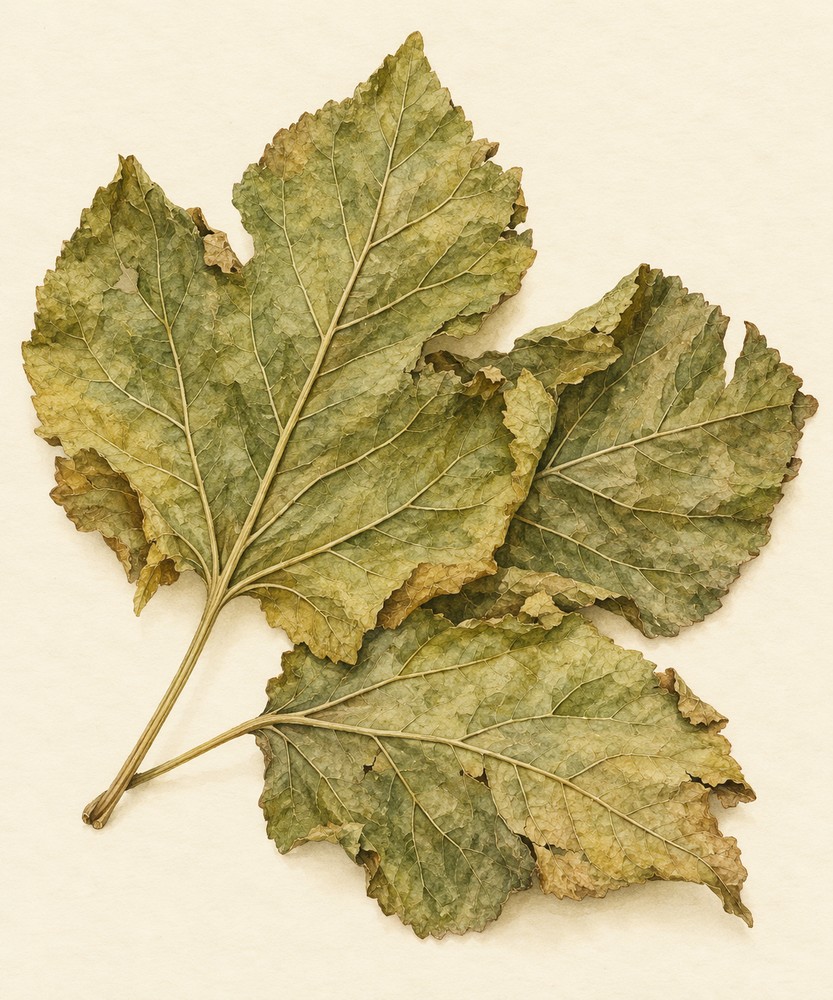
Sang Ye is Morus alba leaf. HKBU describes ovate leaves with raised veins, often collected after autumn frost; other parts of the same tree have distinct materia medica names.
Modern evidence
Wind-heat dispersing, lung-moistening, and liver-clearing are traditional descriptions. Leaf or extract research does not establish treatment for flu, glucose disorders, or eye disease.
Safety
Allergy and pesticide contamination are possible. People using diabetes or blood-pressure medicines should ask a clinician because potential interactions are not fully characterized.
Pairing in reference texts
Sang Ye appears with chrysanthemum, mint, or Platycodon in historical formulas. This reflects classical theory, not a cold or fever prescription.
Growing, care, and harvest timing
HKBU habitat record: Growing in hills, on hill-slopes, near villages and in fields. Can be cultivated. Distributed in all parts of China. The medicinal materials are mainly produced in Anhui, Jiangsu, Zhejiang, Sichuan, Hunan and etc Harvest and processing as recorded: Leaves: collected from Oct-Nov after Frost Descend, removed branchlet and impurities, and sun-dried. Velamen excavated in winter, washed, scraped brown cork when fresh, cut open vertically, slightly beat with mallet to separate bark from duramen, and sun-dried. Branchlet: collected in late spring and early summer, removed leaves, slightly sundried, cut into 30-60cm segments when fresh or obliquely sliced, and sun-dried. Fruit cluster: collected red fruit cluster from May to June, sun-dried or sun-dried after steamed
Source-recorded harvest/processing: Leaves: collected from Oct-Nov after Frost Descend, removed branchlet and impurities, and sun-dried. Velamen excavated in winter, washed, scraped brown cork when fresh, cut open vertically, slightly beat with mallet to separate bark from duramen, and sun-dried. Branchlet: collected in late spring and early summer, removed leaves, slightly sundried, cut into 30-60cm segments when fresh or obliquely sliced, and sun-dried. Fruit cluster: collected red fruit cluster from May to June, sun-dried or sun-dried after steamed
The reviewed source does not provide a complete species-specific sowing/growing routine, irrigation/fertilization schedule, or universal plant age. The page therefore does not infer care instructions or years to harvest; consult local cultivation guidance.
Open habitat and season source ↗FROM PLANT / SOURCE HABITAT TO DRIED MATERIAL · REFERENCE WORKFLOW
- HKBU records leaf collection in late autumn; use traceable Morus alba cultivation and reject contaminated or moldy leaves.
- Remove twigs and foreign matter using clean methods; do not mix leaves with root bark or branches.
- Spread thinly and sun-dry or use controlled ventilated drying; prevent crumbling and moisture reabsorption.
- Grade and record date and origin; seal in a cool, dry place away from chemicals and strong odors.
These are post-harvest study notes, not directions to prepare a remedy for self-treatment. Processing reference ↗
How to read formula amounts
The cited sources do not provide a formula with specific amounts for this profile; no ratio is invented. Absence from the incompatibility list does not establish safety.
Habitat, season, and harvest in the HKBU botanical record
HKBU botanical record (translated summary): Flowering and fruiting dates: Flowering: April to May, fruiting: June to July Habitat and distribution: Growing in hills, on hill-slopes, near villages and in fields. Can be cultivated. Distributed in all parts of China. The medicinal materials are mainly produced in Anhui, Jiangsu, Zhejiang, Sichuan, Hunan and etc Harvest and processing as recorded: Leaves: collected from Oct-Nov after Frost Descend, removed branchlet and impurities, and sun-dried. Velamen excavated in winter, washed, scraped brown cork when fresh, cut open vertically, slightly beat with mallet to separate bark from duramen, and sun-dried. Branchlet: collected in late spring and early summer, removed leaves, slightly sundried, cut into 30-60cm segments when fresh or obliquely sliced, and sun-dried. Fruit cluster: collected red fruit cluster from May to June, sun-dried or sun-dried after steamed
Open botanical source ↗