Taxus chinensis (Pilg.) Rehder · The filtered CITES record uses the trade term “medicine” but does not specify a plant part or composition. A conservation account reports medicinal exploitation of plant parts; this does not identify a standardized dried drug or a safe part for use.
Materia medica properties in reference
The plant part in the CITES trade record is unspecified
Properties as recorded in the source: Taste, meridian entry, or pharmacopoeial functions specific to T. chinensis and a defined plant part were not verified in the reviewed sources. Properties from other Taxus species are not assigned here.
The plant part in the CITES trade record is unspecified
No sourced, species-specific formula with individual quantities was verified; this page does not invent a benefit or ratio.
CITES international-trade evidence
The plant part in the CITES trade record is unspecified
The 2026.1 CITES Trade Database contains 9 comparative-tabulation rows for Taxus chinensis during 2017, 2018, 2019, 2020, 2021, 2022, 2023, 2024. The query selected reported purpose T (Commercial) and trade term MED (medicine); appendices appearing in these rows: II. Reported importer codes include CN; exporter codes include CA. These are comparative-tabulation rows, not shipment counts or summed volume. This record does not establish clinical efficacy, the legality of an individual transaction, or safety of use.
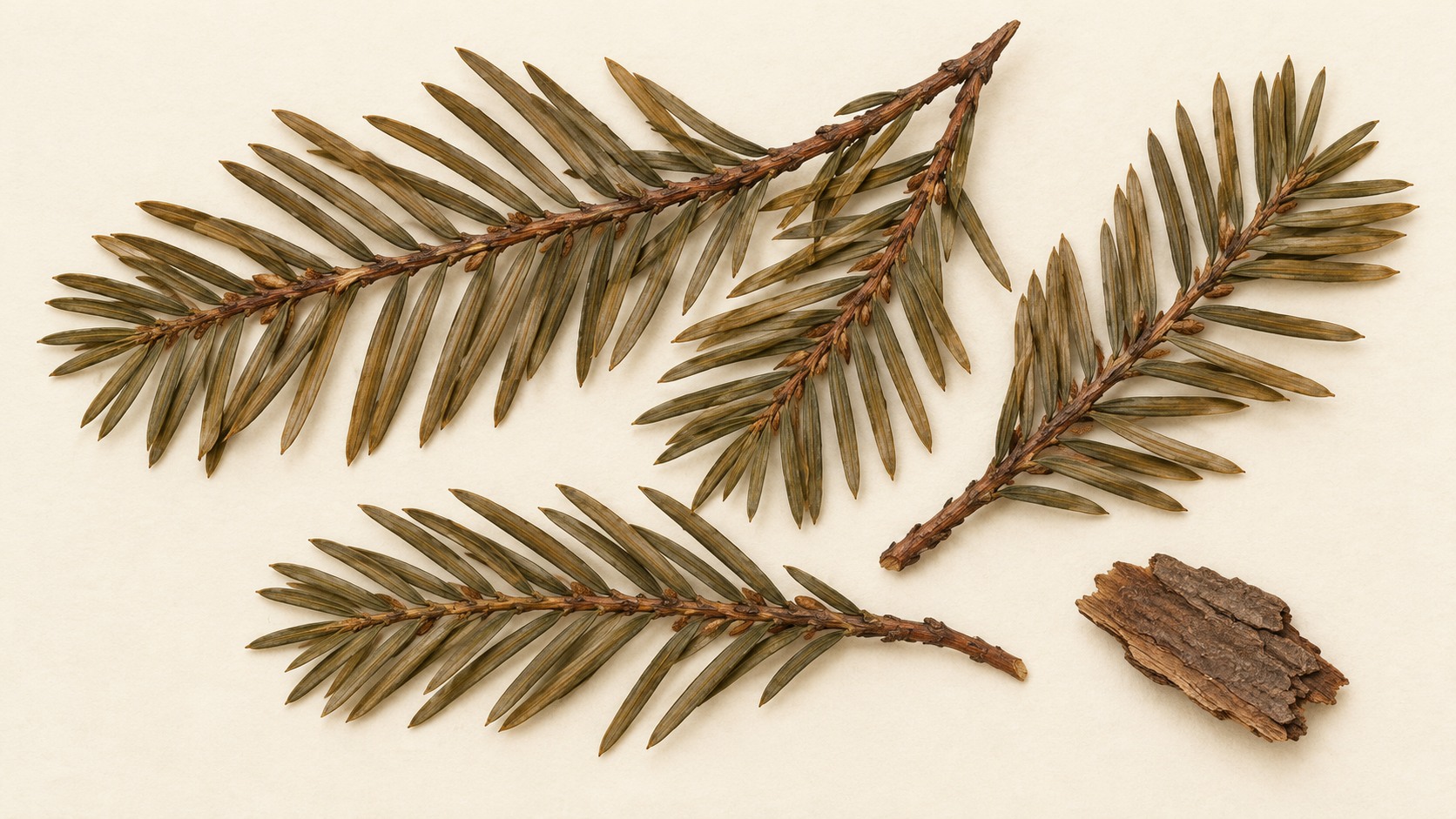
For morphology study; not a substitute for an authenticated voucher
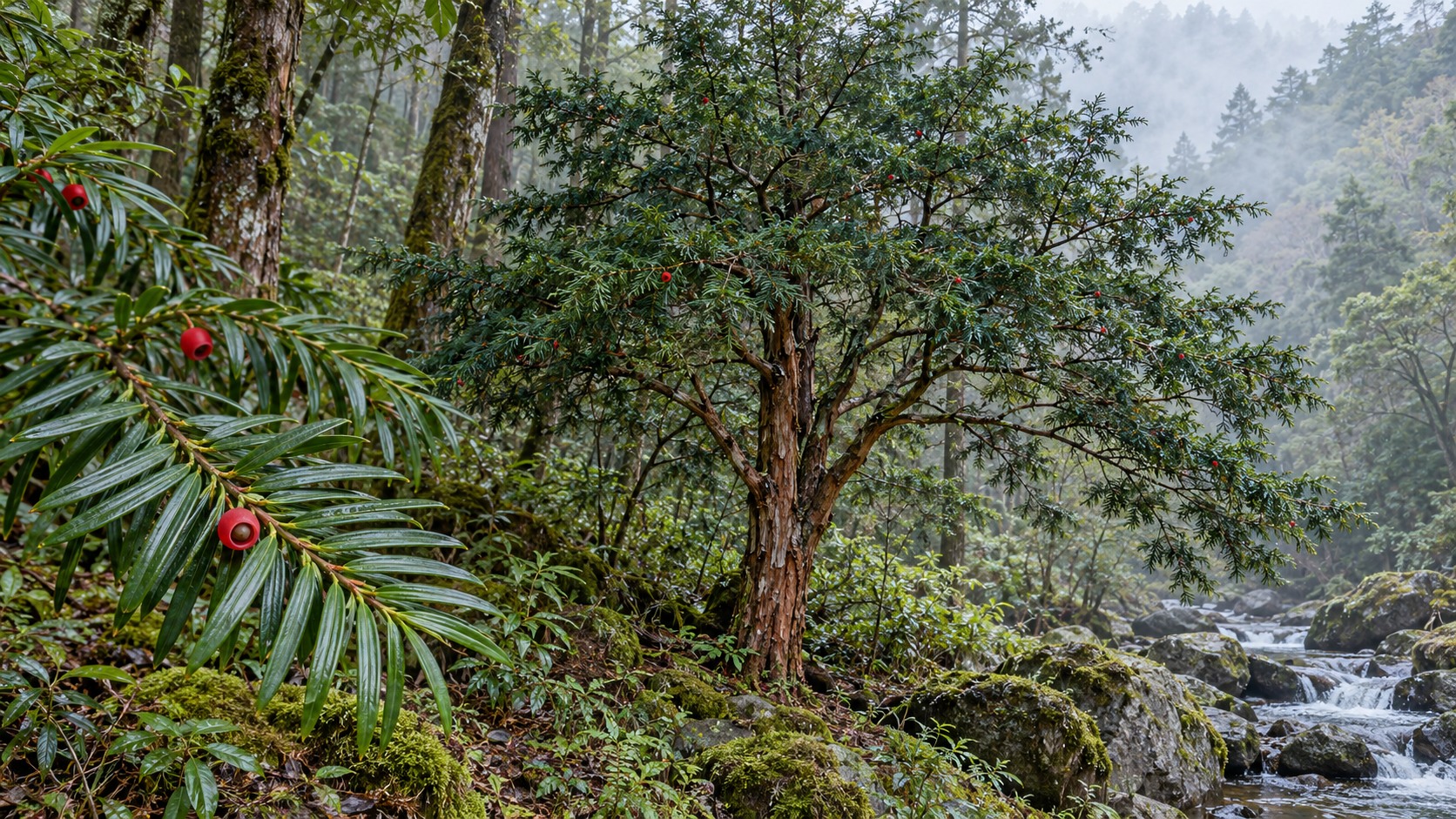
Taxus chinensis (Pilg.) Rehder is accepted by Kew’s Plants of the World Online. It belongs to Taxaceae and is an evergreen tree with flattened needle-like leaves, branching twigs, and reddish-brown to grey bark that may peel in flakes. Unlike pines with stiff needles in bundles and woody cones, yew leaves are flat and attached individually along the twig; female plants form a red, cup-like aril around one seed. These cues help with observation but cannot authenticate a wild specimen because Taxus contains closely related species and variable forms. Kew gives the native range as central and southern China and describes a tree of temperate biomes. A specialist conservation account describes scattered individuals in evergreen or deciduous broad-leaved forest, often near streams and in mountain areas. That account also includes Vietnamese localities under its taxonomic treatment, while Kew’s current accepted-name page states China. This profile keeps the two records distinct and does not claim a specific Vietnamese wild locality.
For morphology study; not a substitute for an authenticated voucher
This species is included because CITES data contain trade records under the name Taxus chinensis, not because a product under that name is automatically a safe medicine or proven treatment. In the project dataset filtered for trade term “medicine” and purpose T (commercial), nine comparative rows appear from 2017 through 2024. They report China as importer and Canada as exporter; the source code is A. Under CITES terminology, source A denotes artificially propagated specimens. These are comparative-tabulation rows, not confirmation of individual shipments, plant part, or total market volume. The species is in Appendix II, so international trade in covered specimens is regulated under CITES and applicable domestic law.
For morphology study; not a substitute for an authenticated voucher
The Royal Botanic Garden Edinburgh conservation account describes medicinal and pharmaceutical exploitation of Taxus chinensis plant parts, including material associated with taxanes. That is historical and conservation context; it does not mean leaves, bark, seeds, or twigs can be used as household medicine. North Carolina State University Extension rates the exact species as highly poisonous, identifies taxine as the toxic principle, and lists leaves, bark, and seeds as poisonous parts. Although that source notes that wildlife eat the red aril and reports the fleshy aril as edible in small amounts, this page does not encourage tasting it: the seed is directly inside, confusion is easy, and a mistake can be serious. Do not wild-harvest, dry, grind, decoct, tincture, or combine this plant with other herbs for self-use. The living and dried images are AI morphology illustrations, not commercial specimens or an authenticated materia medica.
Traditional context
General habitat illustration, not a verified locality
The common name “Chinese yew” and related vernacular names can cover different taxonomic scopes; retain the scientific name exactly as recorded in each source. Historical CITES documents explain that several Asian Taxus species were added to Appendix II in connection with commercial pressure on plant products and derivatives. The RBGE conservation account describes exploitation of roots, wood, bark, and leaves of T. chinensis in a traditional Chinese medicine context. These are records of use and pressure on populations, not prescribing monographs.
General habitat illustration, not a verified locality
The sources reviewed for this profile did not establish a current pharmacopoeial monograph, taste/temperature or meridian properties, a dose, or a multi-herb formula for the exact name T. chinensis with a specified plant part and processing method. Properties of T. wallichiana, T. mairei, or the genus Taxus are not transferred to this species. Nor does the CITES trade term “medicine” reveal whether a record concerns leaves, bark, or a taxane extract. The traditional-use section therefore preserves sourced context while marking missing standards instead of inventing a claimed effect or formula.
Modern evidence
General habitat illustration, not a verified locality
The evidence here falls into distinct categories. One is botanical and conservation information: accepted name, distribution, habitat, and risk status from Kew and specialist sources. Another is taxane research and pharmaceutical exploitation of Taxus. Paclitaxel is a modern chemotherapy medicine; that does not mean raw plant material has the same activity, purity, or can replace an authorized medicine. Pharmaceutical ingredients come from controlled materials and processes; neither an image nor a species name reveals compound concentration.
The plant part in the CITES trade record is unspecified
CITES trade rows show that national reports used the trade term “medicine,” but they are not clinical trials and make no therapeutic conclusion. The sources reviewed did not establish clinical evidence for taking whole T. chinensis as treatment for a particular disease. This profile separates medicinal-plant exploitation, chemical research, and human treatment evidence; one cannot stand in for another.
Safety
General habitat illustration, not a verified locality
The primary warning is that the plant itself has high toxicity. NC State Extension identifies taxine and lists leaves, bark, and seeds as poisonous parts; source-listed symptoms include abdominal pain, vomiting, diarrhoea, weakness, tremor, breathing difficulty, heart rhythm disturbance, and seizures, with possible fatality. Do not use a common name, location, or red aril color to decide that a plant part is safe to eat. The poisonous seed sits inside the fleshy aril; fallen leaves and clipped twigs should also be kept from children, pets, and livestock. Wear gloves when pruning and dispose of clippings according to local waste rules; do not burn them indoors or use as feed.
General habitat illustration, not a verified locality
This profile has not verified a specific herb pairing that makes T. chinensis “turn toxic.” That absence is not reassurance: the plant’s own toxicity is documented, while interactions with anticancer, cardiovascular, or other medicines require professional pharmacology review. Do not combine it or adjust medication yourself. If a person or animal may have chewed Taxus leaves, seed, bark, or a preparation, contact emergency services or a veterinary poison service promptly; do not wait for symptoms or induce vomiting yourself.
The plant part in the CITES trade record is unspecified
No sufficiently detailed formula with ingredients and individual quantities for exact Taxus chinensis was found in the reviewed sources. This page names no pairing as beneficial and gives no ratio for self-mixing. CITES uses “medicine” as a trade reporting term, not a prescription. Taxane literature likewise cannot be turned into instructions to combine the plant with other herbs.
General habitat illustration, not a verified locality
No specific herbal pairing proven toxic with this exact species was identified; that does not lessen the danger of Taxus itself. Documented risks include toxic leaves, bark, and seeds and the possibility of confusing species or plant parts. The learning goal is to understand evidence boundaries: distinguish a standardized pharmaceutical from raw plant material, separate documented incompatibility from intrinsic poisoning risk, and do not experiment with formulas. The dried image beside this section shows morphology after drying; it is not a picture of a medicine ingredient or formula.
Identification and study notes
For morphology study; not a substitute for an authenticated voucher
Observe the twig: leaves are flattened, narrow, and arranged in two roughly planar ranks; the lower surface is often paler. The thin bark can peel in scales or strips. Female trees bear a red aril open at the tip, exposing a single seed. Do not mistake the aril for an ordinary berry, taste it, or handle the seed for identification. Color changes with age, light, and specimen condition.
For morphology study; not a substitute for an authenticated voucher
Species identification requires reproductive characters, a provenance-backed voucher, locality, botanical expertise, and current taxonomic references. AI art can get leaf number, length, or arrangement wrong; use it only to guide observation, never to decide the identity of a traded or wild-collected specimen. Trade names such as “Chinese yew” or “Taxus” do not replace a scientific label.
Growth and habitat
General habitat illustration, not a verified locality
Ornamental care reference, not a medicinal-crop protocol
Kew records a native range in central and southern China and treats it as a temperate-biome tree. Threatened Conifers of the World (Royal Botanic Garden Edinburgh) describes scattered trees in evergreen or deciduous broad-leaved forests, often near streams, at roughly 1,100–2,700 m in China; that account also lists northern Vietnamese limestone-karst populations under its taxonomic scope. The difference from Kew’s range may reflect how names and taxonomy are treated; a single elevation figure should not be used to infer suitable cultivation everywhere.
NC State’s ornamental guidance permits full sun or partial shade, sandy or loamy soil, neutral to slightly acidic conditions, and good drainage. This is landscape advice for North Carolina, not a description of every wild population or a medicinal-crop standard for Vietnam. The habitat image is a generalized illustration, not a real locality.
Ornamental care reference, not a medicinal-crop protocol
General habitat illustration, not a verified localityUse only legally nursery-propagated stock with a clear scientific name; do not collect from the wild. Before purchase or cross-border movement, verify Appendix-II permit requirements for Taxus and conservation rules in both origin and destination.
General habitat illustration, not a verified localityChoose a site with room for a woody tree and away from areas frequented by children or animals. NC State describes hedge or specimen use; because poisonous parts occur on the plant, avoid play areas, livestock paddocks, or places where clippings could enter feed.
General habitat illustration, not a verified localityThe soil should drain well; NC State lists sandy or loamy texture and neutral to slightly acidic pH. If garden soil is heavy and waterlogged, do not mound soil against the root collar as a shortcut; assess drainage and soil structure before planting.
General habitat illustration, not a verified localityOrnamental guidance allows full sun to partial shade. In hot-humid regions unlike North Carolina, monitor local heat and sun stress; this is landscape adaptation, not a verified light or temperature prescription for medicinal production.
General habitat illustration, not a verified localityWater to prevent newly planted stock from drying out, while avoiding prolonged root saturation. The source gives no weekly schedule valid for all soils and climates. NC State notes some drought tolerance in established plants; that is not a reason to neglect young stock or follow a rigid calendar.
General habitat illustration, not a verified localityNC State lists stem cuttings and describes the species as easy to propagate, but its page does not provide rooting rates, a cutting season, or a medicinal harvest age. For ornamental propagation, follow nursery guidance and keep provenance records; do not take cuttings from wild trees.
General habitat illustration, not a verified locality
How long until harvest? No medicinal harvest age or time to a safe-use stage was confirmed in the reviewed sources. NC State gives an ornamental size of about 3 m, but that is not a harvest milestone; conservation accounts describe a long-lived species with declining populations. Do not cut landscape trees for medicinal material or self-use dried parts.
Ornamental care reference, not a medicinal-crop protocol
From plant to dried material · source-recorded workflow
General habitat illustration, not a verified localityDo not harvest wild plants. Check the scientific name, propagation provenance, origin records, and conservation permits before material enters a research facility or authorized supply chain.
General habitat illustration, not a verified localityThe filtered CITES entry states only the term “medicine”; it does not identify leaves, bark, roots, seeds, extracts, or finished products. An illustration cannot determine which part should be harvested.
Not for home processing or self-useThe sources reviewed provide no home-processing workflow or dried-drug standard applicable to this trade record. Taxus material requires a controlled professional chain that manages toxic hazards and follows applicable rules; this page does not instruct readers to decoct, tincture, grind, or drink it.
Not for home processing or self-useRecord species, verified part, cultivation source, processing state, lot, and permits separately. Do not mix with another Taxus species or any other herb while identity and standards remain unverified.
Not for home processing or self-use
This record supports study and processing traceability; it is not a home preparation or self-use guide.