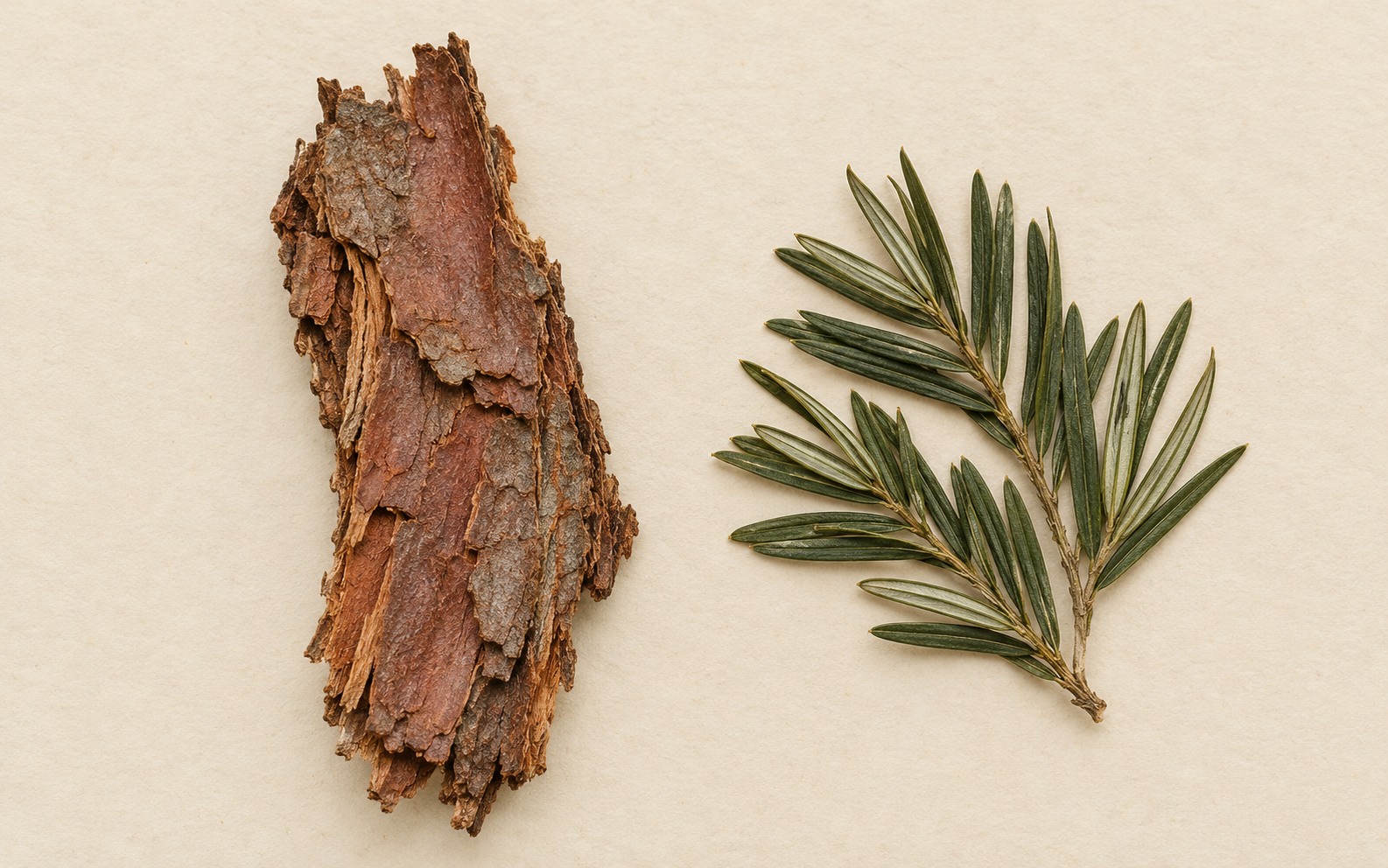
Taxus wallichiana Zucc. · Leaves, young shoots, and inner bark appear in traditional-use references; CITES rows include leaves, dried plants, extracts, and medicine. Trade rows do not authenticate each lot or plant part.
Materia medica properties in reference
Materia medica form discussed in this paragraph
Properties as recorded in the source: The linked sources do not establish standardized Chinese materia medica taste, channels, or functions for Taxus wallichiana. Ayurveda and Unani records belong to different systems and contexts and are not interchangeable.
No sufficiently sourced quantified formula or therapeutic benefit for a pairing containing this exact species was verified; no recipe or ratio is assigned.
CITES international-trade evidence
Materia medica form discussed in this paragraph
The 2026.1 CITES Trade Database contains 9 comparative-tabulation rows for Taxus wallichiana during 2016, 2023, 2024. The query selected reported purpose T (Commercial) and trade term MED (medicine); appendices appearing in these rows: II. Reported importer codes include CZ, GR, IN, IT, JP, RU, SG; exporter codes include CN. These are comparative-tabulation rows, not shipment counts or summed volume. This record does not establish clinical efficacy, the legality of an individual transaction, or safety of use.
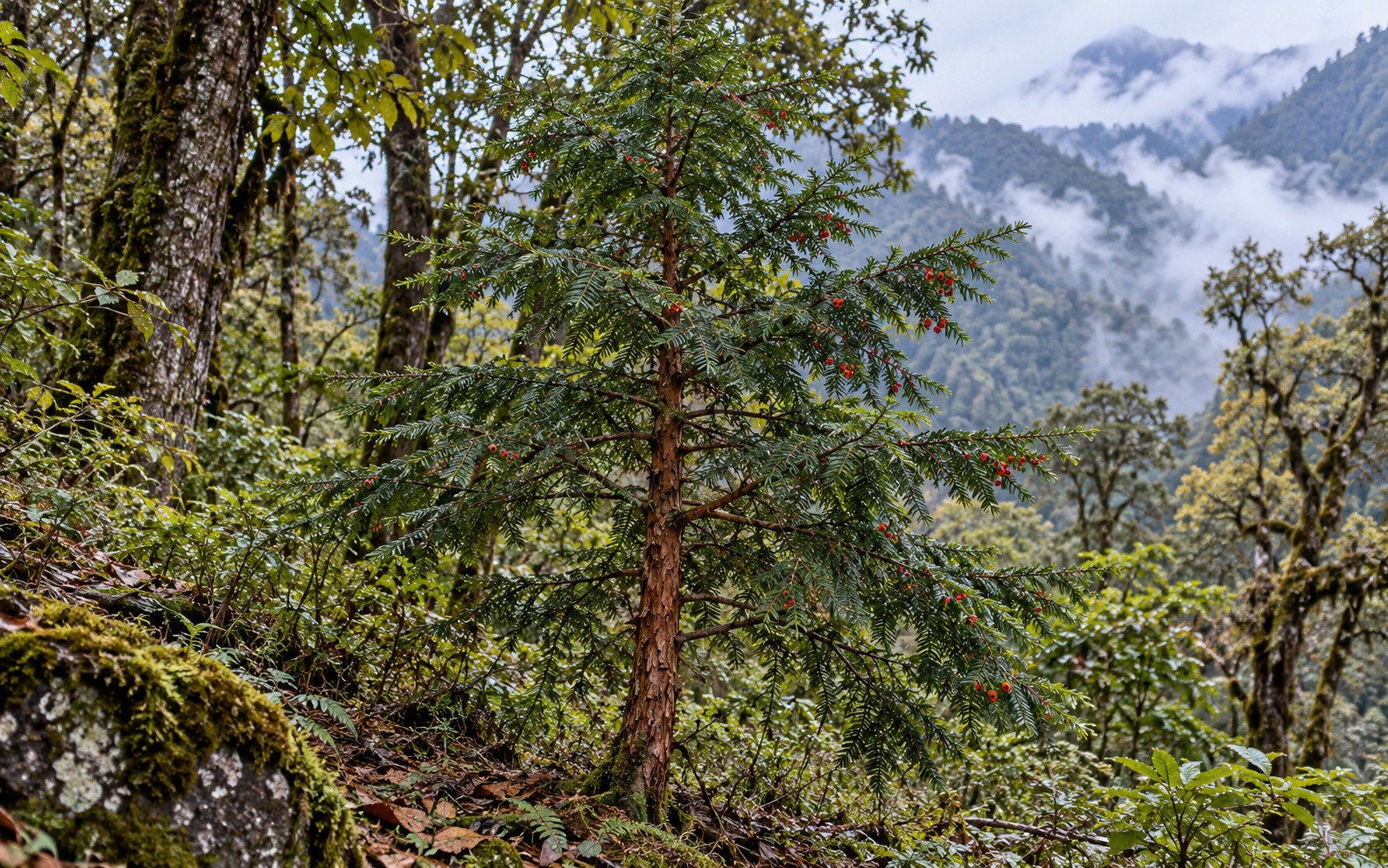
Taxus wallichiana Zucc. is the accepted name in Kew’s taxonomic record for an evergreen conifer in Taxaceae. It commonly grows as an understorey or lower-canopy tree in montane temperate forest; on exposed rocky slopes it may take a spreading shrub form. Its leaves are narrow, flat, and arranged along the small branches; each seed is partly surrounded by a fleshy red aril. The berry-like appearance does not make the plant safe to eat: the seed is poisonous, and foliage and bark also carry toxicity concerns. Do not taste or collect any part for identification.
General morphology for study
Taxonomy within Himalayan Taxus is complex. Kew gives a broad native range, while the Royal Botanic Garden Edinburgh synthesis notes that some western Himalayan populations are treated as T. contorta and some southern Vietnamese populations have been re-identified as T. mairei. A common name such as “red yew,” a label, leaf shape, or AI illustration cannot verify that a tree or materia-medica lot is T. wallichiana. Reliable identification needs a voucher, locality, documented determination, and botanical expertise. CITES records commercial international transactions under the species name; these are reported trade records, not authentication of a product. The page images support general study only.
Himalayan yew references come from several ethnobotanical and South Asian medical contexts; they should not be translated automatically into Chinese materia medica properties. The Royal Botanic Garden Edinburgh synthesis records historical use of leaves, young shoots, and sometimes inner bark in local preparations in parts of the Himalayas. A CITES technical report also describes shoot and leaf uses in Ayurveda, leaf and bark uses in some Unani practices, and other practices that vary by community. These are historical accounts, not established efficacy or treatment doses. The sources do not support assigning standardized Chinese medicine taste, channel entry, functions, or a classical formula to this exact species and plant part. Research or medical use of a purified Taxus compound does not mean the raw plant has the same effect. Paclitaxel is a refined medicine used under medical control, not a direction to use the tree.
Taxanes are compounds studied in Taxus species; paclitaxel is a purified, quality-controlled anticancer medicine used under specialist care. No therapeutic benefit can be inferred for leaves, bark, tea, homemade powder, or unstandardized extracts. This profile does not claim that Himalayan yew treats cancer, coughs, colds, insomnia, or any disease. The project’s 2026.1 CITES dataset includes reported records for T. wallichiana, with commercial-purpose entries using terms such as “medicine,” “leaves,” “dried plants,” and “extract” in the queried years. The database reflects reports by Parties; exporter and importer quantities may differ, and a trade term does not replace species authentication, quality testing, active-constituent analysis, legality checks, or conservation review. Appendix-II listing and the endangered status cited by Kew/RBGE make traceable provenance and current legal compliance essential.
Taxus presents a serious poisoning hazard. MedlinePlus says taxine occurs in many parts of yew and is highest in the seed; poisoning can involve altered awareness, breathing difficulty, seizures, vomiting, collapse, and slow, fast, or irregular heartbeat. It advises immediate medical help after suspected ingestion and says not to induce vomiting unless poison control or a clinician instructs this. That source describes yew generally rather than toxicology testing of every T. wallichiana population, so treat it as a serious genus-level warning, not a dose threshold. Do not use leaves, bark, seeds, arils, dried twigs, or unidentified preparations; drying does not establish detoxification. Keep children, pets, and livestock away. If exposure occurs, contact emergency services or a local poison center immediately rather than waiting for symptoms. Similar-looking Taxus taxa and trade lots cannot be safely identified by appearance alone.
The sources reviewed do not provide a sufficiently documented, quantified formula for this exact Taxus wallichiana species, nor do they establish a therapeutic benefit from pairing it with another herb. Given the plant’s own serious toxicity, this profile supplies no combination ratio, decoction method, amount, or self-care formula. It also does not claim that the plant has “no incompatibilities” or is safe when mixed with herbs, alcohol, supplements, or prescription medicines; absence of a report is not proof of safety. A purified compound’s role in a medically supervised cancer regimen does not imply that raw yew can be combined with medicines. Anticancer treatment choices belong to oncology clinicians and clinical pharmacists.
Identification and study notes
General morphology for study
Field identification requires expertise. This evergreen conifer commonly occupies the understorey of montane forest; its narrow, flat leaves usually form two ranks along the branchlets, with a paler underside; older trunks have thin reddish-brown bark that flakes irregularly. Male and female reproductive structures are on separate trees; the red covering around a seed is not a true berry. These traits support study only: closely related Taxus and populations within the complex may require voucher specimens or molecular evidence. Never use an AI image, bark color, one leaf, or a red aril as a basis for collecting or purchasing material. Record coordinates, elevation, habitat, whole-tree and branch photographs, date, determiner, and specimen provenance. Do not strip bark, cut branches, or collect seed from wild trees; exploitation pressure and CITES controls apply.
The Royal Botanic Garden Edinburgh describes the species in temperate to warm-temperate montane forest, usually in the understorey or lower canopy. In the Himalayas it is recorded on south-facing slopes with high summer rainfall, at about 1,900–2,700 m and sometimes up to 3,300 m; soils are usually acidic to neutral, and it may occur with Quercus, Tsuga, Abies, and Picea. These describe documented settings, not a universal recipe for every region. Vietnam’s Forest Science Institute reports cultivation research on red yew in Lam Dong: the study sites were humid and rainy, with loose humus-rich soils; young plants needed initial shade and more light as they developed. Do not assume every Vietnamese population called T. wallichiana is the same taxon; RBGE notes southern populations reassigned to T. mairei.
Illustration, not a harvesting instruction
Reference habitat; populations require expert identificationUse only documented nursery stock with taxon verification from an authorized forestry source. Do not collect seed, cuttings, seedlings, or root-zone material from natural forest; check legal provenance and CITES requirements first.
Reference habitat; populations require expert identificationVietnam’s Forest Science Institute study in Lam Dong describes initial shade for seedlings, humid conditions, and loose, well-drained soil; light exposure increases as plants grow. These were local trial conditions, not a guarantee for all climates.
Reference habitat; populations require expert identificationIn that study, healthy seedlings about 1.5–2 years old and at least 30 cm tall were used for outplanting trials. Do not treat these figures as a current universal forestry standard or a medicinal-harvest age.
Reference habitat; populations require expert identificationThe Lam Dong source reports prolonged physiological dormancy, with seed germination potentially taking about two years; cuttings from healthy young shoots were also studied. Timing varies with seed source, nursery conditions, and population; the source is not a recommendation to apply rooting hormones or seed-treatment chemicals at home.
Illustration, not a harvesting instructionMonitor shade, soil moisture, drainage, competing vegetation, and pests; record sowing/cutting date, lot provenance, survival, and each transplant. Do not cut branches, strip bark, or harvest foliage for medicinal use. CITES, conservation, and local forestry rules still apply.
How long until harvest? No medicinal-harvest age is recommended here. The tree is slow-growing, wild populations are endangered, and leaves, bark, and seeds carry toxicity concerns. A forestry study’s seedling age for outplanting is not a medicinal-material maturity age. Do not harvest the tree or material for self-use; research sampling requires permits and conservation protocols.
From plant to dried material · source-recorded workflow
Reference habitat; populations require expert identificationDo not collect wild trees; verify forestry permits, nursery provenance, and current CITES rules before moving or receiving any specimen.
AI study specimen; does not verify quality or safetyCITES records commercial terms such as leaves, dried plants, extract, and medicine; these do not constitute one standardized medicinal-processing method.
AI study specimen; does not verify quality or safetyKeep research vouchers labelled with taxon determination, plant part, lawful locality, date, and determiner; do not mix related Taxus or use an AI image to label a lot.
AI study specimen; does not verify quality or safetyDo not prepare tea, powder, or an oral remedy. The sources reviewed do not provide a reliable home detoxification method; drying does not establish safety.
AI study specimen; does not verify quality or safety
This record supports study and processing traceability; it is not a home preparation or self-use guide.