Gastrodia tuber · Tian Ma
Gastrodia elata Blume · Tuber
Name and part used
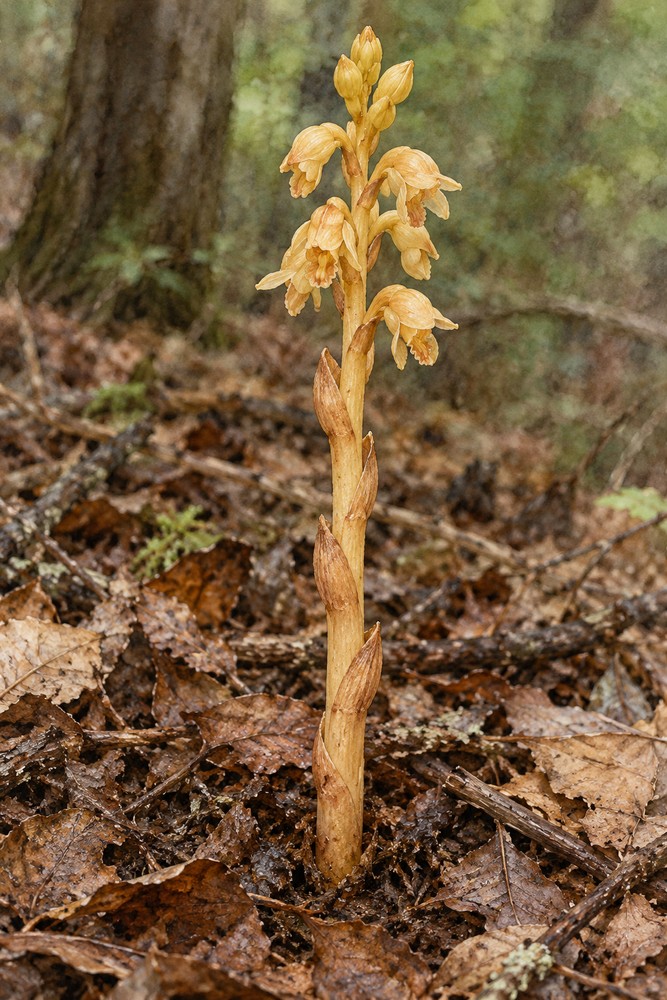
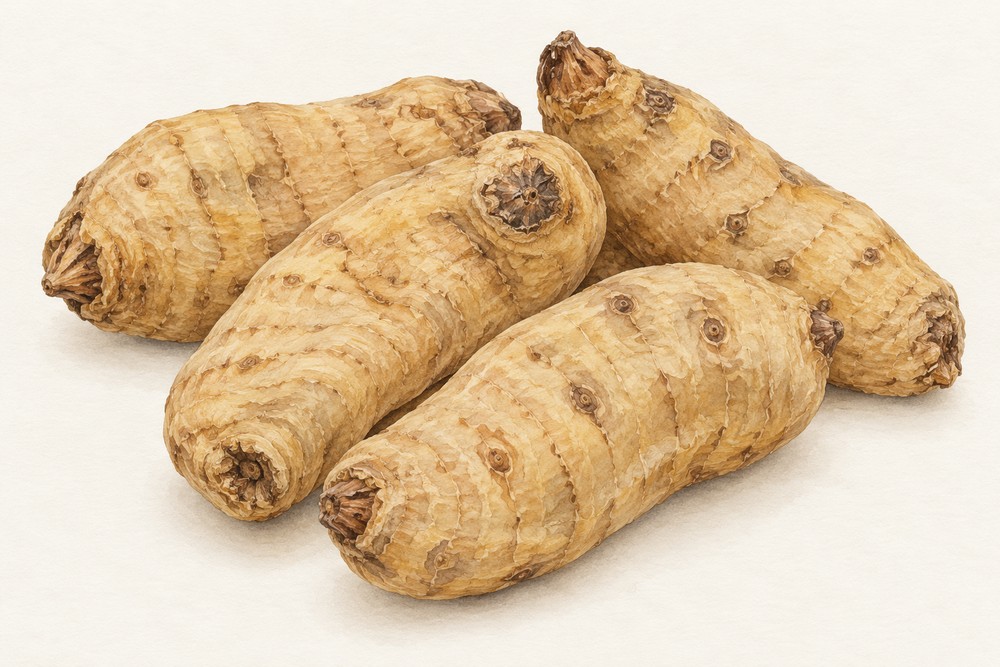
A leafless parasitic orchid with an ochre flowering stem; its underground tuber has distinctive ringed nodes.
Traditional context
Tian Ma is the tuber of Gastrodia elata, which depends on fungal symbiosis and can be misunderstood from appearance. HKBU notes seasonal harvest and conservation concern; use lawful cultivated sources.
Modern evidence
Liver-calming and wind-extinguishing are traditional concepts. They do not show that unverified products treat epilepsy, vertigo, or hypertension.
Safety
Dizziness, allergy, or sedative interactions may occur; do not combine casually with CNS medicines. Avoid unknown-source material and consult a clinician with chronic illness.
Pairing in reference texts
Tian Ma appears with Uncaria or Achyranthes in historical texts. This is not a treatment instruction for headache or seizures.
Growing, care, and harvest timing
HKBU habitat record: Growing in shrub edges and under sparse forest. Distributed in Jilin, Liaoning, Inner Mongolia, Hebei, Shaanxi, Gansu, Shanxi, Jiangsu, Anhui, Zhejiang, Jiangxi, Henan, Hubei, Hunan, Taiwan, Sichuan, Chongqing, Guizhou, Yunnan, and Tibet. It is also distributed in Nepal, Bhutan, India, Japan, the Korean Peninsula and Russia. The medicinal materials are mainly produced in the Chinese provinces of Sichuan, Yunnan, Guizhou, Shanxi, Hubei Harvest and processing as recorded: Harvested in winter and spring. Well-washed, steamed and sliced, dried
Source-recorded harvest/processing: Harvested in winter and spring. Well-washed, steamed and sliced, dried
The reviewed source does not provide a complete species-specific sowing/growing routine, irrigation/fertilization schedule, or universal plant age. The page therefore does not infer care instructions or years to harvest; consult local cultivation guidance.
Open habitat and season source ↗FROM PLANT / SOURCE HABITAT TO DRIED MATERIAL · REFERENCE WORKFLOW
- Harvest tubers in winter or spring from cultivated fungal-symbiosis systems; avoid threatened wild populations.
- Wash and grade by size and condition; authenticate Gastrodia elata.
- HKBU records steaming, slicing, and drying. Steaming is facility processing, not a home-preparation instruction.
- Check dryness, mold, and lot identity; document cultivation source, season, and processing form.
These are post-harvest study notes, not directions to prepare a remedy for self-treatment. Processing reference ↗
How to read formula amounts
The cited sources do not provide a formula with specific amounts for this profile; no ratio is invented. Absence from the incompatibility list does not establish safety.
Habitat, season, and harvest in the HKBU botanical record
HKBU botanical record (translated summary): Flowering and fruiting dates: Flowering and fruiting: May to July Habitat and distribution: Growing in shrub edges and under sparse forest. Distributed in Jilin, Liaoning, Inner Mongolia, Hebei, Shaanxi, Gansu, Shanxi, Jiangsu, Anhui, Zhejiang, Jiangxi, Henan, Hubei, Hunan, Taiwan, Sichuan, Chongqing, Guizhou, Yunnan, and Tibet. It is also distributed in Nepal, Bhutan, India, Japan, the Korean Peninsula and Russia. The medicinal materials are mainly produced in the Chinese provinces of Sichuan, Yunnan, Guizhou, Shanxi, Hubei Harvest and processing as recorded: Harvested in winter and spring. Well-washed, steamed and sliced, dried
Open botanical source ↗