Tu Fu Ling · glabrous greenbrier rhizome · Tu Fu Ling
Smilax glabra Roxb. · Dried rhizome
Name and part used
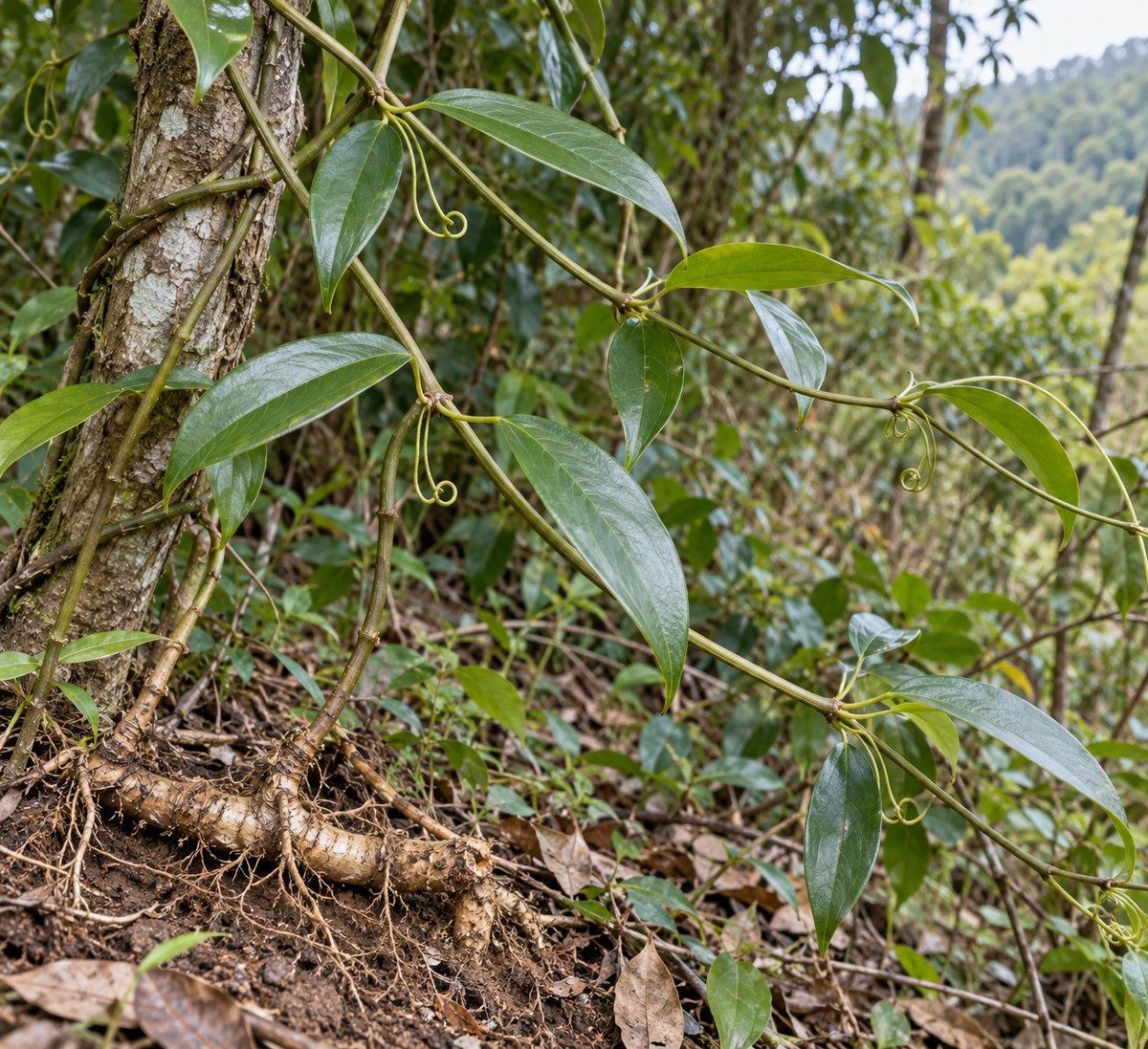
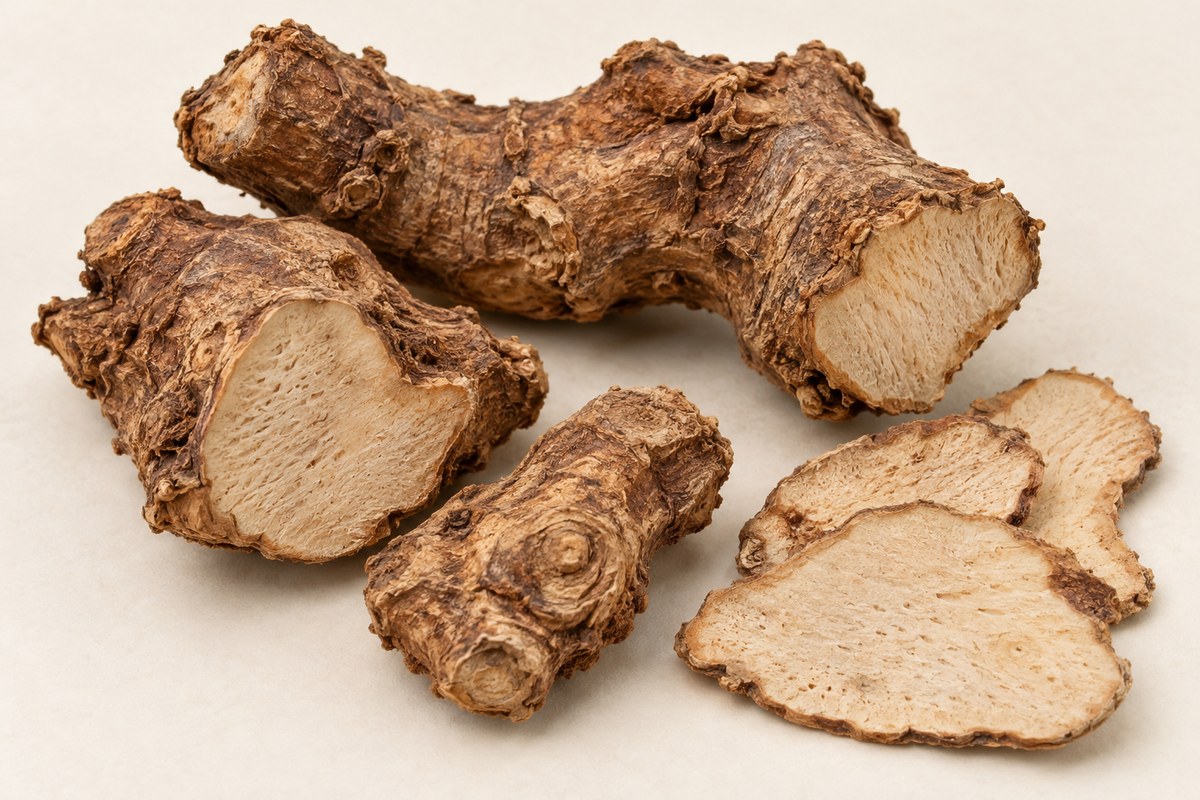
Tu Fu Ling is the dried rhizome of Smilax glabra Roxb., a woody climber with tendrils and alternate narrowly elliptic leaves. HKBU describes rhizomes as irregular lumps or curved cylindrical pieces, commonly 2–5 cm across, earthy-brown with stem scars; the hard fracture is pale and powdery. Common names can refer to several Smilax species, so compare the Latin identity and lot.
Traditional context
HKBU records a sweet, bland taste and neutral nature; traditional actions include resolving toxin, clearing dampness, and benefiting joints. Historical texts mention skin, urinary, and joint complaints, but this does not establish treatment of syphilis, urinary infection, or modern joint disease.
Modern evidence
The HKBU pages cited here document identity, morphology, and traditional actions; they are not treatment trials. “Detoxifying” or “benefiting joints” cannot be translated into proven clinical efficacy. Do not substitute a home-grown plant or tea for antibiotics, STI evaluation, or joint care.
Safety
Do not self-use during pregnancy/breastfeeding, kidney disease, or prescription treatment without professional advice. HKBU records historical forms and amounts, not a personally safe dose. Joint pain with heat/swelling or fever, painful urination, discharge, or genital ulcers needs medical evaluation; do not delay it with herbs.
Safety reference ↗Pairing in reference texts
Reviewed records do not establish a specific toxic pair or standardized pairing ratio for Tu Fu Ling. Do not infer that combining it with another “detoxifying” herb is safe or curative; folk examples in source records are not recommendations. No recorded incompatibility does not prove every combination is safe.
Identification and study notes
Plant recognition: stems can climb 1–4 m and are relatively smooth; alternate leaves are narrowly elliptic with visible venation. Paired tendrils near the petiole are useful when the plant is climbing. Rhizomes are thick, jointed, and branched; excavated pieces are curved and stout rather than slender taproots. HKBU’s dried drug is irregular or slightly fat-cylindrical, earthy brown with stem scars; the hard fracture is pale and powdery. Slices may show vascular-bundle spots. Tu Fu Ling can be confused with other Smilax species; visual comparison does not replace a specimen or laboratory identification. AI illustrations teach broad features but cannot verify variety, provenance, or purity.
Growth and habitat
HKBU places Smilax glabra on mountain slopes, uncultivated hills, and semi-shaded forest edges across southern and central-eastern China. It is a climber needing a support, drained humus-rich soil, and roots kept cool; it tolerates light shade better than intense sun. Choose clean soil because the harvested part grows underground.
Identification and study notes
Plant recognition: stems can climb 1–4 m and are relatively smooth; alternate leaves are narrowly elliptic with visible venation. Paired tendrils near the petiole are useful when the plant is climbing. Rhizomes are thick, jointed, and branched; excavated pieces are curved and stout rather than slender taproots. HKBU’s dried drug is irregular or slightly fat-cylindrical, earthy brown with stem scars; the hard fracture is pale and powdery. Slices may show vascular-bundle spots. Tu Fu Ling can be confused with other Smilax species; visual comparison does not replace a specimen or laboratory identification. AI illustrations teach broad features but cannot verify variety, provenance, or purity.
Growing and care
- Chọn đất tơi, giàu hữu cơ, thoát nước; trộn phân ủ hoai đã kiểm soát nguồn. Trồng hom có mắt hoặc cây con vào mùa ấm, lấp gốc vừa kín và phủ mùn.
- Use loose, organic-rich, well-drained soil and clean mature compost. Plant rooted cuttings or nursery plants in warm weather, cover the crown lightly, and mulch.
How long until harvest? A perennial; the source gives a rhizome harvest season but no years from cutting to harvest. A study plant may need multiple growing seasons to form a substantial rhizome; sources do not establish a home-use date.
Documented toxic incompatibility
No species- and rhizome-specific toxic pair was confirmed in the reviewed records. This cannot be used to conclude that any herb or medicine combination is safe.
AI study illustrations; not for specimen identification.
FROM PLANT / SOURCE HABITAT TO DRIED MATERIAL · REFERENCE WORKFLOW
- Excavate in late autumn or early winter per HKBU from a lot authenticated as Smilax glabra; do not mix other roots.
- Remove stem tips and fibrous roots, wash soil away, and sort damaged pieces. Sun-dry whole sections or slice and dry as the source describes.
- Dry evenly in a clean ventilated area, protected from dust, insects, and damp mold. Dried pieces are brown and firm with a pale powdery fracture.
- Record species, growing site, harvest date, and drying method; seal dry for study comparison. Do not prepare a home decoction to treat disease.
These are post-harvest study notes, not directions to prepare a remedy for self-treatment. Processing reference ↗
Material source, dried appearance, and processing forms (HKBU)
HKBU identifies the drug as dried Smilax glabra Roxb. rhizome. Pieces are irregular, curved or branched, commonly 2–5 cm thick, earthy brown with nodes and stem scars. They are hard to break; the fracture is pale brown or ivory and somewhat powdery. Thin slices may show vascular-bundle spots. The botanical record says to excavate in late autumn/early winter, remove stem tips and fibrous roots, wash, then sun-dry whole or sliced.
Open original materia medica record ↗Habitat, season, and harvest in the HKBU botanical record
HKBU records Smilax glabra as a 1–4 m climber of mountain slopes, uncultivated hills, and semi-shaded forest edges. Rhizomes are excavated in late autumn/early winter, trimmed, washed, then dried whole or sliced; no universal sowing-to-harvest duration is supplied.
Open botanical source ↗