Wu Jia Pi · slenderstyle acanthopanax bark · Wu Jia Pi
Acanthopanax gracilistylus W.W. Smith · Dried root bark
Name and part used
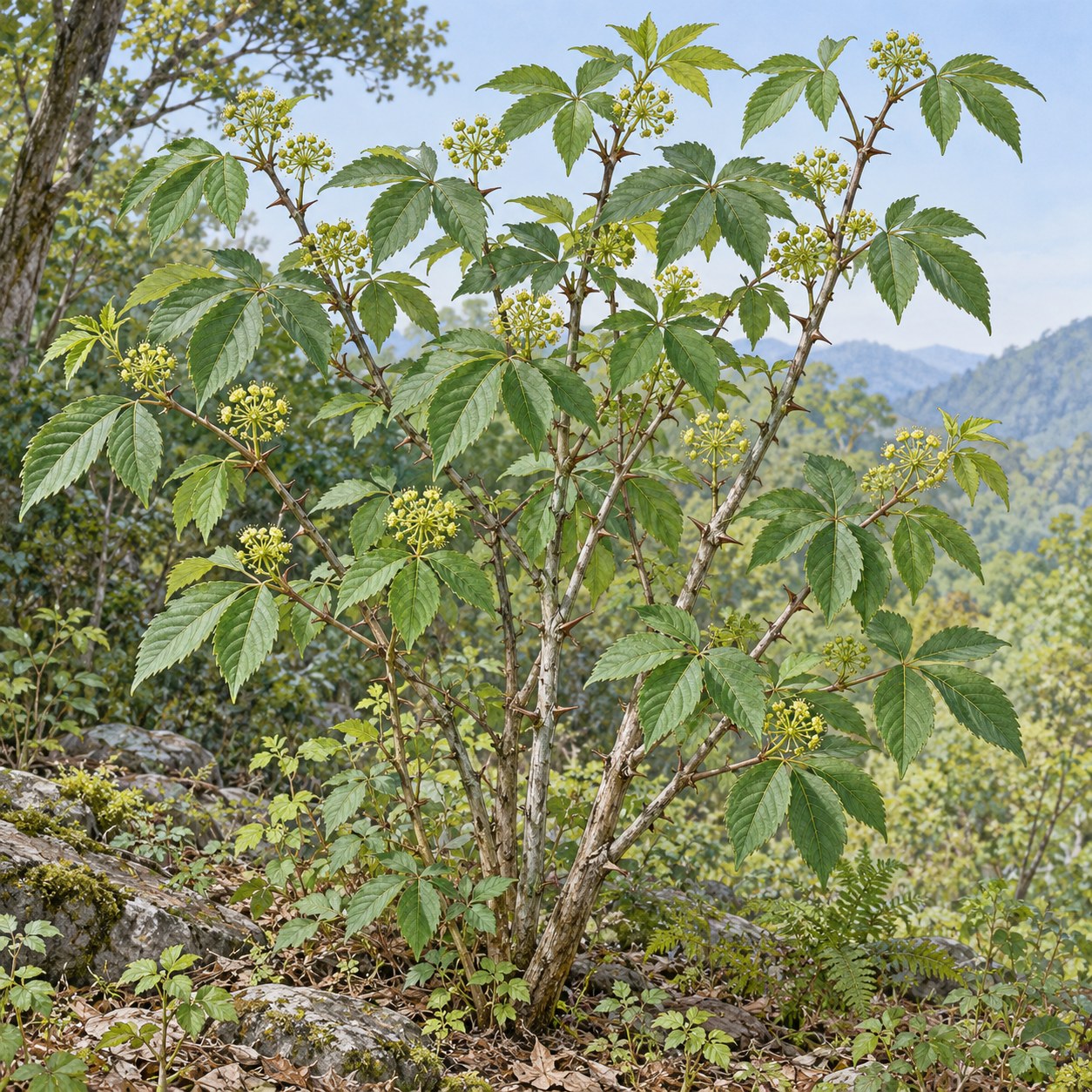
Wu Jia Pi here is the root bark of Acanthopanax gracilistylus W.W. Smith (placed in Eleutherococcus by some taxonomic sources), not every species called an acanthopanax. It is a deciduous woody shrub around 2–3 m tall; branches may be unarmed or bear a single flat spine. Alternate leaves usually have five serrated leaflets. Small yellow-green flowers form round axillary umbels and fruits darken when ripe. HKBU and a Chinese medicinal-plant garden place it at forest edges, scrub, and roadsides in China. The medicinal part is root bark, not leaf or stem bark.
Traditional context
HKBU records an acrid, bitter, warm nature and traditional actions of dispelling wind-dampness, supplementing liver/kidney, strengthening sinews/bones, and promoting urination. These descriptions do not prove treatment of arthritis, muscle weakness, edema, or kidney disease. Root bark is difficult to harvest sustainably; do not girdle or strip roots from a garden shrub for home medicine.
Modern evidence
HKBU documents the materia medica and traditional actions; botanical/chemical data do not replace human efficacy or safety trials. Distinguish Acanthopanax gracilistylus from Xiang Jia Pi, the different material from Periploca sepium: substitution can cause digitalis-like cardiac poisoning. Do not assume all products labeled Wu Jia Pi are equivalent without identity and quality verification.
Safety
Critical substitution warning: Periploca sepium root bark is Xiang Jia Pi/香加皮 and contains cardiac glycosides; substituting it for genuine Wu Jia Pi can cause digitalis-like poisoning and dangerous arrhythmias. Do not buy/use unidentified root bark; AI images cannot authenticate a commercial specimen. People with heart disease, digoxin/antiarrhythmic therapy, pregnancy, or breastfeeding should not self-use medicinal barks.
Safety reference ↗Pairing in reference texts
No safe therapeutic combination ratio is established here. The specific risk to remember is confusing Wu Jia Pi with Xiang Jia Pi: this is material substitution, not a medicinal “pair.” Xiang Jia Pi contains cardiac glycosides; do not substitute or mix the materials. Evidence is insufficient to claim all other pairings with Wu Jia Pi are safe.
Identification and study notes
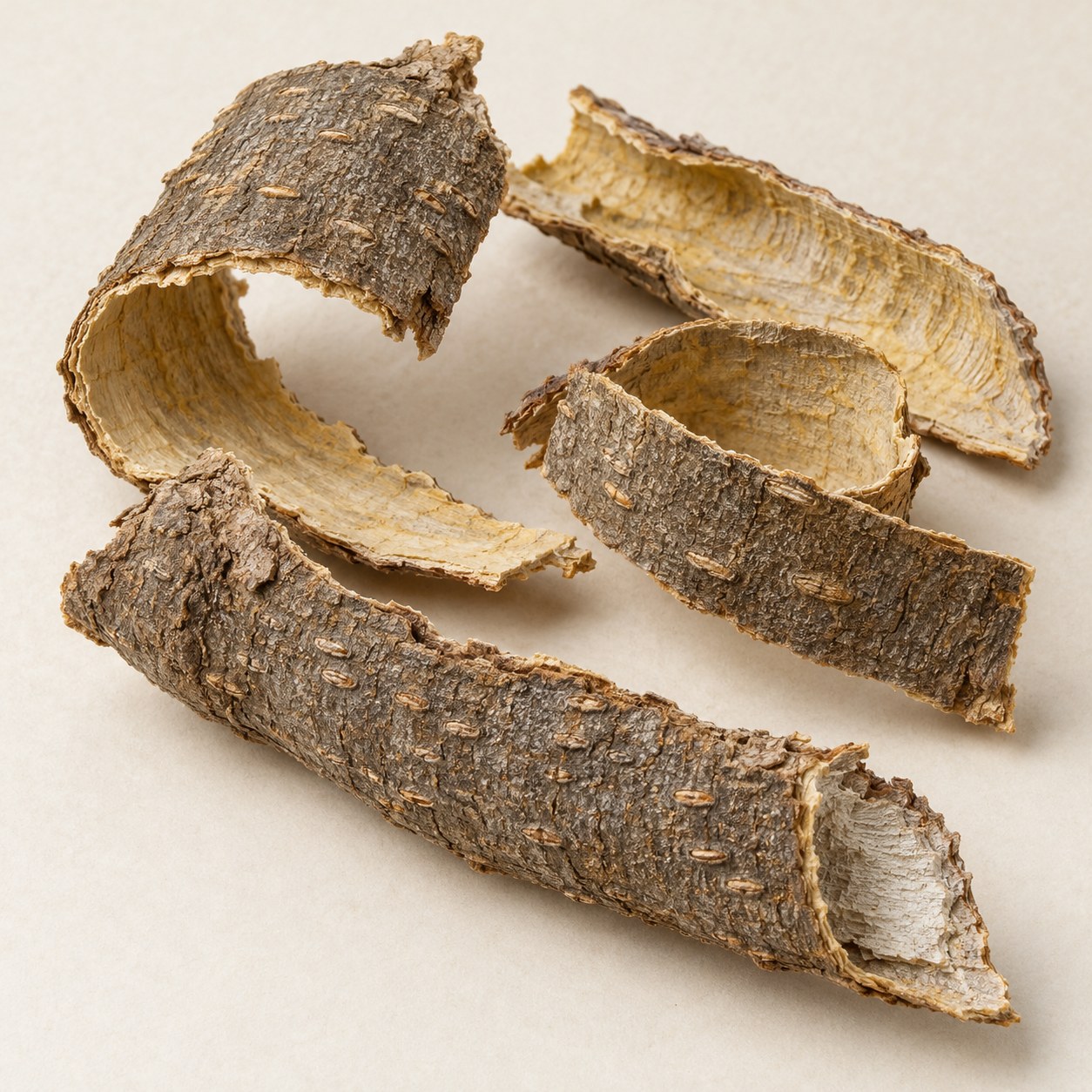
The living shrub has palmately compound leaves, usually five serrated leaflets per petiole; tiny yellow-green flowers gather in round umbels and fruits darken. Genuine drug material is root bark: thin rolled or channel-shaped strips, gray-brown outside with transverse lenticel-like marks, pale yellow inside, brittle with a gray-white fracture. Xiang Jia Pi (Periploca sepium) is also root bark but belongs to a different family/species and contains cardiac glycosides; health authorities warn that substitution can cause digitalis-like poisoning. Do not rely on similar-looking images: verify Latin identity, monograph, and lot testing. AI art cannot authenticate real materia medica.
Growth and habitat
Acanthopanax gracilistylus occurs at forest edges, scrub, trails, and hills and is a deciduous shrub adapted to temperate seasons. A medicinal-plant garden records flowering around July and fruit in September–October; source regions include Hubei, Henan, Anhui, and Sichuan. For observation, use drained humus-rich soil in sun or partial sun, allow space for a tall shrub, and avoid contaminated ground.
Identification and study notes
The living shrub has palmately compound leaves, usually five serrated leaflets per petiole; tiny yellow-green flowers gather in round umbels and fruits darken. Genuine drug material is root bark: thin rolled or channel-shaped strips, gray-brown outside with transverse lenticel-like marks, pale yellow inside, brittle with a gray-white fracture. Xiang Jia Pi (Periploca sepium) is also root bark but belongs to a different family/species and contains cardiac glycosides; health authorities warn that substitution can cause digitalis-like poisoning. Do not rely on similar-looking images: verify Latin identity, monograph, and lot testing. AI art cannot authenticate real materia medica.
Growing and care
- Đào hố rộng hơn bầu, giữ cổ rễ ngang mặt đất, lấp đất tơi trộn ít phân ủ hoai và tưới đẫm một lần để ổn định. Cắm biển tên Latin ngay cạnh cây.
- Dig a hole wider than the root ball, keep the crown at soil level, backfill with loose soil and a small amount of mature compost, then water deeply to settle. Label the plant with its Latin name.
How long until harvest? A perennial shrub needs multiple seasons to establish, but reviewed sources do not publish a minimum medicinal root-bark harvest age or cultivated yield. Root-bark harvesting damages the plant and makes post-drying identity difficult; grow it for botanical study and obtain any medicinal material only from tested suppliers.
FROM PLANT / SOURCE HABITAT TO DRIED MATERIAL · REFERENCE WORKFLOW
- For growth study, record leaf fall, flowering, and fruiting seasons; do not dig mature plants or strip roots. Commercial material must be authenticated as Acanthopanax gracilistylus before processing.
- Materia medica processing must control the root-bark part and remove soil/foreign material; never use unidentified bark or bark from another species.
- HKBU describes dried root bark as thin rolled strips, gray-brown outside with transverse lenticel-like marks, pale yellow/gray-yellow inside; light, brittle, with an uneven gray-white fracture and faint aroma.
- Dry and store sealed in controlled facilities. Do not prepare it at home; confusion with Xiang Jia Pi can cause cardiac poisoning.
These are post-harvest study notes, not directions to prepare a remedy for self-treatment. Processing reference ↗
Habitat, season, and harvest in the HKBU botanical record
HKBU identifies Acanthopanax gracilistylus as a deciduous 2–3 m shrub with five-leaflet compound leaves and yellow-green umbels; the materia medica is dried root bark. A botanical garden source places it at forest edges/scrub, flowering in July and fruiting September–October; no root-bark harvest age is specified.
Open botanical source ↗