Yi Zhi Huang Hua · common goldenrod herb · Yi Zhi Huang Hua
Solidago decurrens Lour. · Dried whole aerial herb
Name and part used
Yi Zhi Huang Hua is the dried whole herb of Solidago decurrens Lour., a 15–60 cm perennial Asteraceae species with alternate leaves and small yellow flower heads in branched sprays. Do not confuse it with other Solidago species or unrelated goldenrod-like plants; drying changes color. HKBU identifies Solidago decurrens, while the Chinese Pharmacopoeia-based description records whole-plant harvest at autumn flowering/fruiting, soil removal, and sun-drying.
Traditional context
HKBU records a bitter taste and fresh fragrant odor, with traditional heat-clearing action. Historical materia medica records list indications such as sore throat, cough with yellow phlegm, jaundice, and urinary symptoms; these do not prove treatment of infection, influenza, jaundice, or kidney disease.
Modern evidence
Studies of Solidago include multiple species, extracts, and laboratory models; they cannot be transferred into clinical evidence for whole Solidago decurrens. HKBU and pharmacopoeial records document identity, harvest, and traditional use, not clinical trials or prescribing guidance.
Safety
People allergic to Asteraceae (such as chrysanthemums or ragweed) may cross-react with the plant/flowers; avoid it after a prior allergy. Long-term oral safety and interaction data for Solidago decurrens are limited. Kidney disease, diuretics/antibiotics, pregnancy/breastfeeding, or infection symptoms warrant professional advice; fever, flank pain, blood in urine, or retention should not be self-treated with herbs.
Safety reference ↗Pairing in reference texts
Reviewed sources do not establish a specific toxic pair or standardized ratio for Yi Zhi Huang Hua. A traditional formula does not prove that pairing it with any herb is safe or treats infection. Do not self-combine it with diuretics, antibiotics, or other diuretic herbs.
Identification and study notes
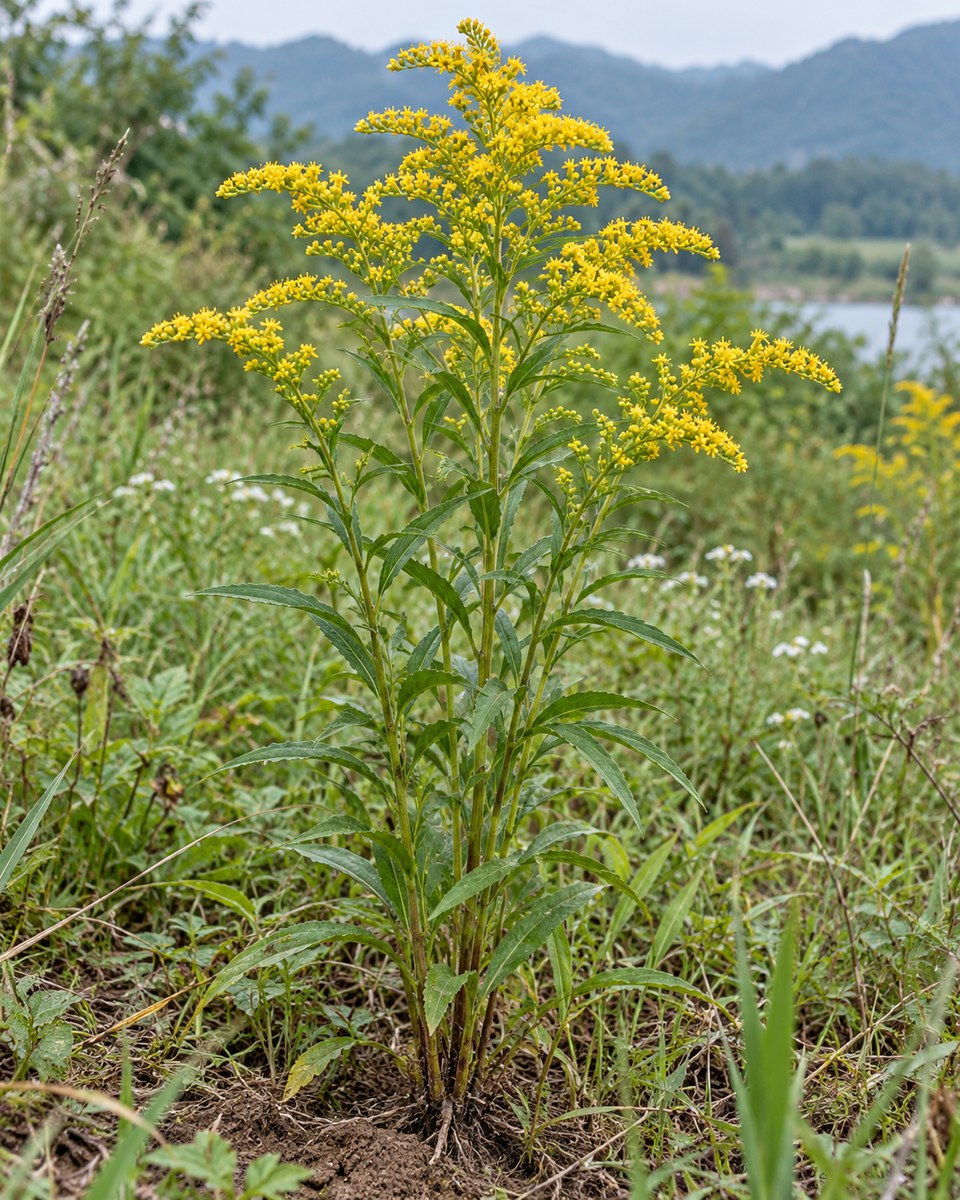
Solidago decurrens is a relatively short perennial compared with some tall goldenrods; stems grow singly or in clumps and may be finely hairy above. Leaves are alternate; mid-stem leaves are ovate to oblong with winged petioles, while upper leaves are smaller and narrow. Tiny yellow flower heads form branched panicles, each only a few millimeters wide. The dried drug is the whole herb; at harvest stems may be 30–100 cm with pale fibrous roots, wrinkled leaves, and remaining yellow or browned florets. Pharmacopoeial descriptions note ridged brittle stems with fibrous fracture, leaves 1–9 cm when unfolded, faint fragrance, and slightly bitter/pungent taste. Do not confuse it with invasive S. canadensis or other yellow Asteraceae. AI images cannot authenticate species, harvest season, or contamination status.
Growth and habitat
Solidago decurrens is a perennial of grassland, slopes, woodland margins, and drained soils in East Asia. HKBU describes a 15–60 cm plant with alternate leaves and yellow flowers, occurring in temperate/subtropical parts of China. Grow in sun or partial shade with drained soil and control spread so a study plant does not become invasive.
Identification and study notes
Solidago decurrens is a relatively short perennial compared with some tall goldenrods; stems grow singly or in clumps and may be finely hairy above. Leaves are alternate; mid-stem leaves are ovate to oblong with winged petioles, while upper leaves are smaller and narrow. Tiny yellow flower heads form branched panicles, each only a few millimeters wide. The dried drug is the whole herb; at harvest stems may be 30–100 cm with pale fibrous roots, wrinkled leaves, and remaining yellow or browned florets. Pharmacopoeial descriptions note ridged brittle stems with fibrous fracture, leaves 1–9 cm when unfolded, faint fragrance, and slightly bitter/pungent taste. Do not confuse it with invasive S. canadensis or other yellow Asteraceae. AI images cannot authenticate species, harvest season, or contamination status.
Growing and care
- Trồng nơi nắng hoặc bán nắng, đất thoát nước; giữ khoảng cách và cắt bỏ đầu hạt nếu cần kiểm soát lan rộng.
- Plant in sun or partial sun with drained soil; leave spacing and remove seed heads if spread must be controlled.
How long until harvest? A perennial; sources describe autumn harvest at flowering/fruiting but no cultivation age. Wait for the source-described growth stage and authenticate the species; there is no validated home-use date or harvest age.
Documented toxic incompatibility
Reviewed sources do not establish a specific toxic pair; interaction data are also limited. Do not infer that pairing with antibiotics, diuretics, or another “heat-clearing” herb is safe.
AI study illustrations; not for specimen identification.
FROM PLANT / SOURCE HABITAT TO DRIED MATERIAL · REFERENCE WORKFLOW
- Harvest the whole herb in autumn while flowering/fruiting according to the specialist description; do not mix with invasive Solidago or unidentified relatives.
- Shake off soil, remove damaged parts and debris, and retain stems, leaves, and flower heads in one labeled Solidago decurrens lot.
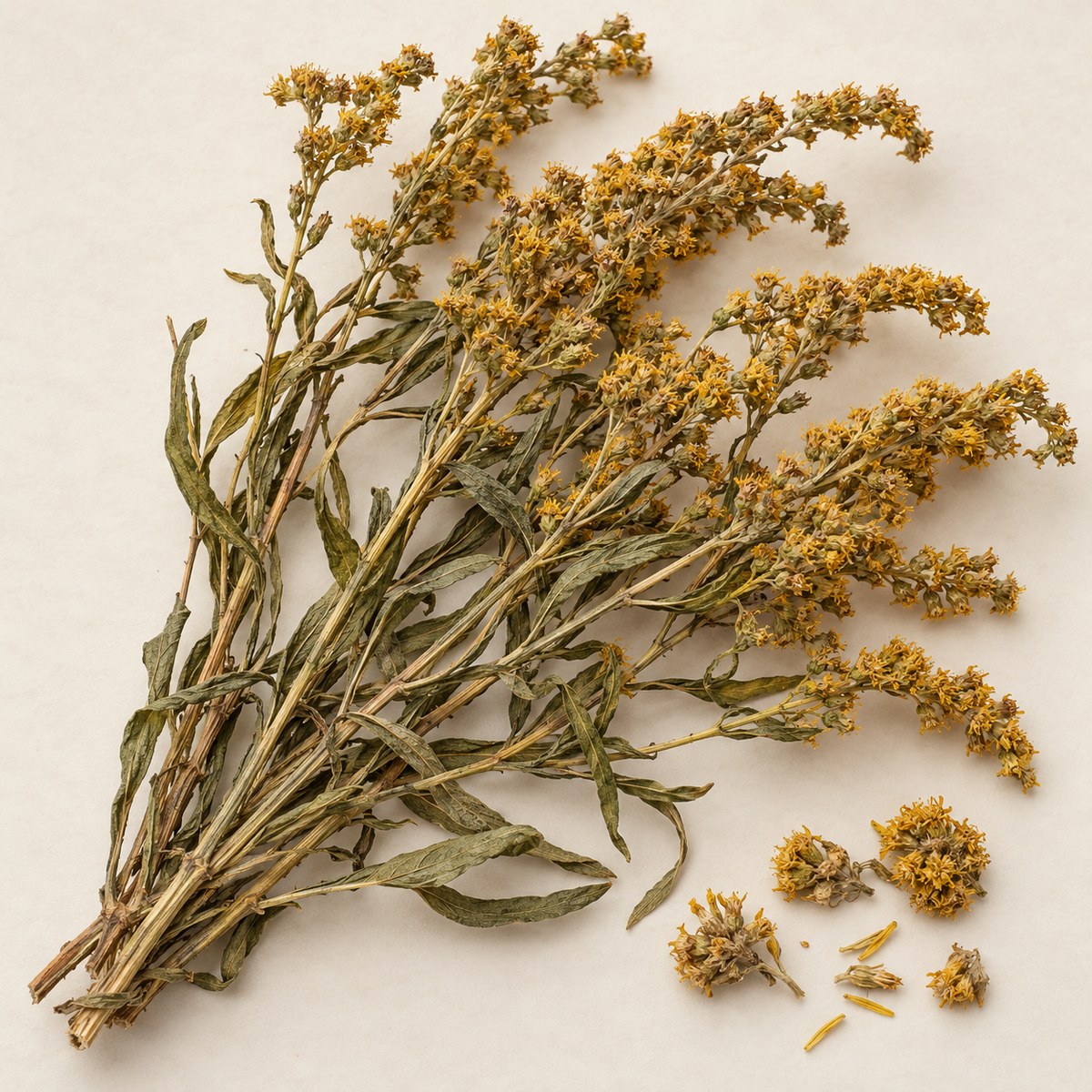
- Sun-dry or use facility-standard drying; the dried drug has ridged stems, alternate leaves, and small yellow-brown flower heads. Control mold, dust, and residues.
- Seal and label provenance and harvest date. Do not decoct it at home for infection, jaundice, or urinary disease.
These are post-harvest study notes, not directions to prepare a remedy for self-treatment. Processing reference ↗
Material source, dried appearance, and processing forms (HKBU)
HKBU identifies Yi Zhi Huang Hua as Herba Solidaginis from Solidago decurrens Lour. (Asteraceae), the whole herb. Its botanical record describes a 15–60 cm plant with alternate leaves and small yellow heads in clusters. A Chinese Pharmacopoeia-based description records autumn whole-plant harvest at flowering/fruiting, soil removal, and sun-drying; dried stems are ridged and brittle, leaves wrinkled, and yellow florets may remain. These descriptors support comparison, not botanical authentication or lot testing.
Open original materia medica record ↗Habitat, season, and harvest in the HKBU botanical record
HKBU records Solidago decurrens as a 15–60 cm perennial with single or clustered stems and small yellow heads in branched panicles; the pharmacopoeial description harvests the whole herb in autumn at flowering/fruiting, removes soil, and sun-dries it. No fixed sowing-to-harvest duration is given.
Open botanical source ↗