Zhu Ling · Umbellate polypore sclerotium · Zhu Ling
Polyporus umbellatus (Pers.) Fr. · Dried fungal sclerotium
Name and part used
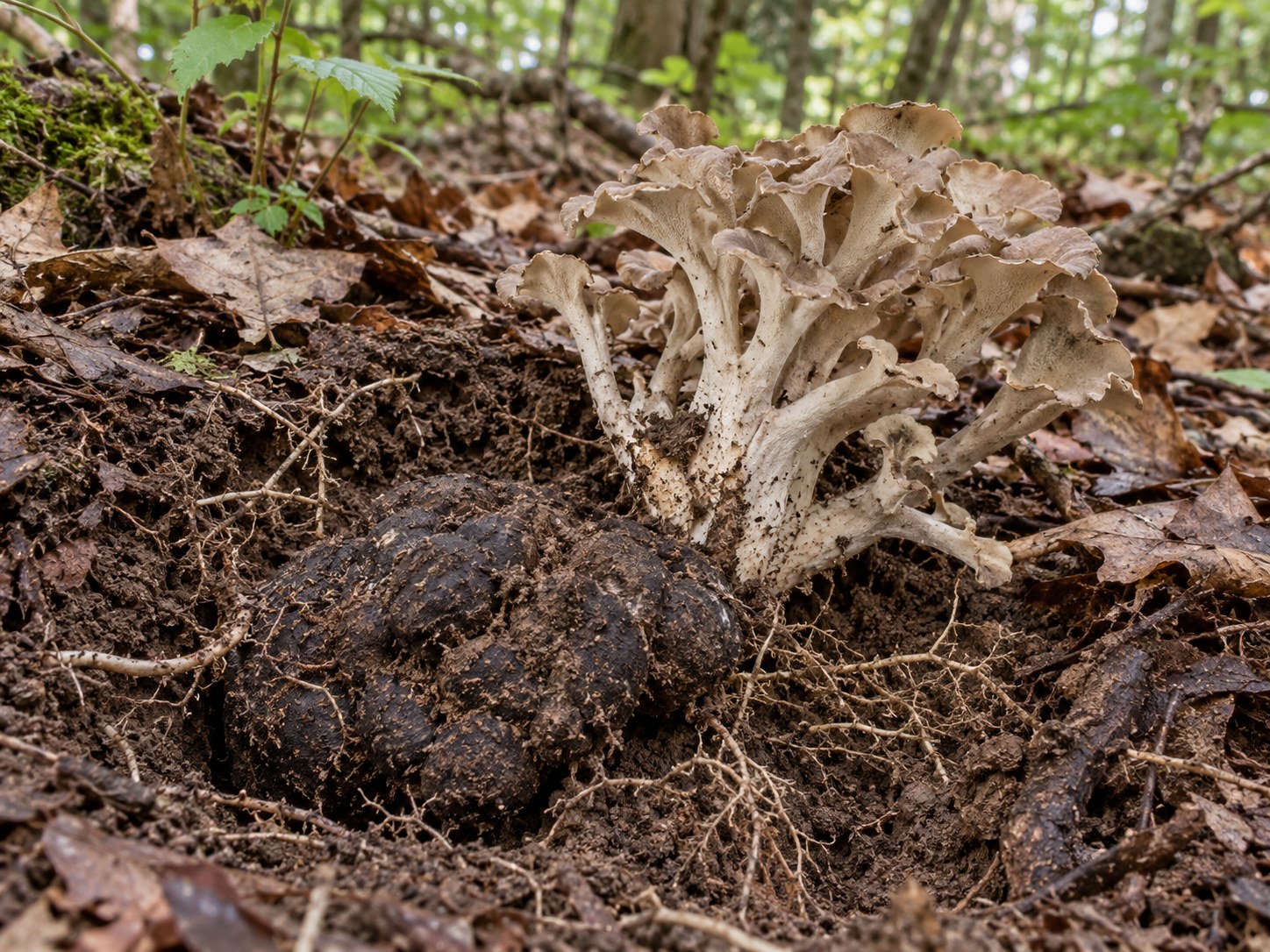
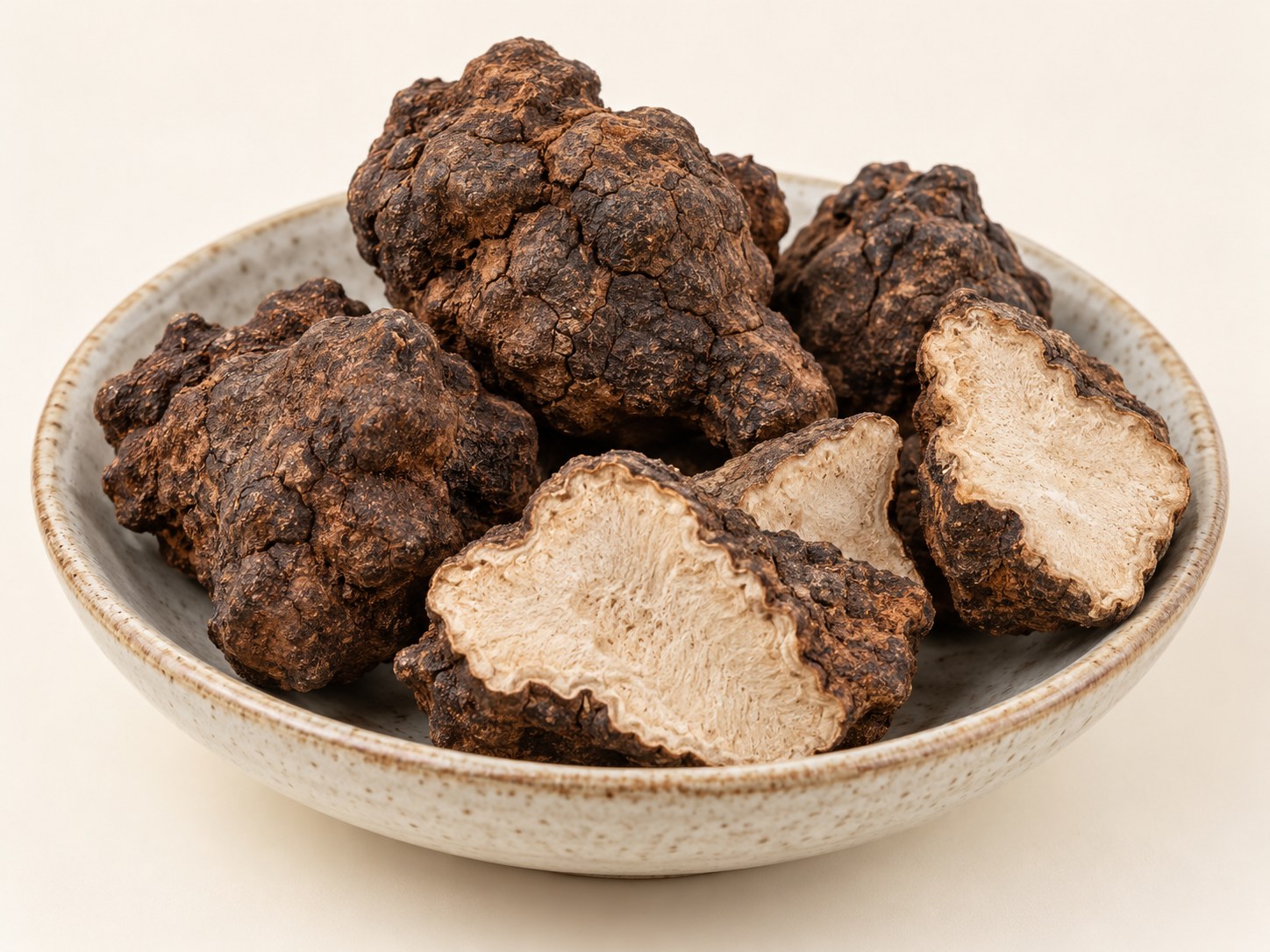
Zhu Ling is the sclerotium of Polyporus umbellatus (Pers.) Fr., also called Grifola umbellata in some literature, a polypore in Polyporaceae. The underground sclerotium forms irregular dark-brown clusters with pale cut flesh. Above ground, the fruiting body branches into an umbellate cluster, each branch bearing a light-brown cap. It is not a plant root or Ling Zhi. The fungus has a complex ecological association with Armillaria and host roots/wood, making cultivation demanding. HKBU records the dried sclerotium as the drug and lists production regions in China. The AI image depicts one illustrative stage and cannot establish symbiosis or medicinal quality; fungal identification requires expertise.
Traditional context
HKBU records Zhu Ling as sweet, bland, and neutral, with a traditional action of promoting urination and draining dampness. Historical indications include edema and urinary difficulty, but do not show that the fungus treats kidney disease, hepatitis, or cancer. Edema, low urine, blood in urine, jaundice, or back pain with fever needs medical assessment; do not self-dose the fungus as a diuretic.
Modern evidence
Research on polysaccharides, steroids, or sclerotium culture is compositional or preclinical and does not establish treatment effects for dried drug material. Its complex ecology and long growth cycle can affect quality, so specimens from different lots are not interchangeable. Botanical records do not support using Zhu Ling to treat cancer, chronic hepatitis, or kidney stones; historical indication lists are not clinical trials.
Safety
Zhu Ling can be confused with other sclerotia or decayed wood; mold can produce toxins and incorrect species pose risk. Do not dig, eat, or decoct a wild fungus yourself; use tested supply and seek clinician/pharmacist advice, especially with kidney disease, diuretic or blood-pressure medicines, pregnancy, or breastfeeding. Dehydration, edema, or reduced urination requires medical evaluation; adding a diuretic herb may delay diagnosis.
Safety reference ↗Pairing in reference texts
Classical formulas record Zhu Ling with Fu Ling, Bai Zhu, Ze Xie, or other drugs, with amounts varying by formula and source. This is not a self-mixing guide, and a traditional diuretic action does not make it safe for kidney disease or prescribed diuretic use. Do not copy a formula ratio without qualified assessment.
Identification and study notes
The plant-side illustration shows a branched fruiting cluster, while the dried drug is a dark underground sclerotium with a pale cut surface. Do not confuse it with the cap cluster or glossy red Ling Zhi. Sclerotia may carry fungal tissue, wood, or soil; a rough surface alone cannot establish maturity or quality. Core study cues are the organism, drug part, Armillaria association, and a growth period measured in years. Not every fungal stage is visible above ground. The underground sclerotium is the drug part, while the umbellate fruiting cluster can appear seasonally and may be hard to find. The paired illustrations support memory but do not prove that the stages belong to one individual or a particular Armillaria association. In production, strain identity, host wood, inoculation lot, and maturity matter; the process takes years. Purchasing commercial material requires regional traceability, mold checks, and quality analysis rather than an internet photo. A similar fungus on decaying wood is not necessarily Zhu Ling. Learners should study preserved, scientifically labelled specimens and avoid forest digging that may damage fungal networks and host roots. Specialist farms maintain lot-level notes for the host wood, fungal strains, moisture, season of inoculation, and any contamination. A small home garden cannot reproduce that ecological chain by simply burying a piece of mushroom. Before harvest, trained staff distinguish mature sclerotium from host roots, wood, and other soil fungi. Do not turn experimental growth conditions into directions for medicinal preparation; laboratory sterilization, strain control, and quality testing require trained facilities. For learners, the safest practical exercise is comparing authenticated museum specimens and recording which structures are underground and which form the visible fruiting cluster.
Growth and habitat
Zhu Ling is associated with forest roots/wood and Armillaria; production occurs in temperate forest regions. Research describes symbiotic cultivation, not ordinary pot gardening. Sclerotia require organic forest soil, moisture without waterlogging, suitable host wood, and authenticated compatible inoculum. Wild harvesting can destroy sclerotia and fungal networks; prefer documented cultivated supply.
Identification and study notes
The plant-side illustration shows a branched fruiting cluster, while the dried drug is a dark underground sclerotium with a pale cut surface. Do not confuse it with the cap cluster or glossy red Ling Zhi. Sclerotia may carry fungal tissue, wood, or soil; a rough surface alone cannot establish maturity or quality. Core study cues are the organism, drug part, Armillaria association, and a growth period measured in years. Not every fungal stage is visible above ground. The underground sclerotium is the drug part, while the umbellate fruiting cluster can appear seasonally and may be hard to find. The paired illustrations support memory but do not prove that the stages belong to one individual or a particular Armillaria association. In production, strain identity, host wood, inoculation lot, and maturity matter; the process takes years. Purchasing commercial material requires regional traceability, mold checks, and quality analysis rather than an internet photo. A similar fungus on decaying wood is not necessarily Zhu Ling. Learners should study preserved, scientifically labelled specimens and avoid forest digging that may damage fungal networks and host roots. Specialist farms maintain lot-level notes for the host wood, fungal strains, moisture, season of inoculation, and any contamination. A small home garden cannot reproduce that ecological chain by simply burying a piece of mushroom. Before harvest, trained staff distinguish mature sclerotium from host roots, wood, and other soil fungi. Do not turn experimental growth conditions into directions for medicinal preparation; laboratory sterilization, strain control, and quality testing require trained facilities. For learners, the safest practical exercise is comparing authenticated museum specimens and recording which structures are underground and which form the visible fruiting cluster.
Growing and care
- Do not collect wild spawn; use a professional fungal facility that authenticates Polyporus umbellatus and compatible Armillaria.
- Use permitted forest-farm or forest-like plots with suitable host wood such as birch or oak under local guidance; obtain landholder and conservation approval.
- Prepare host substrate, symbiotic inoculum, moisture, and inoculation season under a specialist protocol; control contamination while maintaining humid ventilation.
- Monitor for years and have sclerotia assessed by a mycologist; do not dig test pieces or use immature material medicinally.
How long until harvest? Research reports that artificially cultivated sclerotia commonly take 3–5 years to mature, depending on symbiotic strains and conditions. This is not a quick-cycle edible mushroom. Harvest only after a specialist confirms maturity and species identity.
Habitat, season, and harvest in the HKBU botanical record
HKBU specimen records identify Zhu Ling as Polyporus umbellatus and the drug as dried sclerotium, with traditional bland/sweet nature and water-draining action. Modern cultivation studies describe Armillaria symbiosis and a 3–5-year sclerotium maturation cycle. Laboratory procedures should not be converted into a home-growing or self-treatment recipe.
Open botanical source ↗FROM PLANT / SOURCE HABITAT TO DRIED MATERIAL · REFERENCE WORKFLOW
- Harvest only from a documented cultivation lot with verified species and Armillaria partner; do not use wild fungi identified by image.
- Dig mature sclerotia by lot and retain host-wood and source records; exclude foreign or decayed material.
- Remove soil, woody roots, and soft damaged parts; rinse briefly with clean water and slice to the facility specification before drying.
- Dry to a controlled moisture standard and record species, cultivation years, site, method, and lot; store dry and reject mold or unusual odor.
These are post-harvest study notes, not directions to prepare a remedy for self-treatment. Processing reference ↗