Zi Wan · Tatarian aster root · Zi Wan
Aster tataricus L. f. · Dried root and rhizome
Name and part used
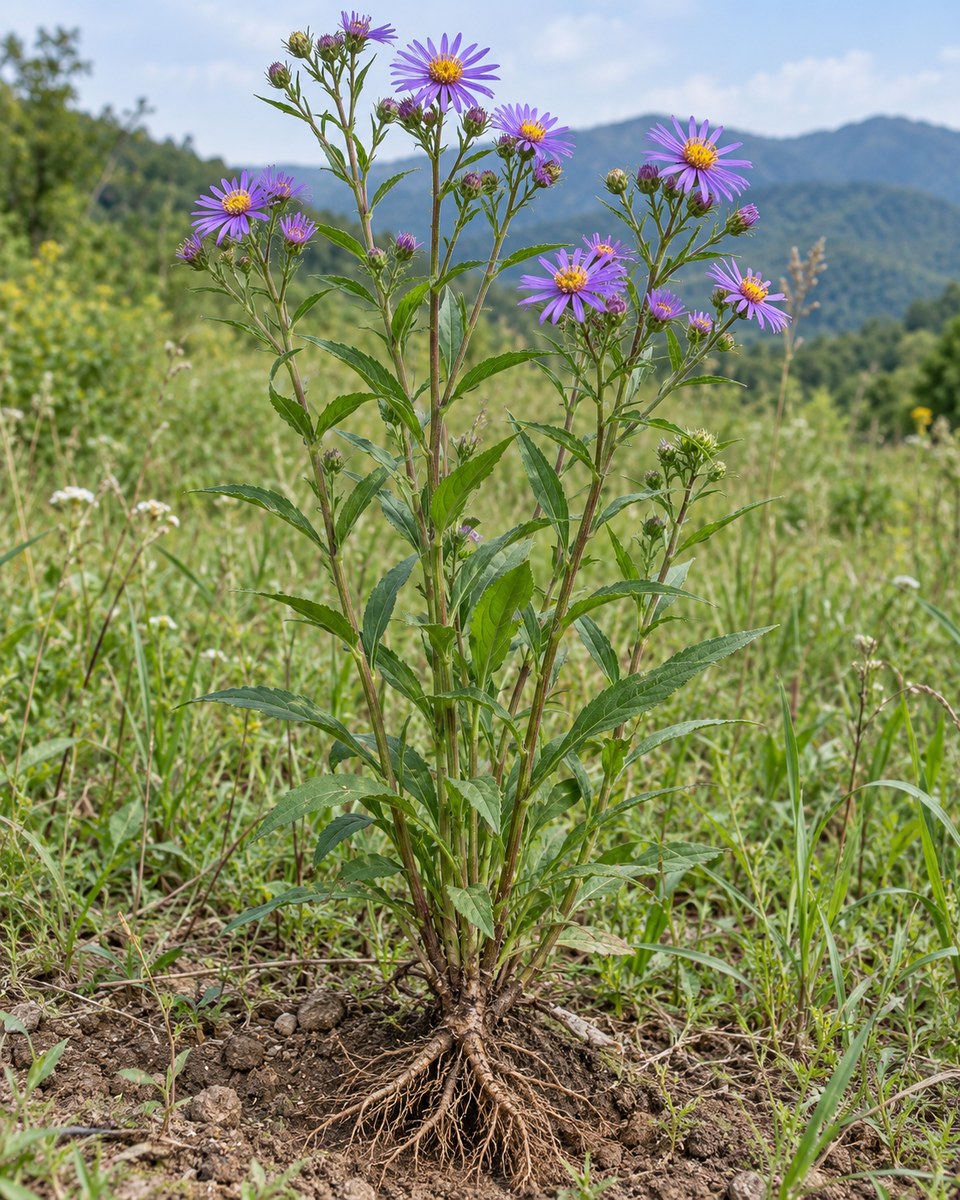
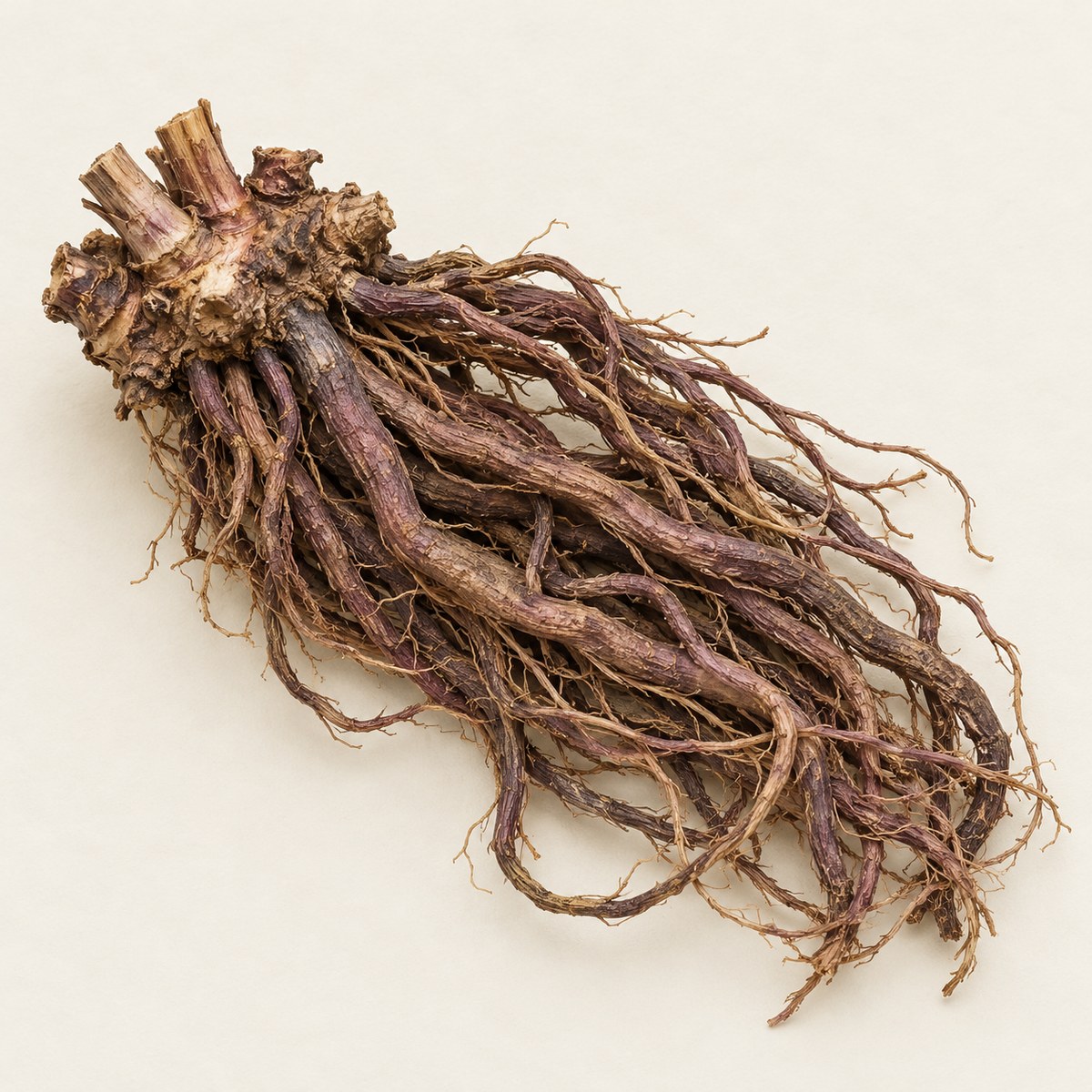
Zi Wan is the dried root and rhizome of Aster tataricus L. f., a perennial aster with erect stems, alternate leaves, and violet daisy-like heads with yellow centers. The dried drug combines a short rhizome and many long, pliable purplish-red to gray-red rootlets; HKBU notes that the roots may be braided. Names and images support study but cannot authenticate a real specimen.
Traditional context
HKBU’s materia medica record describes it as pungent, bitter, and warm, with traditional actions of moistening the lung, directing qi downward, transforming phlegm, and relieving cough. These are traditional descriptors and do not establish treatment for asthma, pneumonia, hemoptysis, or any modern respiratory diagnosis.
Modern evidence
Modern reviews describe constituents, extracts, and cell or animal studies; these preclinical findings do not show that crude Zi Wan root cures cough or lung disease in people. A 2025 review also notes limited cultivation and toxicology data and cautions about possible liver toxicity or hemolytic effects at high doses or with prolonged use.
Safety
Do not self-decoct or use long-term. A recent review reports toxicity signals in some extract fractions and greater concern with high doses or prolonged exposure; it does not establish a safe home dose. Breathlessness, chest pain, high fever, coughing blood, or persistent cough needs medical care. Pregnancy, breastfeeding, childhood, liver disease, and concurrent medicines warrant professional advice before any preparation.
Safety reference ↗Pairing in reference texts
A review discusses pairing Zi Wan with Kuan Dong Hua in research on reducing toxicity, but this is not clinical proof that the pair is safe or effective for users. Reviewed sources do not establish a specific toxic incompatibility or a home-use ratio. Do not combine herbs on your own; traditional formulas vary by source and patient.
Identification and study notes
Living identification: a clump-forming perennial with upright grooved stems and alternate lance-shaped leaves; violet ray flowers surround yellow centers, rather than one oversized solitary bloom. Underground is a short rhizome with many fine roots. Dried material: roots are often long, pliable, purplish to gray-red, longitudinally wrinkled, and faintly aromatic; the rhizome may retain stem bases. HKBU notes the rootlets may be braided because they are numerous and soft. Commercial lots differ in how much rhizome is retained, so read the materia medica label and compare the source; purple color alone cannot authenticate the species. Zi Wan and Zi Wan Gen can be used differently across texts. This image illustrates one Aster tataricus plant; it is neither an authenticated specimen nor a representation of every regional cultivar.
Growth and habitat
Aster tataricus occurs in East Asia, including China, Korea, Japan, and parts of Siberia. A 2025 review describes moist, partly shaded sites at roughly 400–2,000 m, low-mountain grassland, marshy ground, and slopes; Hebei and Anhui are named production areas in China. This habitat reference does not guarantee the same constituents in plants grown elsewhere.
Identification and study notes
Living identification: a clump-forming perennial with upright grooved stems and alternate lance-shaped leaves; violet ray flowers surround yellow centers, rather than one oversized solitary bloom. Underground is a short rhizome with many fine roots. Dried material: roots are often long, pliable, purplish to gray-red, longitudinally wrinkled, and faintly aromatic; the rhizome may retain stem bases. HKBU notes the rootlets may be braided because they are numerous and soft. Commercial lots differ in how much rhizome is retained, so read the materia medica label and compare the source; purple color alone cannot authenticate the species. Zi Wan and Zi Wan Gen can be used differently across texts. This image illustrates one Aster tataricus plant; it is neither an authenticated specimen nor a representation of every regional cultivar.
Growing and care
- Chọn đất thịt nhẹ hoặc pha cát tơi, giàu mùn, giữ ẩm nhưng thoát nước; đặt nơi có nắng buổi sáng hoặc bán râm. Tổng quan mô tả cây ưa ẩm và hơi râm; úng liên tục làm tăng nguy cơ thối rễ.
- Choose loose, humus-rich loam or sandy loam that retains moisture but drains freely; provide morning sun or partial shade. The review describes a moist, partly shaded preference, while prolonged waterlogging raises root-rot risk.
How long until harvest? A perennial. The cultivation review describes root harvest and selection of healthy propagation roots around late October but gives no fixed number of years from sowing to medicinal harvest. One season cannot be promised to yield authenticated, standard-grade materia medica. Use only professionally identified, tested, and processed material.
Documented toxic incompatibility
Reviewed sources do not identify a specific classical toxic incompatibility for Zi Wan. One review mentions research pairing it with Kuan Dong Hua when examining toxicity; this is not a general-use formula. There is insufficient evidence to publish a safe ratio or home-use recommendation.
AI study illustrations; not for specimen identification.
FROM PLANT / SOURCE HABITAT TO DRIED MATERIAL · REFERENCE WORKFLOW
- Collect root and rhizome in spring or autumn according to species records; a cultivation review places selection of healthy propagation roots around late October in some regions. Do not dig from polluted sites or protected areas.
- Shake off soil, separate rootlets and rhizomes by lot, and discard damaged or moldy parts; retain scientific name, growing site, and harvest date. HKBU notes that roots may be braided; the AI image is not a grading standard.
- Sun-dry or use controlled drying under professional procedures, preserving the pliable purplish-red appearance described by sources; do not honey-process, roast, or formulate it at home.
- Qualified facilities should control moisture, mold, contaminants, and identity; learners should not ingest untested material.
These are post-harvest study notes, not directions to prepare a remedy for self-treatment. Processing reference ↗
Material source, dried appearance, and processing forms (HKBU)
HKBU identifies the material as dried root and rhizome of Aster tataricus L. f. (Asteraceae), Asteris Radix et Rhizoma. Dried morphology: irregular root clusters, sometimes retaining stem or leaf bases at the top, many fine roots around 3–15 cm long and 0.1–0.3 cm in diameter, purplish or gray-red with longitudinal wrinkles; roots are relatively pliable, faintly aromatic, sweet and slightly bitter. HKBU describes superior material as long-rooted, purplish-red, pliable, and free of foreign matter. Some rootlets are braided into a “ponytail.” These are study descriptors, not a home quality-control test.
Open original materia medica record ↗Habitat, season, and harvest in the HKBU botanical record
HKBU’s dried-material record identifies Aster tataricus L. f.; major production regions include northeastern and northwestern China and Anhui. A recent botanical review describes moist meadows, low-mountain grassland, humid slopes, and partly shaded sites around 400–2,000 m; Hebei and Anhui are named in the cultivation review. Sources describe spring or autumn root harvest, soil removal, drying, and braiding in some lots. These stages depend on climate and facility procedures and cannot be converted into a fixed number of growing days.
Open botanical source ↗