Adonis vernalis L. · Aerial herb is discussed in the references; toxic plant, not for foraging or self-medication
Materia medica properties in reference
Materia medica form discussed in this paragraph
Properties as recorded in the source: Kew accepts Adonis vernalis L. in Ranunculaceae. An EMA/EMEA report on residues in veterinary medicines describes cardenolides (cardiac glycosides) in the plant and Adonis preparations; this is constituent/pharmacology information, not an East Asian taste, meridian, or treatment profile. The sources reviewed do not establish a standardized East Asian materia-medica property profile for this exact species. This page therefore records taxonomy, the plant part discussed, and toxicity concerns without inferring a thermal nature, meridian entry, or treatment effect.
A 1999 EMEA report records that Adonis preparations in European phytotherapy had historically been used mostly with other plant-derived active principles, but the reviewed passage does not identify a verifiable pair or ratio. The report is not a current treatment recommendation. Do not combine Adonis with herbs or cardiovascular medicines on your own.
Documented incompatible or toxic pairings
Materia medica form discussed in this paragraph
The sources below report these combinations as incompatible or cautionary; this does not mean every co-use has been proven to cause poisoning.
Documented toxic incompatibility
Materia medica form discussed in this paragraph
The sources reviewed do not verify a specific plant pair that becomes poisonous when combined with Adonis vernalis. The EMA report only says historical preparations were often used with other plant-derived actives, without naming a pair or ratio in the reviewed passage. No beneficial pair, incompatibility, or ratio is assigned. The plant itself contains cardiac glycosides and is listed as toxic by a poison-information service; do not combine it with heart medicines or other herbs without professional assessment.
Materia medica form discussed in this paragraph
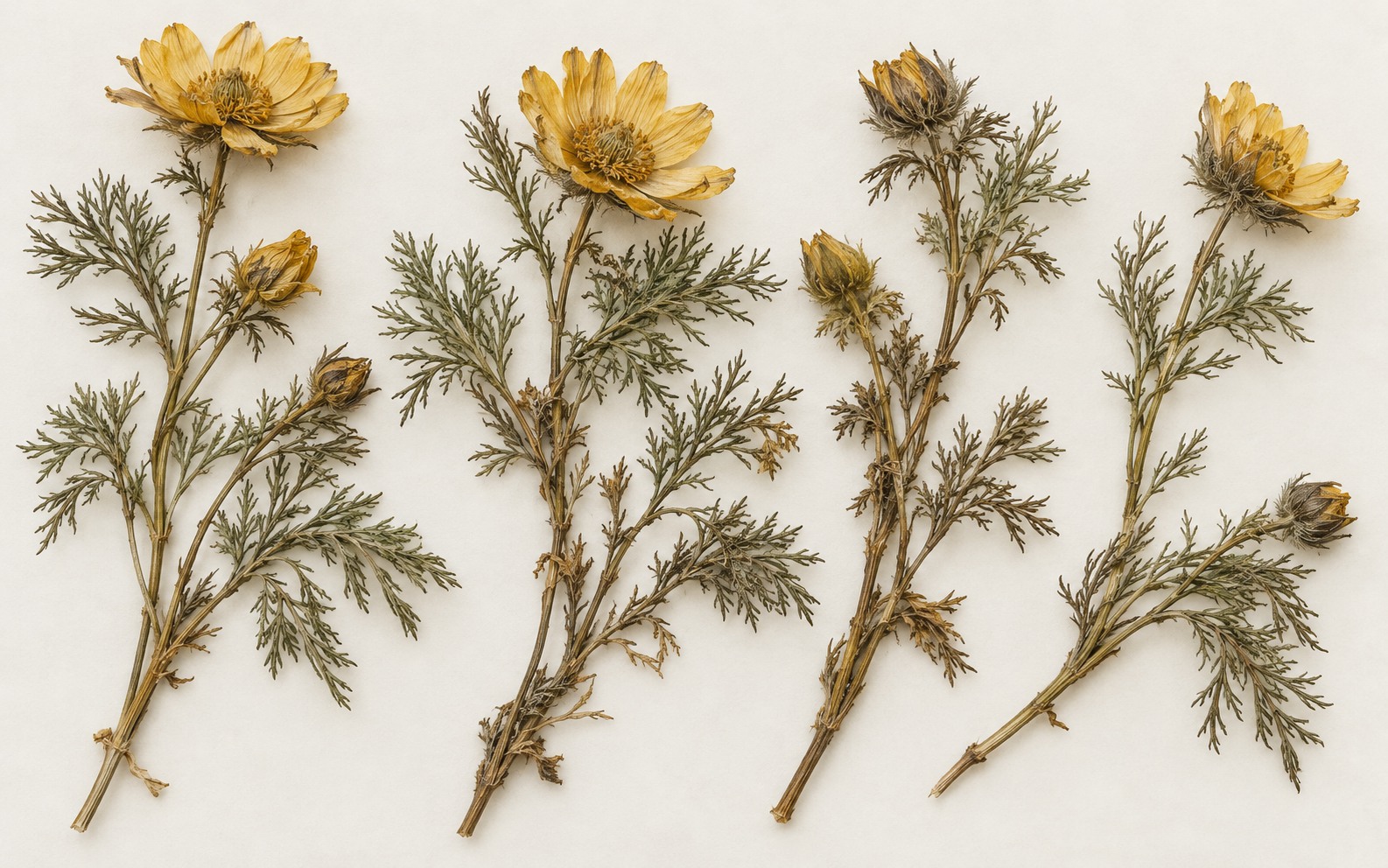
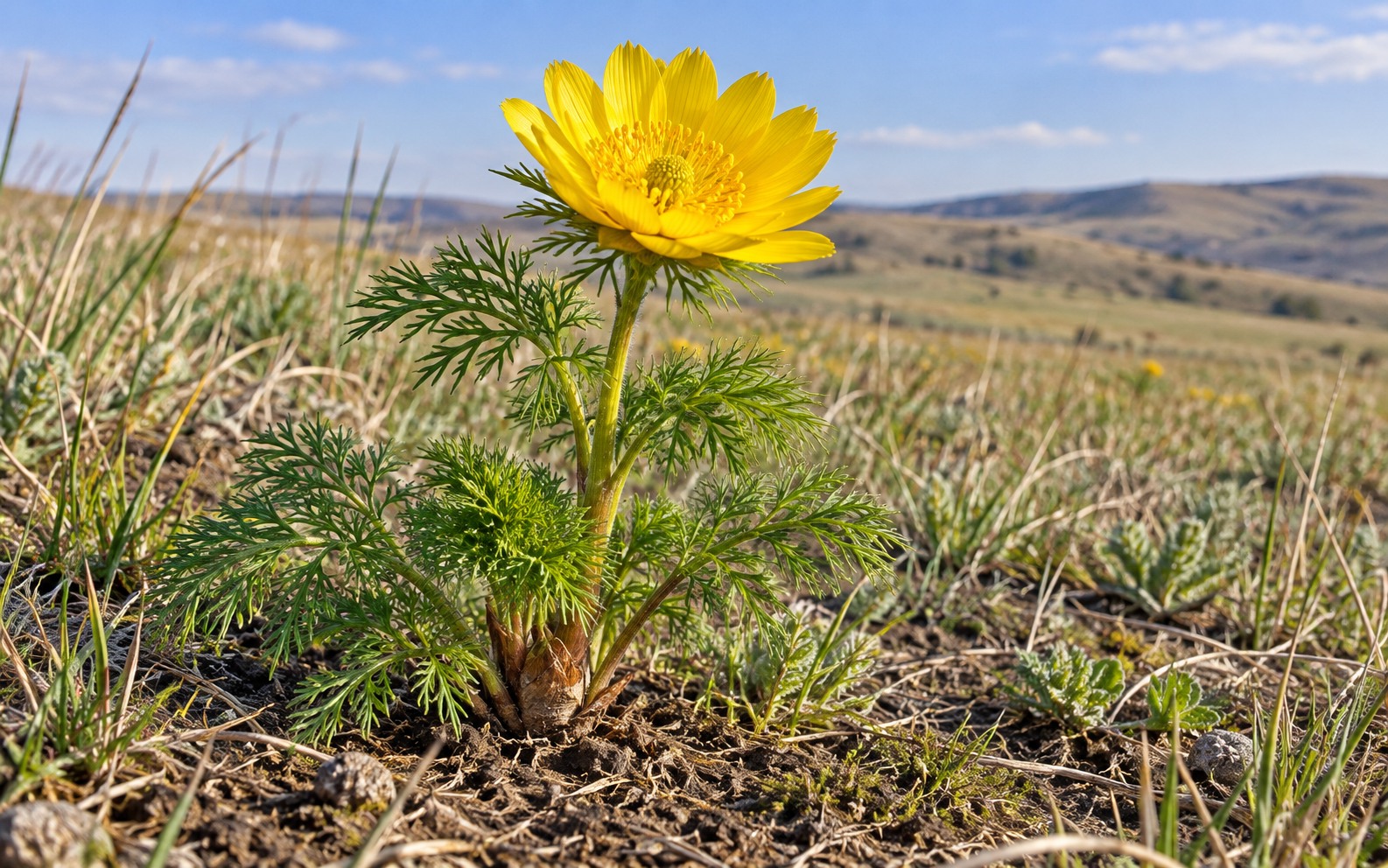
AI study illustrations; not for specimen identification.
CITES international-trade evidence
Materia medica form discussed in this paragraph
The 2026.1 CITES Trade Database contains 7 comparative-tabulation rows for Adonis vernalis during 2019, 2021, 2023, 2024. The query selected reported purpose T (Commercial) and trade term MED (medicine); appendices appearing in these rows: II. Reported importer codes include AT, BR, CA, CO; exporter codes include CH, FR. These are comparative-tabulation rows, not shipment counts or summed volume. This record does not establish clinical efficacy, the legality of an individual transaction, or safety of use.
Kew accepts Adonis vernalis L. as a perennial in Ranunculaceae, native from Europe through Siberia to the Caucasus and growing primarily in the temperate biome. Common English names include spring adonis and spring pheasant’s-eye; this profile uses the descriptive name “Spring Adonis” rather than inventing an unsupported Vietnamese materia-medica or Chinese name. The plant forms a low clump with finely divided
Living-plant features for identification study
, feathery green leaves and bright yellow spring flowers. The Royal College of Physicians describes it as rhizomatous and grown in its medicinal garden in full sun and well-drained soil. These are AI illustrations, not a way to authenticate a real specimen or distinguish close Adonis species.
Traditional context
Materia medica form discussed in this paragraph
The EMEA/EMA report records that Adonis preparations had historically been used in European phytotherapy for cardiac dysfunction, mostly alongside other plant-derived active principles. This is a historical statement in a residues-risk assessment
Materia medica form discussed in this paragraph
, not a clinical efficacy conclusion, use instruction, or recommendation for patients. The Royal College of Physicians cites a 1633 Gerard record of historical use while also warning that the plant is toxic and best avoided. Appearance in medical writing or materia-medica trade does not establish that raw plant material is safe; this information must not be used for self-treatment of heart failure, palpitations, or edema.
Modern evidence
Materia medica form discussed in this paragraph
The project’s CITES Trade Database 2026.1 extract contains seven comparative-tabulation rows for Adonis vernalis in 2019, 2021, 2023, and 2024. The project filter selected purpose T (Commercial), term MED (medicine), Appendix II. These are Party-reported comparative data rows, not shipment counts, total volume, revenue, or the entire herbal market. Trade records do not prove efficacy or legality in a particular jurisdiction. CITES currently lists Adonis vernalis in Appendix II with annotation #2; check the current interpretation and required documents with the competent authority before transport.
Materia medica form discussed in this paragraph
The 1999 EMEA/EMA report describes reported cardenolide
Materia medica form discussed in this paragraph
/cardiac-glycoside content in dried aerial parts at 0.2–1.0% of dry matter; this is compositional information in an older report, not a modern product-quality specification. It also describes pharmacological action of the glycosides on cardiac muscle. Chemical activity alone does not establish therapeutic benefit from the plant, tea, powder, or a foraged specimen. This page gives no dose; historical amounts in the report are not converted into use instructions.
Safety
Materia medica form discussed in this paragraph
Norway’s poison-information service lists Adonis vernalis among toxic Adonis species and advises contacting its poison center if a child has tasted the plant. The EMEA/EMA report describes cardenolide/cardiac glycosides
Materia medica form discussed in this paragraph
in the aerial parts; these compounds act on cardiac muscle. Do not taste, chew, decoct, soak, grind, or prepare the plant yourself; keep it away from children and pets, and never use it to self-treat a heart condition. The UK MHRA lists Adonis vernalis among herbal ingredients subject to UK controls; that describes UK law only and does not replace the rules where a reader lives. If ingestion is suspected, contact local medical services or a poison center for guidance.
Key features in the flowering illustration are a low clump, one bright yellow flower with many narrow radiating petals, and leaves divided into very fine, feathery segments. The Royal College of Physicians describes a mound of fine foliage and buttercup-like spring flowers; Kew records a temperate perennial. Colors and details in AI artwork follow those descriptions but do not represent all natural variation. When dried
Living-plant features for identification study
, flowers fade and stems/leaves collapse, reducing diagnostic features; a dried bundle cannot be securely identified by sight alone. An older CITES proposal notes that several perennial Adonis species look similar and may be confused in traded material. Do not forage this toxic plant for identification practice.
Growth and habitat
Illustrated plant and growing setting
Kew gives a native range from Europe to Siberia and the Caucasus, with many distributions in Central/Eastern Europe and temperate Eurasia. The Royal College of Physicians describes sandy soils
, grassland, heath, and pine woodland in Europe. These references provide biogeographic and habitat context, not proof that a local population is abundant or may be harvested. Successful cultivation in a London medicinal garden does not show that Vietnam’s tropical climate is suitable.
Living plant / habitatFor ornamental or study growing only, obtain lawfully sourced nursery stock labeled Adonis vernalis. Do not dig wild plants or collect seed from natural populations; CITES and historical trade records do not authorize collection.
Living plant / habitatThe Royal College of Physicians records successful growth in a raised bed in full sun with well-drained soil; its habitat note also mentions sandy European soils. This describes a UK garden, not a validated commercial medicinal-crop protocol for Vietnam.
Illustrated plant and growing settingThe RCP source recommends planting the crown a couple of centimetres below soil level and applying annual leaf-mould mulch. Do not infer a seed-sowing depth, watering calendar, or fertilizer amount without species- and site-specific guidance.
Illustrated plant and growing settingMonitor waterlogging and plant condition, and keep children/pets from touching or eating it. The cultivation source reviewed does not give a complete irrigation, pest-control, or propagation schedule; consult a specialist nursery before attempting cultivation.
Living plant / habitatThe RCP source reviewed does not give years to maturity or a medicinal harvest age. Although the plant is perennial in gardens, no time interval makes it safe for self-use. Grow it for observation, not harvest or ingestion.
Illustrated plant and growing setting
How long until harvest? No growing period makes Adonis vernalis safe to take as medicine. The RCP source does not provide a medicinal harvest age; this is a toxic plant for observation or controlled ornamental cultivation only.
From plant to dried material · source-recorded workflow
Plant before harvestVerify Adonis vernalis L., plant provenance, and applicable CITES/national rules before purchase, cultivation, or transport. Do not collect wild plants for identification practice.
Dried materia medica form of this speciesFor ornamental cultivation, record stock source, planting date, bed location, and growing conditions; follow a specialist nursery’s directions. Wear gloves and prevent children/pets from touching or eating the plant.
Illustration of the processing step describedAn older CITES proposal describes historical trade forms as crude drug in whole or cut condition; this is not a current processing method or advice to forage. The sources reviewed provide no safe home-drying instructions.
Dried materia medica form of this speciesDo not grind, decoct, soak, formulate, or experiment with a dose. The EMEA/EMA report identifies cardenolides in the plant; handling toxic materia medica belongs in authorized facilities with appropriate controls.
Dried materia medica form of this speciesKeep records of accepted species name, plant part, provenance, and trade documents; CITES Appendix II and annotation #2 do not replace country-specific legal checks.
Illustration of the processing step described
This record supports study and processing traceability; it is not a home preparation or self-use guide.