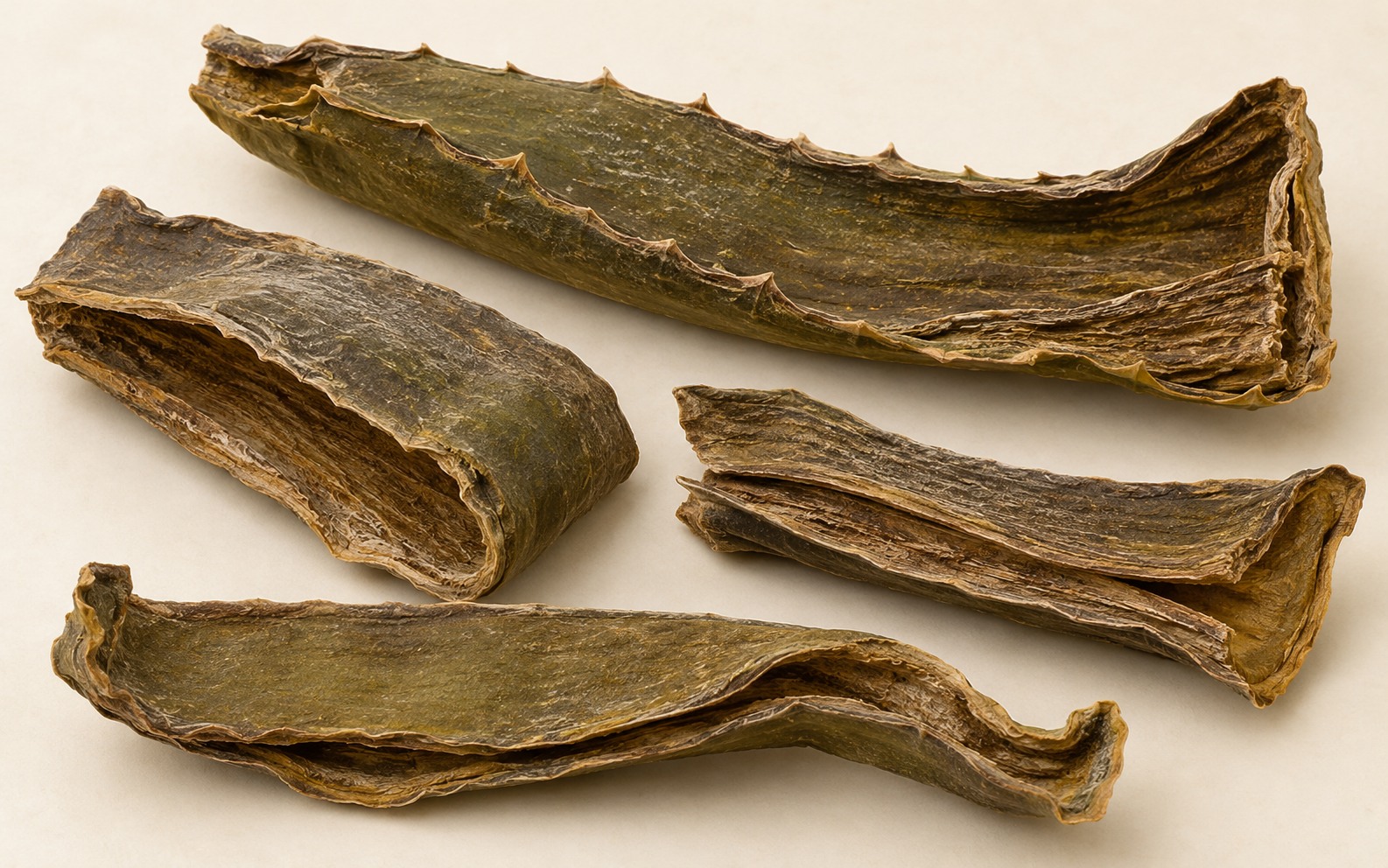
Aloe arborescens Mill. · Leaves; distinguish clear inner gel from bitter yellow exudate beneath the leaf surface
Materia medica properties in reference
Materia medica form discussed in this paragraph
The linked references do not establish the taste, temperature, meridian entry, and traditional functions for this exact species/material. No properties are inferred from a related species.
Combinations recorded in formulas
Materia medica form discussed in this paragraph
No sufficiently specific formula record is linked to this profile. The page therefore does not invent a beneficial pairing or a ratio.
Documented incompatible or toxic pairings
Materia medica form discussed in this paragraph
The sources below report these combinations as incompatible or cautionary; this does not mean every co-use has been proven to cause poisoning.
Documented toxic incompatibility
Materia medica form discussed in this paragraph
The sources reviewed do not confirm a specific herb pair that is toxic when combined with Aloe arborescens, so this profile does not invent a plant combination or ratio. The supported concern is that anthraquinone-rich leaf exudate can cause cramping, diarrhoea, and dehydration when taken orally or misused; medicine interactions must be assessed for the exact product. “No documented toxic pair found” does not prove all combinations are safe.
Materia medica form discussed in this paragraph
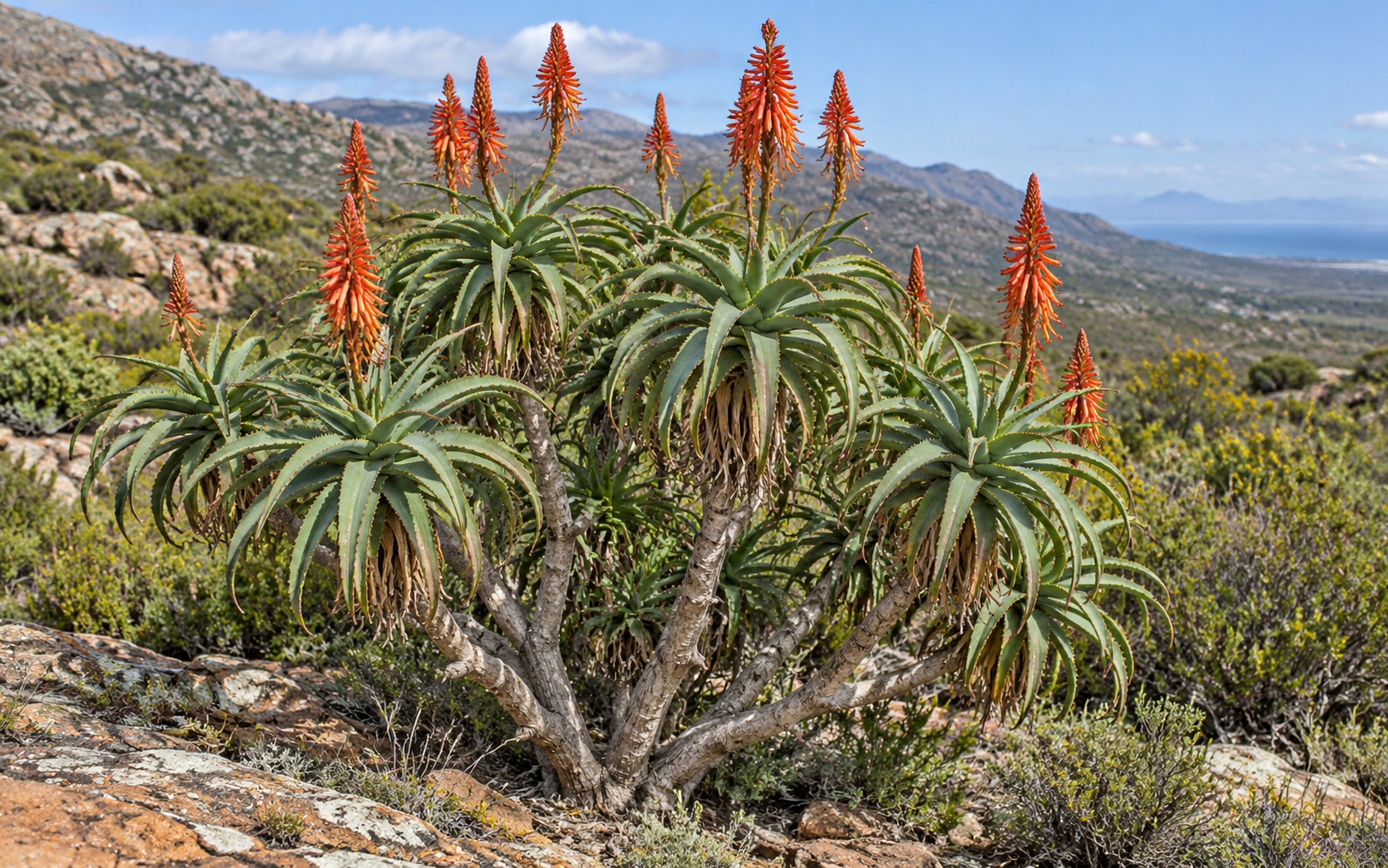
AI study illustrations; not for specimen identification.
CITES international-trade evidence
Materia medica form discussed in this paragraph
The 2026.1 CITES Trade Database contains 31 comparative-tabulation rows for Aloe arborescens during 2018, 2019, 2020, 2021, 2022, 2023, 2024. The query selected reported purpose T (Commercial) and trade term MED (medicine); appendices appearing in these rows: II. Reported importer codes include CN, HK, KP, KR, SG, VN; exporter codes include JP. These are comparative-tabulation rows, not shipment counts or summed volume. This record does not establish clinical efficacy, the legality of an individual transaction, or safety of use.
Kew accepts Aloe arborescens Mill. in the family Asphodelaceae. It is a branching succulent shrub, often bearing several leaf rosettes at branch tips; it is not the ground-level rosette form of Aloe vera. Leaves are long and lance-shaped, grey-green, sometimes reddish under dry conditions, with firm marginal teeth. Upright, dense racemes carry tubular flowers ranging from orange to scarlet.
Living-plant features for identification study
Leaves are used in different contexts, but clear inner gel, bitter yellow exudate, and whole-leaf material are compositionally and toxicologically distinct. The AI images here support broad morphology study only; they must not be used to identify, harvest, or authenticate real material.
Traditional context
Living plant discussed in this paragraph
PROTA records region-specific uses: split or crushed fresh leaves have been used externally in folk practice for burns and wounds; a leaf decoction has also been recorded in some South African communities in the context of childbirth. In Japan, leaves are used as a vegetable or health food and commercial products exist.
Living plant discussed in this paragraph
These are ethnobotanical records, not proof that fresh leaves treat burns, wounds, constipation, or another condition. Do not merge Aloe arborescens with Aloe vera, Aloe ferox, or hybrids just because all may be called “aloe.” The references reviewed do not establish East Asian taste, temperature, meridian entry, or a classical formula specifically for this species; this profile does not assign them.
Modern evidence
Materia medica form discussed in this paragraph
A systematic review of Aloe arborescens brings together chemical, preclinical, and some pilot or clinical reports. Study designs, preparations, doses, and participants vary substantially; the review does not establish that raw plant material treats a particular disease.
Materia medica form discussed in this paragraph
PROTA records medicinal and cosmetic cultivation in some markets while also noting that reliable commercial production statistics are unavailable. In the project’s 2026.1 CITES trade extract, an exact-name filter returns 31 comparative-tabulation rows for Aloe arborescens in 2018–2024; the reported purpose is T (commercial), the commodity term is MED (medicine), and the Appendix is II. These are comparative database rows, not shipments, weight, revenue, or proof that every labeled product contains the correct species.
Safety
Living plant discussed in this paragraph
Aloe leaves are not one uniform material. PROTA reports that Aloe arborescens leaf exudate contains aloin and related anthraquinones; aloin has laxative activity after metabolism, whereas inner gel has a different composition.
Materia medica form discussed in this paragraph
PROTA lists pregnancy, breastfeeding, intestinal inflammation, and haemorrhoids among contraindications for anthraquinone laxative preparations; prolonged use may cause griping, diarrhoea, and impaired bowel function. These facts do not establish a safe self-use dose for fresh plant material. NCCIH warns about oral aloe preparations, but much of its commonly cited safety evidence focuses on Aloe vera; Aloe vera findings must not be treated as species-specific proof for A. arborescens. People taking medicines or living with intestinal, cardiac, or kidney conditions, and anyone pregnant or breastfeeding, should consult a clinician or pharmacist before using aloe products; do not stop or replace prescribed medicines. Ingestion of concentrated exudate or severe diarrhoea, abdominal pain, weakness, or faintness warrants prompt medical or poison-control advice.
No reliable source reviewed provides a specific Aloe arborescens formula with ingredients, amounts, and an established effect that could be presented as a recipe.
Materia medica form discussed in this paragraph
Nor did we verify a particular herb pair that instantly becomes poisonous when mixed with this species; that absence does not mean all combinations are safe. The documented concern is anthraquinone-containing aloe exudate and oral use, not a general two-plant mixing ratio. NCCIH discusses interactions for oral aloe, including cardiac-glycoside cautions in the context of latex misuse; that is a medicine warning, not evidence for a specific herb–herb pair. Because no named plant combination or ratio was verified, the page invents neither a ratio nor an image of a hypothetical pairing.
Identification and study notes
Dried-drug features for identification study
For study, start with the whole habit: the plant often forms a many-branched shrub with visible woody stems near the base; fleshy leaves cluster into rosettes at branch tips. Margins bear firm triangular teeth, pale yellow to brown with age; grey-green leaves may redden during dry periods. The upright, dense, tapered raceme carries orange-to-red tubular flowers; PROTA describes terminal racemes about 20–40 cm long.
Living-plant features for identification study
Habit, teeth, and flower traits vary with environment, population, and natural hybridization. Its branched shrub form helps separate it from Aloe vera, but do not identify a specimen from one image or one trait. AI artwork may misstate leaf, tooth, or flower details; real specimens require qualified botanical review and provenance.
Growth and habitat
Illustrated plant and growing setting
Kew places the native range of Aloe arborescens in southern tropical and southern Africa, including Botswana, Eswatini, Malawi, Mozambique, Zimbabwe, and South African provinces.
PROTA records habitats from rocky montane grassland and open evergreen forest to coastal forest, from near sea level to about 2,100 m and occasionally higher. This is broader than a simple “desert plant” label: drainage and local rainfall matter, while exact habitat differs by region. NParks records full-sun or semi-shade preference and low-to-moderate water needs. These sources describe native ecology and ornamental cultivation; they do not establish medicinal-grade growing conditions in Vietnam.
Illustrated plant and growing settingNếu gieo hạt, dùng khay sạch và giá thể thoát nước; theo dõi nảy mầm và chỉ chuyển cây khi đủ khỏe để thao tác. Nguồn PROTA xác nhận cách nhân giống bằng hạt nhưng không đưa lịch nảy mầm hoặc thời điểm sang chậu tiêu chuẩn.
Living plant / habitatFor seed, use a clean tray and freely draining medium; monitor germination and transplant only when seedlings are sturdy enough to handle. PROTA confirms seed propagation but does not give a standard germination schedule or transplant date.
Illustrated plant and growing setting
How long until harvest? The botanical and cultivation sources reviewed do not establish a “ready to use after X months” medicinal-harvest interval. NParks classifies growth as moderate; PROTA gives no medicinal harvest age. A mature ornamental plant is not thereby identified, tested, or safe to ingest or apply.
From plant to dried material · source-recorded workflow
Dried materia medica form of this speciesVerify the name Aloe arborescens and lot provenance from supplier records; have the mother plant reviewed by a qualified botanist. Do not use an AI image to select wild plants.
Dried materia medica form of this speciesSource descriptions distinguish clear inner gel, leaf tissue, and bitter exudate beneath the leaf surface. Keep these materials separate in study records or controlled research; they are not interchangeable products.
Illustration of the processing step describedPROTA records fresh-leaf folk use and freeze-dried leaves in research; this does not establish a home-processing method. A finished material must be described accurately as leaf, gel, exudate, powder, or extract.
Plant before harvestCommercial or research processing requires a controlled facility, species identity, appropriate quality standards, and assessment of anthraquinones for the specific preparation and applicable rules. Do not dry leaves, concentrate exudate, or self-medicate with collected material.
Illustration of the processing step described
This record supports study and processing traceability; it is not a home preparation or self-use guide.