Aloe marlothii A.Berger · Leaves and leaf exudate appear in ethnobotanical records; one laboratory study also examined roots. These parts are not interchangeable in effect or safety.
Materia medica properties in reference
Materia medica form discussed in this paragraph
Properties as recorded in the source: The sources reviewed document several folk uses but do not establish standardized Chinese materia medica taste, channels, or properties for A. marlothii. Do not transfer properties from Aloe vera or Aloe ferox.
No sufficiently sourced, clearly quantified formula containing this exact Aloe marlothii was verified; no ratio or pairing benefit is assigned.
CITES international-trade evidence
Materia medica form discussed in this paragraph
The 2026.1 CITES Trade Database contains 1 comparative-tabulation rows for Aloe marlothii during 2019. The query selected reported purpose T (Commercial) and trade term MED (medicine); appendices appearing in these rows: II. Reported importer codes include FR; exporter codes include FR. These are comparative-tabulation rows, not shipment counts or summed volume. This record does not establish clinical efficacy, the legality of an individual transaction, or safety of use.
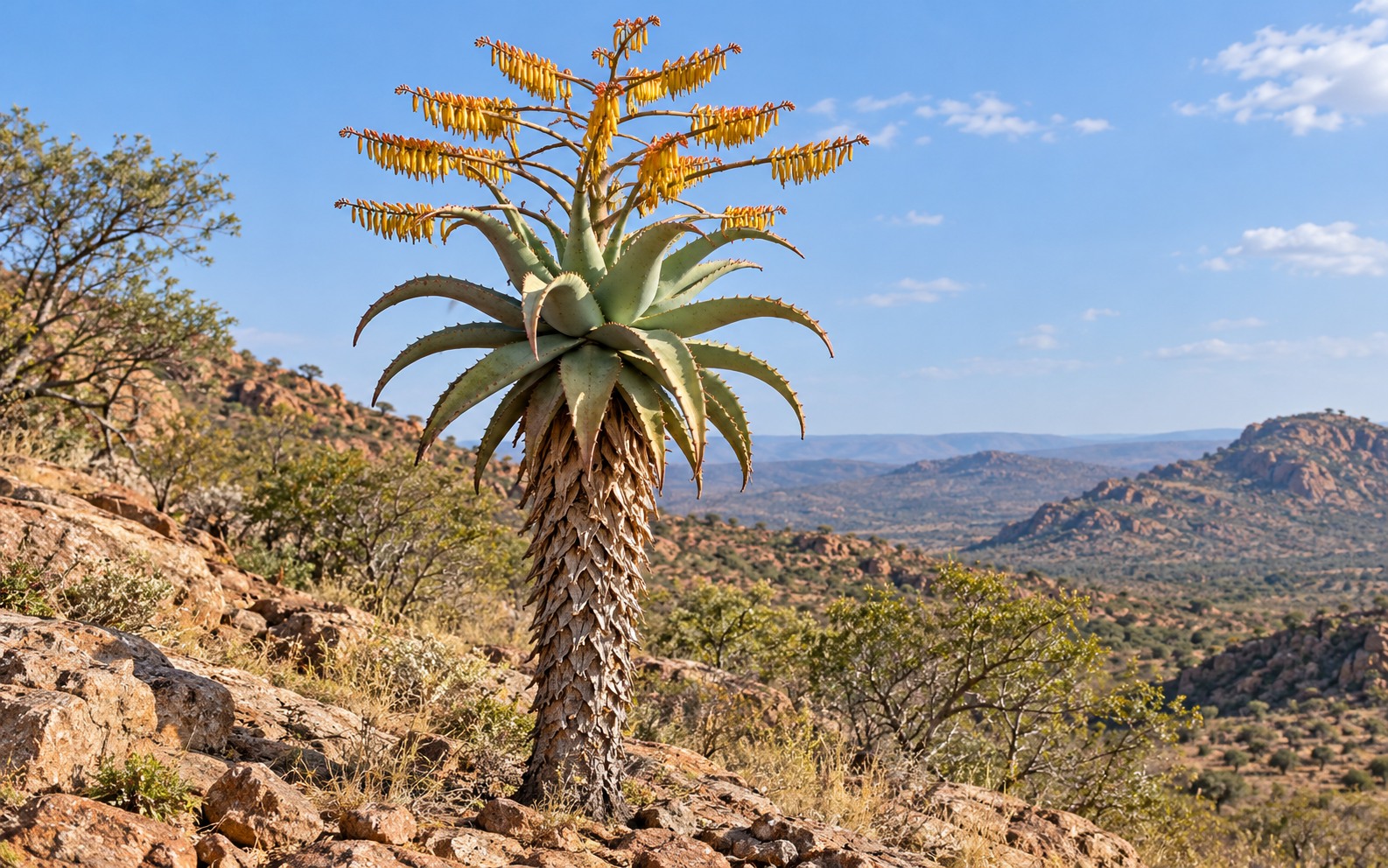
Aloe marlothii A.Berger is an accepted Aloe species in Kew’s taxonomic record, native from southeastern Botswana to KwaZulu-Natal in southern Africa. It is a large succulent shrub or small tree; Kew commonly reports a height of 2–4 m, sometimes more. Its usually unbranched stem retains old dried leaf bases. A dense rosette crowns the stem, with grey-green fleshy leaves that are broad at the base and taper to a point; irregular reddish-brown spines occur along the margins and sometimes across the leaf surfaces. The branched flower stalk bears racemes that usually extend horizontally, with tubular flowers ranging from yellow and orange to red. These features help readers picture the plant but do not replace a voucher specimen for identification.
General morphology for study
Kew recognizes two subspecies. Subsp. orientalis is often shorter, may form clumps in sandy soils, and tends to have fewer surface spines than the typical form. Leaf colour, habit, and spine density therefore vary among populations. A label such as “aloe,” a common name, or a market tag does not establish A. marlothii; it should not be conflated with Aloe vera, Aloe ferox, or other Aloe species with their own use records. CITES Appendix II controls international trade in listed plants and derivatives. The project’s CITES dataset contains one 2019 comparative record for “medicine” under A. marlothii, with commercial purpose and source code W (wild). This reported row documents a transaction record under a species name; it does not authenticate each product or establish efficacy or safety. Images are AI study illustrations, not verified specimens.
Traditional context
Materia medica form discussed in this paragraph
Kew summarizes multiple ethnobotanical records for A. marlothii. Bitter leaf exudate has been recorded historically as a purgative and weaning aid; leaf preparations are reported in some contexts for intestinal parasites. Ethnoveterinary sources also record use for equine disease and livestock parasites in some southern African communities. SANBI separately describes Zulu records involving leaf and root decoctions for traditional purposes. These reports belong to specific communities and periods; they are not instructions for practice or proof of clinical efficacy. The sources do not establish a single ratio or preparation method, so this page gives no recipe, amount, or oral-use direction. It does not assign Chinese-medicine taste, channels, or formula roles because the cited materials describe southern African knowledge, not a Chinese pharmacopoeia monograph.
Modern evidence
Materia medica form discussed in this paragraph
A 2022 study examined A. marlothii roots and selected compounds in in-vitro assays against Plasmodium falciparum. Laboratory findings do not show that the plant or its root treats malaria in people; the study was not a clinical trial and does not establish a dose. An in-vitro assay tests selected material under controlled conditions and does not recreate digestion, absorption, metabolism, immune response, dosing, or interactions in a person. A chemical signal may support further research, but does not establish that a leaf, root, or retail product contains the same compounds at an effective concentration. A review of Aloe ethnomedicine in southern Africa documents diverse uses across many species and cautions against generalizing within a highly diverse genus. Evidence about Aloe vera or Aloe ferox cannot be transferred directly to A. marlothii. This profile therefore separates traditional-use records from laboratory evidence and makes no claim that the species treats infections, parasites, diabetes, or animal disease.
Safety
Illustrative rocky slope; do not identify from AI art
The Royal Horticultural Society flags A. marlothii itself as harmful if eaten by people and some pets. Do not use gel, latex, exudate, leaves, roots, or unidentified dried material for self-treatment or food. Leaf exudate is described historically as a purgative; laxative activity does not mean safe use and may pose risks, especially with underlying conditions, medicines, pregnancy, or breastfeeding. The sources reviewed do not provide a complete drug-interaction assessment, a human dose-toxicity profile, or a home detoxification process. Aloe vera safety information does not substitute for species-specific evaluation of A. marlothii. If a child or animal ingests the plant, contact local medical, emergency, or veterinary services; do not induce vomiting or wait for symptoms.
On a mature plant, look for a single upright stem several metres tall, often wrapped in persistent brown dried leaf bases; a large crown of thick grey-green leaves with reddish-brown marginal teeth; and a branched flowering stalk whose racemes spread sideways. Not every plant flowers at once, and young plants may not yet show a clear trunk. Some leaves bear surface spines while others have fewer, so spine density alone cannot identify the species. Photograph the whole plant, both leaf surfaces, stem, and inflorescence when present; record locality and date. Avoid handling the spines or cutting a leaf to inspect its sap. The AI image teaches general form and cannot authenticate a market specimen.
Growth and habitat
Illustrative rocky slope; do not identify from AI art
Illustrative rocky slope; do not identify from AI art
Kew places A. marlothii on rocky hillsides and in habitats ranging from savanna to bushveld, within a native range from southeastern Botswana to KwaZulu-Natal. SANBI records it from low elevations to about 1,600 m across South African provinces and neighbouring countries; its natural climate generally has wet summers and dry winters. Subsp. orientalis can tolerate sandy coastal soils and may remain shorter and clump-forming. These differences mean habitat notes should name the locality, conditions, and subspecies where known; South African settings are not universal rules for all tropical regions. The plant is widely grown ornamentally, while international trade in plants and derivatives remains controlled under CITES Appendix II.
Reference image; care follows Kew/RHS sources
Illustrative rocky slope; do not identify from AI artUse legally sourced nursery seed or offsets labelled Aloe marlothii with provenance; do not remove wild plants. Kew records propagation by seed or offsets. For home growing, prefer naturally formed offsets rather than damaging the mother plant’s growing point to induce them.
Illustrative rocky slope; do not identify from AI artChoose a container with several drainage holes and a gritty, freely draining medium. Kew uses a mix with a high proportion of coarse mineral material; RHS recommends cactus compost with added horticultural grit. Avoid containers that remain waterlogged.
Illustrative rocky slope; do not identify from AI artPlace the plant in a bright, ventilated position and acclimatize it gradually when moving it from a greenhouse outdoors. Kew grows it in the brightest conditions available; RHS recommends full sun and shelter. Sudden exposure after shade can damage foliage.
Illustrative rocky slope; do not identify from AI artWater during active growth, allow the medium to drain and dry down, and reduce watering during dormancy. Kew reports watering its conservatory specimens about monthly and allowing the compost to dry, with more frequent watering while flowering. This is Kew’s facility schedule, not a fixed rule for every climate or pot.
Reference image; care follows Kew/RHS sourcesFor seed propagation, SANBI describes a draining tray or pot, spring sowing on river sand, a light sand covering, gentle watering, and a warm, bright, ventilated position. It reports that seedlings may be potted on after several months to two years, depending on size. Do not apply fungicides or chemicals without appropriate professional guidance and product directions.
Reference image; care follows Kew/RHS sourcesWatch for waterlogging, aphids on flower stalks, mealybugs, and thrips; record sowing date, stock source, repotting, and growth observations. Wear gloves around sharp spines and do not cut leaves to test their sap. Ornamental cultivation does not authorize medicinal harvesting.
Illustrative rocky slope; do not identify from AI art
How long until harvest? The RHS estimates ornamental maturity at about 5–10 years under UK garden conditions. This is not a medicinal-harvest age, cannot be transferred directly to other climates, and does not establish safety or composition. Kew/SANBI do not state a medicinal-harvest age. This page does not recommend harvesting leaves or exudate for use.
From plant to dried material · source-recorded workflow
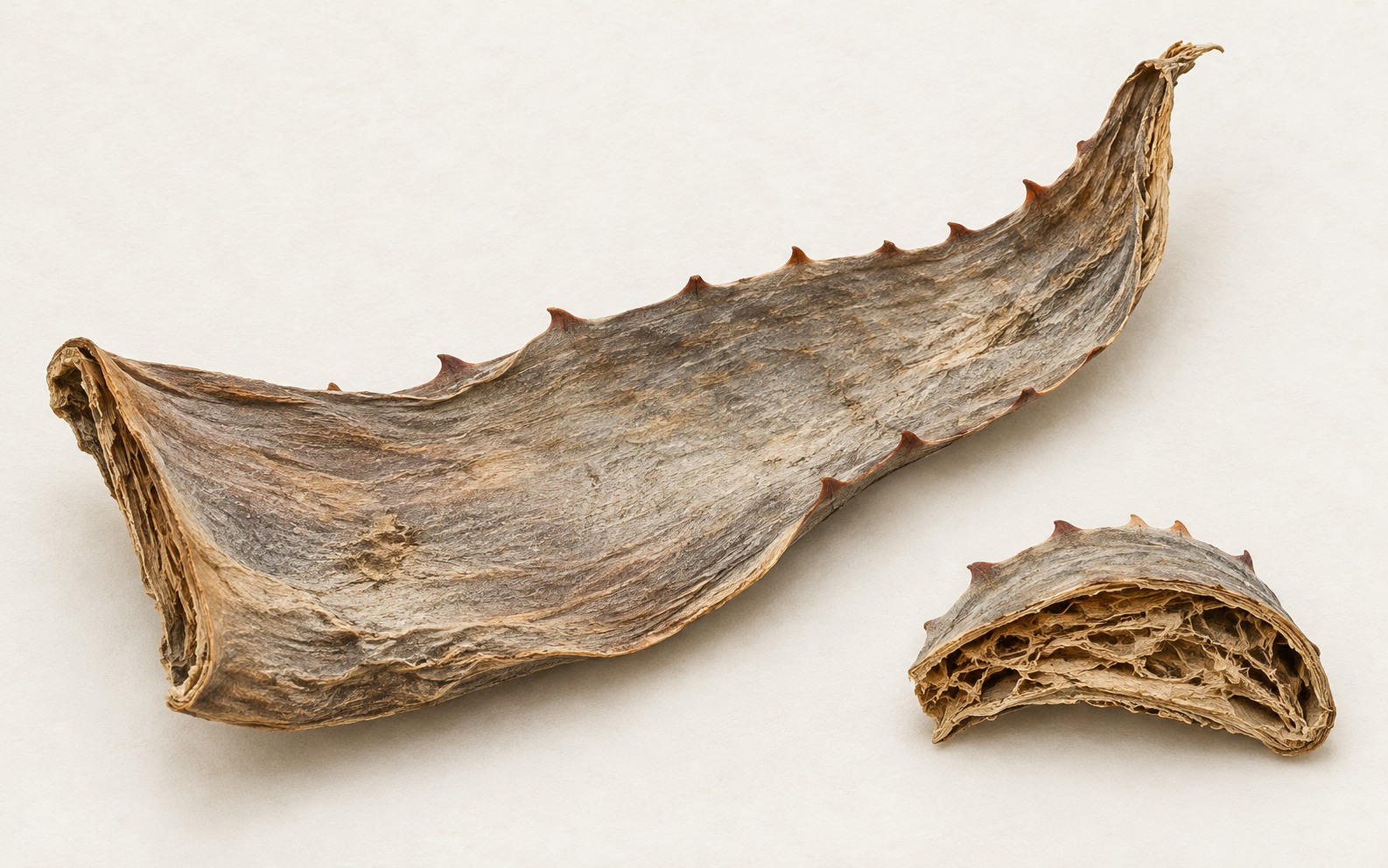
AI dried-leaf illustration; does not verify processing or safetyCITES contains one commercial record under Aloe marlothii with the trade term “medicine.” The row does not identify manufacturing steps, the actual plant part in each lot, or quality; verify taxonomy, provenance, and applicable permits before any trade.
AI dried-leaf illustration; does not verify processing or safetyKew describes historical concentration and drying of bitter leaf exudate in some medicinal aloes, but says Aloe ferox is now the main source of South African aloe products. This historical account is not a processing instruction for A. marlothii.
AI dried-leaf illustration; does not verify processing or safetyDo not cut leaves or concentrate exudate at home. The sources reviewed do not provide a validated process to remove harmful constituents, standardize content, or ensure safety for A. marlothii.
AI dried-leaf illustration; does not verify processing or safetyFor licensed research samples, record scientific name, subspecies when known, plant part, locality, date, and determiner; do not identify material from an AI image or exudate color.
AI dried-leaf illustration; does not verify processing or safety
This record supports study and processing traceability; it is not a home preparation or self-use guide.