Dahurian angelica · Bai Zhi
Angelica dahurica (Fisch. ex Hoffm.) Benth. & Hook. f. ex Franch. & Sav. · Root
Name and part used
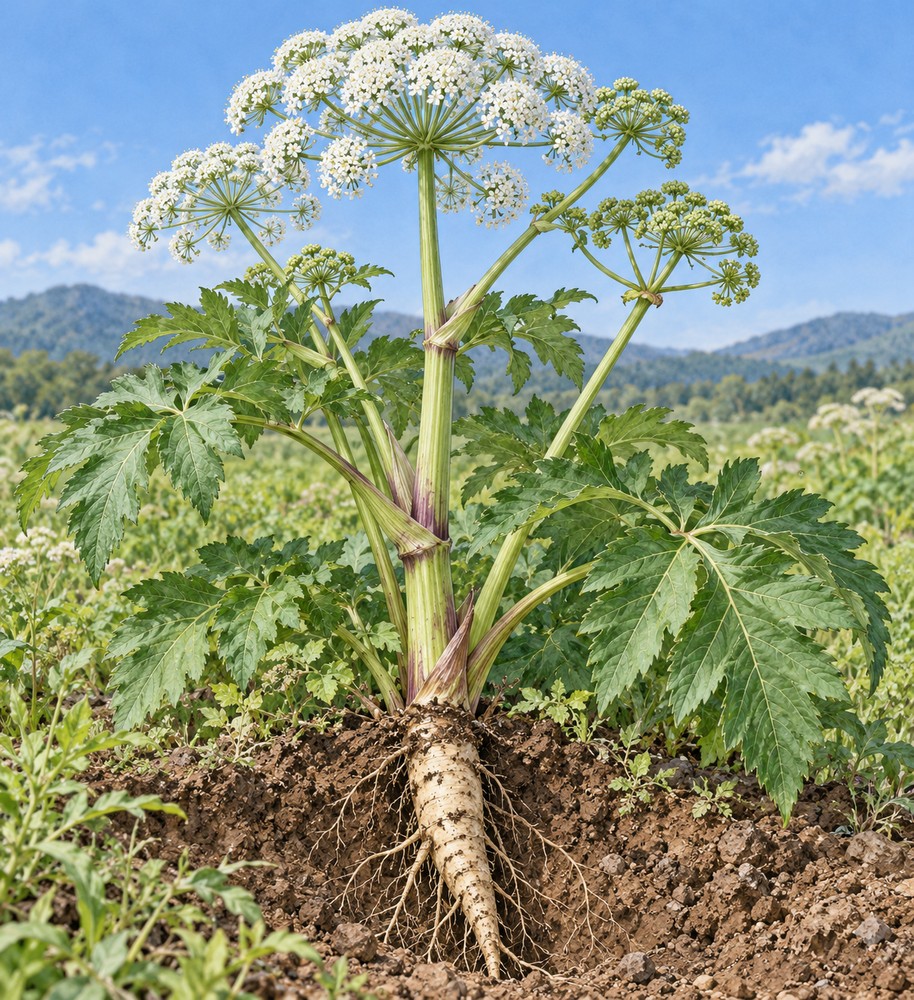
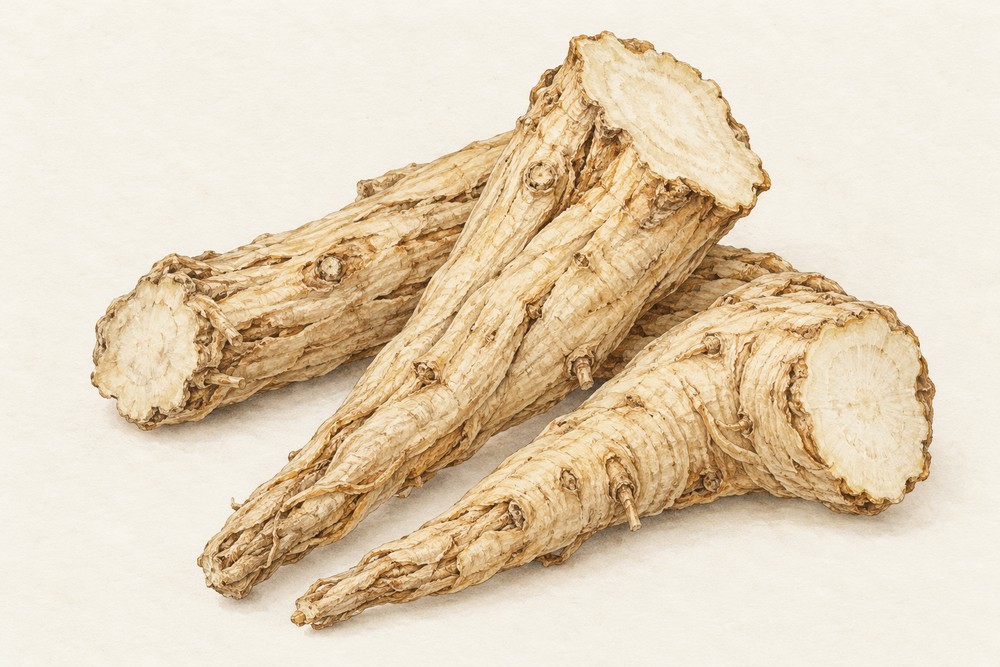
An Apiaceae herb with divided leaves, large white umbels, and a fleshy root.
Traditional context
HKBU records Bai Zhi as Angelica dahurica root, with regional cultivars. Apiaceae includes poisonous look-alikes, so an image cannot identify a wild plant.
Modern evidence
Furocoumarins in this species make controlled identity and handling important; traditional descriptions are not proof of treatment for headache or sinus disease.
Safety
Do not collect Apiaceae plants yourself. People taking medicines, sensitive to sunlight, pregnant, or with chronic conditions should ask a professional before considering products.
Pairing in reference texts
It appears in some classical formula records; textual co-use does not prove a commercial product is interaction-free.
Growing, care, and harvest timing
HKBU habitat record: Growing in humid meadow, thickets, and sandy soil or gravel soil by riverbanks. Distributed in Zhejiang, Taiwan, Fujian and etc. The medicinal materials are mainly produced in Sichuan, Zhejiang, Henan, Hebei, Anhui and etc Harvest and processing as recorded: Collected in summer and autumn, removed foreign matters, well washed, mixed with lime, a week later, put it out, sun-dried, or dried in low temperature. Removed foreign matters, divided by size, immersed briefly, moistened fully, cut into thick sections and sun-dried
Source-recorded harvest/processing: Collected in summer and autumn, removed foreign matters, well washed, mixed with lime, a week later, put it out, sun-dried, or dried in low temperature. Removed foreign matters, divided by size, immersed briefly, moistened fully, cut into thick sections and sun-dried
The reviewed source does not provide a complete species-specific sowing/growing routine, irrigation/fertilization schedule, or universal plant age. The page therefore does not infer care instructions or years to harvest; consult local cultivation guidance.
Open habitat and season source ↗FROM PLANT / SOURCE HABITAT TO DRIED MATERIAL · REFERENCE WORKFLOW
- Use only cultivated material verified as Angelica dahurica; do not collect wild plants based on a white umbel alone.
- Remove foreign matter, wash under a facility procedure, and sort by source/size; reject damaged or unidentified specimens.
- HKBU describes regional processing and drying variations; use qualified procedures compliant with current rules and do not apply chemicals at home.
- Record species, growing region, processing, and lot; store dry and protect from light, moisture, and cross-contamination.
These are post-harvest study notes, not directions to prepare a remedy for self-treatment. Processing reference ↗
How to read formula amounts
The cited sources do not provide a formula with specific amounts for this profile; no ratio is invented. Absence from the incompatibility list does not establish safety.
Habitat, season, and harvest in the HKBU botanical record
HKBU botanical record (translated summary): Flowering and fruiting dates: Flowering: May to June; fruiting: July Habitat and distribution: Growing in humid meadow, thickets, and sandy soil or gravel soil by riverbanks. Distributed in Zhejiang, Taiwan, Fujian and etc. The medicinal materials are mainly produced in Sichuan, Zhejiang, Henan, Hebei, Anhui and etc Harvest and processing as recorded: Collected in summer and autumn, removed foreign matters, well washed, mixed with lime, a week later, put it out, sun-dried, or dried in low temperature. Removed foreign matters, divided by size, immersed briefly, moistened fully, cut into thick sections and sun-dried
Open botanical source ↗