Coastal glehnia root · Bei Sha Shen
Glehnia littoralis F. Schmidt ex Miq. · Root
Name and part used
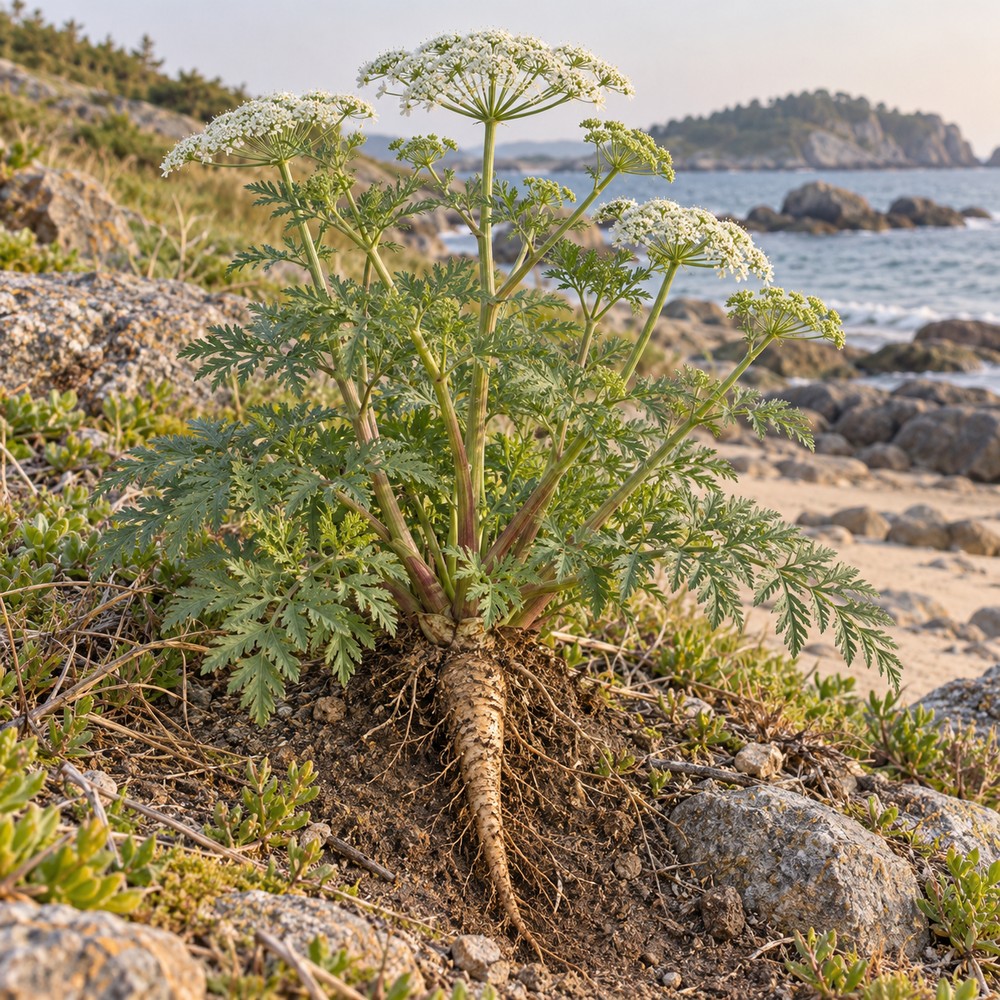
A low softly hairy plant with ternate or divided leaves and white umbels; its root grows in coastal sandy habitats.
Traditional context
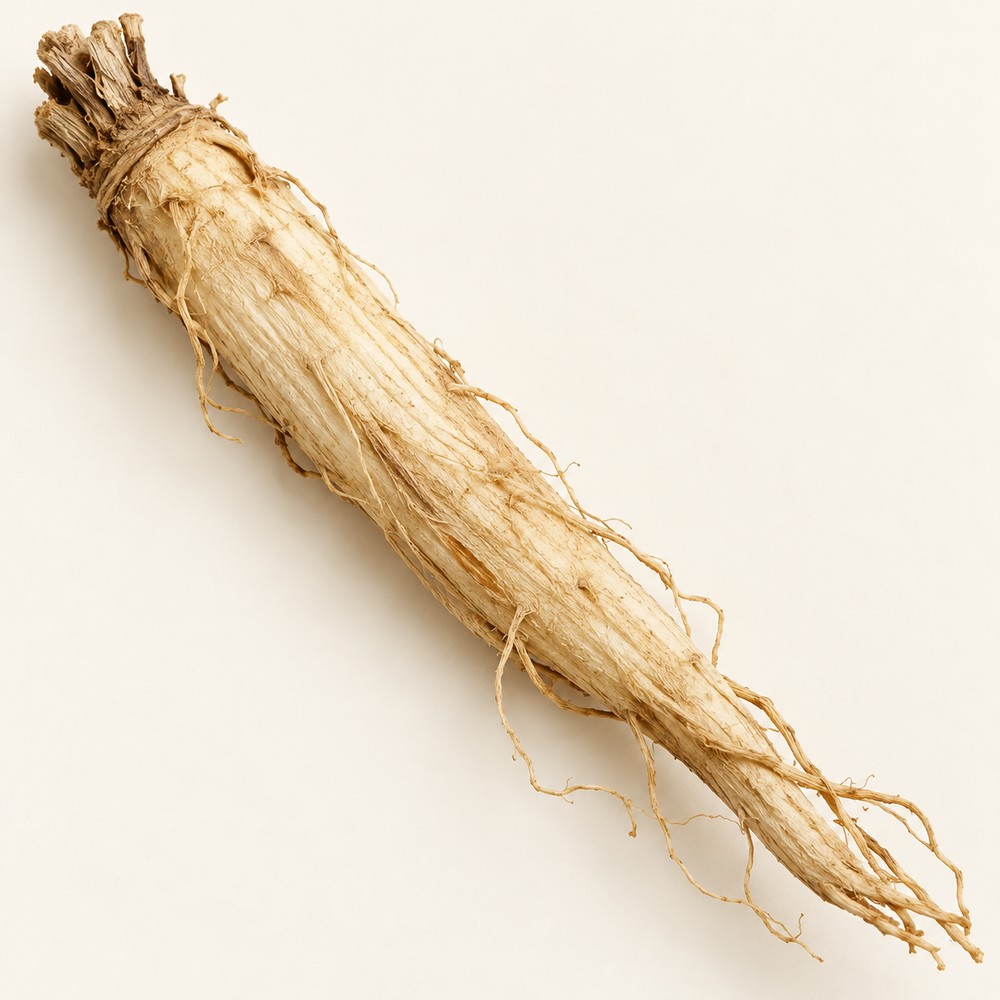
Bei Sha Shen is Glehnia littoralis root, distinct from Nan Sha Shen in Adenophora. HKBU records coastal distribution and cultivation; the long root should be authenticated carefully.
Modern evidence
Yin-nourishing, lung-clearing, and phlegm-transforming are traditional claims. It should not replace treatment for pneumonia or persistent cough.
Safety
The Apiaceae family contains deadly toxic lookalikes; never wild-harvest or identify by image. People with respiratory illness, medicines, or pregnancy should consult a clinician.
Pairing in reference texts
Bei Sha Shen can appear with Mai Men Dong, Yu Zhu, or Zhi Mu in traditional formulas. Historical pairing does not establish patient-specific suitability.
Growing, care, and harvest timing
HKBU habitat record: Growing along beaches. Can be cultivated. Distributed in Liaoning, Hebei, Shandong, Jiangsu, Zhejiang, Guangdong, Fujian, Taiwan and etc. Also distributed in North Korea, Japan and Russia. The medicinal materials are mainly produced in Shandong, Hebei, Liaoning, Jiangsu and etc Harvest and processing as recorded: Excavated from July and August, or the last ten days of September. Removed the aboveground stem and fibrous root, well washed, heated with boiling water and removed bark, sun-dried or baked to dry, removed stemfoot, simply washed, fish out, cut into segment when slightly moist, and sun-dried
Source-recorded harvest/processing: Excavated from July and August, or the last ten days of September. Removed the aboveground stem and fibrous root, well washed, heated with boiling water and removed bark, sun-dried or baked to dry, removed stemfoot, simply washed, fish out, cut into segment when slightly moist, and sun-dried
The reviewed source does not provide a complete species-specific sowing/growing routine, irrigation/fertilization schedule, or universal plant age. The page therefore does not infer care instructions or years to harvest; consult local cultivation guidance.
Open habitat and season source ↗FROM PLANT / SOURCE HABITAT TO DRIED MATERIAL · REFERENCE WORKFLOW
- HKBU records root collection in July–September; prioritize traceable cultivation and avoid wild coastal harvest.
- Remove stems and fine roots, clean sand under facility procedures, and authenticate Glehnia littoralis against Nan Sha Shen.
- The source describes hot-water peeling followed by drying; this must be controlled facility processing, not a home method.
- Cut segments at the specified moisture stage, finish drying, test identity and contaminants, and document origin.
These are post-harvest study notes, not directions to prepare a remedy for self-treatment. Processing reference ↗
How to read formula amounts
The cited sources do not provide a formula with specific amounts for this profile; no ratio is invented. Absence from the incompatibility list does not establish safety.
Habitat, season, and harvest in the HKBU botanical record
HKBU botanical record (translated summary): Flowering and fruiting dates: Flowering: May to July; fruiting: July to August Habitat and distribution: Growing along beaches. Can be cultivated. Distributed in Liaoning, Hebei, Shandong, Jiangsu, Zhejiang, Guangdong, Fujian, Taiwan and etc. Also distributed in North Korea, Japan and Russia. The medicinal materials are mainly produced in Shandong, Hebei, Liaoning, Jiangsu and etc Harvest and processing as recorded: Excavated from July and August, or the last ten days of September. Removed the aboveground stem and fibrous root, well washed, heated with boiling water and removed bark, sun-dried or baked to dry, removed stemfoot, simply washed, fish out, cut into segment when slightly moist, and sun-dried
Open botanical source ↗