Chinese thorowax root · Chai Hu
Bupleurum chinense DC. · Root
Name and part used
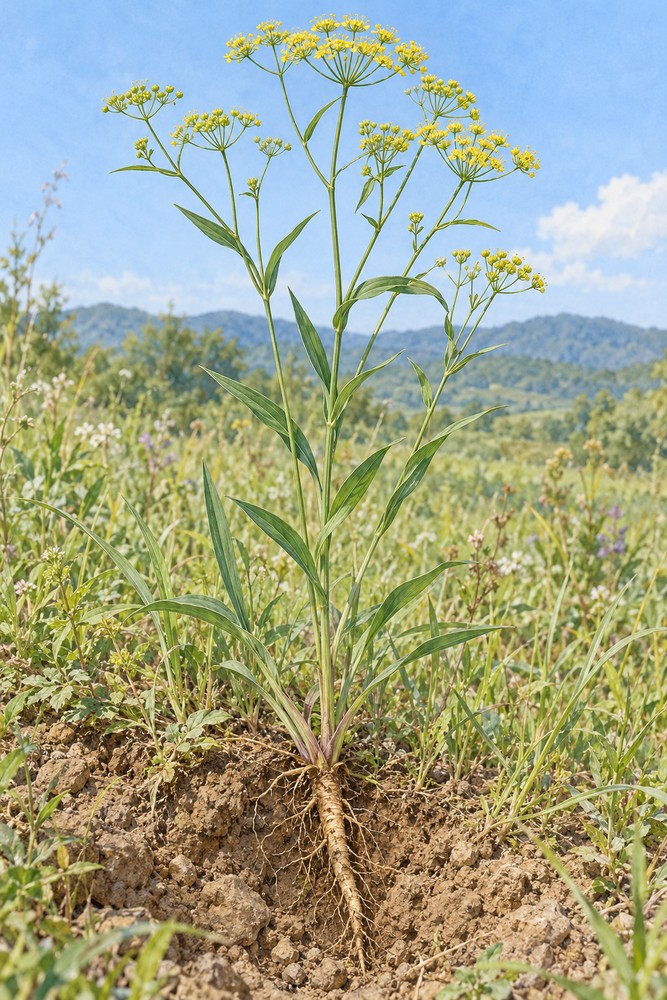
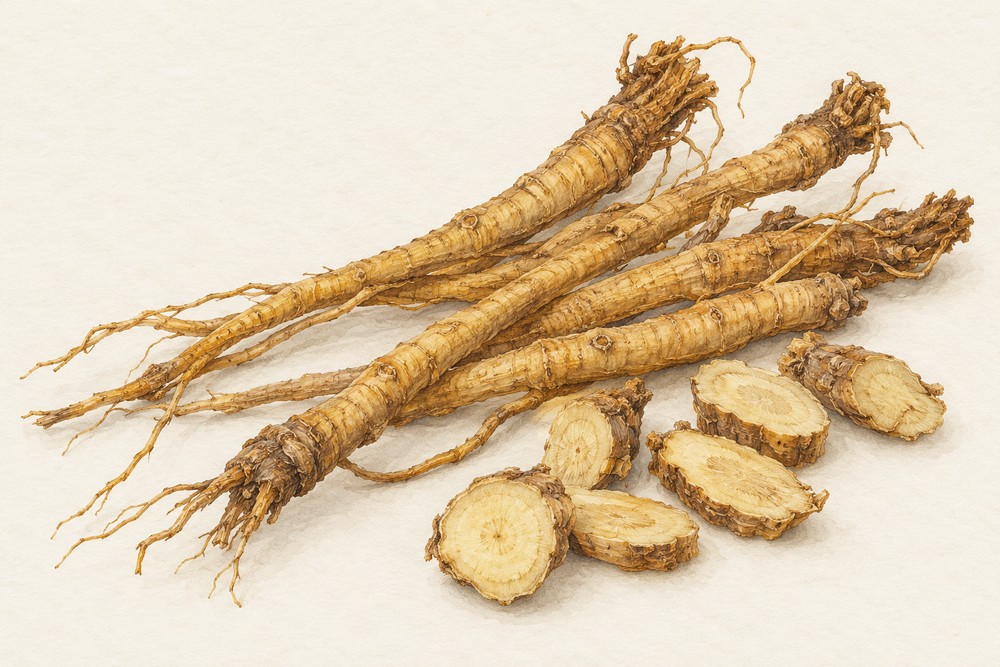
An upright Apiaceae herb with narrow leaves and small yellow umbels; the medicinal root is long and yellow-brown.
Traditional context
This profile identifies Chai Hu as Bupleurum chinense DC. HKBU records spring or autumn root harvest. Toxic Apiaceae lookalikes exist; never identify wild plants by this illustration.
Modern evidence
Shaoyang harmonizing and liver-qi soothing are traditional terms. Chemical or animal research does not establish treatment for fever or liver disease.
Safety
Bupleurum products may affect hepatic drug metabolism, and liver injury has been reported with some products. Do not self-use or combine with prescriptions; avoid in pregnancy without professional advice.
Pairing in reference texts
Chai Hu with Scutellaria, Pinellia, ginseng, and other herbs is part of Xiao Chai Hu Tang. This is a historical record, not a home-treatment recipe.
Growing, care, and harvest timing
HKBU habitat record: Growing in dry and barren hill slopes, fields and roadsides. Distributed in Jilin, Liaoning, Henan, Shandong, Anhui, Jiangsu, Zhejiang, Hubei, Sichuan, Shanxi, Shaanxi, Gansu, Tibet and etc. The medicinal materials are mainly produced in Liaoning, Gansu, Hebei and Henan Harvest and processing as recorded: Excavated in spring and autumn, removed cauline leaves and soil, dried, removed foreign matters and withered stem, well washed, totally moist, cut into thick slices and dried
Source-recorded harvest/processing: Excavated in spring and autumn, removed cauline leaves and soil, dried, removed foreign matters and withered stem, well washed, totally moist, cut into thick slices and dried
The reviewed source does not provide a complete species-specific sowing/growing routine, irrigation/fertilization schedule, or universal plant age. The page therefore does not infer care instructions or years to harvest; consult local cultivation guidance.
Open habitat and season source ↗FROM PLANT / SOURCE HABITAT TO DRIED MATERIAL · REFERENCE WORKFLOW
- HKBU records spring or autumn root harvest from authenticated cultivation; avoid wild collection due to toxic Apiaceae lookalikes.
- Remove foliage and soil, clean under facility procedures, drain, lot, and authenticate Bupleurum chinense.
- Wilt or partially dry, condition moisture uniformly under the facility standard, slice, then dry fully.
- Test identity and contaminants, record origin and processing date, and segregate from other Apiaceae.
These are post-harvest study notes, not directions to prepare a remedy for self-treatment. Processing reference ↗
How to read formula amounts
The cited sources do not provide a formula with specific amounts for this profile; no ratio is invented. Absence from the incompatibility list does not establish safety.
Habitat, season, and harvest in the HKBU botanical record
HKBU botanical record (translated summary): Flowering and fruiting dates: Flowering: August to September; fruiting: September to October Habitat and distribution: Growing in dry and barren hill slopes, fields and roadsides. Distributed in Jilin, Liaoning, Henan, Shandong, Anhui, Jiangsu, Zhejiang, Hubei, Sichuan, Shanxi, Shaanxi, Gansu, Tibet and etc. The medicinal materials are mainly produced in Liaoning, Gansu, Hebei and Henan Harvest and processing as recorded: Excavated in spring and autumn, removed cauline leaves and soil, dried, removed foreign matters and withered stem, well washed, totally moist, cut into thick slices and dried
Open botanical source ↗