Da Ji · Japanese thistle · Da Ji
Cirsium japonicum Fisch. ex DC. · Dried aerial parts or root
Name and part used
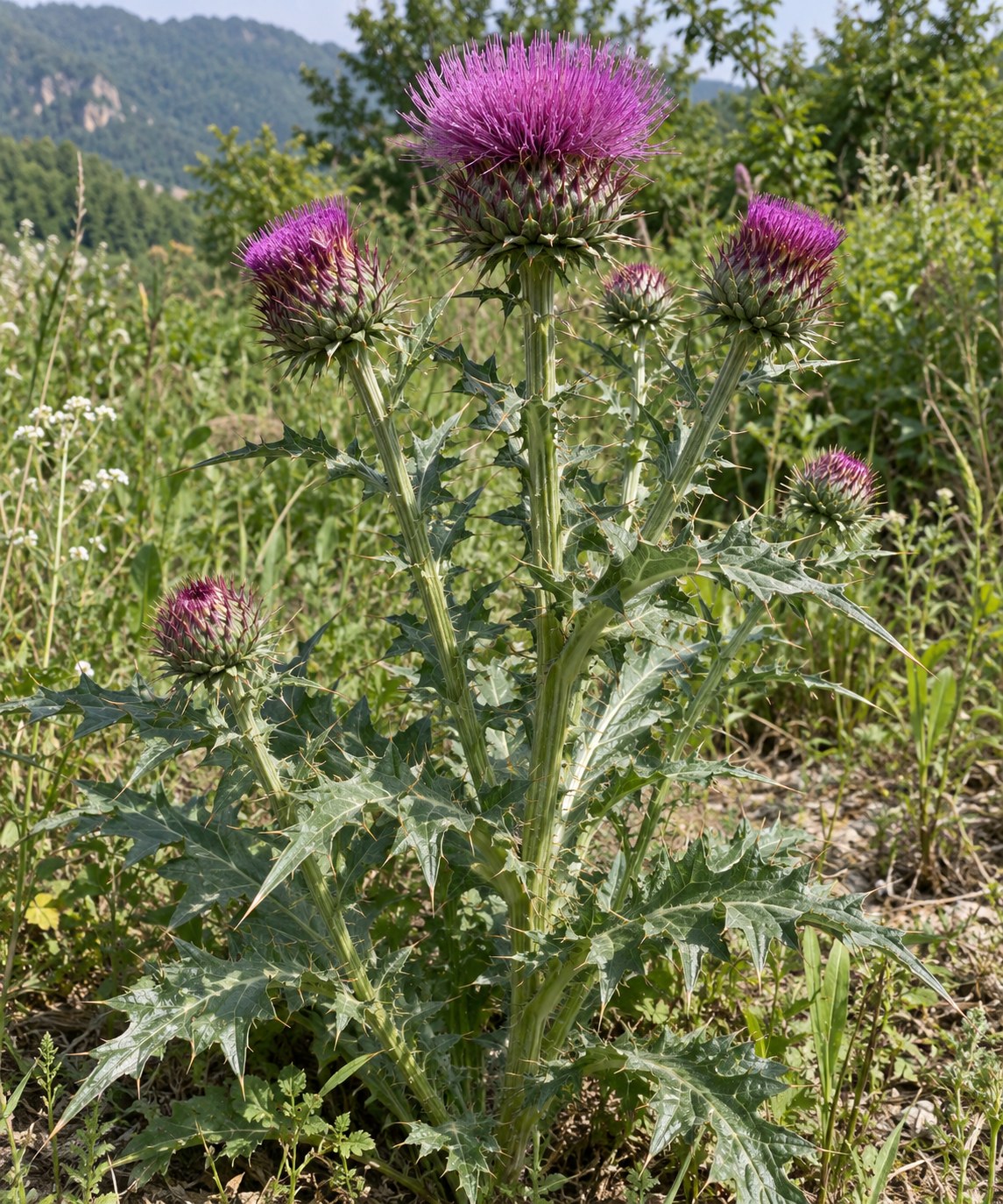
Da Ji is Cirsium japonicum Fisch. ex DC., a perennial Asteraceae herb distinct from Xiao Ji, Cirsium setosum. Upright stems about 30–80 cm tall are ridged and hairy. Basal leaves are usually large, obovate to lanceolate, pinnatifid, with lobes bearing spiny teeth; upper leaves become smaller and partly clasp the stem. Purple-red heads occur singly or in small groups at branch tips; roots are swollen, spindle- or radish-shaped. HKBU records two drug parts—aboveground herb and root—with different harvests: cut aerial parts when flowering in summer–autumn; dig roots from third-year plants, wash, and dry. Because multiple parts are used, a label must state herb or root. The plant is spiny; AI art is for study, not a reason to handle or collect wild plants.
Traditional context
HKBU specimen records place Da Ji in traditional cooling-blood, stopping-bleeding, stasis-dispersing, and swelling-reducing categories; historical records mention bleeding, hematuria, and boils. This does not establish that it treats hemorrhage, infection, or tumors. Hematuria, coughing blood, heavy bleeding, faintness, or acute abdominal pain needs urgent assessment.
Modern evidence
HKBU records morphology, medicinal parts, and traditional actions; it is not a clinical trial. Chemical findings or laboratory hemostasis research do not prove that root or aerial parts are safe and effective for self-use. Compare it carefully with Xiao Ji, especially leaf size, hair, and the specified drug part. Do not stop anticoagulants, antiplatelet drugs, or prescriptions in favor of Da Ji.
Safety
Do not self-use Da Ji for bleeding. Pregnant/breastfeeding people, children, people with clotting disorders, anyone taking warfarin/anticoagulants, and people before surgery should not experiment with it. The plant has hard spines; wear gloves and keep children from handling it. Root and aerial herb are different materials; do not substitute them casually. Never apply it to deep, contaminated, or embedded-object wounds. Uncontrolled bleeding, black stools, or vomiting blood is an emergency.
Safety reference ↗Pairing in reference texts
HKBU cites a historical bleeding example combining Da Ji, Xiao Ji, and Ce Bai Ye at 9 g each, plus Xian He Cao and scorched Zhi Zi at 12 g each. This is a materia-medica text cited in a botanical record, not a clinically validated treatment dose and must not be decocted by oneself. The page records the ratio for historical comparison but not personal instruction; available herb images are shown on their own profiles. No specific toxic incompatibility was confirmed; do not combine with anticoagulants without professional advice.
Identification and study notes
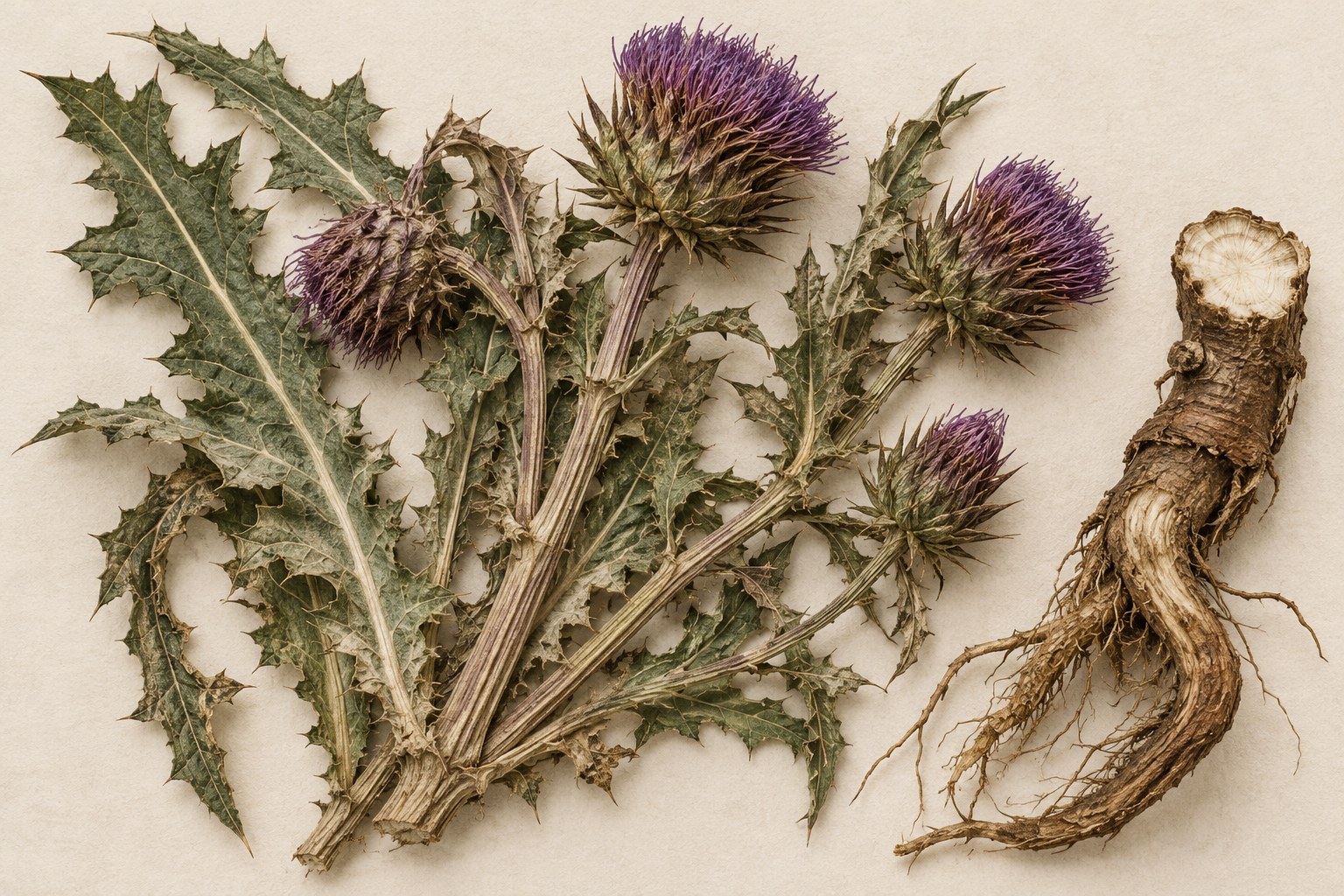
Da Ji has a robust stem and basal leaves often longer and broader than Xiao Ji, with deep divisions and prominent spines; sparse hairs may line the veins. Purple-red heads are often larger, the involucre has several bract layers, and fruits have gray pappus. Dried materia medica may include green-brown aerial parts with cobweb-like hairs and a stout spindle-shaped root. The AI specimen image separates stems/leaves/heads from a root to show the two possible drug parts; it is not a mixed bundle of one standardized part. When comparing it with Xiao Ji, inspect leaf form, hairs, head size, and Latin label, not flower color alone. In a comparative collection, note that the root is not shown in the same bundle as the aerial drug unless the label explicitly says both parts. A detached flower head cannot establish species identity by itself. Keep photographs with a scale and collect no wild plant without expert authorization. When separating Da Ji from Xiao Ji, compare the Latin name, leaf size and shape, marginal spines, head size, and harvested part. Both are Cirsium with purple heads, so purple color alone is not diagnostic. Da Ji root is swollen and spindle-shaped, while the aerial drug is a different lot; the label must specify the part. Do not collect wild thistles without expert confirmation.
Growth and habitat
HKBU records Da Ji on hillsides, grassland, roadsides, and across much of China; it favors bright sites and drained soil, with a larger root after several years. A study garden needs a broad clean sunny bed and spacing so spiny leaves do not obstruct paths. Do not dig plants from wasteland or roadsides; besides misidentification, chemical spray and pollution are concerns. Rhizomes may spread, so contain growth to prevent crowding other plants.
Identification and study notes
Da Ji has a robust stem and basal leaves often longer and broader than Xiao Ji, with deep divisions and prominent spines; sparse hairs may line the veins. Purple-red heads are often larger, the involucre has several bract layers, and fruits have gray pappus. Dried materia medica may include green-brown aerial parts with cobweb-like hairs and a stout spindle-shaped root. The AI specimen image separates stems/leaves/heads from a root to show the two possible drug parts; it is not a mixed bundle of one standardized part. When comparing it with Xiao Ji, inspect leaf form, hairs, head size, and Latin label, not flower color alone. In a comparative collection, note that the root is not shown in the same bundle as the aerial drug unless the label explicitly says both parts. A detached flower head cannot establish species identity by itself. Keep photographs with a scale and collect no wild plant without expert authorization. When separating Da Ji from Xiao Ji, compare the Latin name, leaf size and shape, marginal spines, head size, and harvested part. Both are Cirsium with purple heads, so purple color alone is not diagnostic. Da Ji root is swollen and spindle-shaped, while the aerial drug is a different lot; the label must specify the part. Do not collect wild thistles without expert confirmation.
Growing and care
- Use seed/stock labeled Cirsium japonicum in a separate sunny bed with clean, draining soil. Avoid roadsides and animal areas because of the spines and accidental ingestion risk.
- Keep lightly moist while seedlings establish, then water according to weather; contain rhizomes if the plant spreads. HKBU does not provide a numeric pH or fertilizer schedule.
- Weed with thick gloves and keep paths clear; record large basal lobed leaves, spines, and purple heads. Label clearly as Da Ji to avoid confusing it with Xiao Ji.
- HKBU records aerial harvest during summer–autumn flowering and roots from third-year plants. This is professional materia-medica timing, not advice to harvest home-grown plants for ingestion.
How long until harvest? HKBU records root harvest from third-year plants and aerial harvest during summer–autumn flowering. This is not a home-use safety date and does not apply to unverified plants. Record the intended part before comparison; do not self-use Da Ji.
Habitat, season, and harvest in the HKBU botanical record
HKBU describes Cirsium japonicum at 30–80 cm, with deeply lobed spiny leaves and purple-red heads; habitats include hillsides, grassland, and roadsides. Aerial material is cut during summer–autumn bloom; roots are dug from third-year plants, washed, and dried. The Da Ji name covers different parts in the record, so identify which part is being discussed.
Open botanical source ↗FROM PLANT / SOURCE HABITAT TO DRIED MATERIAL · REFERENCE WORKFLOW
- HKBU distinguishes two procedures: cut aerial material during summer–autumn flowering and dig roots from third-year plants. Keep the lots separate.
- Cut or dig the specified part under controlled conditions and wear spine-resistant gloves. Wash soil from roots; discard rotten, insect-damaged, or mixed species.
- The source records aerial material used fresh or sun-dried and roots washed then dried. Spread in a clean ventilated area away from rain/dust; do not process it for home ingestion.
- Labels must state Cirsium japonicum, aerial part or root, plant age for roots, date, and processing site. Store dry; discard mixed Xiao Ji or moldy samples.
These are post-harvest study notes, not directions to prepare a remedy for self-treatment. Processing reference ↗