Fragrant rosewood (Jiangxiang) · Jiang Xiang · Xiang Hong Mu
Dalbergia odorifera T.C.Chen · The Chinese Pharmacopoeia material Jiangxiang is the dried heartwood of the trunk and roots of the exact species Dalbergia odorifera. Do not equate it with other rosewoods, agarwood, bark, or retail essential oil.
Materia medica properties in reference
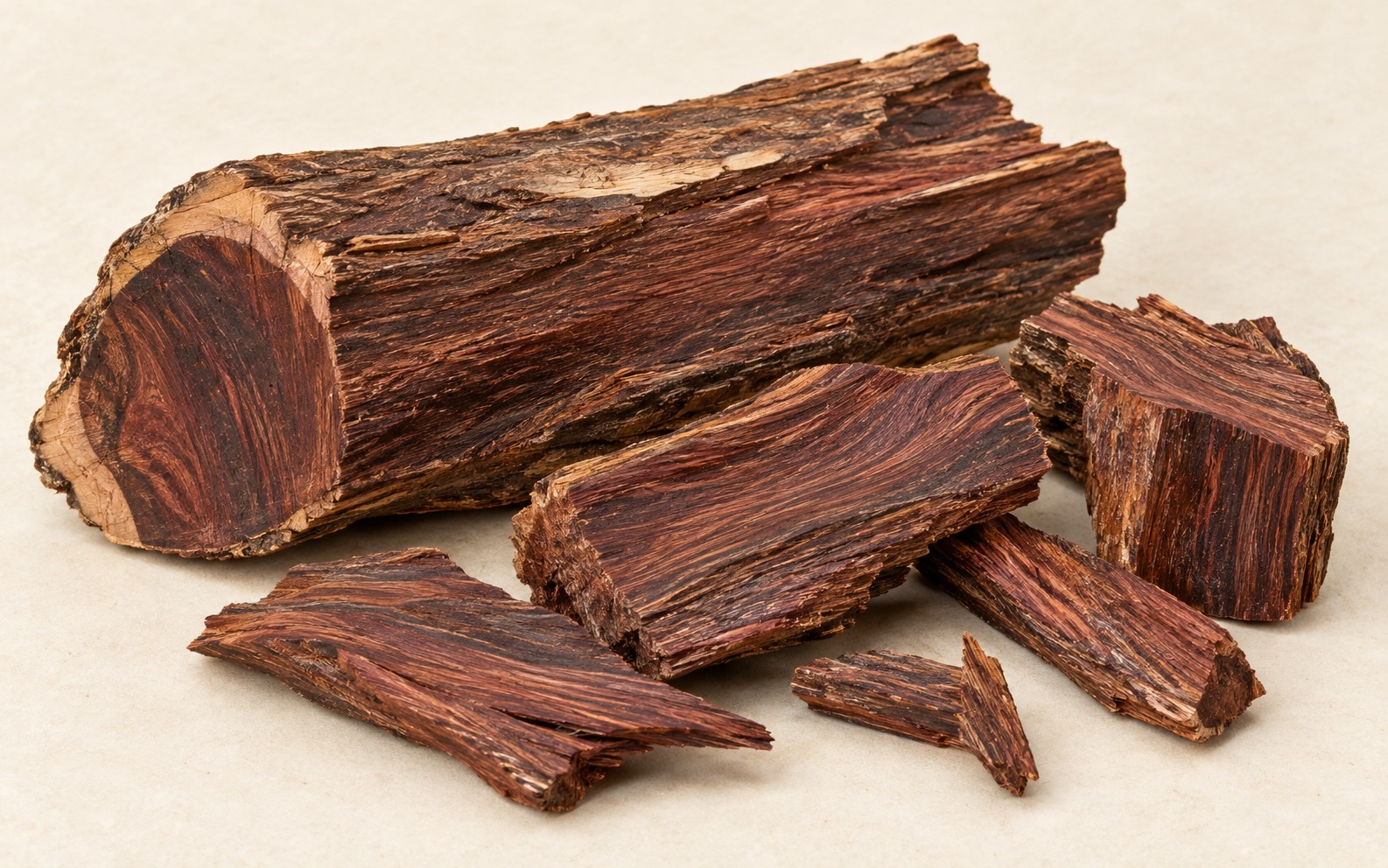
Illustrative heartwood; does not authenticate a lot
Properties as recorded in the source: Chinese Pharmacopoeia 2020 translation: pungent, warm; Liver and Spleen channels; traditional actions recorded as moving qi and blood, stopping bleeding, and relieving pain. These are monograph properties, not a clinical efficacy claim.
Illustrative heartwood; does not authenticate a lot
No specific Jiangxiang combination with sufficiently clear ingredients, amounts, and source was verified; no benefit or ratio is assigned.
CITES international-trade evidence
Illustrative heartwood; does not authenticate a lot
The 2026.1 CITES Trade Database contains 1 comparative-tabulation rows for Dalbergia odorifera during 2023. The query selected reported purpose T (Commercial) and trade term MED (medicine); appendices appearing in these rows: II. Reported importer codes include MY; exporter codes include CN. These are comparative-tabulation rows, not shipment counts or summed volume. This record does not establish clinical efficacy, the legality of an individual transaction, or safety of use.
General morphology for study; compare with a voucher
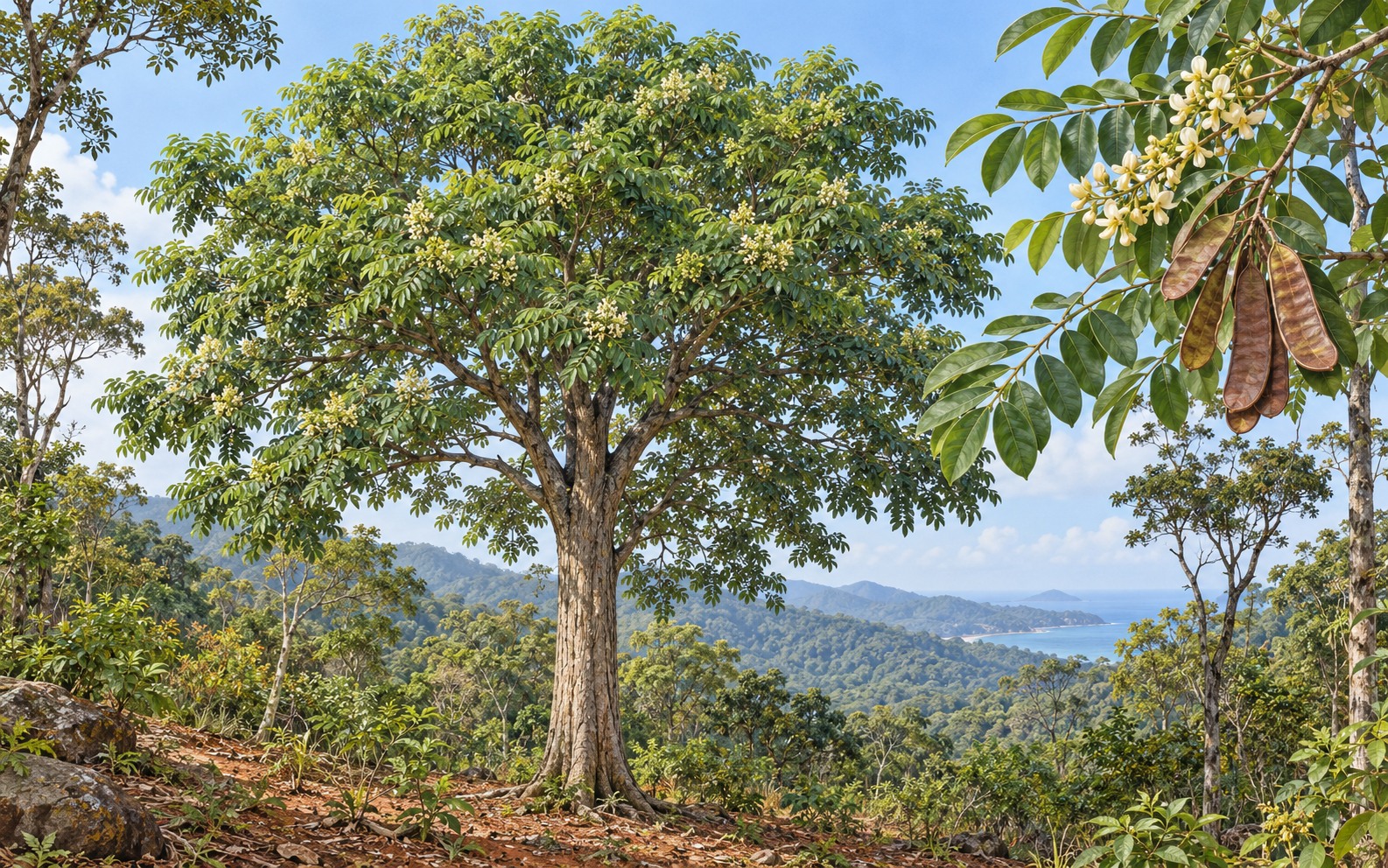
Dalbergia odorifera T.C.Chen is a species accepted by Kew in the legume family Fabaceae. Kew gives its native range as Fujian and Zhejiang to Hainan Island in China and places it in the subtropical biome. The Xishuangbanna Tropical Botanical Garden describes a semi-deciduous tree that prefers light, tolerates some drought, and does not tolerate waterlogging; it has been planted in several southern Chinese provinces. Common names such as fragrant rosewood, Jiangxiang, and huanghuali vary across local and commercial usage. Many Dalbergia species have aromatic wood, pinnate leaves, and similar flat pods, so a trade label or wood colour is not enough for identification. A scientific label, documented seedling provenance, and a voucher checked by a qualified botanist are needed.
General morphology for study; compare with a voucher
The medicinal part has a precise boundary. Shennong Alpha’s record of the 2020 Chinese Pharmacopoeia defines Jiangxiang as dried heartwood from the trunk and roots of D. odorifera; sapwood is removed, the material is air-dried, then split or sliced. Kew’s Medicinal Plant Names Services also links Jiangxiang to this exact species and heartwood. Furniture timber, research essential oil, sawdust, and processed materia medica are different product forms; evidence for one form cannot automatically be transferred to another.
General morphology for study; compare with a voucher
The project’s CITES dataset contains one 2023 comparative row for D. odorifera: Appendix II, trade term medicine, reported purpose T (commercial), quantity 2 kg, China as reported exporter to Malaysia, and source code D. This is one reported row, not the total number of global shipments or an authenticated consignment. CITES defines code D under a specific provision for artificially propagated Appendix-I plants exported commercially; the appearance of that code alongside this species and Appendix II should be interpreted in the reporting context, not treated as a permit or proof of verified origin. All images on this page are AI study illustrations, not herbarium vouchers or identification evidence.
Traditional context
Illustrative heartwood; does not authenticate a lot
In Chinese traditional medicine, Jiangxiang (降香) is the materia-medica name associated with the heartwood of D. odorifera. Shennong Alpha’s English rendering of the 2020 Chinese Pharmacopoeia records a pungent flavour and warm nature, entry into the Liver and Spleen channels, and traditional actions described as moving qi and blood, stopping bleeding, and relieving pain. Indications transcribed from that monograph include certain bleeding presentations, hypochondriac or chest pain, traumatic pain, vomiting, and abdominal pain. These are descriptions within a traditional medical system, not conclusions from modern clinical trials.
Illustrative heartwood; does not authenticate a lot
Historical disease terms and pattern diagnoses do not map one-to-one onto current medical diagnoses. This page preserves them as context rather than self-treatment advice for bleeding, chest pain, or abdominal pain; those symptoms may require urgent medical care. A 2020 scientific review describes the history of D. odorifera use in China in terms of dispelling blood stasis, regulating qi, and relieving pain, while noting that mechanisms, quality control, and standardization remain incomplete.
Illustrative heartwood; does not authenticate a lot
Not every wood sold as “fragrant wood,” “rosewood,” or “huanghuali” is medicinal Jiangxiang. Botanical records, drug monographs, and trade documents answer different questions: traditional literature records historical use; a pharmacopoeia defines the material, part, and product standard; CITES records reported trade and does not establish therapeutic action.
Modern evidence
Illustrative heartwood; does not authenticate a lot
Modern research on D. odorifera includes heartwood chemistry, essential oils, and preclinical assays. A 2020 Journal of Ethnopharmacology review summarizes investigated pharmacological activities but concludes that mechanisms still require clarification and that quality-control research is limited. An open study of heartwood formation reports volatile compounds and flavonoids in the heartwood; formation is slow and varies with tree age, growing conditions, and tissue damage. Findings from an extract, an oil profile, or a cell model do not show that a piece of wood, sawdust, or retail product treats disease in people.
Illustrative heartwood; does not authenticate a lot
A pharmacopoeia provides a material identity and quality standard within its regulatory scope; that is not the same as proof of a therapeutic effect from a well-designed clinical trial. CITES data answer whether a reportable trade record appears under a selected query, not whether the product has pharmacological activity. When reading a study, check how the species was authenticated, which plant part was used, the extraction solvent, the experimental concentration, whether controls were included, and whether the result was replicated.
Illustrative heartwood; does not authenticate a lot
This profile does not conclude that Jiangxiang treats cardiovascular disease, bleeding, pain, inflammation, or any other condition. Clinical claims would require appropriate human trials using a standardized preparation, a suitable sample and outcome, and adverse-event monitoring. The sources reviewed do not provide a basis for self-treatment or replacing prescribed care.
Safety
Illustrative heartwood; does not authenticate a lot
The references reviewed do not provide a complete human toxicology profile, a universally safe maximum dose, or a comprehensive interaction assessment for D. odorifera heartwood. Do not ingest, chew, burn for inhalation, or prepare oil or powder at home from unidentified wood. Medicinal heartwood should come from a traceable supplier and meet the applicable standard; commercial wood may be dyed, treated, mixed with another species, or contaminated by dust and processing chemicals.
Illustrative heartwood; does not authenticate a lot
No linked source reviewed here confirms a specific herb pairing that creates a toxic substance with Jiangxiang. This means that a particular pairing was not verified; it does not prove every combination is safe. Do not invent a ratio between Jiangxiang and another herb: an amount in a formula is meaningful only for that exact formula, material, purpose, and source. Shennong Alpha’s translated pharmacopoeia record lists 9–15 g in its monograph context; this is not an individualized recommendation, not a direction to self-decoct, and not transferable to essential oil, sawdust, or products of unknown quality.
Illustrative heartwood; does not authenticate a lot
People who are pregnant or breastfeeding, children, people with liver or kidney disease, bleeding disorders, Fabaceae allergy, or those taking medicines should consult a physician or pharmacist before considering any herbal product. A monograph does not replace individual professional assessment. Chest pain, uncontrolled bleeding, vomiting blood, severe abdominal pain, or pain after trauma needs prompt medical evaluation; do not delay care to try a herb.
Illustrative heartwood; does not authenticate a lot
The reviewed references describe traditional actions for Jiangxiang as a single materia medica, but no clearly sourced multi-herb prescription with ingredients and amounts was verified for this page. It therefore does not pair Jiangxiang with Salvia miltiorrhiza, Ligusticum chuanxiong, or another herb, claim a synergistic benefit, or invent a mixing ratio. The heartwood image above illustrates the material under discussion; it is not a component photograph from a documented formula.
Illustrative heartwood; does not authenticate a lot
No reliable source in this reference set confirms a particular herb as incompatible with Jiangxiang or as becoming poisonous when taken together. The absence of a recorded pairing does not rule out interactions: risk may depend on prescription medicines, underlying conditions, wood quality, extract type, and dose. A combination should be listed only when the original source identifies the materia medica, plant part, quantity, preparation, and reference; otherwise it remains unverified rather than becoming an invented recipe.
Identification and study notes
General morphology for study; compare with a voucher
Pinnate leaves with multiple leaflets, small legume-type flowers, and thin flattened pods are clues to Dalbergia. They do not diagnose D. odorifera because congeners can look similar. Aromatic wood is likewise not a substitute for wood anatomy, a voucher, or chemical authentication.
Growth and habitat
Reference tree; the image does not authenticate the species
Illustration of the canopy and mature trunk
Kew records a native range from Fujian and Zhejiang to Hainan in subtropical China. Xishuangbanna Tropical Botanical Garden describes a semi-deciduous tree that prefers light, tolerates some drought, and is vulnerable to waterlogging; trial plantings in Yunnan and other southern provinces show it can be cultivated beyond its native range. A report of cultivation does not mean every subtropical climate is suitable. This is a tree requiring space, freely draining soil, and legal planting stock; wild trees should not be harvested for heartwood.
Illustration of the canopy and mature trunk
Reference tree; the image does not authenticate the speciesChoose mature seed or nursery stock labelled Dalbergia odorifera with legal provenance. A Hainan study collected healthy seed from plantation trees on 10 February 2017; this is a study sampling date, not a universal seed-collection calendar. Do not collect from wild populations without authorization.
Illustration of the canopy and mature trunkSow in a clean, draining medium and maintain even moisture without waterlogging. One seedling study tested experimental mixtures using red soil, river sand, coconut coir, and leaf litter in different proportions. These were trial treatments, not a universal optimum; another study found germination temperature varied with seed provenance.
Reference tree; the image does not authenticate the speciesKeep trays warm, in bright filtered light and good ventilation; monitor fungi, pests, and moisture. One controlled experiment alternated 27°C with light and 24°C with darkness, while a seed-germination study found optimal temperatures varied among provenances. Do not treat an incubator schedule as a mandatory household setting or watering calendar.
Reference tree; the image does not authenticate the speciesAfter seedlings establish and harden, transplant into deep containers or a sunny site with deep, well-drained soil. Xishuangbanna Botanical Garden notes its light preference and performance on open slopes with deep soil; persistently waterlogged low ground is unsuitable. Allow room for the mature crown and avoid damaging the taproot during transplanting.
Reference tree; the image does not authenticate the speciesWhile young, inspect plants regularly and irrigate during prolonged dry periods while allowing complete drainage; a thin organic mulch may reduce moisture loss but should stay away from the root collar. The cited sources do not provide a universal fertilizer schedule, irrigation volume, or pesticide dose, so follow local soil testing and extension advice.
Reference tree; the image does not authenticate the species
How long until harvest? Seedlings can germinate and grow into trees, but the medicinal part is mature heartwood, not the whole young stem. Studies report that heartwood may begin forming slowly at roughly 6–8 years under some conditions; the Yunnan botanical-garden account estimates about 10 years before heartwood begins to appear and 20–30 years before harvest value. Reviews also emphasize irregular heartwood formation. These are regional estimates, not a guaranteed medicinal harvest age, quality grade, or authorization. Do not fell young trees to test.
From plant to dried material · source-recorded workflow
Reference tree; the image does not authenticate the speciesAccept wood only from traceable cultivation or harvest with the CITES permits and origin documents applicable to the trade route; do not collect wild trees unlawfully.
Dried-material illustration, not use instructionsVerify the scientific name Dalbergia odorifera, the heartwood part from trunk/root, and the responsible identifier; red colour or a distinctive scent alone cannot authenticate the species.
Dried-material illustration, not use instructionsThe pharmacopoeia description transcribed by Shennong Alpha removes sapwood and foreign matter and air-dries the material; a qualified processing facility may split or slice it under the applicable standard.
Reference tree; the image does not authenticate the speciesLabel species, cultivation/harvest source, part, processing date, lot number, and test results; retain a voucher sample. Do not burn, distill, or repurpose decorative wood as materia medica.
Dried-material illustration, not use instructions
This record supports study and processing traceability; it is not a home preparation or self-use guide.