Danshen · red sage · Dan Shen
Salvia miltiorrhiza Bunge · Root and rhizome
Name and part used
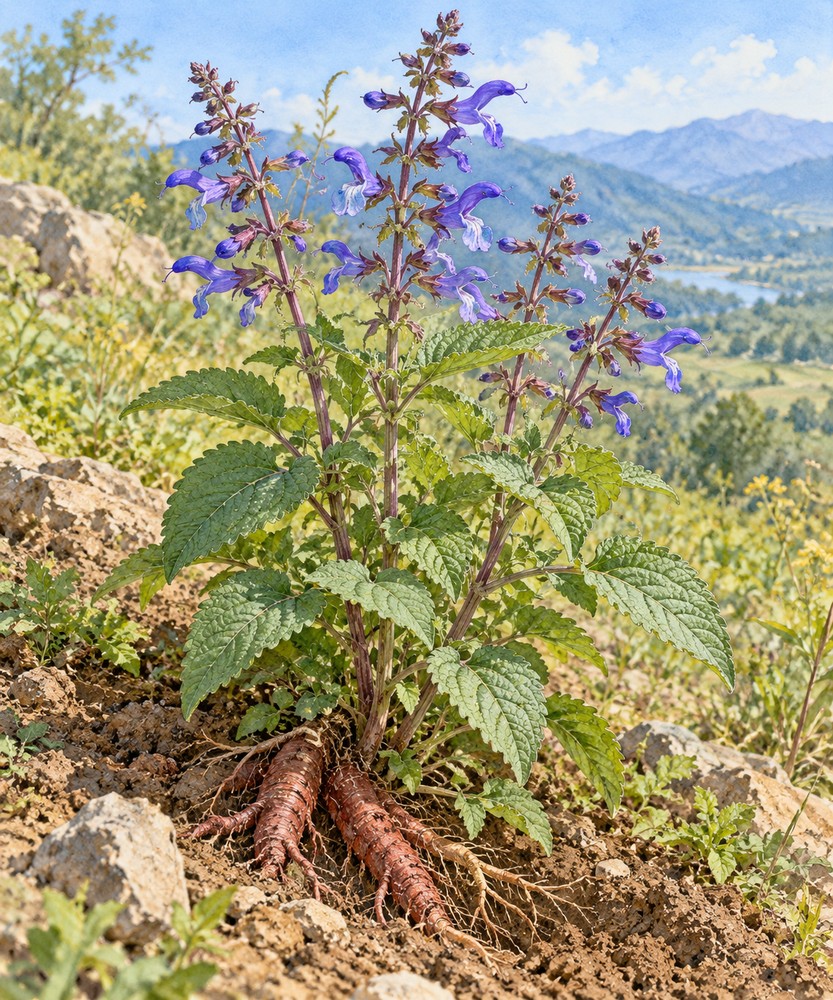
A Lamiaceae herb with opposite compound leaves, blue-violet flowers, and reddish roots.
Traditional context
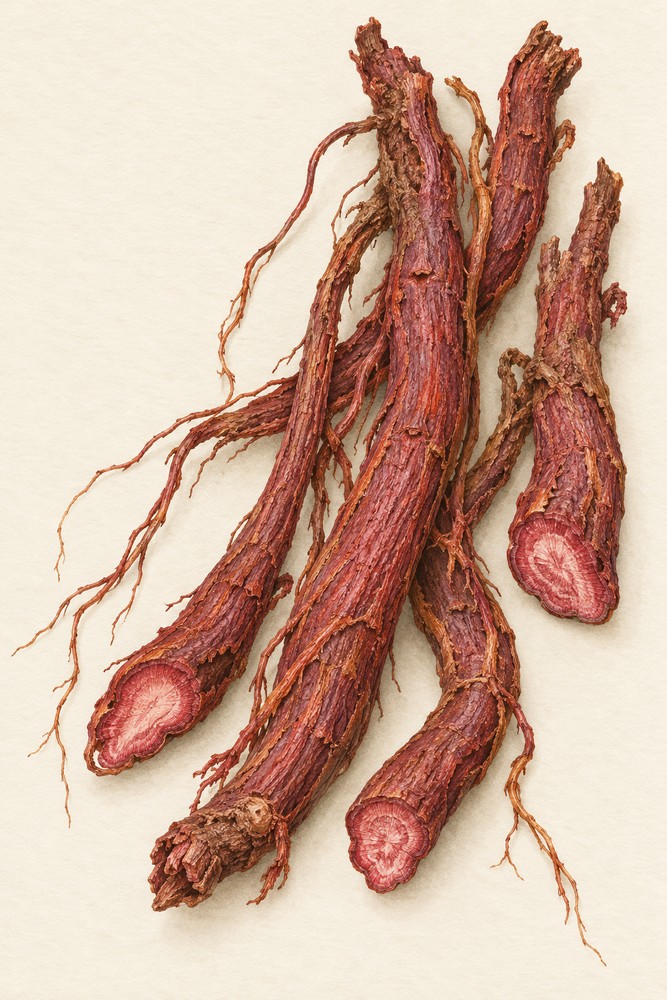
HKBU records Danshen as Salvia miltiorrhiza root and rhizome; do not confuse it with ornamental or culinary Salvia species.
Modern evidence
Studies of tanshinones, salvianolic acids, single-herb products, and multi-herb formulas are different evidence types and cannot be generalized across products.
Safety
A clinically important warfarin interaction has been reported: literature describes increased anticoagulation and bleeding events. Do not self-combine with warfarin or anticoagulants; consult a clinician or pharmacist.
Pairing in reference texts
It appears in traditional formulas, but classical co-use does not remove interactions with modern anticoagulants.
Growing, care, and harvest timing
HKBU habitat record: Growing in forest margins at altitude 2,100-4,050m, on roadsides and in thickets. Distributed in South Gansu, West Sichuan, Northwest Yunnan and Tibet. The medicinal materials are mainly produced in Sichuan, Jiangsu, Anhui, Shanxi, Hebei and etc Harvest and processing as recorded: Excavated the whole plant from Oct.-Nov. of the second year of planting after autumn sowing when the above ground part withers or before sprouting in the next spring, removed remain stem leaves, spread for sun-dried, softening the root, shake off the sediment (not washed), sun-dried to 50%-60% dried. Removed the root, sun-dried to 80%-90% dried, removed the fibril, and sun-dried
Source-recorded harvest/processing: Excavated the whole plant from Oct.-Nov. of the second year of planting after autumn sowing when the above ground part withers or before sprouting in the next spring, removed remain stem leaves, spread for sun-dried, softening the root, shake off the sediment (not washed), sun-dried to 50%-60% dried. Removed the root, sun-dried to 80%-90% dried, removed the fibril, and sun-dried
The reviewed source does not provide a complete species-specific sowing/growing routine, irrigation/fertilization schedule, or universal plant age. The page therefore does not infer care instructions or years to harvest; consult local cultivation guidance.
Open habitat and season source ↗FROM PLANT / SOURCE HABITAT TO DRIED MATERIAL · REFERENCE WORKFLOW
- Harvest cultivated roots in late autumn after aerial growth withers, as in the HKBU record; do not confuse other Salvia species.
- Remove remaining stems and soil; the reference describes shaking soil off rather than vigorous washing, then drying in stages.
- Separate roots and rhizomes, remove fine roots, and continue drying to the facility’s quality standard.
- Record species, source, drying method, date, and lot. The warfarin warning concerns product use, not post-harvest processing.
These are post-harvest study notes, not directions to prepare a remedy for self-treatment. Processing reference ↗
How to read formula amounts
The cited sources do not provide a formula with specific amounts for this profile; no ratio is invented. Absence from the incompatibility list does not establish safety.
Habitat, season, and harvest in the HKBU botanical record
HKBU botanical record (translated summary): Flowering and fruiting dates: Flowering: May to September, fruiting: August to October Habitat and distribution: Growing in forest margins at altitude 2,100-4,050m, on roadsides and in thickets. Distributed in South Gansu, West Sichuan, Northwest Yunnan and Tibet. The medicinal materials are mainly produced in Sichuan, Jiangsu, Anhui, Shanxi, Hebei and etc Harvest and processing as recorded: Excavated the whole plant from Oct.-Nov. of the second year of planting after autumn sowing when the above ground part withers or before sprouting in the next spring, removed remain stem leaves, spread for sun-dried, softening the root, shake off the sediment (not washed), sun-dried to 50%-60% dried. Removed the root, sun-dried to 80%-90% dried, removed the fibril, and sun-dried
Open botanical source ↗