Dendrobium denneanum Kerr · Stems of Dendrobium denneanum are used for the regional materia medica product Dieqiao Shihu under a Chinese geographical-product specification. Do not treat that name as equivalent to every Shihu product or to the other Dendrobium species listed in the Chinese Pharmacopoeia.
Materia medica properties in reference
Illustration of dried stems described in the regional standard
Properties as recorded in the source: Do not assign properties, meridian associations, or doses from a multi-species Shihu monograph to Dieqiao Shihu. A regional source specifies D. denneanum stems as a materia medica product, but the sources reviewed are insufficient to create a species-specific profile that could guide self-use.
Illustration of dried stems described in the regional standard
No formula with every ingredient and amount was verified for this exact species; no ratio is inferred.
CITES international-trade evidence
Illustration of dried stems described in the regional standard
The 2026.1 CITES Trade Database contains 8 comparative-tabulation rows for Dendrobium denneanum during 2020, 2021, 2022, 2023, 2024. The query selected reported purpose T (Commercial) and trade term MED (medicine); appendices appearing in these rows: II. Reported importer codes include CA, SG, US; exporter codes include CN. These are comparative-tabulation rows, not shipment counts or summed volume. This record does not establish clinical efficacy, the legality of an individual transaction, or safety of use.
General plant form; does not authenticate the species
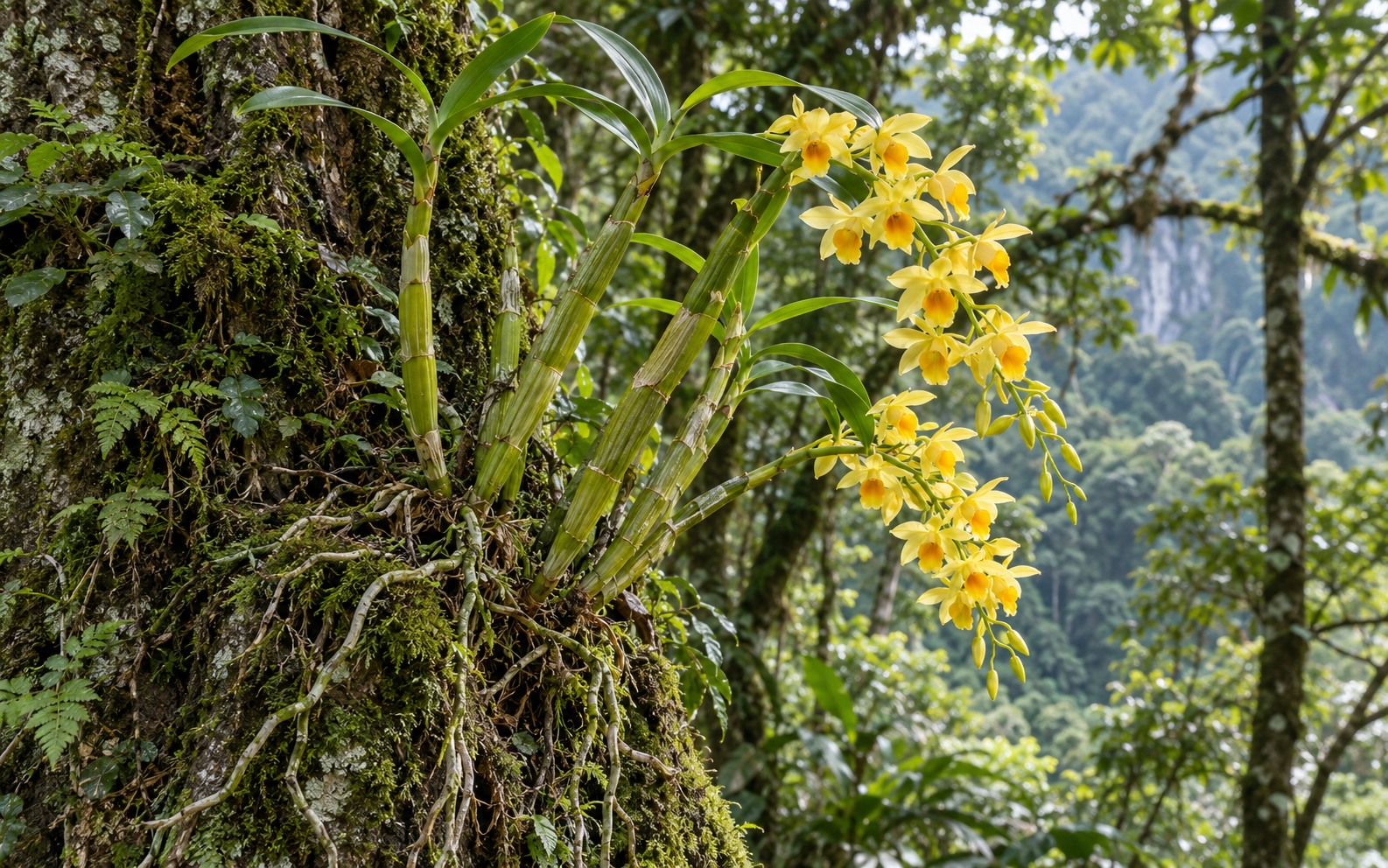
Kew’s Plants of the World Online accepts Dendrobium denneanum Kerr in Orchidaceae. It describes the species as a pseudobulbous epiphyte occurring mainly in subtropical biomes. Its native range extends from the Himalaya to southern China and Indo-China; the distribution list includes Assam, south-central and south-eastern China, the eastern Himalaya, Hainan, Laos, Myanmar, Nepal, Thailand, Vietnam, and the western Himalaya. Epiphytes attach to tree trunks or branches and sometimes grow on rock; they are not plants whose roots should be buried deeply in an ordinary garden bed.
General plant form; does not authenticate the species
The Chinese name 叠鞘石斛 is romanized Dieqiao Shihu. A Chinese geographical-product specification identifies D. denneanum Kerr as the source plant for a product under that name. RHS lists Dendrobium clavatum as a synonym. Seeing one of these names on a label does not authenticate a lot; scientific identity, cultivation origin, plant part, and provenance documents still need to be checked.
General plant form; does not authenticate the species
The visible growth form has elongated, jointed pseudobulb canes, narrow leaves toward the upper stem, and yellow flower clusters. The geographical-product specification describes fresh stems generally 20–60 cm long and 0.5–1.5 cm in diameter, cylindrical, yellow-green, smooth or longitudinally grooved, with clear nodes. Thin leaf sheaths wrap the nodes. Yellow flowers usually grow in clusters, but flowering time and flower count vary with climate, plant age, and cultivation. The images on this page help visualize the orchid and its medicinal stem; AI images cannot authenticate a real specimen.
General plant form; does not authenticate the species
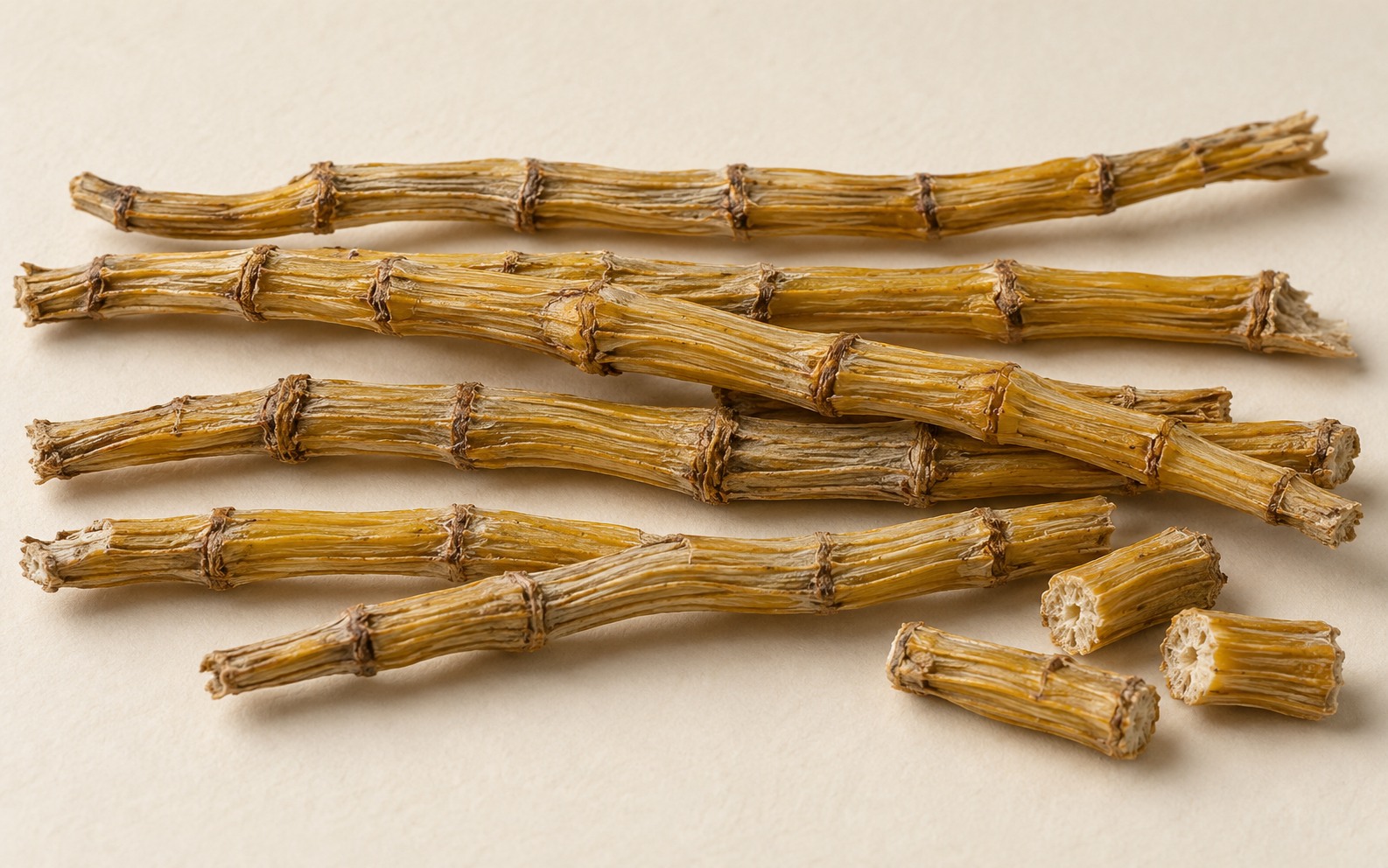
The same specification describes dried stems generally 20–45 cm long and 0.2–1.2 cm in diameter, slender and cylindrical, mostly unbranched, with slightly swollen nodes that are darker than the internodes. The surface is glossy yellow-green and may have longitudinal grooves; the dry stem is brittle, with a pale yellow-brown fracture showing short fibers. A coiled “fengdou” form is also described. These are sensory characteristics of the specified regional product, not a definitive test for species identity or adulteration.
General plant form; does not authenticate the species
The CITES 2026.1 extract used by this atlas contains eight comparative-tabulation rows for D. denneanum from 2020 through 2024. Each reports Appendix II, trade term MED (medicine), purpose T (commercial), and source A; China is reported as exporter, and the reported importers include the United States, Singapore, and Canada. No quantities are supplied in these rows, so they cannot establish volume, shipment count, or market value. They are records reported to the CITES database, not proof of therapeutic efficacy, product safety, or legality of any individual transaction.
Traditional context
Epiphytic orchid and illustrative habitat
The name Dieqiao Shihu appears in reviews of Chinese ethnomedicinal plants, where stems and leaves are reported as used. A review focused on Dendrobium species used for skin disorders summarizes a local practice in which stems of this species were used for impetigo and dried leaves were applied externally. This is an ethnobotanical report, not a treatment recommendation or confirmation of efficacy.
Illustration of dried stems described in the regional standard
A study of polysaccharides from D. denneanum stems describes the plant as a Sichuan medicinal resource and notes its industry use. That does not make it a separately listed source in every pharmacopoeia: the same research paper identifies other Dendrobium species and related species as the official sources named in the 2020 Chinese Pharmacopoeia. Do not transfer properties, doses, or indications from a multi-species Shihu monograph to a Dieqiao Shihu product without a source that names this species.
Epiphytic orchid and illustrative habitat
This page preserves historical and regional context only. Older disease terms in source texts do not map directly to modern dermatologic diagnoses. Do not self-treat impetigo, skin infection, or wounds with the stem or leaves; seek medical assessment, especially for fever, worsening pain, spreading pus, or lesions near the eyes.
Modern evidence
Illustration of dried stems described in the regional standard
Kew POWO supports the accepted name and distribution; synonyms should also be retained when searching older literature. The Chinese geographical-product specification is a key source for Dieqiao Shihu: it names the source species and describes production-area conditions, cultivation, harvest, processing, and sensory quality. PubMed also indexes a pharmacognostic study describing the morphology and microscopy of crude Dieqiao Shihu and comparing it with material from D. nobile.
Epiphytic orchid and illustrative habitat
Chemical work on the stems has isolated phenanthrene derivatives. This is laboratory constituent analysis, not a clinical treatment trial. A polysaccharide study in an acute gastric-ulcer rat model reports preclinical findings and notes that composition and effects may differ by cultivation habitat. Results in rats or cells do not establish efficacy or a safe dose in people.
Illustration of dried stems described in the regional standard
The review of external skin uses compiles ethnobotanical records rather than clinical trials. Among the sources checked, no controlled human clinical trial was found that establishes the reported folk use of this exact species. CITES demonstrates reported international trade rows; it does not authenticate each traded lot or its medicinal quality.
Safety
Illustration of dried stems described in the regional standard
The regional specification describes a product made from stems meeting its standard, but it does not provide a complete interaction dossier for every user. “Shihu” in trade can refer to multiple species, parts, and preparations; misidentification, substitution, contamination, or damp storage are practical risks. Do not use study images to select or quality-check raw material.
Illustration of dried stems described in the regional standard
The sources reviewed do not establish a specific combination that makes D. denneanum poisonous, and they are insufficient to conclude that any combination is safe. Do not combine it on your own with prescription medicines, other herbs, or supplements. People who are pregnant or breastfeeding, children, people with medical conditions, or anyone taking medicines should consult a clinician or pharmacist before considering an herbal product. Folk topical-use records are not a substitute for infection care; stop exposure and seek medical help if irritation or worsening symptoms occur.
Illustration of dried stems described in the regional standard
Do not collect wild orchids. D. denneanum appears in Appendix II CITES trade data extracted for this atlas; cross-border trade must follow current permits and laws in the countries concerned. Source code A in the dataset is a reported artificially propagated source category, not a substitute for checking documentation for a specific lot.
Kew records a native range from the Himalaya to southern China and Indo-China and describes a subtropical epiphyte. The Dieqiao Shihu specification describes a near-wild production area with abundant rainfall, mean annual temperature around 17°C, relative humidity around 80%, elevation 400–1,300 m, and plants attached to sandstone, cliff faces, or rocky sites with drainage. These figures describe a specific regional product area, not universal thresholds for every grower.
Visualize an epiphytic mount; not a substitute for production standards
Epiphytic orchid and illustrative habitatChoose nursery-propagated D. denneanum with scientific labeling and provenance; do not remove wild orchids. The regional specification uses healthy mother plants at least three years old for propagation.
Epiphytic orchid and illustrative habitatPropagate by division or stem-borne keikis as described in the source; use clean tools and preserve healthy roots. The specification does not supply laboratory sterilization procedures.
Epiphytic orchid and illustrative habitatMount plants on rock or a coarse, airy support to mimic their epiphytic habitat and allow rapid drainage. The regional specification limits density to no more than 400 clumps per 667 m².
Epiphytic orchid and illustrative habitatUse spray irrigation to keep the support evenly moist without waterlogging. The source recommends early-morning or evening irrigation in hot summer and autumn, and around midday in cooler spring and winter; drain the site after rain. Fertilizers, crop-protection products, and site hygiene must follow local rules.
Epiphytic orchid and illustrative habitatMonitor weeds and canopy conditions without damaging attached roots. The regional specification calls for manual weeding during the growing season and scheduled fertilization; do not transfer its commercial fertilizer rates to a home pot.
Epiphytic orchid and illustrative habitat
How long until harvest? The specification allows harvest from autumn through the following spring, with November–December preferred. Its “harvest old, retain young” method requires above-ground parts to have grown for at least 18 months; this is a regional production threshold and does not guarantee that any potted plant meets medicinal quality standards.
Visualize an epiphytic mount; not a substitute for production standards
From plant to dried material · source-recorded workflow
Epiphytic orchid and illustrative habitatHarvest only legally cultivated lots with species, site, stem age, harvest date, and provenance recorded; do not collect wild orchids.
Epiphytic orchid and illustrative habitatThe regional specification allows harvest from autumn through the following spring, preferably November–December. Under its “retain young, harvest old” method, take only above-ground parts that have grown for at least 18 months.
Dried form for study; not an image of a tested lotRemove soil, roots, and foreign matter; material sold fresh is cleaned of roots and mud under the specification. For dried material, the source describes brief scalding or softening with heat, then rubbing while drying to remove leaf sheaths.
Dried form for study; not an image of a tested lotDry at no more than 65°C to moisture content of 12% or less; stems may be coiled into fengdou or cut into segments under the standard. These are regional product-processing parameters, not home-preparation instructions for ingestion.
Dried form for study; not an image of a tested lotLabel species, part, fresh/dried state, date, and lot separately; check moisture, impurities, and regulatory requirements before packing. AI images are illustrative, not quality standards.
Dried form for study; not an image of a tested lot
This record supports study and processing traceability; it is not a home preparation or self-use guide.