Loddiges’ dendrobium (Mei Hua Shi Hu) · Mei Hua Shi Hu · Shi Hu
Dendrobium loddigesii Rolfe · Some regional materia-medica sources include fresh or dried stems of Dendrobium loddigesii in Dendrobii Herba / Shi Hu. The name Shi Hu does not make every Dendrobium species interchangeable; verify the species and cultivated provenance.
Materia medica properties in reference
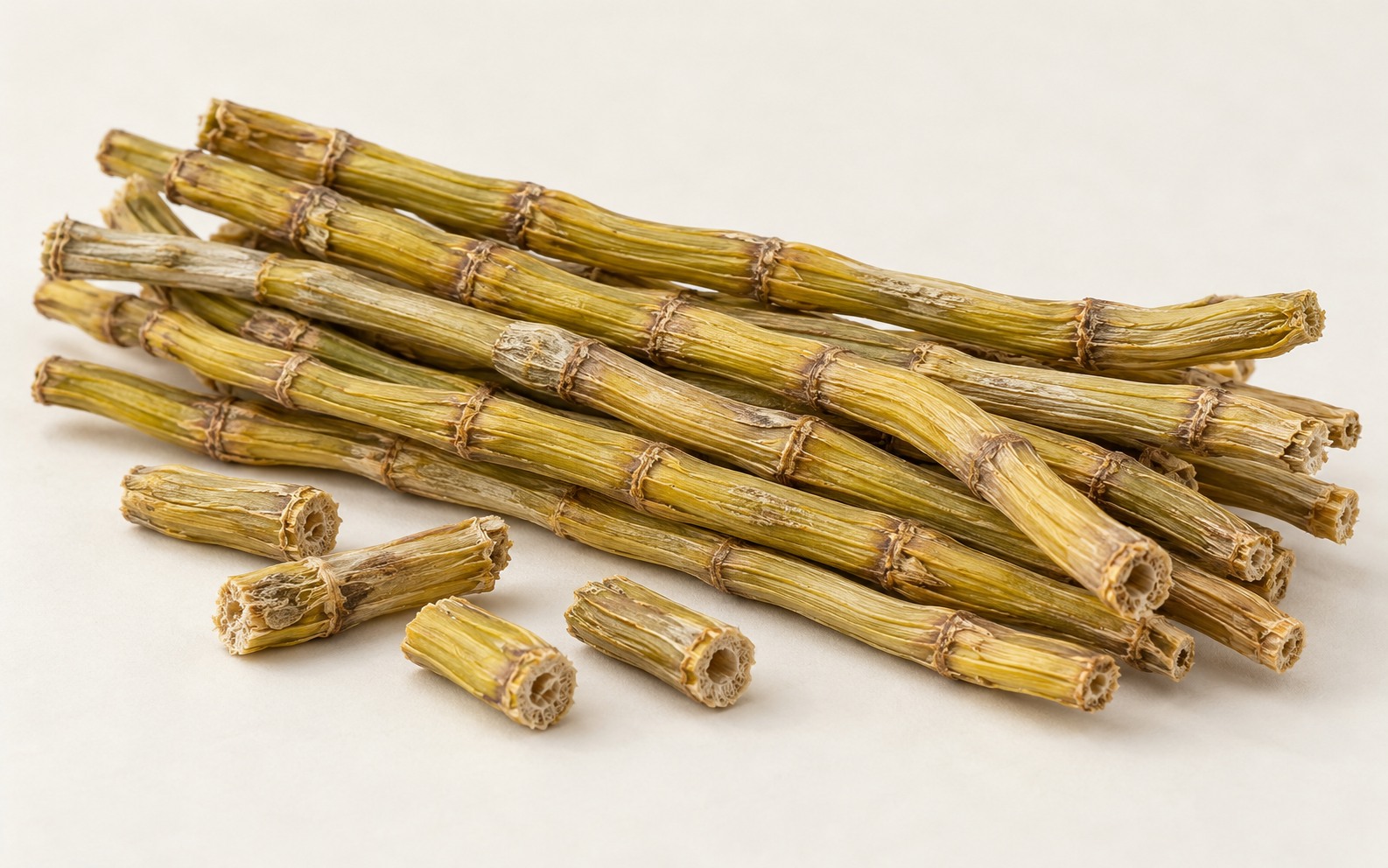
Dried-stem illustration; species not authenticated
Properties as recorded in the source: A Korean traditional-medicine record links D. loddigesii stem with Shi Hu and records a sweet, bland taste and slightly cold nature; the source translates traditional actions as clearing stomach heat, generating fluids, and nourishing yin. This is a regional source description, not a universal standard or clinical trial result.
Dried-stem illustration; species not authenticated
No clearly quantified formula pairing for exact D. loddigesii was verified; no pairing benefit or ratio is invented.
CITES international-trade evidence
Dried-stem illustration; species not authenticated
The 2026.1 CITES Trade Database contains 8 comparative-tabulation rows for Dendrobium loddigesii during 2016, 2017, 2018, 2021. The query selected reported purpose T (Commercial) and trade term MED (medicine); appendices appearing in these rows: II. Reported importer codes include CA, SG, US; exporter codes include HK. These are comparative-tabulation rows, not shipment counts or summed volume. This record does not establish clinical efficacy, the legality of an individual transaction, or safety of use.
Study image; compare with an authenticated voucher
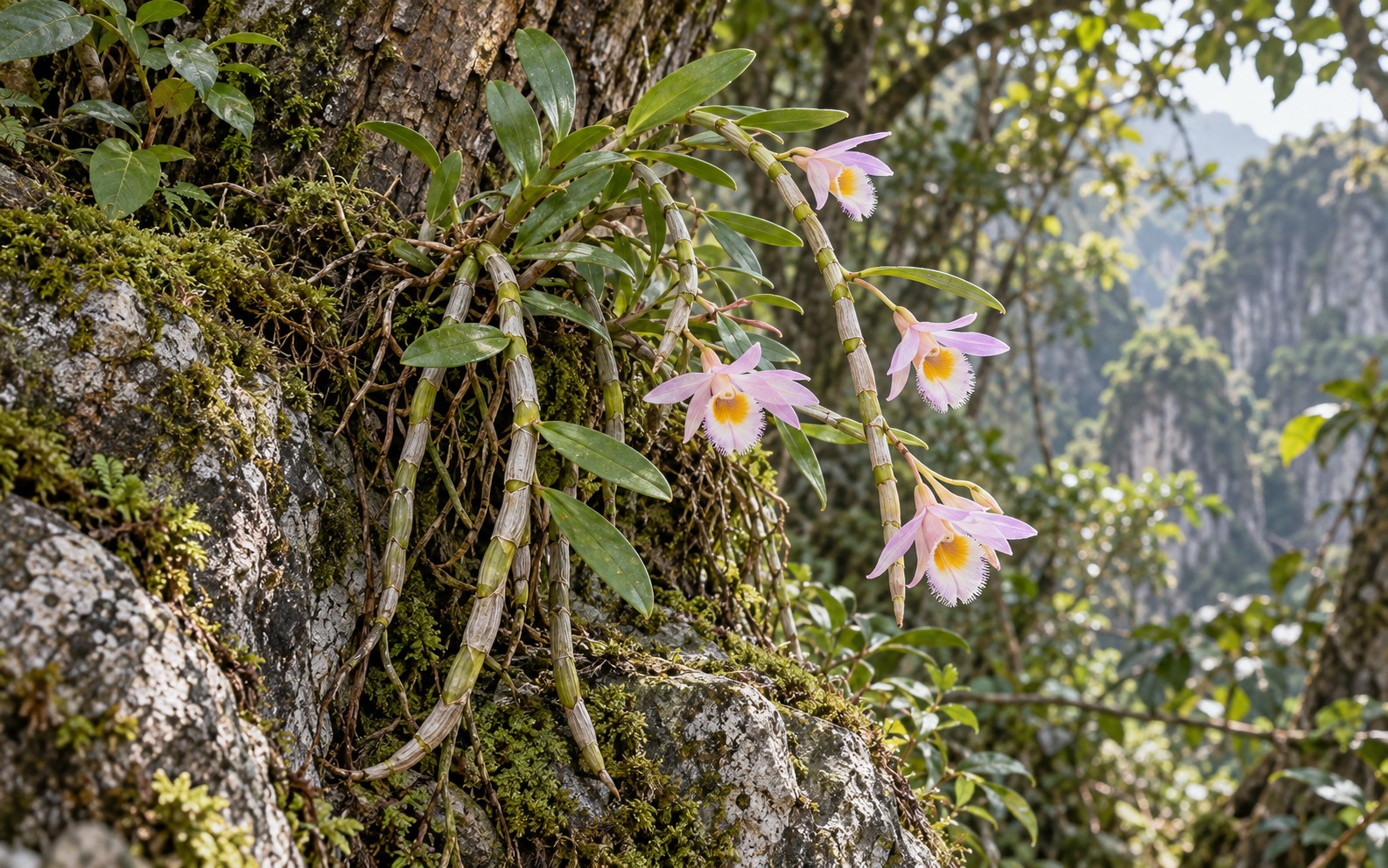
Dendrobium loddigesii Rolfe is an accepted species in Kew’s taxonomic record and belongs to the orchid family Orchidaceae. Kew describes it as an epiphyte or lithophyte: it grows attached to trees or rocks rather than as a woody terrestrial plant. Its slender, jointed pseudobulb stems are often pendulous. The native range extends from southern China into Indochina, including Hainan, Laos, Myanmar, Thailand, Cambodia, and Vietnam. The Hong Kong Herbarium describes many-noded pendulous stems, alternate leaves, and single flowers arising from upper nodes; sepals and petals are pale pink, with a yellow-orange centre and fringed lip. In Hong Kong it is recorded on rocks or tree trunks in lowland forest, with flowering noted around March to May. These features help readers learn the plant, but do not replace an authenticated voucher because other Dendrobium orchids can have jointed canes and pink flowers.
Study image; compare with an authenticated voucher
Some East Asian materia-medica sources list D. loddigesii stems within Dendrobii Herba / Shi Hu, but the scope of regional standards differs. The Korean Traditional Knowledge Portal has a Dendrobii Herba entry tied to this species; Taiwan’s Ministry of Health includes D. loddigesii among plant sources for Dendrobium stem. The Hong Kong Herbarium records medicinal or folk use without supplying a standardized species-specific formula. This profile therefore separates the botanical name, drug name, and the scope of each source; properties of D. officinale, D. nobile, or every plant in the genus are not transferred here.
Study image; compare with an authenticated voucher
The project’s 2026.1 CITES dataset has eight comparative rows for the trade term “medicine,” reported purpose T (commercial), and source code A, in 2016, 2017, 2018, and 2021. Reports name Hong Kong as exporter, China as origin, and Canada, Singapore, or the United States as importers. CITES uses code A for artificially propagated plant specimens. These are rows in the filtered reporting dataset, not a count of all global shipments or proof that a particular transaction was lawful. The species is in CITES Appendix II; wild orchids should not be collected for study or medicinal use. The images on this page are AI illustrations of the plant and dried stem, not authenticated specimens.
Traditional context
Dried-stem illustration; species not authenticated
The Hong Kong Herbarium records D. loddigesii as an ornamental plant with medicinal or folk use. The Korean Traditional Knowledge Portal links this exact name to a Dendrobii Herba record describing the dried stem; that source records a sweet and bland taste, slightly cold nature, and traditional actions translated as clearing stomach heat, generating fluids, and nourishing yin. Taiwan’s Ministry of Health also includes the species among sources for Dendrobium stem. These records belong to particular regional systems and texts; they do not establish one pharmacopoeial standard in every country or for every market lot.
Dried-stem illustration; species not authenticated
Names such as Shi Hu, Huan Cao Shi Hu, Mei Hua Shi Hu, and Dendrobium stem are used with different scopes. A materia-medica product called Shi Hu may be defined by one or several species depending on the text. If a retail label says only “Dendrobium” and omits species, plant part, or cultivation provenance, it cannot be treated as D. loddigesii. The Hong Kong Herbarium labels the use medicinal/folk but does not provide a dose or formula; the Korean record gives pattern-specific cautions within its own system, which should not be turned into a diagnosis for readers.
Dried-stem illustration; species not authenticated
This profile preserves traditional descriptions as study material and does not recommend the stem for dry mouth, fever, digestive disease, or any other condition. No multi-herb ratio is supplied because the reviewed sources do not establish a sufficiently clear formula with exact species, material form, and quantities for each ingredient.
Modern evidence
General habitat illustration, not a verified locality
A PubMed-indexed study compared morphology and polysaccharide content in D. loddigesii material from different habitats. Such work can inform raw-material quality control and show variation among sources; it is not a human treatment trial. A separate nursery-stage study assessed seedlings and propagation conditions, not therapeutic effects of mature plants or dried stems.
Dried-stem illustration; species not authenticated
Research on Dendrobium is especially vulnerable to overgeneralization: species, growing conditions, stem age, drying, and extraction can all change chemistry. Results from D. officinale, D. nobile, or mixed extracts cannot automatically be assigned to D. loddigesii. In-vitro assays and polysaccharide analyses measure selected constituents or early experimental models; evidence of benefit in people would require clinical trials using an authenticated and standardized preparation.
Dried-stem illustration; species not authenticated
The sources reviewed for this profile did not establish a controlled clinical trial sufficient to confirm a therapeutic effect specific to D. loddigesii stem. Traditional statements therefore remain in their own section and are not converted into treatment claims. Nor does a CITES trade term of “medicine” prove medicinal efficacy: it is a reporting category for the traded specimen, not a pharmacological test.
Safety
Dried-stem illustration; species not authenticated
The sources reviewed do not provide a human toxicology assessment, a general safe-use level, or a complete drug-interaction list for D. loddigesii stem. Do not collect wild orchids, chew the cane, prepare a home decoction, or use an ornamental plant as medicine. Orchids and many Dendrobium species are subject to trade controls; a product being sold does not establish its species identity, quality, or permits. Consider only traceable cultivated material meeting applicable standards, and consult a health professional if you take medicines or have a medical condition.
Dried-stem illustration; species not authenticated
The Korean record lists cautions using pattern concepts from Korean traditional medicine. These are regional source notes, not human toxicology findings. Do not transfer warnings for D. officinale or another Dendrobium product to this species without species-specific evidence. No reviewed source confirms a specific herb pairing that becomes toxic with D. loddigesii; that absence also cannot establish that every combination is safe.
Dried-stem illustration; species not authenticated
Children, pregnant or breastfeeding people, people with chronic conditions, and people taking medicines should not experiment with an unevaluated herbal material. If a product has been used and an unusual reaction occurs, stop and contact a health professional; breathing difficulty, facial swelling, fainting, or severe symptoms require emergency care. Do not replace prescribed treatment with an orchid or an advertised preparation.
Dried-stem illustration; species not authenticated
No linked source reviewed here provides a multi-herb prescription with exact species, plant part, amount for each ingredient, and preparation sufficient to verify a specific benefit from combining D. loddigesii with another materia medica. The page therefore does not pair it with Astragalus, ginseng, or another Shi Hu species, invent a ratio, or present the illustration as an ingredient in a formula. If a formula is added later, its original source and exact amounts must be shown without turning them into personal dosing advice.
Dried-stem illustration; species not authenticated
The reviewed sources also do not reliably document a specific herb that is incompatible with D. loddigesii or creates a toxic substance when combined with it. This is an evidence gap, not a safety guarantee. Risk may involve species substitution, raw-material quality, medicines, or health conditions. The dried-stem illustration helps readers picture a processed Dendrobium cane; it does not authenticate the species or show a real formula ingredient.
Identification and study notes
Study image; compare with an authenticated voucher
Study cues include pendulous jointed canes, alternate oblong leaves, and single upper-node flowers with pale pink petals, a yellow-orange lip centre, and a fringed margin. RHS describes canes up to around 10 cm, though plant size varies with conditions. Related orchids can look similar; compare flowers, stems, locality, and a voucher together.
Growth and habitat
General habitat illustration, not a verified locality
General habitat illustration, not a verified locality
Kew places the species in a wet tropical biome and describes its epiphytic/lithophytic habit. The Hong Kong Herbarium records it on trunks or rocks in lowland forest, across southern China and parts of Laos and Vietnam; its Hong Kong record notes flowering in March–May. Do not assume every population shares the same elevation, flowering season, or temperature requirements. In nature, roots attach to surfaces with moss and organic matter; the plant needs atmospheric humidity but should not remain waterlogged.
Living-plant illustration for morphology study
Living-plant illustration for morphology studyBuy a nursery plant or division legally labelled Dendrobium loddigesii with cultivation provenance. Do not remove mature plants, keikis, or fallen canes from protected or wild sites; CITES-listed orchids require appropriate documents for cross-border movement.
General habitat illustration, not a verified localityUse a medium-grade, airy bark-based orchid mix with moisture-holding material suited to the local room, or mount on cork/wood where humidity is adequate. The pot or basket must drain freely. RHS notes roots prefer a somewhat restricted space, so avoid oversizing the pot.
General habitat illustration, not a verified localityPlace it in bright filtered light or gentle morning sun, avoiding harsh midday sun through glass. RHS lists full sun to partial shade in a sheltered position; adjust if leaves scorch or growth becomes weak. Keep air moving around roots and canes rather than in a persistently stagnant, wet corner.
Living-plant illustration for morphology studyRHS gives average temperatures of 20–25°C in summer and 8–14°C in winter for its growing guidance. These are ornamental-care recommendations from that source, not exact survival limits for every provenance or climate. Water thoroughly as the medium approaches dryness, then let all excess drain; roots should dry between waterings, especially in winter.
General habitat illustration, not a verified localityMaintain higher atmospheric humidity with ventilation and an appropriate humidity tray or misting during active growth; do not leave stagnant water trapped in leaf sheaths overnight. Check for scale, aphids, mealybugs, spider mites, and fungal problems. Repot when bark begins to break down, ideally as new growth appears in spring, and minimize root damage.
Living-plant illustration for morphology studyFor home propagation, divide a mature clump when it outgrows its container, retaining enough healthy canes and roots on each division. RHS advises separating a keiki only after new roots reach at least about 2 cm. Seed propagation requires controlled laboratory conditions because orchid seeds are tiny and dependent on symbiotic fungi; ordinary pot sowing is not a reliable shortcut.
Living-plant illustration for morphology study
How long until harvest? RHS estimates ornamental maturity at about 5–10 years under UK garden conditions; this is not a medicinal harvest age and cannot be transferred directly to Vietnam’s climate. The sources reviewed do not state a medicinal stem-harvest age or a species-specific harvest standard for D. loddigesii. Do not cut canes for self-use; raw material must follow applicable standards and come from authorized cultivation.
From plant to dried material · source-recorded workflow
Not a home-processing instructionVerify the cultivated plant’s species label and provenance documents; retain a voucher before cutting. For protected plants or international trade, check CITES permits and local rules.
Not a home-processing instructionUse only the species and plant part covered by the applicable monograph; do not mix Dendrobium stems because dried morphology and chemistry can differ.
Not a home-processing instructionReferences describe fresh or dried stems, but no single processing protocol was verified for every market. An authorized facility should wash, remove foreign matter, dry under the applicable standard, and control moisture and mould; this page does not instruct readers to prepare material for drinking.
General habitat illustration, not a verified localityRecord scientific name, propagation source, harvest date, part, process, lot number, and test results; keep a separate voucher. AI art and a trade name cannot replace botanical authentication or CITES documentation.
Not a home-processing instruction
This record supports study and processing traceability; it is not a home preparation or self-use guide.