Dendrobium nobile Lindl. · Fresh or dried pseudostem · Shihu (a pooled multi-species materia medica)
Materia medica properties in reference
Materia medica form discussed in this paragraph
Properties as recorded in the source: HKBU records Shihu as sweet and cold, with traditional actions described as generating fluids, nourishing the stomach, nourishing yin, and clearing heat. Shihu is a multi-source Dendrobium materia medica, not a name exclusive to D. nobile. Read these as pooled monograph descriptions; they do not establish treatment efficacy or safety for every species, preparation, or product.
HKBU lists historical formulas using Shihu, but its materia-medica record pools D. nobile, D. officinale, and D. fimbriatum var. oculatum. No formula ratio, beneficial pairing, or toxic pairing was verified specifically for D. nobile; no amount is invented here.
CITES international-trade evidence
Materia medica form discussed in this paragraph
The 2026.1 CITES Trade Database contains 2 comparative-tabulation rows for Dendrobium nobile during 2016, 2022. The query selected reported purpose T (Commercial) and trade term MED (medicine); appendices appearing in these rows: II. Reported importer codes include CA, KZ; exporter codes include CN, HK. These are comparative-tabulation rows, not shipment counts or summed volume. This record does not establish clinical efficacy, the legality of an individual transaction, or safety of use.
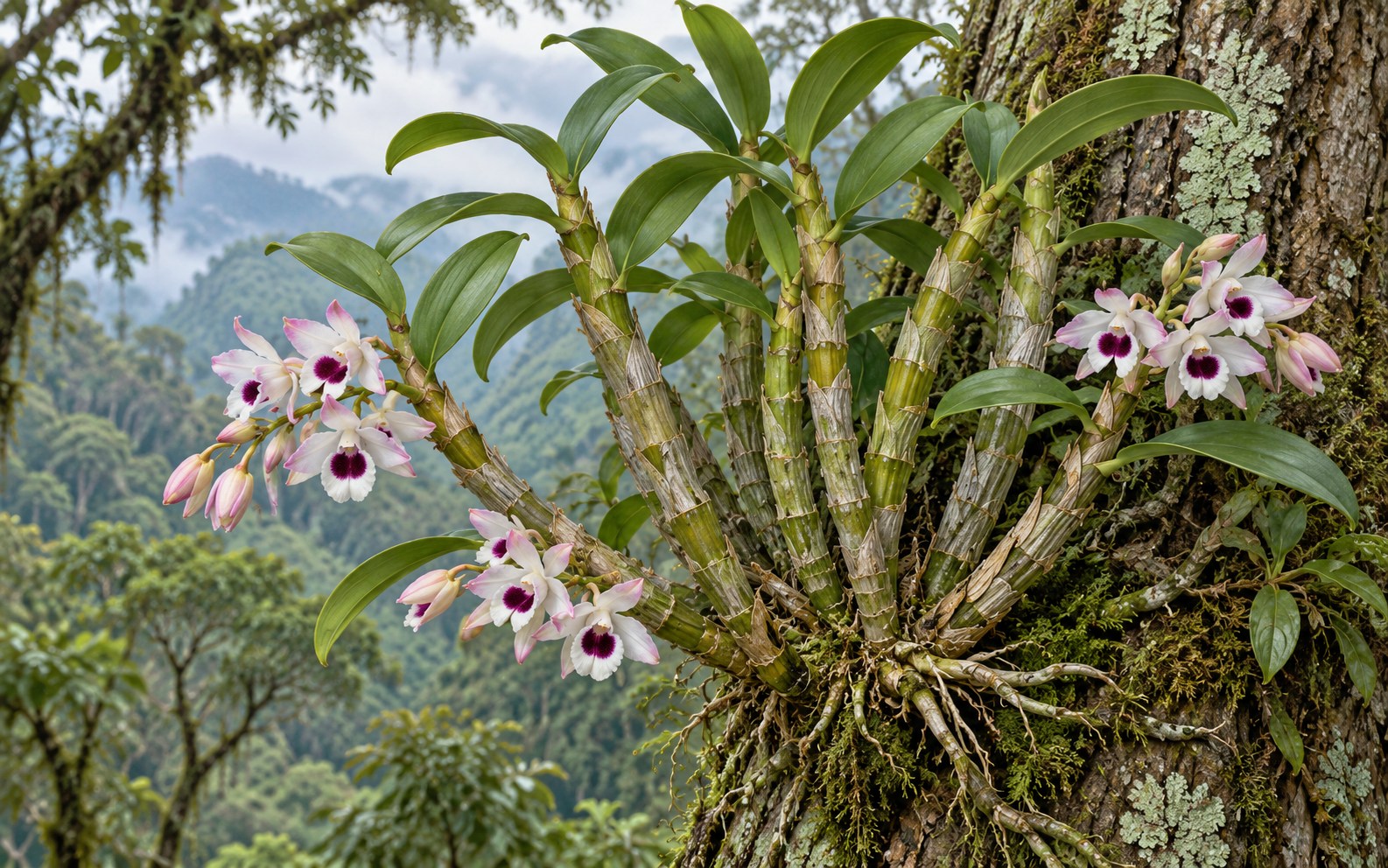
Living plant and morphology · AI study illustration
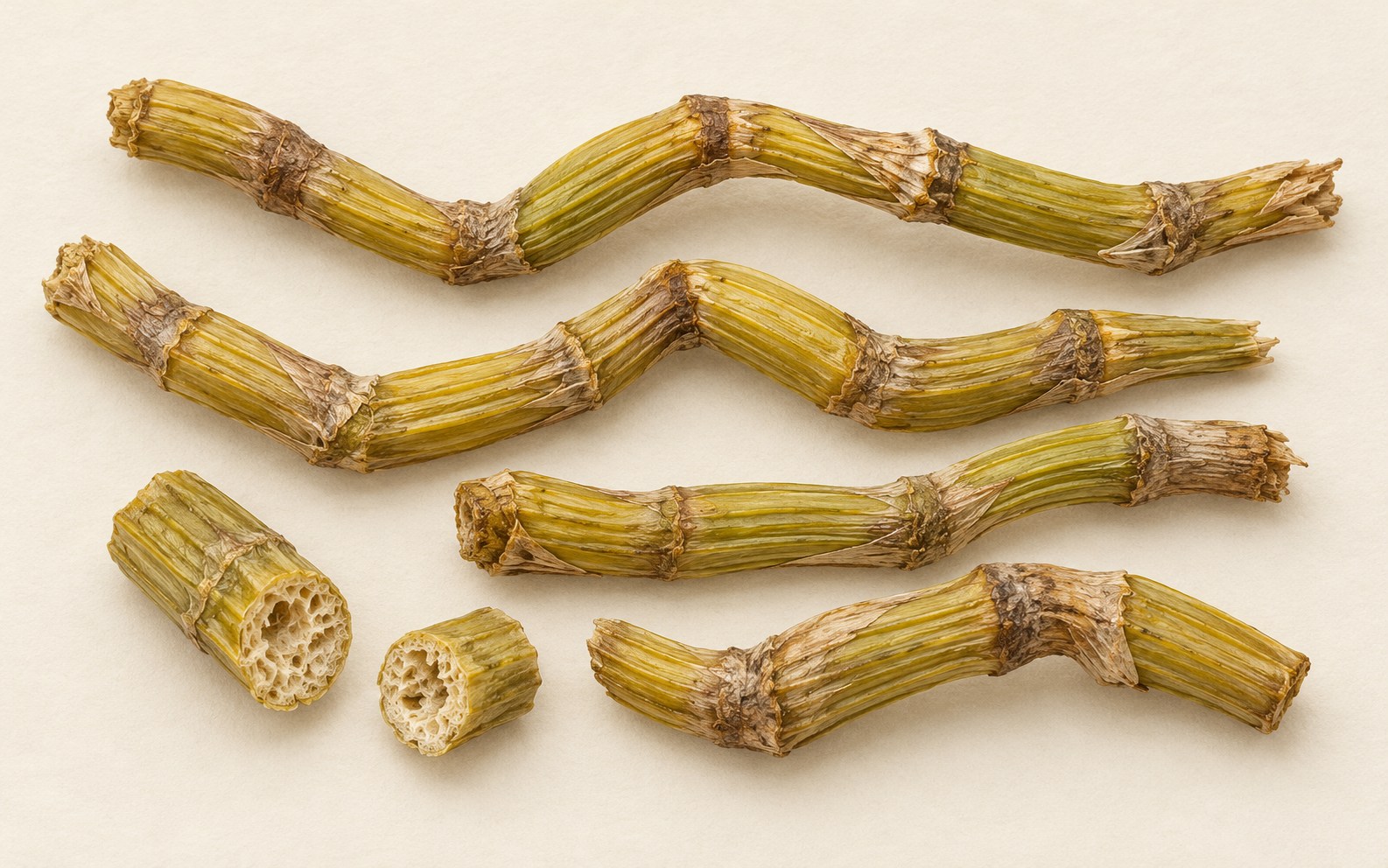
Dried-drug features for identification study
Kew accepts Dendrobium nobile Lindl. in the orchid family (Orchidaceae). It is a pseudobulbous epiphyte or lithophyte, native from Nepal to southern China and Indochina. Shihu (石斛) is the Chinese materia-medica name, while Jin Chai Shihu (金釵石斛) is a Chinese name associated with this species. The English common name is noble dendrobium.
Traditional context
Dried stem form in the HKBU record · AI illustration
Illustrated epiphytic habit · AI
HKBU describes a perennial epiphyte with clustered, erect, yellow-green stems bearing many nodes; pseudobulbs may reach about 60 cm. Flower clusters arise from nodes on older canes, usually with one to four drooping flowers. HKBU describes white flowers and bracts that may have purple-red tips; RHS and Kew also describe white or pale pink flowers with a purple-red lip. Cultivars vary, so a single flower colour is not enough to authenticate a specimen.
Materia medica form discussed in this paragraph
In traditional Chinese materia medica, the stem is used under the name Shihu. HKBU records a sweet, cold nature and traditional actions described as generating fluids, nourishing the stomach, nourishing yin, and clearing heat. The source discusses fresh and dried Shihu in different traditional contexts; these are traditional-system descriptions, not clinical-trial proof that the plant treats dry mouth, fever, cough, or stomach disease.
Materia medica form discussed in this paragraph
HKBU also records a harvest and processing note for its D. nobile entry: cultivated plants may be harvested after about two to three years, and collection may occur throughout the year depending on whether fresh or dried material is wanted. This is an agronomic record, not a guarantee of yield, quality, or suitable harvest age in every region or production system.
Modern evidence
Illustrates the material, not research findings
Materia medica form discussed in this paragraph
Evidence should be separated into three layers. First, botanical records establish the name, morphology, and distribution. Second, the CITES data below document reported international trade for this species name. Third, chemical or pharmacological studies may generate activity hypotheses; none of these layers substitutes for clinical trials.
Illustrated epiphytic habit · AI
Kew lists compounds isolated from stems or leaves and reports activities in cell experiments. In-vitro findings do not establish a safe dose or health benefit in people. A 2021 clinical-study protocol describes an exploratory, single-arm, non-randomized study planned for 30 participants over eight weeks; it is a protocol, not a report of trial results. It must not be cited as proof that D. nobile treats metabolic syndrome.
Materia medica form discussed in this paragraph
The U.S. Operation Supplement Safety resource says evidence for Dendrobium in performance supplements is limited and product contents may be difficult to control. Research on the genus or on a different extract should not be treated as evidence for the exact D. nobile stem material.
Safety
Image does not depict toxicity or dose
Materia medica form discussed in this paragraph
D. nobile contains alkaloids, including dendrobine described in research sources. The U.S. Uniformed Services University’s OPSS resource warns that sufficiently high dendrobine exposure can slow breathing and heart rate and cause an unsafe drop in blood pressure. This is not a self-use threshold and does not establish the toxicity of a standardized Shihu specimen. Proprietary supplement blends may not disclose active-ingredient amounts and may contain undeclared ingredients.
Materia medica form discussed in this paragraph
Do not use an ornamental plant, wild-collected orchid, or product with an unverified identity. Safety cannot be inferred from an image, the trade name Shihu, cultivated status, or a CITES source code. People taking medicines, people with medical conditions, pregnant or breastfeeding people, and children should consult a qualified clinician or pharmacist before considering a preparation. This page does not give an ingestion dose or home-preparation instructions.
Materia medica form discussed in this paragraph
The sources reviewed did not confirm a specific herb pairing that is toxic with the exact D. nobile stem material. That absence does not prove every combination is safe; evidence is insufficient for an interaction table or general safe ratio for this species.
Study morphology and confirm against botanical references
Living-plant features for identification study
The pseudobulbous canes grow in clumps with distinct nodes. Lance-shaped leaves grow along the stems and may fall as canes age. Flowers usually arise from nodes on mature canes, with one to four drooping flowers per cluster; they are white or pale pink, commonly with a purple-red lip. Dried medicinal material consists of jointed stems, slightly flattened and zigzag-shaped, with longitudinal grooves and a yellow-green to yellow-brown colour; nodes are often darker and leaf sheaths may remain. These are study features from HKBU/Kew, not enough to authenticate a real specimen without expert examination.
Growth and habitat
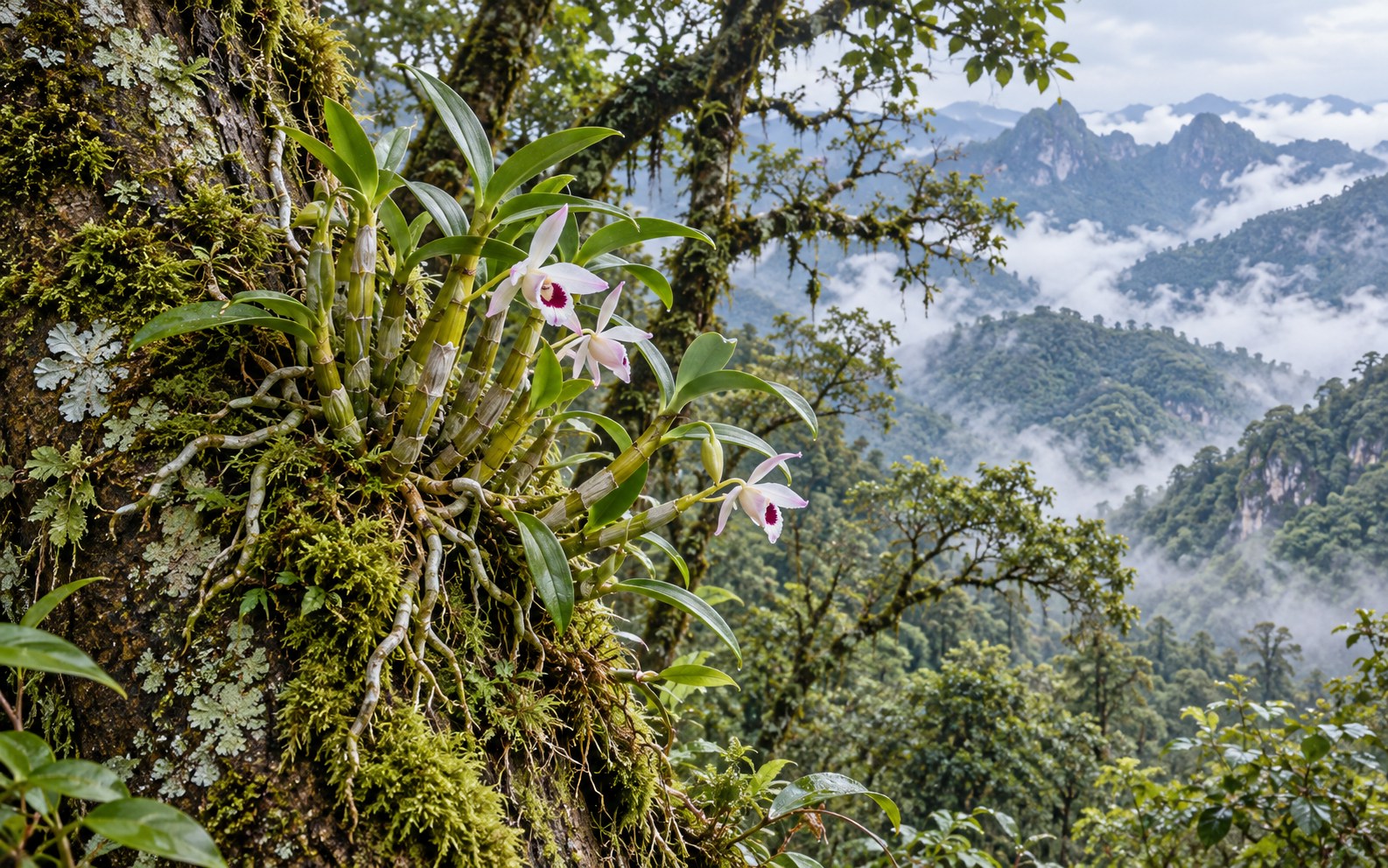
Illustrated epiphytic habit · AI
Illustrated epiphytic habit · AI
Kew gives the native range as Nepal to southern China and Indochina; the species occurs in deciduous forests of Himalayan foothills and nearby regions, commonly around 1,500–2,000 m. It grows as an epiphyte on trees or lithophyte on rocks. HKBU also records trees in thin forests and ravine rocks at roughly 480–1,700 m. The differing elevations reflect source ranges, not a single absolute ecological limit.
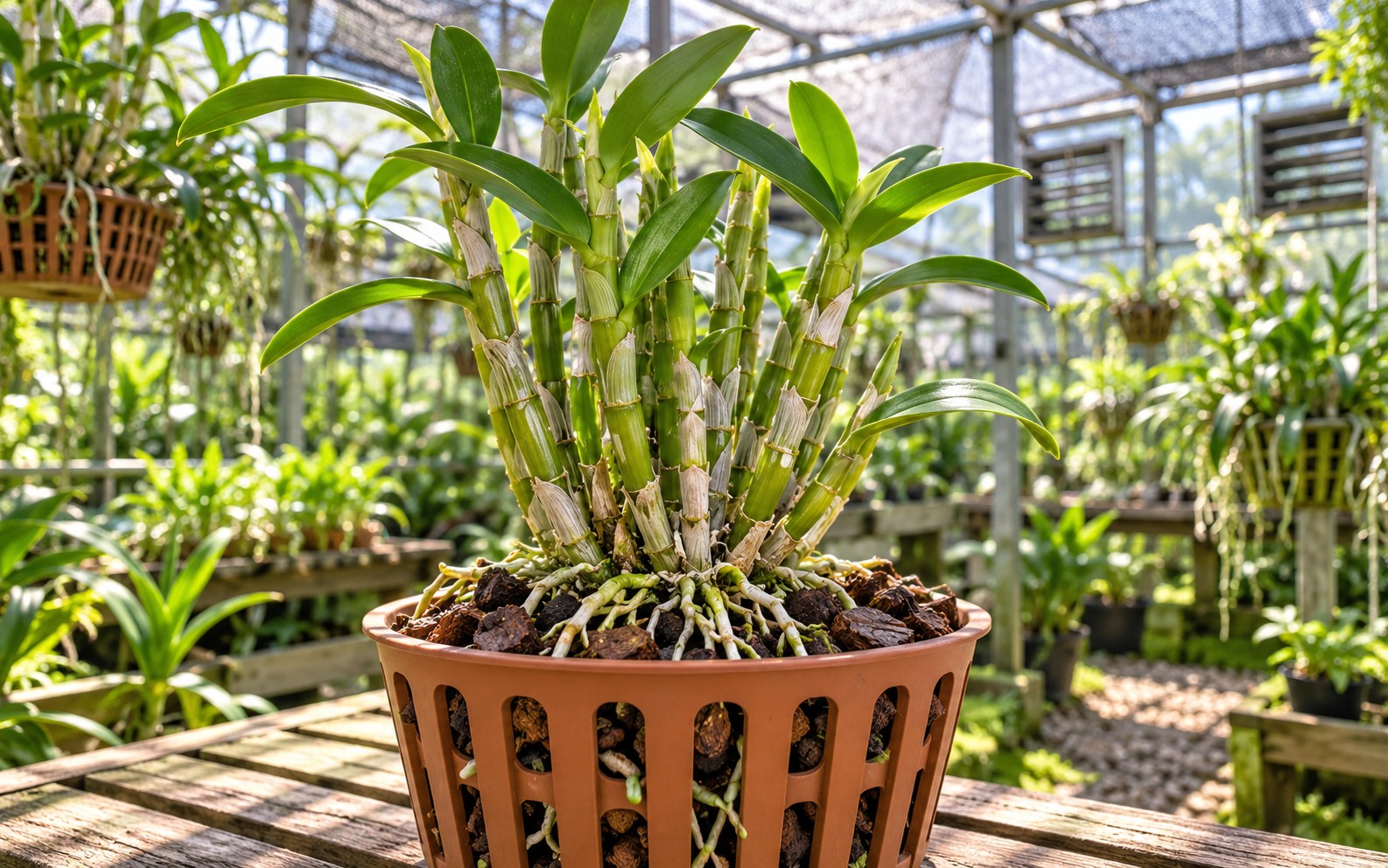
Ornamental care illustration · not a medicinal-production protocol
Illustrated epiphytic habit · AIStart with a lawfully nursery-propagated plant labeled Dendrobium nobile Lindl.; retain its label and purchase record. Dendrobium is covered by CITES Appendix II, so check current paperwork before cross-border movement. Do not collect wild orchids.
Illustrated epiphytic habit · AIUse a small orchid pot or basket with ample drainage and an airy epiphytic mix such as bark, pumice, and charcoal as described by Kew. Roots need airflow; do not use compact garden soil. Repot when the medium deteriorates or the plant outgrows its space.
Illustrated epiphytic habit · AIPlace it in bright light with summer protection from harsh direct sun and provide ventilation. RHS recommends partial shade and shelter; Kew advises brighter winter light. Adjust to local climate and avoid leaf scorch or freezing.
Illustrated epiphytic habit · AIWhile new canes and roots are growing, water enough to moisten the medium, then let it drain fully; do not leave roots standing in water. Kew describes keeping plants damp during growth and drier during winter dormancy. Avoid a fixed watering schedule when temperature, light, and drying rates vary.
Ornamental care illustration · not a medicinal-production protocolRHS describes partial shade and good ventilation from late spring through summer, with daytime temperatures around 18–25°C, nights above 10°C, and higher humidity. As growth slows in winter, Kew and RHS advise reducing water and feed to support the flowering cycle. This is ornamental orchid care, not a commercial medicinal-crop protocol.
Ornamental care illustration · not a medicinal-production protocolPropagate by division when the clump fills its pot, retaining several healthy canes and roots per division. RHS lists about 2–5 years to horticultural maturity. HKBU records harvesting cultivated stems after about 2–3 years in its medicinal-material entry. These are different milestones; neither guarantees that a home-grown plant is medicinally suitable or safe to ingest.
Illustrated epiphytic habit · AIWatch for aphids, mealybugs, and red spider mites; isolate new plants and inspect leaf sheaths, leaf undersides, and cane bases. Remove clearly damaged tissue with clean tools. Do not harvest stems for medicine merely because an ornamental plant has matured; identity standards and testing are separate requirements.
Ornamental care illustration · not a medicinal-production protocol
How long until harvest? HKBU records cultivated stem harvest after about 2–3 years; RHS lists 2–5 years to horticultural maturity. These are agronomic/gardening milestones, not proof that a home-grown plant meets medicinal standards or directions for self-use.
Ornamental care illustration · not a medicinal-production protocol
Ornamental care illustration · not a medicinal-production protocol
HKBU records habitat on trees in thin forests or ravine rocks and distribution across parts of China, India, the Himalaya, and Indochina. Its record lists flowering around April–May. RHS reports winter-to-spring flowering under UK cultivation; timing varies with climate and cultivar.
From plant to dried material · source-recorded workflow
Illustrated epiphytic habit · AIHKBU records that cultivated stems may be harvested after about two to three years; actual timing depends on plant health and growing region. Medicinal-material harvest should follow appropriate facility procedures and identity records; do not collect wild plants.
Dried materia medica after processingFor fresh stems, the source says to remove fibrous roots and impurities while fresh. Keep lots separate by authenticated species and record the cultivated source; Shihu can refer to several Dendrobium species.
Illustration of the processing step describedFor dried material, HKBU describes removing roots, washing, and rubbing away leaf sheaths. This is a source-recorded process, not a direction for home preparation or ingestion.
Illustration of the processing step describedThe source records sun-drying or heated drying; another method is to briefly scald washed Shihu before drying. A producer must control heat, moisture, identity, foreign matter, and applicable quality specifications.
Illustrated epiphytic habit · AIOnce dried, separate lots and record scientific name, cultivated source, harvest date, and processing date; store protected from moisture and mould. Colour and form in AI art cannot authenticate a real specimen or establish quality.
Illustration of the processing step described
This record supports study and processing traceability; it is not a home preparation or self-use guide.