Dendrobium officinale Kimura & Migo · Stem; pharmacopoeial material is the dried stem
Materia medica properties in reference
Chemical research alone does not establish clinical efficacy
Properties as recorded in the source: Kew POWO accepts Dendrobium officinale Kimura & Migo in Orchidaceae. The Chinese Pharmacopoeia identifies Tiepi Shihu as the dried stem of this exact species; the broad market name “Dendrobium” can refer to other species, so the scientific name matters. Dendrobium catenatum Lindl. appears among rejected synonyms in POWO’s current treatment. Older sources and product labels may use different names; products sharing a common name should not automatically be combined into one species record.
Chemical reviews analyze polysaccharides, bibenzyls, phenanthrenes, flavonoids, and other compound groups. Sample composition varies with cultivar, region, plant part, age, harvest season, and processing. Results for an extract do not represent fresh stems, ornamental plants, unidentified dried goods, or every product labeled Dendrobium.
Traditional Chinese materia-medica theory often describes this drug as sweet, slightly cold, and associated with the stomach and kidney channels; traditional functions include nourishing yin, benefiting the stomach, generating fluids, and clearing heat. These are concepts within a traditional system, not modern clinical findings or self-treatment directions. The pharmacopoeia defines the material as the dried stem and describes its product forms. This profile does not infer a personal dose, turn traditional properties into a cure claim, or assume every market product has identical quality.
Chemical research alone does not establish clinical efficacy
Multi-ingredient products labeled Dendrobium exist, but reviewed sources for exact Dendrobium officinale did not establish a formula with species, purpose, ingredient amounts, and ratios suitable for reproduction as instructions. Formulas for Dendrobium nobile, other Dendrobium species, or supplements are not evidence for this exact species.
CITES international-trade evidence
Chemical research alone does not establish clinical efficacy
The 2026.1 CITES Trade Database contains 9 comparative-tabulation rows for Dendrobium officinale during 2016, 2017, 2018, 2020, 2023, 2024. The query selected reported purpose T (Commercial) and trade term MED (medicine); appendices appearing in these rows: II. Reported importer codes include AU, CA, MO, SG, TH, US; exporter codes include CN, FR, HK. These are comparative-tabulation rows, not shipment counts or summed volume. This record does not establish clinical efficacy, the legality of an individual transaction, or safety of use.
Tiepi Shihu is a perennial epiphytic orchid. Its Chinese materia-medica name is Tiepi Shihu, commonly romanized as Tie Pi Shi Hu. Kew accepts Dendrobium officinale Kimura & Migo; POWO lists Dendrobium catenatum Lindl. among rejected synonyms under its current treatment. When consulting older material, compare scientific name, plant part, and source instead of relying only on “Dendrobium.”
Identification traits · AI illustration
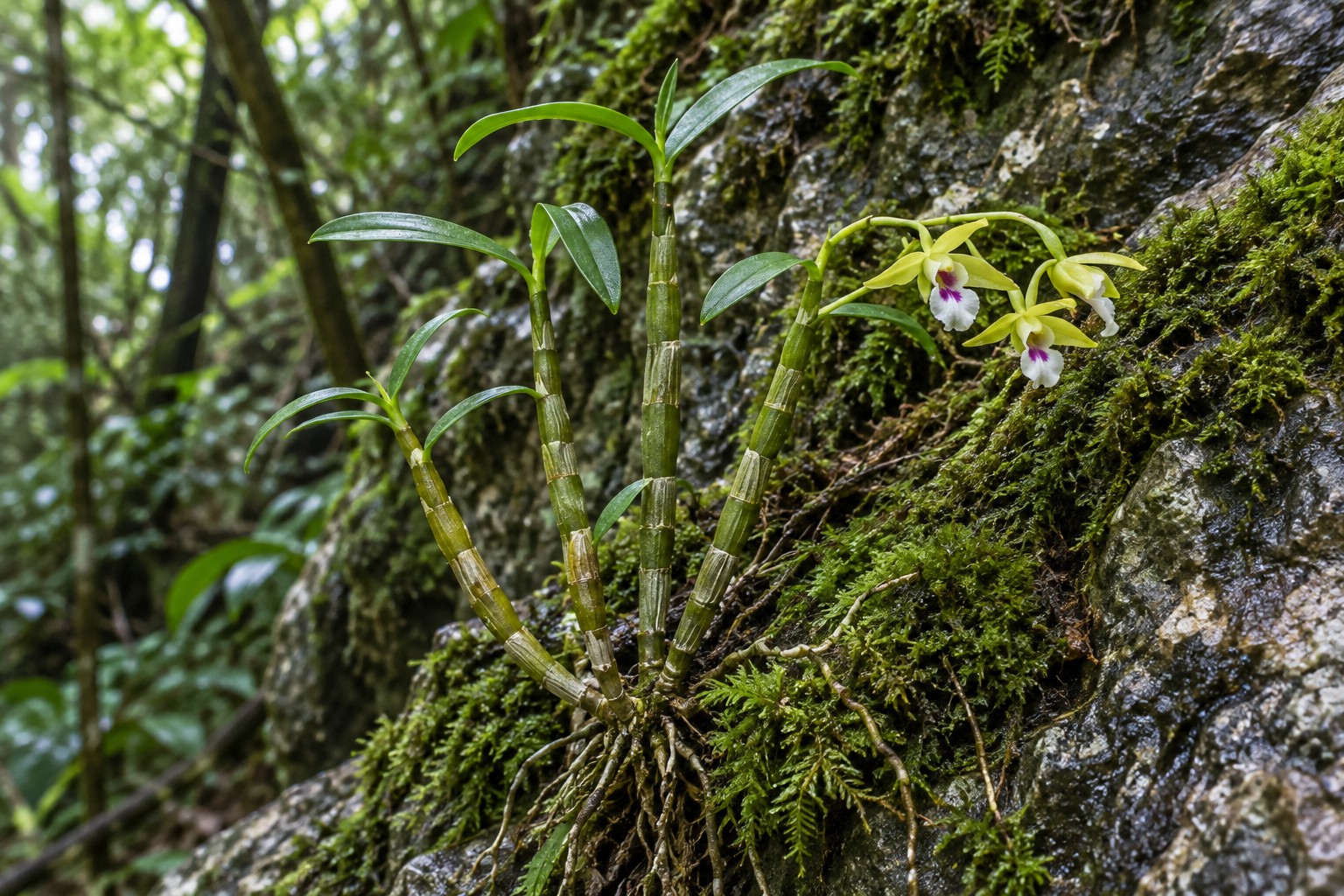
The plant forms slender
Identification traits · AI illustration
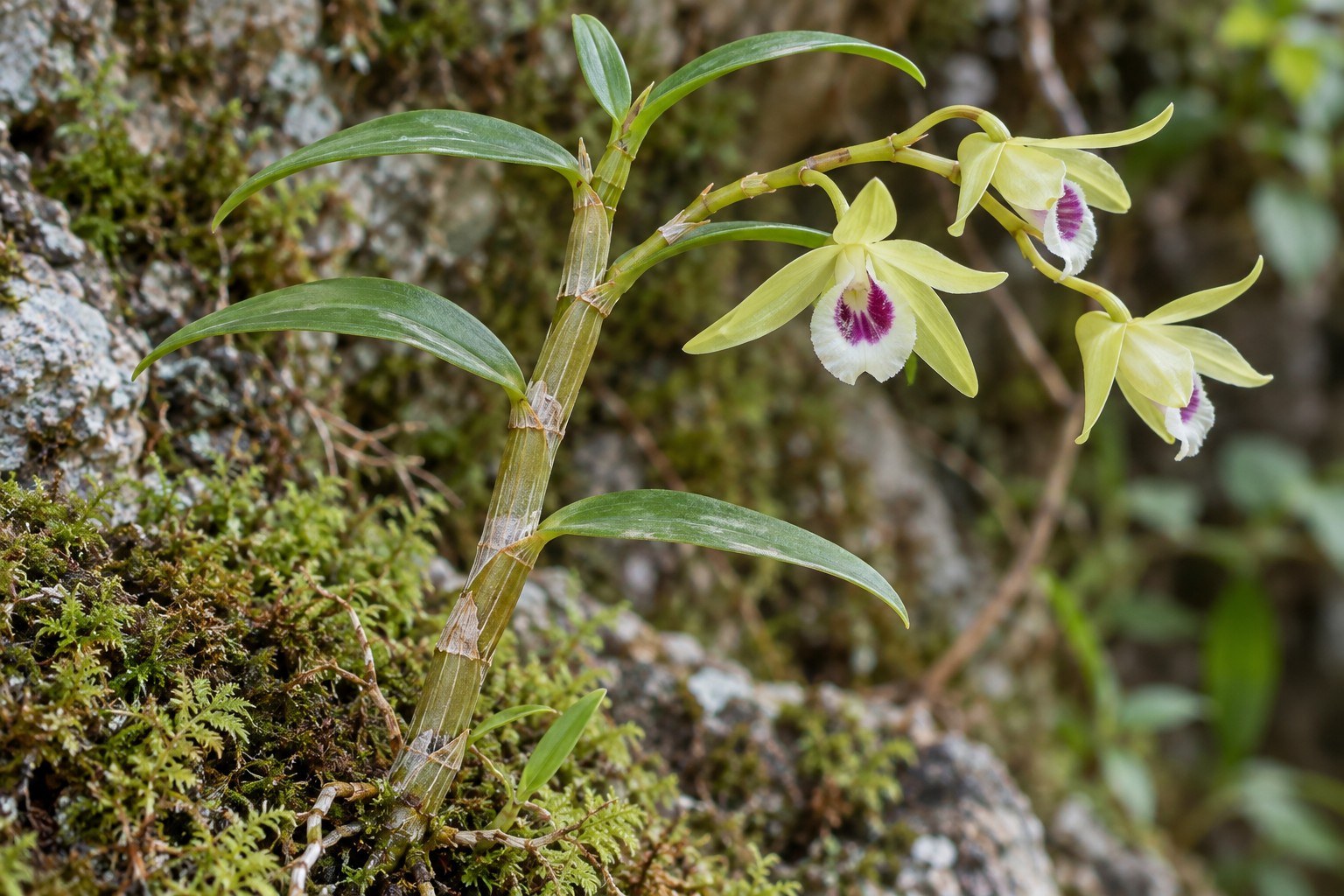
green pseudobulbous canes, upright or slightly arching, with conspicuous nodes. Narrow lance-shaped leaves usually cluster toward the upper portion; leaf sheaths may bear purple spots. Short inflorescences typically carry a few yellow-green flowers, with a white lip bearing a central purple-red blotch as a useful feature. China’s protected-plant database describes it as an epiphyte on moist, partly shaded mountain rocks, records it around 1,600 m, and gives a March–June flowering period. Cultivated plants can vary with age and growing conditions.
Identification traits · AI illustration
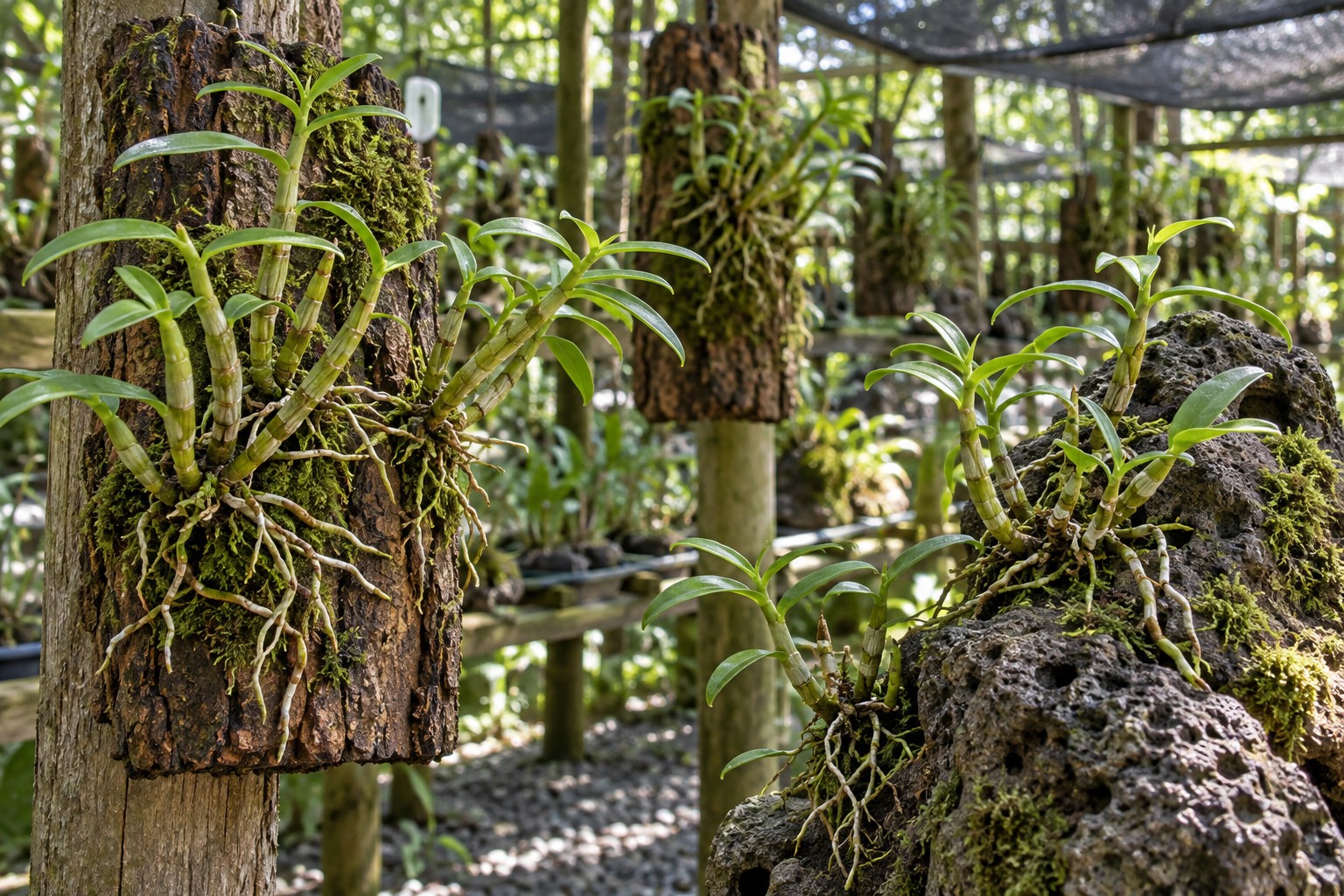
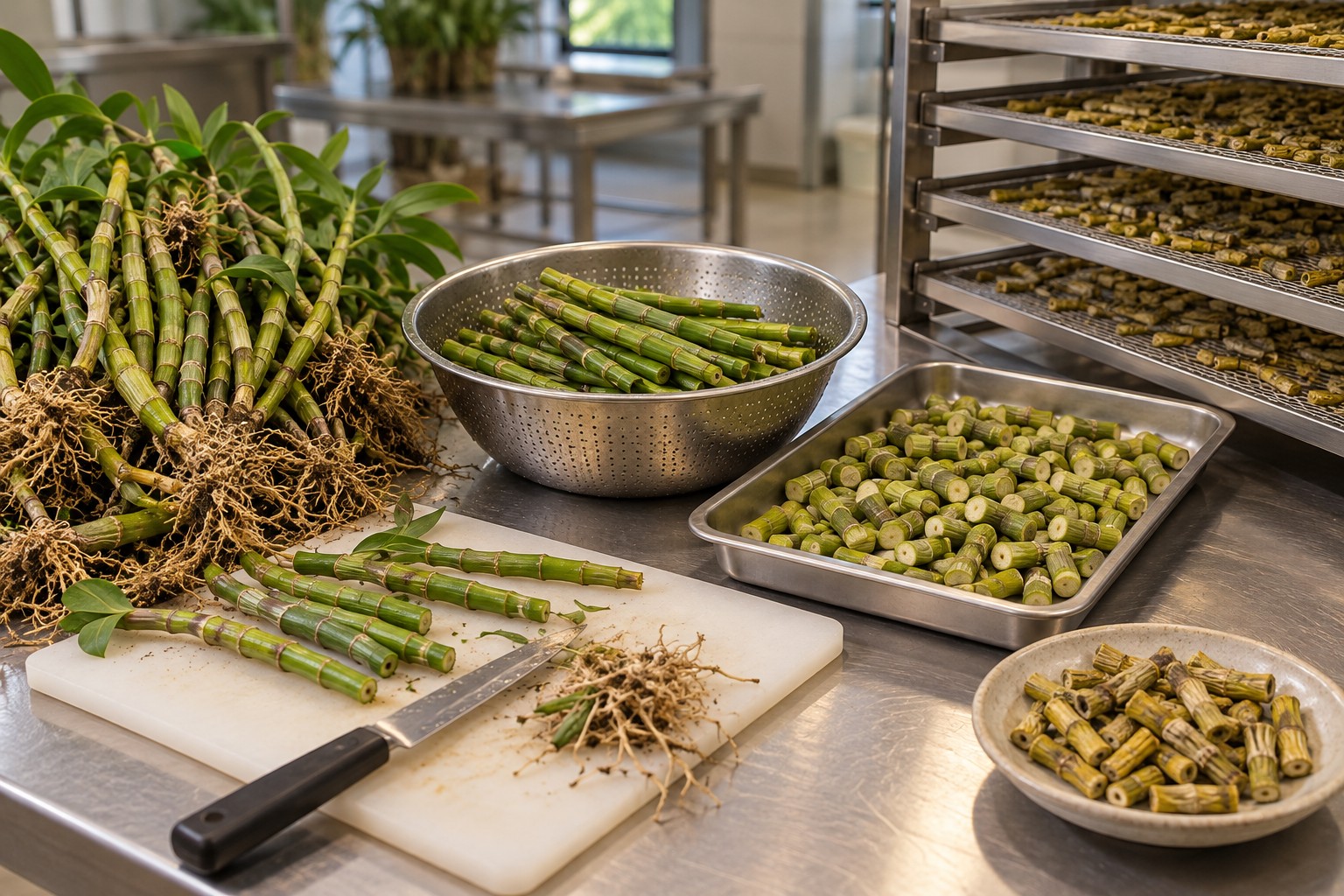
The profile contains separate AI illustrations of the living plant, dried stems, close-up traits, habitat, epiphytic cultivation, and reference processing. These images are for study, not voucher-backed specimen photos; do not use them to identify wild plants, decide whether to harvest, or distinguish cultivars.
Traditional context
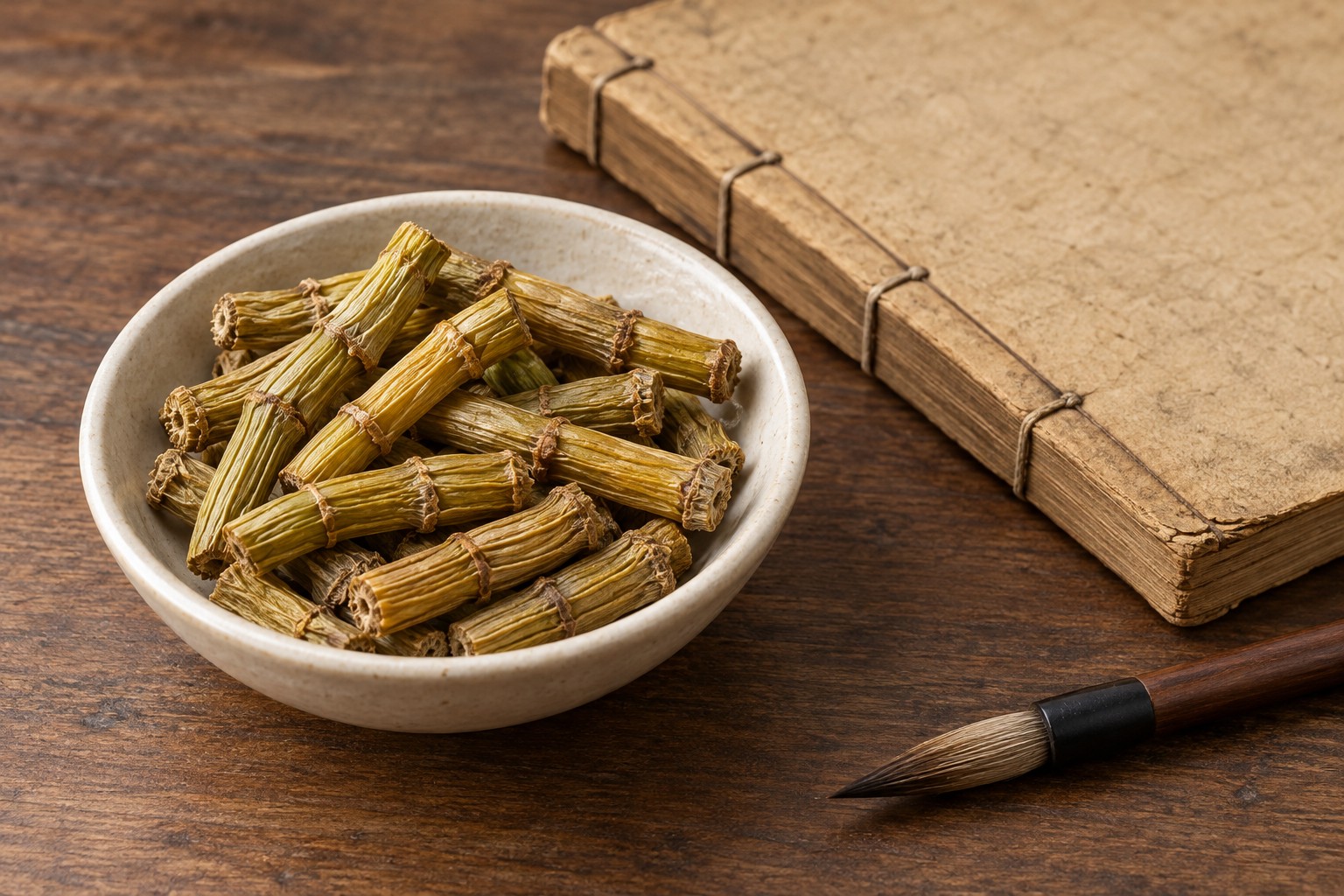
Study context · AI image, not a historical artifact
Chemical research alone does not establish clinical efficacy
The pharmacopoeia uses Tiepi Shihu for the stem of Dendrobium officinale. A medical review recounts Dendrobium’s history in Chinese medicine and quotes classical descriptions such as nourishing yin, benefiting the stomach, and generating fluids. These passages describe
Chemical research alone does not establish clinical efficacy
historical thought and traditional classification; they do not establish that the stem treats dry mouth, diabetes, stomach or eye disorders, or chronic disease.
Chemical research alone does not establish clinical efficacy
Modern markets include fresh stems, dried sections, curled stems, and food ingredients, sometimes under related names. These forms differ in plant part, specification, cultivation origin, and quality. In 2024, China’s health authority announced cultured protocorms from Dendrobium officinale or D. huoshanense as a novel food ingredient under specific conditions. That notice concerns cultured protocorms; it should not be generalized into approval of every plant part, preparation, or treatment claim for Tiepi Shihu stems.
Chemical research alone does not establish clinical efficacy
When reading traditional material, distinguish historical description, pharmacopoeial standard, and research hypothesis. Do not turn a drug name into an individual prescription; this section supports study of context, not self-administration.
Modern evidence
Chemical research alone does not establish clinical efficacy
Chemical research alone does not establish clinical efficacy
The project’s CITES Trade Database 2026.1 extract contains nine comparative-tabulation rows for Dendrobium officinale, term MED (medicine), purpose T (commercial), in 2016, 2017, 2018, 2020, 2023, and 2024. CITES describes the database as official annual reports submitted by Parties. These rows are not nine independent shipments, total production, revenue, or all international trade. Quantities in different units or reported by exporters and importers must not be combined into an unsupported total. A transaction record does not prove efficacy or present-day legality of a particular product.
Chemical research alone does not establish clinical efficacy
Modern research studies
Chemical research alone does not establish clinical efficacy
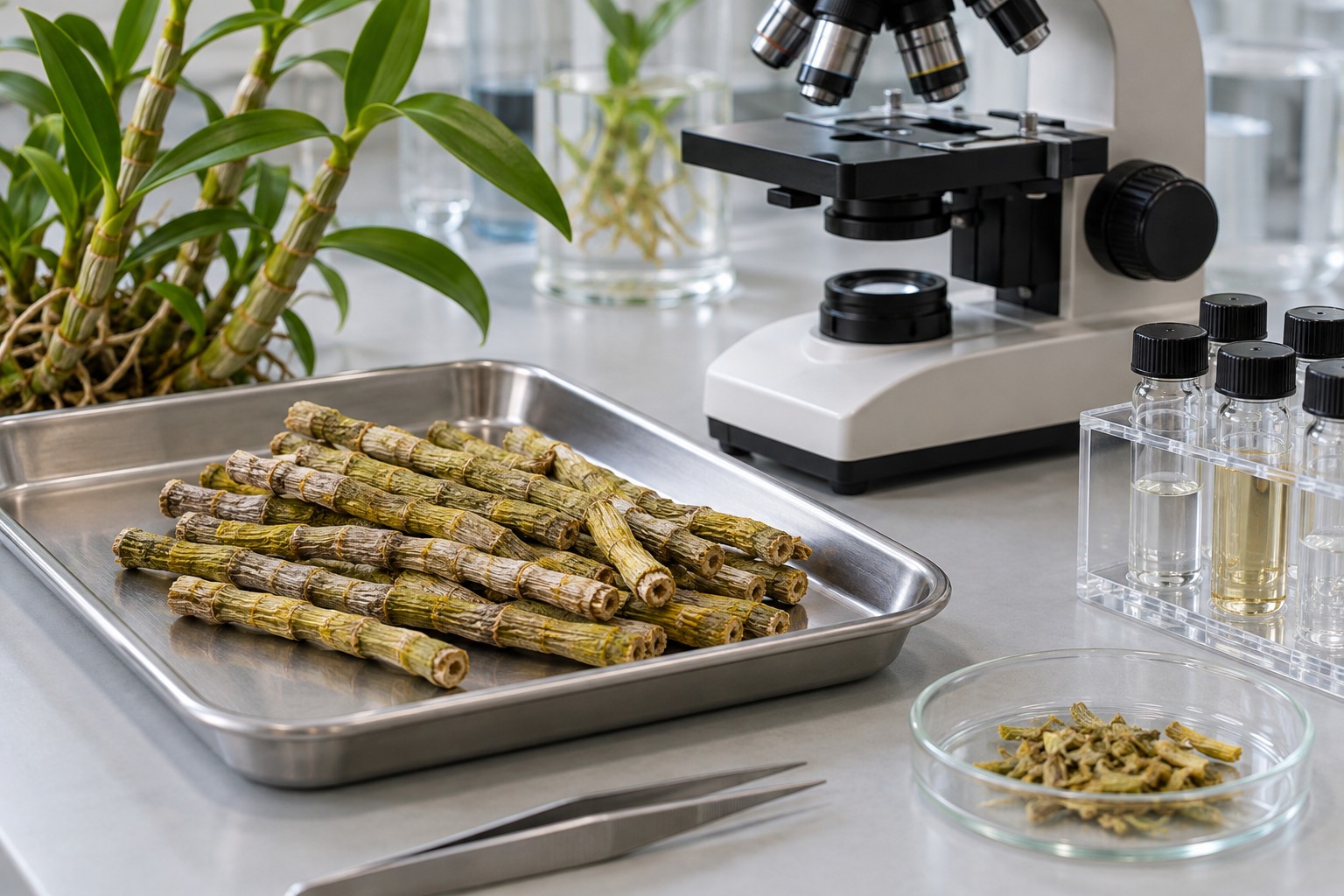
polysaccharides, chemical markers, extracts, and activity in vitro or in animal models. An industry review notes that human clinical data remain limited and better studies are needed to assess efficacy, safety, and dose. Mechanistic, cellular, or animal results therefore are not treatment advice. Studies may use different samples, parts, cultivars, processes, and standards; a laboratory extract does not represent a home-grown plant or untested material.
Chemical research alone does not establish clinical efficacy
A trade count describes only records reported within a particular query. It does not show how many people used a product, how many retail products were sold, active-compound concentration, or health benefit. The page separates trade evidence from traditional-use history so commodity movement is not mistaken for clinical proof.
Safety
Chemical research alone does not establish clinical efficacy
CITES records trade in the species within the Convention framework; orchid requirements depend on current appendices and annotations, specimen origin, product form, and route. China’s protected-plant database lists Tiepi Shihu as Category II protected in China. This is jurisdiction-specific
Chemical research alone does not establish clinical efficacy
and does not replace checking Vietnamese or other national rules. Do not collect wild plants for identification or commercial supply.
Chemical research alone does not establish clinical efficacy
Health Canada lists Dendrobium officinale in its approved herbal-name database and records fresh or dried source material. An ingredient listing is not authorization for every product, proof of efficacy, or a recommendation to use it. People taking medicines, pregnant or breastfeeding, living with a health condition, or with allergy history should consult a qualified professional about the exact product and ingredients.
Chemical research alone does not establish clinical efficacy
Supply-chain risks include species substitution, mixing stems from several Dendrobium species, missing traceability, pesticide residues, mold from poor storage, and labels that misstate processing form. AI images do not authenticate plants or certify product quality. Prefer suppliers documenting scientific identity, plant part, cultivation source, testing, and trade papers; do not infer safety because a product is labeled an herb or food.
Chemical research alone does not establish clinical efficacy
No formula is included because reviewed primary sources did not establish the exact species, purpose, ingredient amounts, and ratio together. A multi-ingredient product does not prove
Chemical research alone does not establish clinical efficacy
benefit for a disease, and a study of a mixture cannot isolate Tiepi Shihu’s effect.
Chemical research alone does not establish clinical efficacy
The reviewed sources do not name a specific herb that becomes poisonous when combined with Dendrobium officinale. This profile therefore does not label another plant a toxic partner, invent ratios, or infer incompatibility from the broad genus name Dendrobium. This does not prove every combination safe: risk may depend on product, dose, health conditions, and medicines used.
Chemical research alone does not establish clinical efficacy
Any formula added later should preserve source, scientific name and synonym, plant part, units, context, and cautions. Ingredient images should only be added after verification. There is no “toxic pair” image because no reliable specific pair was found; a composite would falsely imply a proven interaction.
Identification and study notes
Identification traits · AI illustration
When examining a living plant, look for stem nodes, sheathing leaf bases, narrow upper leaves, and short inflorescences with few flowers. Flowers may be absent outside the season or on young plants; their absence alone does not rule out the species. Cane color changes with age, light, and plant health. Reliable identification may require provenance, a botanist, and microscopic or molecular traits; the close-up image is AI-generated and not a voucher specimen.
Identification traits · AI illustration
The pharmacopoeia describes
Identification traits · AI illustration
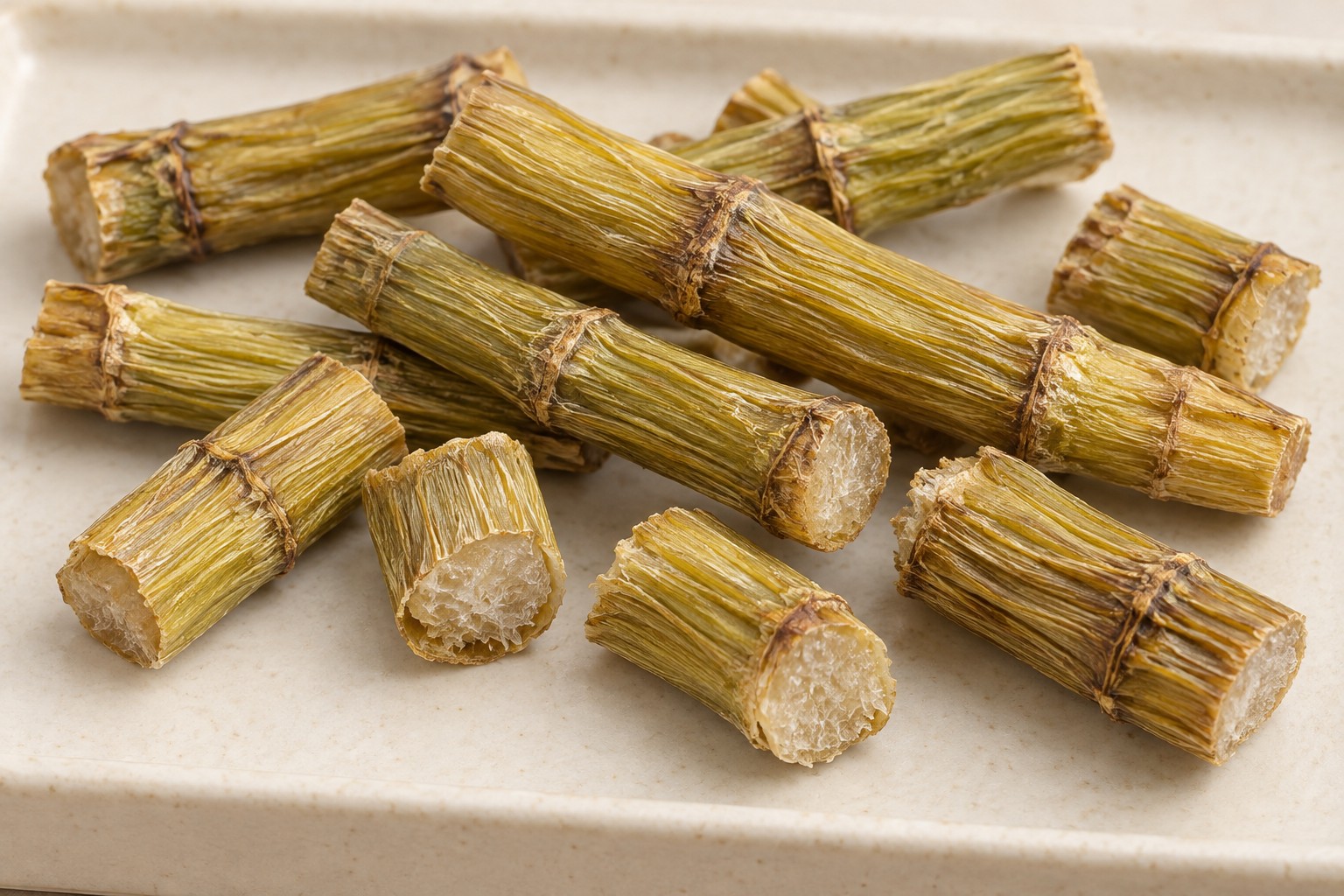
dried curled stems as usually having 2–6 coils, a yellow-green or slightly golden surface, longitudinal wrinkles, distinct nodes, and a grey-white to grey-green cut face. A short remnant of adventitious roots may remain. Another form is cut into sections and dried. Sensory traits support study but cannot confirm species, purity, or pharmacopoeial quality without testing and traceability.
Identification traits · AI illustration
“Tiepi Fengdou” commonly describes stems twisted into coils or springs; it is a product form, not a separate species name. Distinguish the living plant, fresh stems, dried cut sections, curled stems, and extracts. Each has separate specifications and should not be treated as interchangeable in notes or trade data.
Growth and habitat
Moist, partly shaded habitat · AI illustration
Epiphytic cultivation illustration · not a fixed care schedule
Kew records a native range from southern China to northern Vietnam, southern Japan, and east-central Taiwan, primarily in the subtropical biome. China’s protected-plant database describes it as an epiphyte on moist, partly shaded mountain rocks, records it around 1,600 m, and gives a March–June flowering season. It attaches to a surface rather than growing as a tuberous plant buried in soil. In the forest, moss, humid air, and canopy shade contribute to its microhabitat.
Cultivation descriptions
include an airy mounting substrate that retains some moisture but drains quickly, filtered light, and good airflow. Reviews record greenhouse and semi-wild approaches using rock, wood, or host trees. Humidity, light, temperature, germplasm, and substrate affect growth and sample composition. Do not copy subtropical cultivation unchanged to a hot, dry balcony, air-conditioned room, or location with prolonged rain; adapt to the plant and local microclimate.
Epiphytic cultivation illustration · not a fixed care schedule
Moist, partly shaded habitat · AI illustrationBuy nursery stock with scientific identity, invoice, and documented source; do not collect wild plants. Check CITES and conservation rules before transporting live orchids or dried stems.
Moist, partly shaded habitat · AI illustrationMount on an orchid basket, suitable bark slab, or porous rock; if potting, use a coarse, free-draining orchid medium. Do not pack roots into dense garden soil.
Moist, partly shaded habitat · AI illustrationProvide bright filtered light, partial shade, and airflow. Moisten roots and let water drain; avoid standing water around cane bases, leaf axils, or new growth.
Epiphytic cultivation illustration · not a fixed care scheduleMonitor roots, new nodes, leaves, rot, fungi, and pests. Record repotting date, plant source, and care. Do not apply pesticides without knowing the active ingredient and withholding period.
Moist, partly shaded habitat · AI illustrationStem cuttings and tissue-cultured plantlets are used in production. For an ornamental plant, follow a specialist grower’s guidance; do not copy research hormone concentrations at home.
Epiphytic cultivation illustration · not a fixed care schedule
How long until harvest? The pharmacopoeial source gives a stem-harvest season from November through March but no universal cultivation age. Timing depends on cultivar, location, production method, and standards. A qualified producer determines whether a lot meets specification; do not harvest young or wild plants.
Epiphytic cultivation illustration · not a fixed care schedule
From plant to dried material · source-recorded workflow
Reference workflow based on pharmacopoeia · AI imageRecord Dendrobium officinale Kimura & Migo, plant part, cultivation source, supplier, and required documents. Do not mix other Dendrobium species into one lot.
Moist, partly shaded habitat · AI illustrationThe pharmacopoeial description gives a November–March harvest season in production areas, followed by impurity removal and trimming some adventitious roots. This is a standard description, not encouragement to forage.
Reference workflow based on pharmacopoeia · AI imageOne form is cut into sections and dried or dried at low temperature. Another is twisted into coils while heated and then dried; the source describes these forms separately.
Reference workflow based on pharmacopoeia · AI imageThe pharmacopoeia describes dried curled stems as usually having 2–6 coils, distinct nodes, longitudinal wrinkles, and a grey-white to grey-green cut face. Appearance alone does not replace identification and testing.
Reference workflow based on pharmacopoeia · AI imageProduction facilities should control identity, impurities, moisture, residues, and storage under applicable standards. Do not prepare material at home for ingestion or infer a dose from processing.
Reference workflow based on pharmacopoeia · AI image
This record supports study and processing traceability; it is not a home preparation or self-use guide.