Lignum vitae · Guaiacum sanctum · Lignum Vitae · Guaiac Resin
Guaiacum sanctum L. · Heartwood and stem resin are recorded as materia-medica materials; these are distinct products. Do not treat them as interchangeable with Guaiacum officinale or unidentified lignum-vitae wood.
Materia medica properties in reference
Materia medica form discussed in this paragraph
Properties as recorded in the source: The sources reviewed do not provide a standardized Chinese materia-medica monograph for G. sanctum; no taste, channels, or therapeutic action is assigned. Canada and JECFA record guaiac resin in a non-medicinal additive context.
No sourced formula and applicable ratio for G. sanctum was verified; no self-use ratio is provided.
CITES international-trade evidence
Materia medica form discussed in this paragraph
The 2026.1 CITES Trade Database contains 7 comparative-tabulation rows for Guaiacum sanctum during 2016, 2018, 2019, 2022, 2023, 2024. The query selected reported purpose T (Commercial) and trade term MED (medicine); appendices appearing in these rows: II. Reported importer codes include AT, CA, CH; exporter codes include CH, DE, FR. These are comparative-tabulation rows, not shipment counts or summed volume. This record does not establish clinical efficacy, the legality of an individual transaction, or safety of use.
General morphology illustration, not a voucher specimen
Guaiacum sanctum L. is an evergreen tree in Zygophyllaceae and is accepted by Kew as a current species name. Its native range extends from southern Mexico through Central America, Florida, and the Caribbean islands. Kew places it in the tropical wet biome, while a Mexican forestry account also records dry forest and chaparral. These sources show that the species occurs across several regional habitat types; they should not be reduced to one universal climate formula.
General morphology illustration, not a voucher specimen
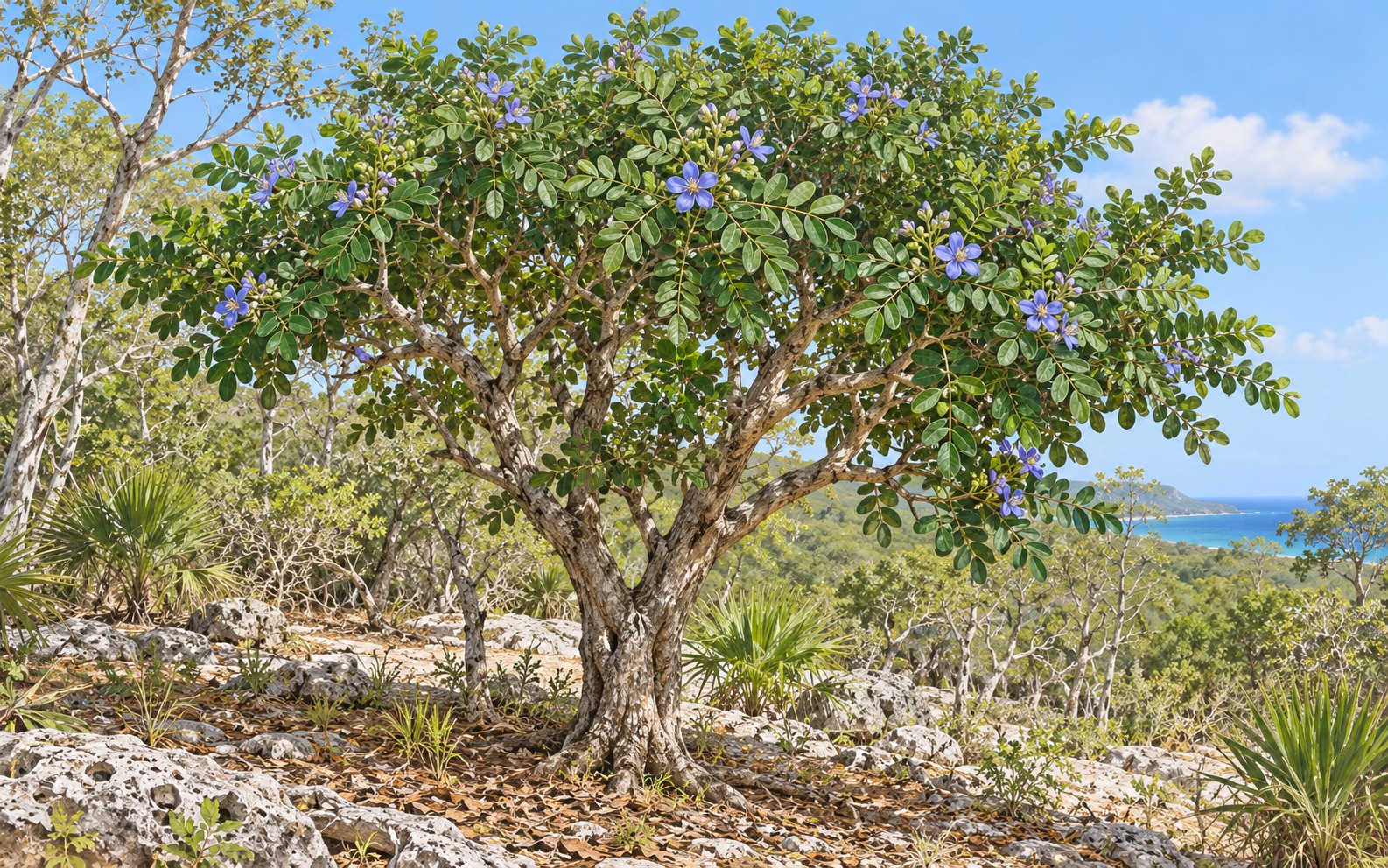
The tree has a rounded crown and is often multi-trunked. Its leaves are opposite or nearly opposite, even-pinnate, and usually carry about three to five pairs of small oval leaflets. Clusters of bluish-purple flowers stand out against dark green foliage; yellow-orange capsules can open to reveal dark seeds with red arils. The heartwood is very dense and heavy, olive-brown to dark brown; stem resin is a separate material. The page images are AI study illustrations based on these descriptions and cannot authenticate a plant or materia-medica lot.
Traditional context
Materia medica form discussed in this paragraph
Historical guaiacum records describe Caribbean Indigenous use of wood or resin, followed by the material’s introduction to Europe in the early sixteenth century, where it was promoted as a remedy for syphilis. An older CITES document describes centuries of international demand for heartwood and extracts and records other folk uses. This is a history of trade and reported use, not proof of treatment. Guaiacum is no longer considered a remedy for syphilis; do not self-use wood, resin, powder, or products labeled guaiac to treat disease.
Materia medica form discussed in this paragraph
The materia-medica name guaiacum does not always identify one species. Kew MPNS links the drug name “guaiac resin” to both G. sanctum and G. officinale, and a Canadian monograph identifies stem resin from either species as a source material for its regulated substance record. A label such as “guaiac,” “lignum vitae,” or “resin” therefore does not establish species, plant part, legal provenance, or product specification. This page assigns no Chinese-medicine taste, channels, actions, or classical formula because the sources reviewed do not provide a standardized Chinese materia-medica monograph specific to G. sanctum.
Modern evidence
Materia medica form discussed in this paragraph
The project’s CITES Trade Database 2026.1 extract contains seven comparative-tabulation rows under the exact name Guaiacum sanctum, filtered to purpose T (commercial) and term MED (medicine), in 2016, 2018, 2019, 2022, 2023, and 2024. The records report source code W. This supports the presence of the species name in international trade reporting under that query; it is not necessarily seven distinct shipments, a measure of total market volume, proof of end use, or confirmation that each transaction was lawful. A separate older CITES report says most Guaiacum trade at that time was timber, so the current MED term should remain distinct from other wood commodities.
Materia medica form discussed in this paragraph
Canada’s database records guaiac resin as a non-medicinal substance used as an antioxidant/preservative; the JECFA monograph defines resin from Guajacum officinale or G. sanctum wood and gives food-additive specifications. An acceptable daily intake in a food-additive assessment is not a medicinal dose and does not apply to raw resin or untested products. Available sources do not establish that wood, resin, tea, or home extracts treat disease. Historical use, trade records, botanical identification, and food-additive assessments are different evidence types and cannot replace clinical trials.
Safety
Materia medica form discussed in this paragraph
Guaiac resin is regulated as an additive ingredient in some food records; this does not make raw resin a medicine or establish safety for every route of exposure. Do not chew, soak, decoct, burn, or extract wood/resin at home for ingestion or topical use. Some historical sources describe an acrid or irritating taste, but that is not enough to quantify risk for modern products. Do not convert JECFA additive information into a self-use amount.
Materia medica form discussed in this paragraph
G. sanctum heartwood is very dense and commercially valuable; CITES lists the species in Appendix II, and the project extract reports source code W for the MED rows. Do not harvest wild trees, buy untraceable wood or resin, or carry specimens across borders without checking CITES requirements and local law. Pregnant or breastfeeding people, children, people with medical conditions, or anyone taking medicines should not self-use guaiac products; consult a clinician or pharmacist and provide the complete label if exposure has occurred. If ingestion of resin/wood is suspected or a reaction develops, contact local medical services or a poison centre.
General morphology illustration, not a voucher specimen
When studying the living-plant illustration, look for opposite pinnate leaves with several pairs of small leaflets, a rounded crown, and bluish-purple flower clusters; mature fruit is yellow-orange. Habit, leaflet count, flowering time, and color can vary with age, season, locality, and cultivation conditions. UF/IFAS notes that most observed trees are much smaller than the maximum height and describes growth as very slow. The red aril around the seed should not be confused with a flower or resin.
General morphology illustration, not a voucher specimen
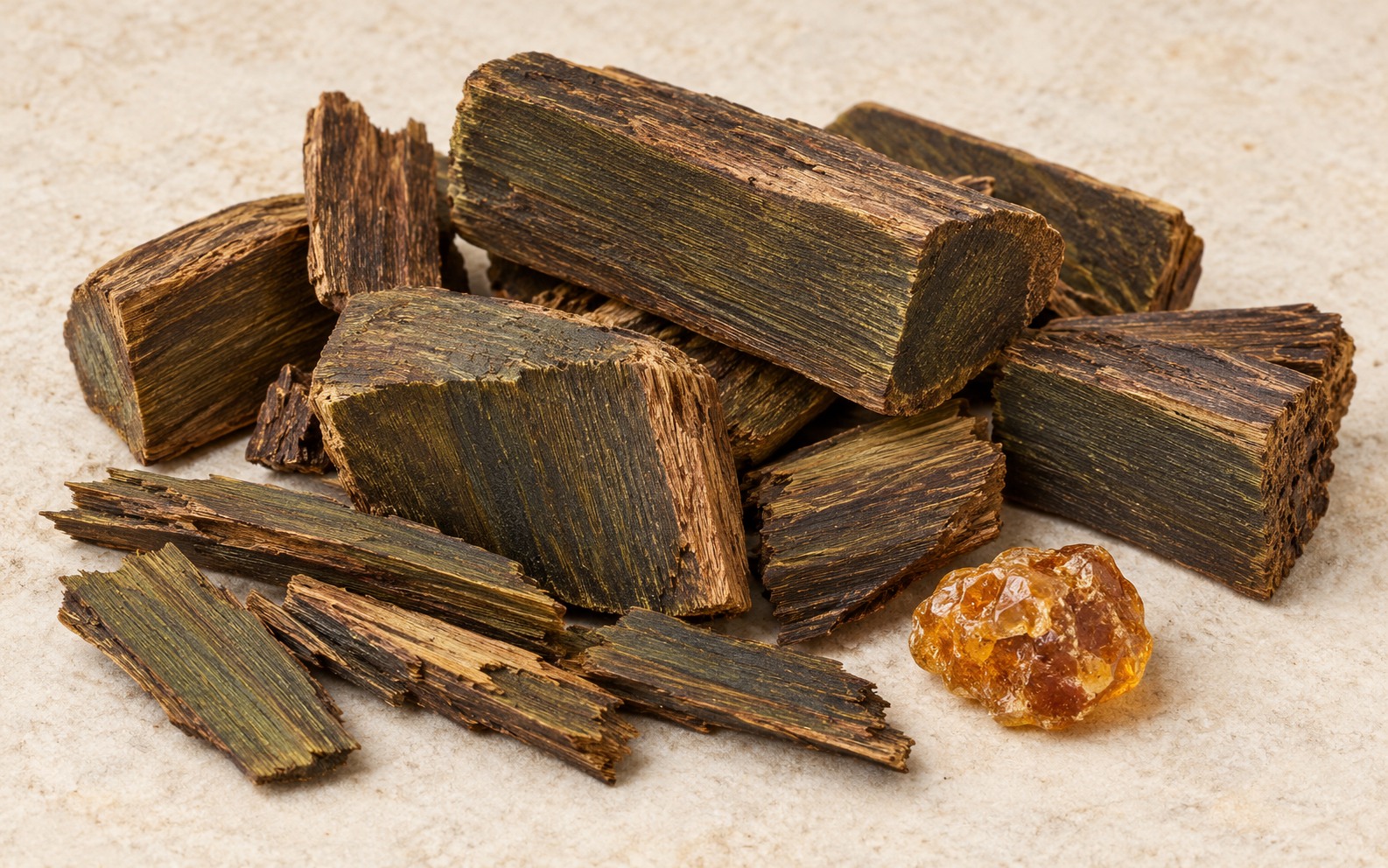
In dried material, heartwood is olive-brown to dark brown, dense, and heavy; guaiac resin appears as irregular masses or pieces in the JECFA monograph. Neither material can be authenticated from image color alone, and commercial lignum-vitae wood may refer to more than one Guaiacum species. Voucher specimens, harvest-origin documentation, provenance papers, and suitable testing are needed to identify a lot. The AI image on this page supports general morphology study only and cannot replace an expert or sample analysis.
Growth and habitat
Reference plant/habitat; AI image does not identify specimens
Slow-growing tree; cultivate only from lawful stock
Kew gives a native range from southern Mexico to Central America, Florida, and the Caribbean, including the Bahamas, Belize, Costa Rica, Cuba, Guatemala, Haiti, Honduras, Nicaragua, Panama, and other islands. UF/IFAS places the tree in warm USDA zones 10B–11 and says it can grow in full sun or partial shade. A Mexican forestry source also records dry forest and chaparral, while Kew assigns the broader tropical-wet biome. These accounts describe different ecological and cultivation contexts; they do not guarantee suitability everywhere.
Well-drained soil is a useful common requirement: UF/IFAS lists sand, loam, clay, alkaline, or acidic soils when drainage is adequate; the Florida Native Plant Society notes sand and limestone. The tree tolerates drought after establishment but the Florida horticultural source does not recommend prolonged saltwater inundation. It is a long-lived, very slow-growing tree, not a short-cycle crop for resin or timber. In Vietnam, local heat, humidity, soils, and conservation law need separate review; this profile does not encourage release of an introduced species into the wild.
Slow-growing tree; cultivate only from lawful stock
Slow-growing tree; cultivate only from lawful stockUse seed only from a lawful, reliably identified cultivated source; do not collect fruit from wild populations or protected areas. Ripe yellow-orange capsules may open and expose dark seeds with red arils. UF/IFAS Extension confirms propagation by seed; a Caribbean seed manual warns that fresh seed loses viability quickly, so sow soon after collection.
Slow-growing tree; cultivate only from lawful stockClean fruit/aril tissue from the seed and sow in a loose, freely draining medium. A Caribbean technical manual describes soaking seed in running water at about 20°C for 24 hours and sowing roughly 1 cm deep in sand trays; this is one source’s propagation method, not a universal requirement for every seed lot. Florida horticultural guidance confirms seed propagation but does not prescribe one standardized treatment.
Reference plant/habitat; AI image does not identify specimensKeep the medium moderately moist but not waterlogged; use a bright site with some protection for young seedlings if needed. The Caribbean manual transfers seedlings to nursery bags at about 6 cm tall. A Nicaraguan dry-forest restoration study found seedling survival varied with light conditions, supporting local observation rather than a single universal shade prescription.
Reference plant/habitat; AI image does not identify specimensFor transplanting, choose a warm site in full sun or partial shade with freely draining soil, including locally appropriate sandy or limestone substrates. Water during establishment, then allow the soil to dry between watering; avoid prolonged waterlogging. UF/IFAS describes tolerance of drought and varied soils but confirms the tree grows very slowly. Do not use growth regulators or chemicals to force faster growth.
Reference plant/habitat; AI image does not identify specimens
How long until harvest? UF/IFAS describes very slow growth; a Caribbean nursery manual says some seedlings may be planted out after about one year when they reach suitable size. None of the sources reviewed establishes a safe, sustainable medicinal harvest age for wood or resin. Do not treat a seedling-production timeline as permission to harvest or use the tree.
Slow-growing tree; cultivate only from lawful stock
From plant to dried material · source-recorded workflow
Reference plant/habitat; AI image does not identify specimensCITES contains seven reported commercial rows under G. sanctum in the purpose-T, term-MED extract for 2016–2025. Before handling material, record the scientific name, cultivated or wild source, harvest/purchase documents, plant part, date, and exporting/importing countries; source code W is not a substitute for a lot’s permits or provenance papers.
Reference material form; does not authenticate a real lotKeep heartwood, stem resin, and unidentified wood separate; Canada/JECFA defines guaiac resin as material obtained from the wood of G. sanctum or G. officinale. A mixed-product description does not authenticate a single-species specimen.
Reference material form; does not authenticate a real lotHistorical materia-medica records describe heartwood as chips or pieces and resin as irregular masses or fragments; these are material descriptions, not home-processing instructions. Do not bore, burn, or cut a tree for resin/wood, especially from wild or untraceable sources.
Reference material form; does not authenticate a real lotLicensed research or trade facilities should segregate lots, control contaminants/moisture under applicable standards, authenticate identity by suitable methods, and retain CITES permits and import/export records. AI images do not establish species, concentration, purity, or quality.
Reference material form; does not authenticate a real lot
This record supports study and processing traceability; it is not a home preparation or self-use guide.